
DYLAN LEVI KING OCTOBER 17, 2022 ARTICLES
The Genealogy of Chinese Cybernetics
The Genealogy of Chinese Cybernetics
The Critical Legacy of Chinese Cybernetics
Five Moments in the History of Chinese Cybernetics
DYLAN LEVI KING OCTOBER 17, 2022 ARTICLES
The Genealogy of Chinese Cybernetics
The Genealogy of Chinese Cybernetics
The Critical Legacy of Chinese Cybernetics
Five Moments in the History of Chinese Cybernetics
In today’s post, I want to look at a question that seems almost too simple to ask: when does a system exist? For this I will be drawing on ideas from…
When Does a System Exist? The Myth of the Given System:
February 16, 2026 daviding
Problematique Dialogue + Conversation as Process and Connection | Systems Thinking Ontario | 20260209
Problematique Dialogue + Conversation as Process and Connection |… – Coevolving Innovations
February 16, 2026 daviding
VSM and Viablity Canvas
VSM and Viablity Canvas
now at https://salon.tautai.net/
h/t Ivo Velitchkov
Introduction
What is systems thinking? The answer depends on whom you ask. Here are two commonperspectives from which you will get two different answers. Engineering. Here, systems thinking is what you need to build a system whose requirements go beyond current practice. Example: all stages in a plan to evolve into a national energy distribution system for low-emission transportation. Metapolitics (a neologism analogous to metamathematics). Here, systems thinking is what you need (1)to understand the ambient social systems in which we all have unconsciously long been embedded, and (2)to use that understanding to attempt to bring these systems into alignment with current needs, given some disruptive change such as newtechnology or increased scale. Example: modifying the global economy in response to climate change.
This essay is based on the Metapolitics perspective. In two Examples I explore perverse behavior patterns of two ambient social systems, a newoneandanolder one: 1. mass radicalization, disinformation, and other perverse social consequences secondary to new technologies that facilitate intensive everyone-to-everyone communication (for example, “social networking”), and 2. environmental destruction secondary to a compulsion to grow arising from the financing structures of public corporations. Analysis of both of these behavior patterns reveals a common element: Emergent behaviors, not anticipated in classical thinking, arise from highly intraconnected or coupled networks. This failure of classical thought leads to The Big Lesson I wish to communicate in this essay: THINK NETWORKSFIRST, ACTORS SECOND. Here is the importance of this lesson: Effective interventions will arise from altering interactions within networks. You cannot even see these interactions unless you focus on the network. This essay offers two examples that contradict the conventional understanding of Network Effects. We are living inside something we don’t understand.
Peter writes:
“I’ve spent 40 years applying cybernetic frameworks to real organisations — from the U.S. Army War College to UNESCO to distributed educator networks spanning 18,000 participants. Recently, I’ve been working intensively with Claude (Anthropic’s AI), and something struck me: every interface Claude offers is a different kind of conversation, with different affordances and different costs.
(2) Post | LinkedIn
So I wrote a practitioner’s guide mapping Claude’s eight conversation surfaces through the lens of Gordon Pask’s Conversation Theory (1975, 1976).
The core insight: every time you switch from chat to Claude Code, or from a Project to an Artifact, you’re not just changing tools — you’re changing the structure of the conversation itself. And that structure determines what kind of knowing is possible.
The guide introduces what I call the “re-education tax” — the real cost of re-establishing shared understanding when you switch surfaces or start fresh sessions. If you’ve ever felt frustrated explaining context to an AI again after switching tools, you’ve been paying this tax without naming it.”
[Completing a trio of recent LinkedIn articles]
(15) Jay Forrester and the Discipline That Learned to See Persistence | LinkedIn
Sheila Damodaran
Global, National & Regional Strategy Development | Leadership Capacity, Systemic Research & Longitudinal Thinking Through The Fifth Discipline
February 1, 2026
[Another one where I have great sympathy with the author and intent, but don’t agree with the piece overall – however, lots of juicy debate!]
Abdul Aziz
Strategy & Performance through Empathy, Architecture and Analytics
February 14, 2026
I recently developed a “Systems & Complexity Lifecycle” framework as a teaching device, treating systems theory, complexity science, chaos theory, and catastrophe theory as temporal stages in how entities evolve from stability through transformation.
The framework maps four stages:
Stage 1 – Systems: Stability and homeostasis (Bertalanffy’s General Systems Theory)
Stage 2 – Complexity: Emergence of higher-order properties (Holland’s Hidden Order)
Stage 3 – Chaos: Sensitivity to initial conditions (Gleick’s Chaos)
Stage 4 – Catastrophe: Discontinuous transformation (Thom’s catastrophe theory)
(4) The Great Divide: Systems Thinking and Complexity Science | LinkedIn
Global, National & Regional Strategy Development | Leadership Capacity, Systemic Research & Longitudinal Thinking Through The Fifth Discipline
February 15, 2026
Peter Senge: The Fifth Discipline at Thirty-Five — Lineage, Surge, and Scale
(2) Peter Senge: The Fifth Discipline at Thirty-Five — Lineage, Surge, and Scale | LinkedIn
Sheila Damodaran
Global, National & Regional Strategy Development | Leadership Capacity, Systemic Research & Longitudinal Thinking Through The Fifth Discipline
February 15, 2026
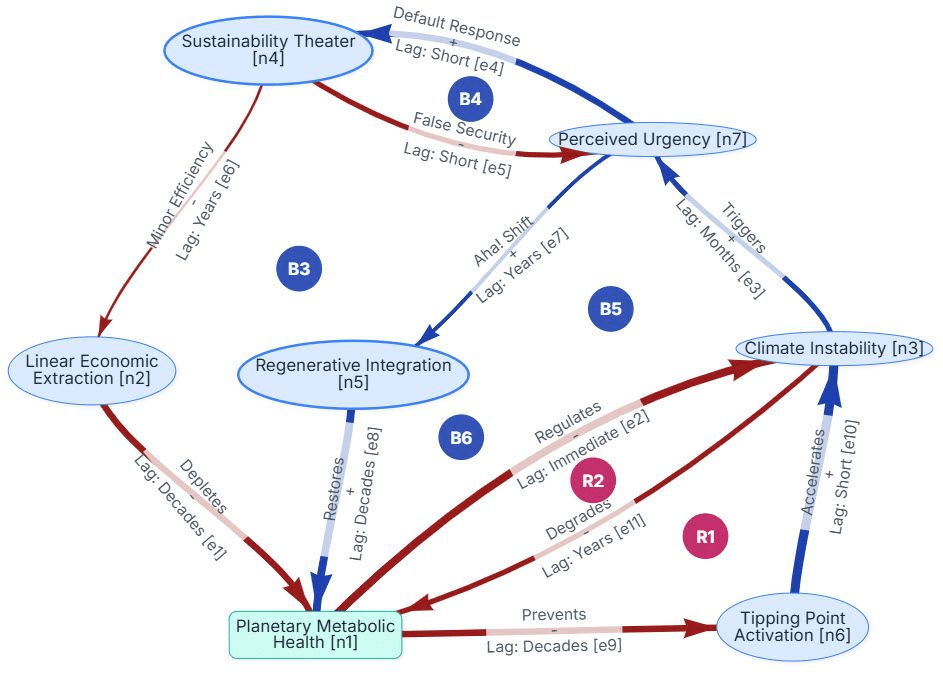
Free 90 Minute AI Modeling Tools Workshop – Create diagrams such as the one below, completely documented, along with an Aha! Paradox, and emotional story embracing the relationships, usually in 10 min or less.
Post | Feed | LinkedIn
The Workshop will be at 11 am Eastern Time (New York) on Feb 19th, and I’ll send out the Zoom link info 1 day and 1 hour before the workshop. Just reply to this post, and I’ll put you on the list.
At Systems Thinking Systems Practice, 24-26 March 2026, University of Hull, we will again run Skills Training Workshops.
These workshops were a huge success at SysPrac25, with many of them oversubscribed.
They will take the form of interactive workshops, which will further develop your skills or introduce you to new approaches you may not have encountered before.
To vote visit https://docs.google.com/forms/d/e/1FAIpQLSfsLoKstfeA5BwI8pK5kAb25abdUAhLeKe2s51Xp4Gmxw_FAg/viewform before 20 February 2026!
The conference: https://stream.syscoi.com/2026/01/25/2026-conference-systems-thinking-and-systems-practice-hosted-by-the-university-of-hull-centre-for-systems-studies-css-systems-and-complexity-in-organisation-scio-and-the-or-society-24-26-march/
Complex Systems Frameworks Collection
Frameworks A-Z – Complex Systems Frameworks Collection
THE GAME
The Game – Birmingham Food Council


You must be logged in to post a comment.