Objects, Models, Theories • 4

Re: Objects, Models, Theories • (1) • (2) • (3)

What are objects, models, theories, and how do they relate to one another?

Recurring questions about the relationship between objects, models, and theories take on a different aspect when viewed from the perspective of Peirce’s pragmatic semiotic, in other words, when cast within a framework of triadic sign relations.

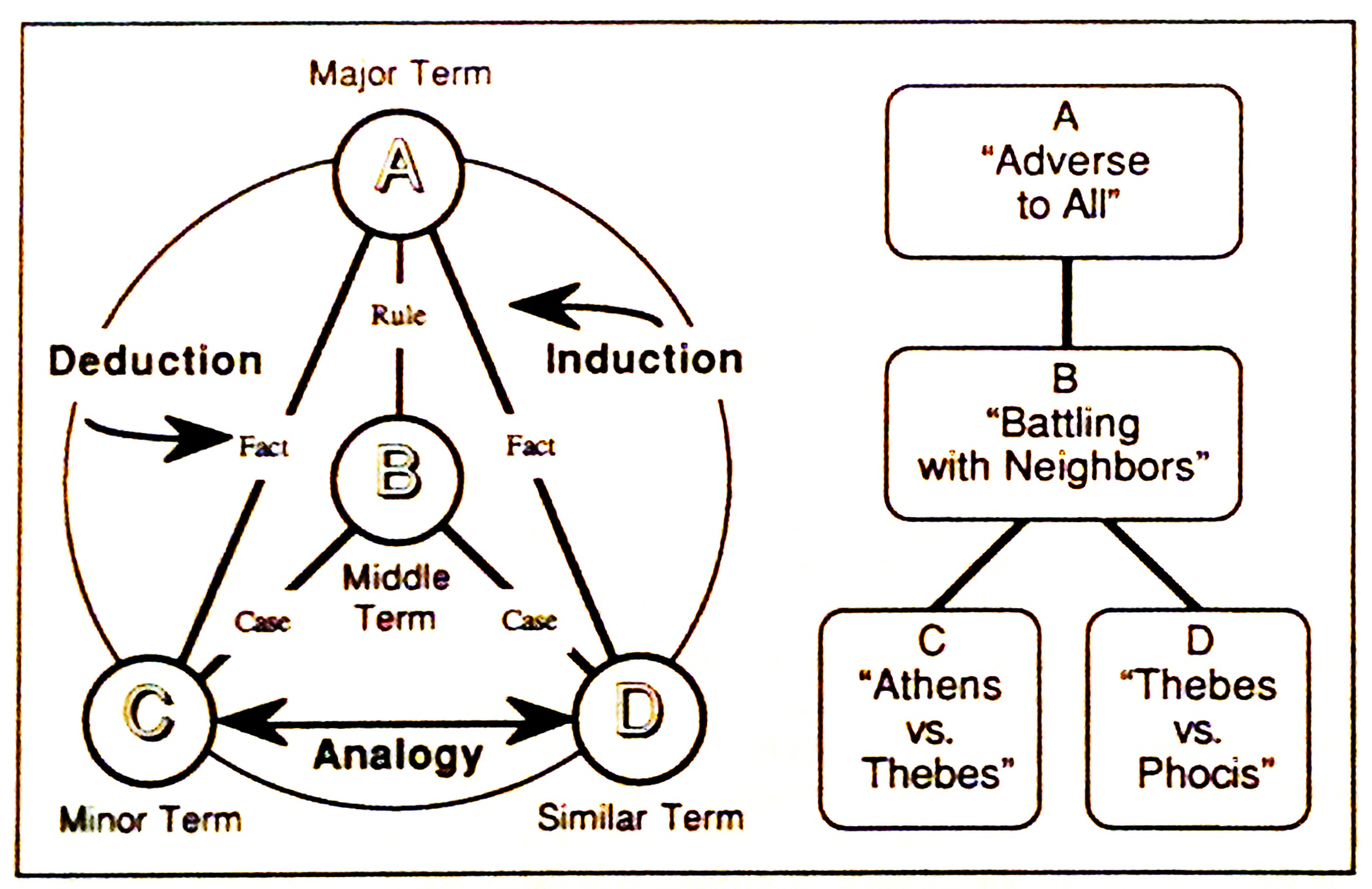
In contemplating the array of questions which come to mind I always find it helpful to ruminate on the diagram shown below — I might even call it a mandala for its wealth of symbolic features and its aid in organizing the pro‑&‑con‑fusion of mental impressions.

Aristotle's Paradigm

Aristotle’s “Paradigm”

Here is the corresponding text from Aristotle and the context that leads on to Peirce’s viewpoint.

Resources

cc: Academia.edu • Cybernetics • Laws of Form • Mathstodon
cc: Research Gate • Structural Modeling • Systems Science • Syscoi

#adaptive-systems, #analogy, #biological-systems, #c-s-peirce, #information, #inquiry, #inquiry-driven-systems, #learning-theory, #logic, #logic-of-science, #mathematical-models, #mathematics, #mental-models, #model-theory, #pragmata, #semiotics, #sign-relations, #triadic-relations, #visualization

Objects, Models, Theories • 3

Re: Objects, Models, Theories • (1) • (2)
Re: Peirce List • Tom Gollier

Here my task is to build bridges between several different classical and contemporary uses of the word model, so I don’t have the luxury of complete control over the words in play but have to start from the customary senses in the various communities of interpretation.  Of course I’m slyly working from a sign‑relational backdrop, but I have to be sleight‑handed about that and not hit people over the head with it.

You can probably guess I’m using object to cover sign‑relational objects, and theories are clearly syntacked together from complexes of sign‑relational signs, so all we have left to pin down is where the various kinds of model sit at the table set with the labels of Object, Sign, Interpretant.

In its theoretical sense, a model of a theory is anything the theory is true of, anything that satisfies the theory.  In that sense, a model is very like an object.  It is whatever the theory is talking about.  In the order of nature, indeed, models come before theories.  But there is another order, the order of art, and one may construct artificial models out of almost any stuff, even the stuff of signs.  So you see the kind of wiggle room we have to work with.

Things are easier outside of logic, in applied mathematics and the special sciences, where models are just things like analogues, icons, simulations, and similar representations of objects.  But that makes them objects serving as signs of other objects, and so you may find some semiotic subtlety lurking there.

Resources

cc: Academia.edu • Cybernetics • Laws of Form • Mathstodon
cc: Research Gate • Structural Modeling • Systems Science • Syscoi

#adaptive-systems, #analogy, #biological-systems, #c-s-peirce, #information, #inquiry, #inquiry-driven-systems, #learning-theory, #logic, #logic-of-science, #mathematical-models, #mathematics, #mental-models, #model-theory, #pragmata, #semiotics, #sign-relations, #triadic-relations, #visualization

Objects, Models, Theories • 2

Re: Gödel’s Lost Letter • The Graph Of Math

GLL:
Kurt Gödel is said to have been a latecomer to appreciating the power of Model Theory.  He was of course the greatest architect of Proof Theory, which stands in contrast to Model Theory.  Model Theory concerns itself with what could be true, while Proof Theory deals with what can be proved.  The latter sounds more definite, but they are supplementary:  a statement is capable of being true somewhere precisely when its negation cannot be proved.  The question is, where is that somewhere?  And when?

What — if anything — is the common sense that connects the different senses of the word model, as it has been used over the years in logic, mathematics, and the special sciences?  It’s a problem I’ve been running into for several decades now and I think I can trace the roots of it going back as far as Aristotle’s treatment of analogy.

Resources

cc: Academia.edu • Cybernetics • Laws of Form • Mathstodon
cc: Research Gate • Structural Modeling • Systems Science • Syscoi

#adaptive-systems, #analogy, #biological-systems, #c-s-peirce, #information, #inquiry, #inquiry-driven-systems, #learning-theory, #logic, #logic-of-science, #mathematical-models, #mathematics, #mental-models, #model-theory, #pragmata, #semiotics, #sign-relations, #triadic-relations, #visualization

Objects, Models, Theories • 1

Happy Birthday, Charles Sanders Peirce❢ — September 10, 1839

I return once more to a recurring subject.

Re: Artem Kaznatcheev • Three Types of Mathematical Models

In speaking of models one tends to find denizens of different disciplines talking at cross purposes to one another.  Logicians use the word to describe what may be distinguished as logical models, saying a model is whatever satisfies a theory — anything a theory holds true of — and that is the sense used in the logical subject of model theory.

Almost everyone else uses the word to describe what may be called analogical models, analogues being things holding enough properties in common with other things that learning about Thing 2 (the analogue system) can teach us about Thing 1 (the object system).

It is actually quite easy to integrate those two senses of the word model into a coherent picture of the whole situation, namely, the triadic relationship among objects, analogues, and theories.  We’ll get into that further as the discussion proceeds.

Resources

cc: Academia.edu • Cybernetics • Laws of Form • Mathstodon
cc: Research Gate • Structural Modeling • Systems Science • Syscoi

#adaptive-systems, #analogy, #biological-systems, #c-s-peirce, #information, #inquiry, #inquiry-driven-systems, #learning-theory, #logic, #logic-of-science, #mathematical-models, #mathematics, #mental-models, #model-theory, #pragmata, #semiotics, #sign-relations, #triadic-relations, #visualization

Reflective Interpretive Frameworks • Incident 2

Re: Terence Tao • Modular Arithmetic Challenge

  • Can a neural network learn to do modular multiplication efficiently?

Incidental Reflection 1

There are alternative models of neural networks which do not depend on threshold neurons and endlessly fiddling with weights.

Incidental Reflection 2

The series of three blog posts linked below present a case study comparing two ways of handling a classic example from the Parallel Distributed Processing paradigm, namely, the “Jets and Sharks” database problem, first taking up the original treatment by McClelland and Rumelhart and then proceeding according to a program I developed for propositional logic modeling.  The latter method makes use of ideas from Grossberg’s competition‑cooperation and winner‑take‑all dynamics, but is purely propositional‑logic based, involving no extraneous weights.

  • Theme One Program • Jets and Sharks • (1) • (2) • (3)

Resources

cc: Academia.edu • Cybernetics • Laws of Form • Mathstodon
cc: Research Gate • Structural Modeling • Systems Science • Syscoi

#arithmetization, #c-s-peirce, #godel-numbers, #higher-order-sign-relations, #inquiry-driven-systems, #inquiry-into-inquiry, #logic, #mathematics, #quotation, #recursion, #reflection, #reflective-interpretive-frameworks, #semiotics, #sign-relations, #triadic-relations, #use-and-mention, #visualization

Reflection On Recursion • Discussion 1

Re: Reflection On Recursion • 1
Re: Laws of Form • John Mingers

JM:
This is a very important and interesting topic.  I think you should consider the relationship to self‑reference, indeed are they really the same thing?

Also the work of Maturana and Varela on autopoiesis and the neurophysiology of cognition which also has recursion at its heart.

Thanks, John.  Yes, we certainly find the whole array of self concepts coming into play here — selfhood, autopoiesis or self creation, self reference and self transformation, just to name a few.  But one thing I need to emphasize from the start is how radically different such concepts appear when viewed in the x‑ray vision of Peirce’s pragmatic semiotics.

I forget where I first heard it, but it’s fairly common observation that the persistence of a recurring problem is a symptom of how unlikely it is to be solved in the paradigm where it keeps occurring.

After a while, it simply becomes time to change the paradigm …

Just by way of a first example, take the very idea of “self‑reference”.  The moment we place it in the medium of triadic sign relations we realize signs do not refer to anything at all except insofar as an interpreter refers them.

And when we ask, “What is this, that we call an interpreter?”, the pragmatic theory of signs tells us we cannot tell when we turn out the light but under the x‑ray of the pragmatic maxim the sum of its effects is effectively modeled by an extended triadic sign relation.

Everything I’ll be working at here will be done within a framework like that.

Regards,
Jon

Resources

cc: Academia.edu • Cybernetics • Laws of Form • Mathstodon
cc: Research Gate • Structural Modeling • Systems Science • Syscoi

#arithmetization, #c-s-peirce, #godel-numbers, #higher-order-sign-relations, #inquiry-driven-systems, #inquiry-into-inquiry, #logic, #mathematics, #quotation, #recursion, #reflection, #reflective-interpretive-frameworks, #semiotics, #sign-relations, #triadic-relations, #use-and-mention, #visualization

Reflection On Recursion • 4

A feature of special note in the recursion diagram is the function traversing the square from one triadic node to the other.  It preserves an image of the object n all the while its precedent p(n) is being retrieved and processed — thus it injects a measure of parallel process and a modicum of extra memory over and above that afforded by the serial composition of functions.

Simple Recursion

Resources

cc: Academia.edu • Cybernetics • Laws of Form • Mathstodon
cc: Research Gate • Structural Modeling • Systems Science • Syscoi

#arithmetization, #c-s-peirce, #godel-numbers, #higher-order-sign-relations, #inquiry-driven-systems, #inquiry-into-inquiry, #logic, #mathematics, #quotation, #recursion, #reflection, #reflective-interpretive-frameworks, #semiotics, #sign-relations, #triadic-relations, #use-and-mention, #visualization

Reflection On Recursion • 3

One other feature of syntactic recursion deserves to be brought into higher relief.  Evidence of it can be found in the recursion diagram by examining the places where three paths meet.  On the descending side there is the point where three paths diverge.  On the ascending side there is the point where the middlemost of the three divergent paths joins the upshot arrow in medias res.

Simple Recursion

The arrows of the diagram represent functions, a species of dyadic relations, but nodes of degree three signify aspects of triadic relations somewhere in the mix.

  • The three arrows from the initial node represent a function F : \mathbb{N} \to \mathbb{N} \times \mathbb{N} \times \mathbb{N} such that F(n) = ( p(n), n, f(n) ).
  • The three arrows at the penultimate node represent a function m : \mathbb{N} \times \mathbb{N} \to \mathbb{N} such that m(j, k) = jk.

For the sake of a first approach, many questions about triadic relations which might arise at this point can be safely left to later discussions, since the current level of generality is comprehensible enough in functional terms.

Resources

cc: Academia.edu • Cybernetics • Laws of Form • Mathstodon
cc: Research Gate • Structural Modeling • Systems Science • Syscoi

#arithmetization, #c-s-peirce, #godel-numbers, #higher-order-sign-relations, #inquiry-driven-systems, #inquiry-into-inquiry, #logic, #mathematics, #quotation, #recursion, #reflection, #reflective-interpretive-frameworks, #semiotics, #sign-relations, #triadic-relations, #use-and-mention, #visualization

Reflection On Recursion • 2

Turning to the form of a simple recursive function f(n) = m(n, f(p(n))), the clause we used to define it earns the title of “syntactic recursion” due to the way the function name ``f" occurring in the defined phrase ``f(n)" re‑occurs in the defining phrase ``m(n, f(p(n)))".

Simple Recursion

It needs to be clear there is no circle in the definition — each instance of the type f is defined in terms of an instance one step simpler until the base case is reached and fixed by fiat.  Instead of a circle then we have two gyres, the gyre down via the precedent function p and the gyre up via the modifier function m.

Resources

cc: Academia.edu • Cybernetics • Laws of Form • Mathstodon
cc: Research Gate • Structural Modeling • Systems Science • Syscoi

#arithmetization, #c-s-peirce, #godel-numbers, #higher-order-sign-relations, #inquiry-driven-systems, #inquiry-into-inquiry, #logic, #mathematics, #quotation, #recursion, #reflection, #reflective-interpretive-frameworks, #semiotics, #sign-relations, #triadic-relations, #use-and-mention, #visualization

Reflection On Recursion • 1

Ongoing conversations with Dan Everett on Facebook have me backtracking to recurring questions about the relationship between formal language theory (as I once learned it) and the properties of natural languages as they are found occurring in the field.  A point of particular interest is the role of recursion in formal and natural languages, along with collateral questions about its role in the cognitive sciences at large.

It has taken me quite a while to bring my reflections up to the threshold of minimal coherence — and the inquiry remains ongoing — but it may catalyze the thinking process if I simply share what I’ve thought so far …

Comment 1

Recursion is where you find it — so, myself not being a natural language researcher, when someone who is says they don’t find it in a given corpus I just take them at their word …

Comment 2

The question to which I keep returning has to do with the relationship between two ways we find recursion occurring.

One way I’d call pragmatic recursion — if I wanted to be precise and cover its full scope — since so many of its operations occur without conscious direction, but for now I’ll defer to more familiar language, calling it cognitive or conceptual recursion.

Comment 3

If we discard from the idea of recursion what is not of its essence, we find recursion occurs when our understanding of one situation has recourse to our understanding of other situations.

Very typically, the object situation presents itself as complex, difficult, or unfamiliar while the resource situations are regarded as being better understood.

It must be appreciated, however, that any ranking of situations by level of understanding is contingent on the circumstances in view and may vary radically in alternate settings.

Comment 4

Recursion occurs more markedly in syntactic recursion, where the recursive process shows its character as such in the symbols of its syntactic expression.

A sense of the difference can be gained by looking at a case of ostensible syntactic recursion.  (How much substance backs the ostentation is a subject we’ll take up, maybe at length, but later …)

Consider the following diagram for the computation of a simple recursive function.

Simple Recursion

For example, the factorial function f(n) = n! has a definition in terms of the predecessor function p(n) = n-1 and the multiplier function m(j, k) = j \cdot k.

Comment 5

Recursion is rife in mathematics and computation, typically sporting its recursive character on its sleeve in the fashion of syntax sketched above.  But mathematics and computation are overlearned subjects and practices, enjoying long histories of being gone over with an eye to articulating every last detail of any way they might be conceived and conducted.  So it’s fair to ask whether all that artifice truly tutors nature or only creates a rationalized reconstruction of it.  Then again, even if that’s all it does, is there anything of use to be learned from it?

Comment 6

The prevalence of recursion in mathematics arises from the architecture of mathematical systems.

Mathematical systems grow from a fourfold root.

  • Primitives are taken as initial terms.
  • Definitions expound ever more complex terms in relation to the primitives.
  • Axioms are taken as initial truths.
  • Theorems follow from the axioms by way of inference rules.

Recursive definitions of mathematical objects and inductive proofs of the corresponding theorems follow closely parallel patterns.  And again, in computation, recursive programs follow the same patterns in action.

Resources

cc: Academia.edu • Cybernetics • Laws of Form • Mathstodon (1) (2) (3)
cc: Research Gate • Structural Modeling • Systems Science • Syscoi

#arithmetization, #c-s-peirce, #godel-numbers, #higher-order-sign-relations, #inquiry-driven-systems, #inquiry-into-inquiry, #logic, #mathematics, #quotation, #recursion, #reflection, #reflective-interpretive-frameworks, #semiotics, #sign-relations, #triadic-relations, #use-and-mention, #visualization

Reflective Interpretive Frameworks • Incident 1

Re: William Waites • The Agent That Doesn’t Know Itself

WW:  ❝Why Has Nobody Done This?❞

People who study C.S. Peirce would say reflective reasoning requires triadic relations at core and there is work being done on that.  One of the challenges is clarifying the role of triadic relations in category theory and raising them into higher relief as fundamental operations.

  • Note.  I was looking for a word to describe a random encounter with something that jogs one’s memory of a recurring theme — incident plays into the reflection theme and looked worth trying for now.

Resources

cc: Academia.edu • Cybernetics • Laws of Form • Mathstodon
cc: Research Gate • Structural Modeling • Systems Science • Syscoi

#arithmetization, #c-s-peirce, #godel-numbers, #higher-order-sign-relations, #inquiry-driven-systems, #inquiry-into-inquiry, #logic, #mathematics, #quotation, #recursion, #reflection, #reflective-interpretive-frameworks, #semiotics, #sign-relations, #triadic-relations, #use-and-mention, #visualization

Sign Relations • Graphical Representations

The dyadic components of sign relations have graph‑theoretic representations, as digraphs (or directed graphs), which provide concise pictures of their structural and potential dynamic properties.

By way of terminology, a directed edge (x, y) is called an arc from point x to point y, and a self‑loop (x, x) is called a sling at x.

The denotative components \mathrm{Den}(L_\mathrm{A}) and \mathrm{Den}(L_\mathrm{B}) can be represented as digraphs on the six points of their common world set W = O \cup S \cup I = \{ \mathrm{A}, \mathrm{B}, ``\text{A}", ``\text{B}", ``\text{i}", ``\text{u}" \}.  The arcs are given as follows.

Denotative Component \mathrm{Den}(L_\mathrm{A})
\mathrm{Den}(L_\mathrm{A}) has an arc from each point of \{ ``\text{A}", ``\text{i}" \} to \mathrm{A}.
\mathrm{Den}(L_\mathrm{A}) has an arc from each point of \{ ``\text{B}", ``\text{u}" \} to \mathrm{B}.
Denotative Component \mathrm{Den}(L_\mathrm{B})
\mathrm{Den}(L_\mathrm{B}) has an arc from each point of \{ ``\text{A}", ``\text{u}" \} to \mathrm{A}.
\mathrm{Den}(L_\mathrm{B}) has an arc from each point of \{ ``\text{B}", ``\text{i}" \} to \mathrm{B}.

\mathrm{Den}(L_\mathrm{A}) and \mathrm{Den}(L_\mathrm{B}) can be interpreted as transition digraphs which chart the succession of steps or the connection of states in a computational process.  If the graphs are read in that way, the denotational arcs summarize the upshots of the computations involved when the interpreters \mathrm{A} and \mathrm{B} evaluate the signs in S according to their own frames of reference.

The connotative components \mathrm{Con}(L_\mathrm{A}) and \mathrm{Con}(L_\mathrm{B}) can be represented as digraphs on the four points of their common syntactic domain S = I = \{ ``\text{A}", ``\text{B}", ``\text{i}", ``\text{u}" \}.  Since \mathrm{Con}(L_\mathrm{A}) and \mathrm{Con}(L_\mathrm{B}) are semiotic equivalence relations, their digraphs conform to the pattern manifested by all digraphs of equivalence relations.  In general, a digraph of an equivalence relation falls into connected components which correspond to the parts of the associated partition, with a complete digraph on the points of each part, and no other arcs.  In the present case, the arcs are given as follows.

Connotative Component \mathrm{Con}(L_\mathrm{A})
\mathrm{Con}(L_\mathrm{A}) has the structure of a semiotic equivalence relation on S.
There is a sling at each point of S, arcs in both directions between the points of \{ ``\text{A}", ``\text{i}" \}, and arcs in both directions between the points of \{ ``\text{B}", ``\text{u}" \}.
Connotative Component \mathrm{Con}(L_\mathrm{B})
\mathrm{Con}(L_\mathrm{B}) has the structure of a semiotic equivalence relation on S.
There is a sling at each point of S, arcs in both directions between the points of \{ ``\text{A}", ``\text{u}" \}, and arcs in both directions between the points of \{ ``\text{B}", ``\text{i}" \}.

Taken as transition digraphs, \mathrm{Con}(L_\mathrm{A}) and \mathrm{Con}(L_\mathrm{B}) highlight the associations permitted between equivalent signs, as the equivalence is judged by the respective interpreters \mathrm{A} and \mathrm{B}.

Resources

cc: Academia.edu • Laws of Form • Research Gate • Syscoi
cc: Cybernetics • Structural Modeling • Systems Science

#c-s-peirce, #connotation, #denotation, #inquiry, #logic, #logic-of-relatives, #mathematics, #relation-theory, #semiosis, #semiotic-equivalence-relations, #semiotics, #sign-relations, #triadic-relations

Sign Relations • Semiotic Equivalence Relations 2

A few items of notation are useful in discussing equivalence relations in general and semiotic equivalence relations in particular.

In general, if E is an equivalence relation on a set X then every element x of X belongs to a unique equivalence class under E called the equivalence class of x under E.  Convention provides the square bracket notation for denoting such equivalence classes, in either the form [x]_E or the simpler form [x] when the subscript E is understood.  A statement that the elements x and y are equivalent under E is called an equation or an equivalence and may be expressed in any of the following ways.

Semiotic Equivalence Relation Display 1

Thus we have the following definitions.

Semiotic Equivalence Relation Display 2

In the application to sign relations it is useful to extend the square bracket notation in the following ways.  If L is a sign relation whose connotative component L_{SI} is an equivalence relation on S = I, let [s]_L be the equivalence class of s under L_{SI}.  In short, [s]_L = [s]_{L_{SI}}.  A statement that the signs x and y belong to the same equivalence class under a semiotic equivalence relation L_{SI} is called a semiotic equation (SEQ) and may be written in either of the following forms.

Semiotic Equivalence Relation Display 3

In many situations there is one further adaptation of the square bracket notation for semiotic equivalence classes which can be useful.  Namely, when there is known to exist a particular triple (o, s, i) in a sign relation L, it is permissible to let [o]_L be defined as [s]_L.  This lets the notation for semiotic equivalence classes harmonize more smoothly with the frequent use of similar devices for the denotations of signs and expressions.

Applying the array of equivalence notations to the sign relations for A and B will serve to illustrate their use and utility.

Connotative Components Con(L_A) and Con(L_B)

The semiotic equivalence relation for interpreter \mathrm{A} yields the following semiotic equations.

Semiotic Equivalence Relation Display 4

or

Semiotic Equivalence Relation Display 5

In this way the SER for \mathrm{A} induces the following semiotic partition.

Semiotic Equivalence Relation Display 6

The semiotic equivalence relation for interpreter \mathrm{B} yields the following semiotic equations.

Semiotic Equivalence Relation Display 7

or

Semiotic Equivalence Relation Display 8

In this way the SER for \mathrm{B} induces the following semiotic partition.

Semiotic Equivalence Relation Display 9

Taken all together we have the following picture.

Semiotic Partitions for Interpreters A and B

Resources

cc: Academia.edu • Laws of Form • Research Gate • Syscoi
cc: Cybernetics • Structural Modeling • Systems Science

#c-s-peirce, #connotation, #denotation, #inquiry, #logic, #logic-of-relatives, #mathematics, #relation-theory, #semiosis, #semiotic-equivalence-relations, #semiotics, #sign-relations, #triadic-relations

Sign Relations • Semiotic Equivalence Relations 1

A semiotic equivalence relation (SER) is a special type of equivalence relation arising in the analysis of sign relations.  Generally speaking, any equivalence relation induces a partition of the underlying set of elements, known as the domain or space of the relation, into a family of equivalence classes.  In the case of a SER the equivalence classes are called semiotic equivalence classes (SECs) and the partition is called a semiotic partition (SEP).

The sign relations L_\mathrm{A} and L_\mathrm{B} have many interesting properties over and above those possessed by sign relations in general.  Some of those properties have to do with the relation between signs and their interpretant signs, as reflected in the projections of L_\mathrm{A} and L_\mathrm{B} on the SI‑plane, notated as \mathrm{proj}_{SI} L_\mathrm{A} and \mathrm{proj}_{SI} L_\mathrm{B}, respectively.  The dyadic relations on S \times I induced by those projections are also referred to as the connotative components of the corresponding sign relations, notated as \mathrm{Con}(L_\mathrm{A}) and \mathrm{Con}(L_\mathrm{B}), respectively.  Tables 6a and 6b show the corresponding connotative components.

Connotative Components Con(L_A) and Con(L_B)

A nice property of the sign relations L_\mathrm{A} and L_\mathrm{B} is that their connotative components \mathrm{Con}(L_\mathrm{A}) and \mathrm{Con}(L_\mathrm{B}) form a pair of equivalence relations on their common syntactic domain S = I.  This type of equivalence relation is called a semiotic equivalence relation (SER) because it equates signs having the same meaning to some interpreter.

Each of the semiotic equivalence relations, \mathrm{Con}(L_\mathrm{A}), \mathrm{Con}(L_\mathrm{B}) \subseteq S \times I \cong S \times S partitions the collection of signs into semiotic equivalence classes.  This constitutes a strong form of representation in that the structure of the interpreters’ common object domain \{ \mathrm{A}, \mathrm{B} \} is reflected or reconstructed, part for part, in the structure of each one’s semiotic partition of the syntactic domain \{ ``\text{A}", ``\text{B}", ``\text{i}", ``\text{u}" \}.

It’s important to observe the semiotic partitions for interpreters \mathrm{A} and \mathrm{B} are not identical, indeed, they are orthogonal to each other.  Thus we may regard the form of the partitions as corresponding to an objective structure or invariant reality, but not the literal sets of signs themselves, independent of the individual interpreter’s point of view.

Information about the contrasting patterns of semiotic equivalence corresponding to the interpreters \mathrm{A} and \mathrm{B} is summarized in Tables 7a and 7b.  The form of the Tables serves to explain what is meant by saying the SEPs for \mathrm{A} and \mathrm{B} are orthogonal to each other.

Semiotic Partitions for Interpreters A and B

Resources

cc: Academia.edu • Laws of Form • Research Gate • Syscoi
cc: Cybernetics • Structural Modeling • Systems Science

#c-s-peirce, #connotation, #denotation, #inquiry, #logic, #logic-of-relatives, #mathematics, #relation-theory, #semiosis, #semiotic-equivalence-relations, #semiotics, #sign-relations, #triadic-relations

Sign Relations • Ennotation

A third aspect of a sign’s complete meaning concerns the relation between its objects and its interpretants, which has no standard name in semiotics.  It would be called an induced relation in graph theory or the result of relational composition in relation theory.  If an interpretant is recognized as a sign in its own right then its independent reference to an object can be taken as belonging to another moment of denotation, but this neglects the mediational character of the whole transaction in which this occurs.  Denotation and connotation have to do with dyadic relations in which the sign plays an active role but here we are dealing with a dyadic relation between objects and interpretants mediated by the sign from an off‑stage position, as it were.

As a relation between objects and interpretants mediated by a sign, this third aspect of meaning may be referred to as the ennotation of a sign and the dyadic relation making up the ennotative aspect of a sign relation L may be notated as \mathrm{Enn}(L).  Information about the ennotative aspect of meaning is obtained from L by taking its projection on the object‑interpretant plane and visualized as the “shadow” L casts on the 2‑dimensional space whose axes are the object domain O and the interpretant domain I.  The ennotative component of a sign relation L, variously written as \mathrm{proj}_{OI} L,  L_{OI},  \mathrm{proj}_{13} L,  or L_{13}, is defined as follows.

Display 5

As it happens, the sign relations L_\mathrm{A} and L_\mathrm{B} are fully symmetric with respect to exchanging signs and interpretants, so all the data of \mathrm{proj}_{OS} L_\mathrm{A} is echoed unchanged in \mathrm{proj}_{OI} L_\mathrm{A} and all the data of \mathrm{proj}_{OS} L_\mathrm{B} is echoed unchanged in \mathrm{proj}_{OI} L_\mathrm{B}.

Tables 5a and 5b show the ennotative components of the sign relations associated with the interpreters \mathrm{A} and \mathrm{B}, respectively.  The rows of each Table list the ordered pairs (o, i) in the corresponding projections, \mathrm{Enn}(L_\mathrm{A}), \mathrm{Enn}(L_\mathrm{B}) \subseteq O \times I.

Ennotative Components Enn(L_A) and Enn(L_B)

Resources

cc: Academia.edu • Laws of Form • Research Gate • Syscoi
cc: Cybernetics • Structural Modeling • Systems Science

#c-s-peirce, #connotation, #denotation, #inquiry, #logic, #logic-of-relatives, #mathematics, #relation-theory, #semiosis, #semiotic-equivalence-relations, #semiotics, #sign-relations, #triadic-relations
