Icon, Likeness, Likely Story, Likelihood, Probability • 3

Re: Peirce ListPhyllis Chiasson

A more complete excerpt and the translator’s notes are very helpful here.

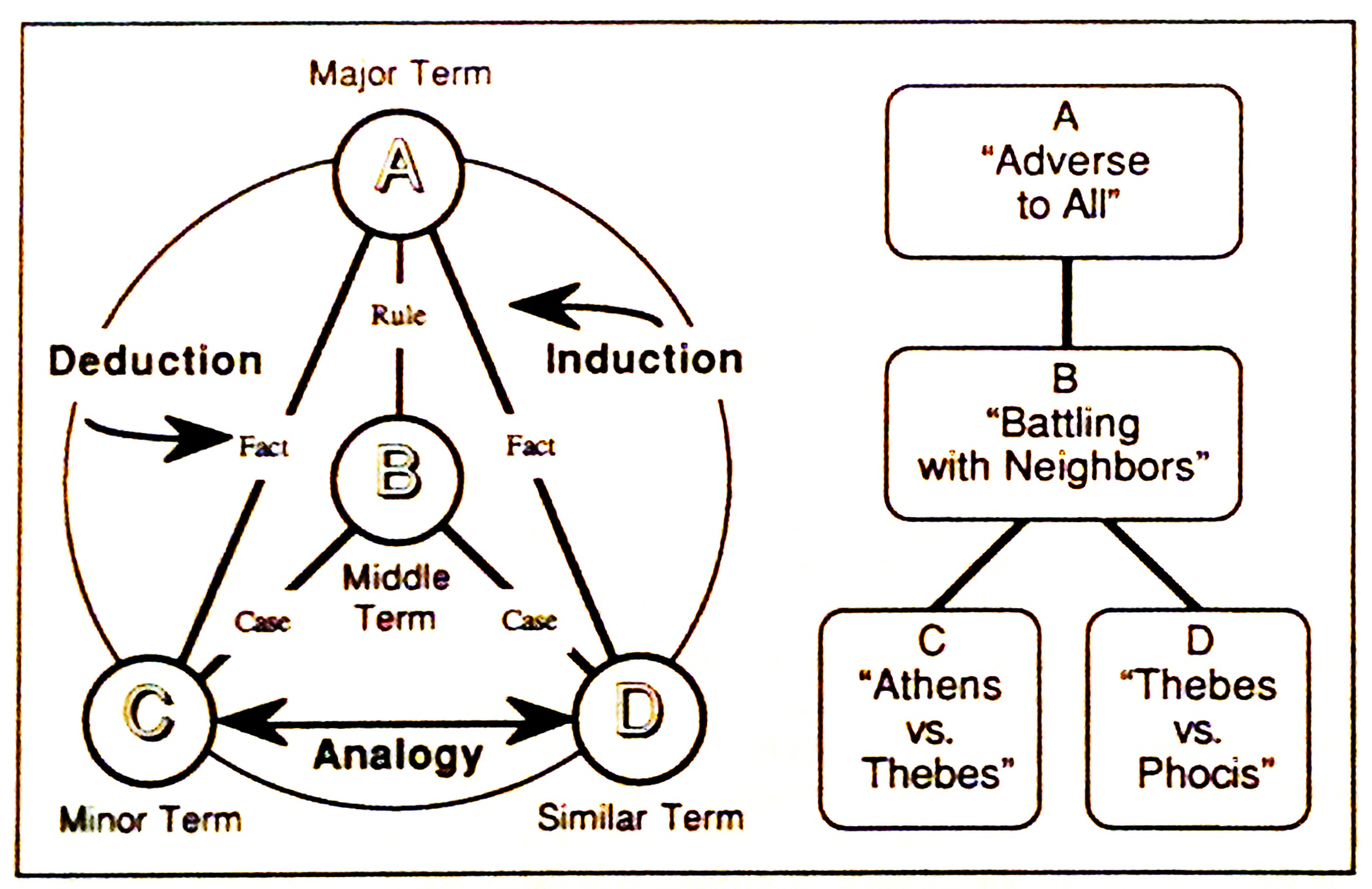
A probability (εικος) is not the same as a sign (σηµειον).  The former is a generally accepted premiss ;  for that which people know to happen or not to happen, or to be or not to be, usually in a particular way, is a probability :  e.g., that the envious are malevolent or that those who are loved are affectionate.  A sign, however, means a demonstrative premiss which is necessary or generally accepted.1  That which coexists with something else, or before or after whose happening something else has happened, is a sign of that something’s having happened or being.

An enthymeme is a syllogism from probabilities or signs ;  and a sign can be taken in three ways — in just as many ways as there are of taking the middle term in the several figures :  either as in the first figure or as in the second or as in the third.

  • E.g., the proof that a woman is pregnant because she has milk is by the first figure ;  for the middle term is ‘having milk’.  A stands for ‘pregnant’, B for ‘having milk’, and C for ‘woman’.
  • The proof that the wise are good because Pittacus was good is by the third figure.  A stands for ‘good’, B for ‘the wise’, and C for Pittacus.  Then it is true to predicate both A and B of C ;  only we do not state the latter, because we know it, whereas we formally assume the former.
  • The proof that a woman is pregnant because she is sallow is intended to be by the middle figure ;  for since sallowness is a characteristic of woman in pregnancy, and is associated with this particular woman, they suppose that she is proved to be pregnant.  A stands for ‘sallowness’, B for ‘being pregnant’, C for ‘woman’.

If only one premiss is stated, we get only a sign ;  but if the other premiss is assumed as well, we get a syllogism,2 e.g., that Pittacus is high-minded, because those who love honour are high-minded, and Pittacus loves honour ;  or again that the wise are good, because Pittacus is good and also wise.

In this way syllogisms can be effected ;  but whereas a syllogism in the first figure cannot be refuted if it is true, since it is universal, a syllogism in the last figure can be refuted even if the conclusion is true, because the syllogism is neither universal nor relevant to our purpose.3  For if Pittacus is good, it is not necessary for this reason that all other wise men are good.  A syllogism in the middle figure is always and in every way refutable, since we never get a syllogism with the terms in this relation4 ;  for it does not necessarily follow, if a pregnant woman is sallow, and this woman is sallow, that she is pregnant.  Thus truth can be found in all signs, but they differ in the ways which have been described.

We must either classify signs in this way, and regard their middle term as an index (τεκµηριον)5 (for the name ‘index’ is given to that which causes us to know, and the middle term is especially of this nature), or describe the arguments drawn from the extremes6 as ‘signs’, and that which is drawn from the middle as an ‘index’.  For the conclusion which is reached through the first figure is most generally accepted and most true.  (Aristotle, Prior Analytics 2.27, 70a3–70b6).

Translator’s Notes

  1. If referable to one phenomenon only, a sign has objective necessity ;  if to more than one, its value is a matter of opinion.
  2. Strictly an enthymeme.
  3. If the signs of an enthymeme in the first figure are true, the conclusion is inevitable.  Aristotle does not mean that the conclusion is universal, but that the universality of the major premiss implies the validity of the minor and conclusion.  The example (<all> those who have honour, etc.) quoted for the third figure contains no universal premiss or sign, and fails to establish a universal conclusion.
  4. i.e. when both premisses are affirmative.
  5. Signs may be classified as irrefutable (1st figure) and refutable (2nd and 3rd figures), and the name ‘index’ may be attached to their middle terms, either in all figures or (more probably) only in the first, where the middle is distinctively middle.
  6. Alternatively the name ‘sign’ may be restricted to the 2nd and 3rd figures, and may be replaced by ‘index’ in the first.

Reference

  • Aristotle, “Prior Analytics”, Hugh Tredennick (trans.), pp. 181–531 in Aristotle, Volume 1, Loeb Classical Library, William Heinemann, London, UK, 1938.

Resource

cc: Academia.eduCyberneticsLaws of FormMathstodon
cc: Research GateStructural ModelingSystems ScienceSyscoi

#analogy, #aristotle, #c-s-peirce, #icon-index-symbol, #induction, #inquiry, #likelihood, #likely-story, #likeness, #logic, #mathematics, #probability, #probable-reasoning, #semiotics, #sign-relations

Icon, Likeness, Likely Story, Likelihood, Probability • 2

Re: Peirce ListPhyllis Chiasson

I’m still a bit fuzzy on how Aristotle’s account relates to Peirce’s usage, though I’m pretty sure Peirce must have taken Aristotle’s usage into account, but it does seem that Aristotle drew some sort of distinction here, using a term “tekmerion” which gets translated as “index” to make the following remark later on in that chapter.

We must either classify signs in this way, and regard their middle term as an index [τεκµηριον] (for the name ‘index’ is given to that which causes us to know, and the middle term is especially of this nature), or describe the arguments drawn from the extremes as ‘signs’, and that which is drawn from the middle as an ‘index’.  For the conclusion which is reached through the first figure is most generally accepted and most true.  (Aristotle, Prior Analytics, 2.27.70b1–6).

Reference

  • Aristotle, “Prior Analytics”, Hugh Tredennick (trans.), pp. 181–531 in Aristotle, Volume 1, Loeb Classical Library, William Heinemann, London, UK, 1938.

Resource

cc: Academia.eduCyberneticsLaws of FormMathstodon
cc: Research GateStructural ModelingSystems ScienceSyscoi

#analogy, #aristotle, #c-s-peirce, #icon-index-symbol, #induction, #inquiry, #likelihood, #likely-story, #likeness, #logic, #mathematics, #probability, #probable-reasoning, #semiotics, #sign-relations

Icon, Likeness, Likely Story, Likelihood, Probability • 1

Re: Peirce ListBenjamin UdellMichael Shapiro

Here’s a likely locus classicus for “icon” in its logical sense —

A probability (εικος) is not the same as a sign (σηµειον).  The former is a generally accepted premiss;  for that which people know to happen or not to happen, or to be or not to be, usually in a particular way, is a probability:  e.g., that the envious are malevolent or that those who are loved are affectionate.  A sign, however, means a demonstrative premiss which is necessary or generally accepted.  That which coexists with something else, or before or after whose happening something else has happened, is a sign of that something’s having happened or being.  (Aristotle, Prior Analytics, 2.27.70a3–10).

Reference

  • Aristotle, “Prior Analytics”, Hugh Tredennick (trans.), pp. 181–531 in Aristotle, Volume 1, Loeb Classical Library, William Heinemann, London, UK, 1938.

Resource

cc: Academia.eduCyberneticsLaws of FormMathstodon
cc: Research GateStructural ModelingSystems ScienceSyscoi

#analogy, #aristotle, #c-s-peirce, #icon-index-symbol, #induction, #inquiry, #likelihood, #likely-story, #likeness, #logic, #mathematics, #probability, #probable-reasoning, #semiotics, #sign-relations

Animated Logical Graphs • 2

Re: Peirce ListJim Willgoose

It’s almost 50 years now since I first encountered the volumes of Peirce’s Collected Papers in the math library at Michigan State, and shortly afterwards a friend called my attention to the entry for Spencer Brown’s Laws of Form in the Whole Earth Catalog and I sent off for it right away.  I would spend the next decade just beginning to figure out what either one of them was talking about in the matter of logical graphs and I would spend another decade after that developing a program, first in Lisp and then in Pascal, that turned graph‑theoretic data structures formed on their ideas to good purpose as the basis of its reasoning engine.

I thought it might contribute to a number of long‑running and ongoing discussions if I could articulate what I think I learned from that experience.

So I’ll try to keep focused on that.

Resources

cc: Academia.eduCyberneticsLaws of FormMathstodon
cc: Research GateStructural ModelingSystems ScienceSyscoi

#abstraction, #amphecks, #analogy, #animata, #automated-research-tools, #boolean-algebra, #boolean-functions, #c-s-peirce, #cactus-graphs, #deduction, #differential-logic, #duality, #form, #graph-theory, #iconicity, #laws-of-form, #leibniz, #logic, #logical-graphs, #mathematics, #minimal-negation-operators, #model-theory, #peirces-law, #praeclarum-theorema, #proof-theory, #propositional-calculus, #propositional-logic, #semiotics, #spencer-brown, #theorem-proving, #topology, #visualization

Animated Logical Graphs • 1

For Your Musement …

Here are some animations I made up to illustrate several different styles of proof in an extended topological variant of Peirce’s Alpha Graphs for propositional logic.

  • Proof Animations
    • Double Negation
    • Double Negation

    • Peirce’s Law
    • Peirce's Law

    • Praeclarum Theorema
    • Praeclarum Theorema

    • Two‑Thirds Majority Function
    • Two‑Thirds Majority Function

A full discussion of logical graphs can be found in the following article.

Additional Resources

cc: Academia.edu • CyberneticsLaws of FormMathstodon
cc: Research GateStructural ModelingSystems ScienceSyscoi

#abstraction, #amphecks, #analogy, #animata, #automated-research-tools, #boolean-algebra, #boolean-functions, #c-s-peirce, #cactus-graphs, #deduction, #differential-logic, #duality, #form, #graph-theory, #iconicity, #laws-of-form, #leibniz, #logic, #logical-graphs, #mathematics, #minimal-negation-operators, #model-theory, #peirces-law, #praeclarum-theorema, #proof-theory, #propositional-calculus, #propositional-logic, #semiotics, #spencer-brown, #theorem-proving, #topology, #visualization

Survey of Precursors Of Category Theory • 6

A few years ago I began a sketch on the “Precursors of Category Theory”, tracing the continuities of the category concept from Aristotle, to Kant and Peirce, through Hilbert and Ackermann, to contemporary mathematical practice.  A Survey of resources on the topic is given below, still very rough and incomplete, but perhaps a few will find it of use.

Background

Blog Series

Categories à la Peirce

cc: FB | Peirce MattersLaws of FormMathstodonOntologAcademia.edu
cc: Conceptual GraphsCyberneticsStructural ModelingSystems Science

#abstraction, #ackermann, #analogy, #aristotle, #c-s-peirce, #carnap, #category-theory, #foundations-of-mathematics, #hilbert, #hypostatic-abstraction, #kant, #logic, #mathematics, #propositions-as-types-analogy, #relation-theory, #saunders-mac-lane, #semiotics, #type-theory, #universals

Survey of Inquiry Driven Systems • 7

This is a Survey of work in progress on Inquiry Driven Systems, material I plan to refine toward a more compact and systematic treatment of the subject.

An inquiry driven system is a system having among its state variables some representing its state of information with respect to various questions of interest, for example, its own state and the states of potential object systems.  Thus it has a component of state tracing a trajectory though an information state space.

Anthem

Elements

Background

Blog Series

  • Pragmatic Cosmos • (1)
  • Reflection On Recursion • (1)(2)(3)(4)
    • Discussions • (1)

Blog Dialogs

  • Architectonics of Inquiry • (1)

Developments

Applications

  • Conceptual Barriers to Creating Integrative Universities
    (Abstract) (Online)
  • Interpretation as Action • The Risk of Inquiry
    (Journal) (doc) (pdf)
  • An Architecture for Inquiry • Building Computer Platforms for Discovery
    (Online)
  • Exploring Research Data Interactively • Theme One : A Program of Inquiry
    (Online)

cc: FB | Inquiry Driven SystemsLaws of FormMathstodonAcademia.edu
cc: Conceptual GraphsCyberneticsStructural ModelingSystems Science

#abduction, #adaptive-systems, #analogy, #animata, #artificial-intelligence, #automated-research-tools, #c-s-peirce, #cognitive-science, #cybernetics, #deduction, #educational-systems-design, #educational-technology, #fixation-of-belief, #induction, #information-theory, #inquiry, #inquiry-driven-systems, #inquiry-into-inquiry, #intelligent-systems, #interpretation, #logic, #logic-of-science, #mathematics, #mental-models, #pragmatic-maxim, #semiotics, #sign-relations, #triadic-relations, #visualization