Objects, Models, Theories • 3

Re: Objects, Models, Theories • (1)(2)
Re: Peirce ListTom Gollier

Here my task is to build bridges between several different classical and contemporary uses of the word model, so I don’t have the luxury of complete control over the words in play but have to start from the customary senses in the various communities of interpretation.  Of course I’m slyly working from a sign‑relational backdrop, but I have to be sleight‑handed about that and not hit people over the head with it.

You can probably guess I’m using object to cover sign‑relational objects, and theories are clearly syntacked together from complexes of sign‑relational signs, so all we have left to pin down is where the various kinds of model sit at the table set with the labels of Object, Sign, Interpretant.

In its theoretical sense, a model of a theory is anything the theory is true of, anything that satisfies the theory.  In that sense, a model is very like an object.  It is whatever the theory is talking about.  In the order of nature, indeed, models come before theories.  But there is another order, the order of art, and one may construct artificial models out of almost any stuff, even the stuff of signs.  So you see the kind of wiggle room we have to work with.

Things are easier outside of logic, in applied mathematics and the special sciences, where models are just things like analogues, icons, simulations, and similar representations of objects.  But that makes them objects serving as signs of other objects, and so you may find some semiotic subtlety lurking there.

Resources

cc: Academia.eduCyberneticsLaws of FormMathstodon
cc: Research GateStructural ModelingSystems ScienceSyscoi

#adaptive-systems, #analogy, #biological-systems, #c-s-peirce, #information, #inquiry, #inquiry-driven-systems, #learning-theory, #logic, #logic-of-science, #mathematical-models, #mathematics, #mental-models, #model-theory, #pragmata, #semiotics, #sign-relations, #triadic-relations, #visualization

Objects, Models, Theories • 2

Re: Gödel’s Lost LetterThe Graph Of Math

GLL:
Kurt Gödel is said to have been a latecomer to appreciating the power of Model Theory.  He was of course the greatest architect of Proof Theory, which stands in contrast to Model Theory.  Model Theory concerns itself with what could be true, while Proof Theory deals with what can be proved.  The latter sounds more definite, but they are supplementary:  a statement is capable of being true somewhere precisely when its negation cannot be proved.  The question is, where is that somewhere?  And when?

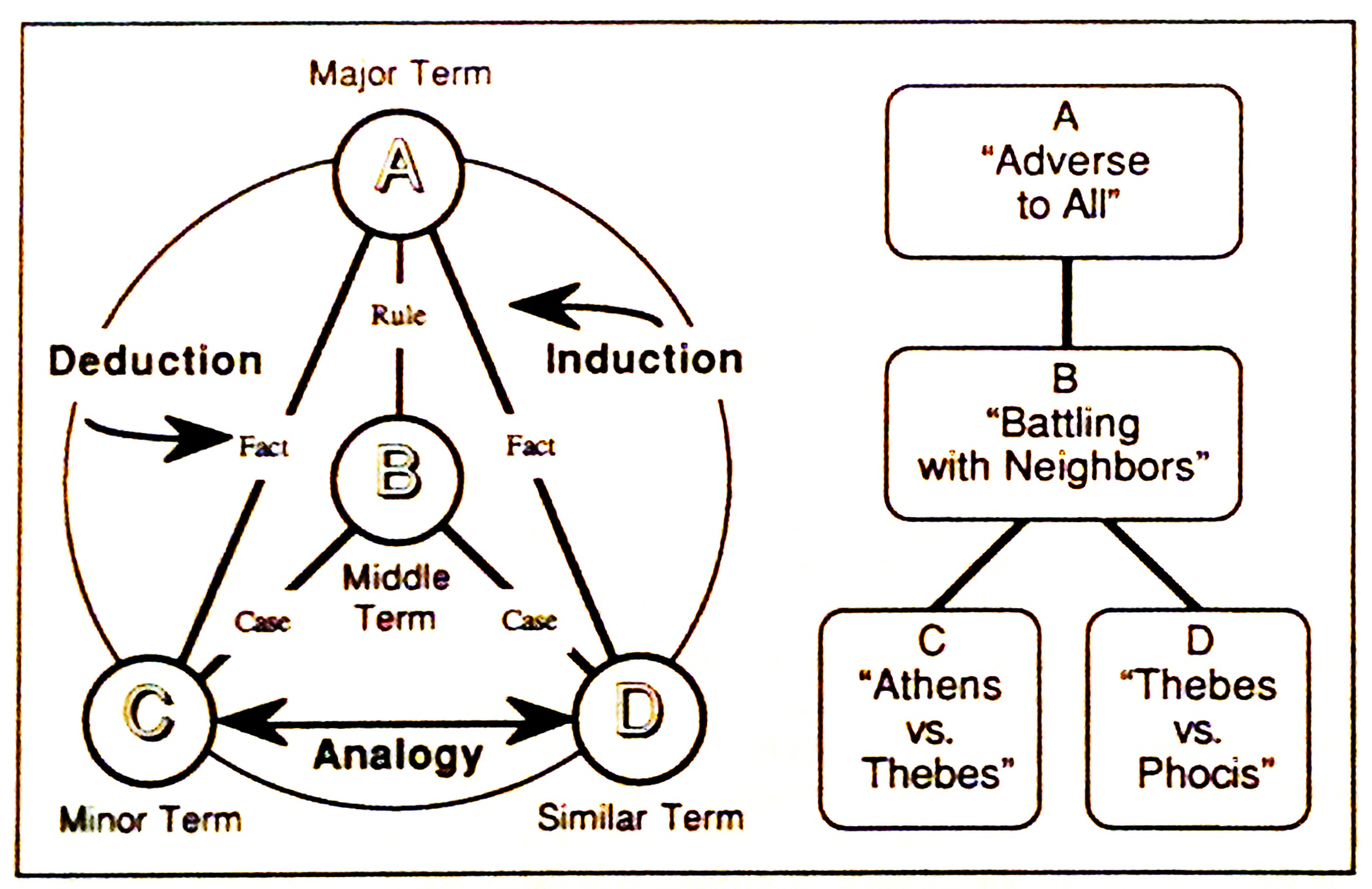
What — if anything — is the common sense that connects the different senses of the word model, as it has been used over the years in logic, mathematics, and the special sciences?  It’s a problem I’ve been running into for several decades now and I think I can trace the roots of it going back as far as Aristotle’s treatment of analogy.

Resources

cc: Academia.eduCyberneticsLaws of FormMathstodon
cc: Research GateStructural ModelingSystems ScienceSyscoi

#adaptive-systems, #analogy, #biological-systems, #c-s-peirce, #information, #inquiry, #inquiry-driven-systems, #learning-theory, #logic, #logic-of-science, #mathematical-models, #mathematics, #mental-models, #model-theory, #pragmata, #semiotics, #sign-relations, #triadic-relations, #visualization

Objects, Models, Theories • 1

Happy Birthday, Charles Sanders Peirce❢ — September 10, 1839

I return once more to a recurring subject.

Re: Artem KaznatcheevThree Types of Mathematical Models

In speaking of models one tends to find denizens of different disciplines talking at cross purposes to one another.  Logicians use the word to describe what may be distinguished as logical models, saying a model is whatever satisfies a theory — anything a theory holds true of — and that is the sense used in the logical subject of model theory.

Almost everyone else uses the word to describe what may be called analogical models, analogues being things holding enough properties in common with other things that learning about Thing 2 (the analogue system) can teach us about Thing 1 (the object system).

It is actually quite easy to integrate those two senses of the word model into a coherent picture of the whole situation, namely, the triadic relationship among objects, analogues, and theories.  We’ll get into that further as the discussion proceeds.

Resources

cc: Academia.eduCyberneticsLaws of FormMathstodon
cc: Research GateStructural ModelingSystems ScienceSyscoi

#adaptive-systems, #analogy, #biological-systems, #c-s-peirce, #information, #inquiry, #inquiry-driven-systems, #learning-theory, #logic, #logic-of-science, #mathematical-models, #mathematics, #mental-models, #model-theory, #pragmata, #semiotics, #sign-relations, #triadic-relations, #visualization

Survey of Inquiry Driven Systems • 7

This is a Survey of work in progress on Inquiry Driven Systems, material I plan to refine toward a more compact and systematic treatment of the subject.

An inquiry driven system is a system having among its state variables some representing its state of information with respect to various questions of interest, for example, its own state and the states of potential object systems.  Thus it has a component of state tracing a trajectory though an information state space.

Anthem

Elements

Background

Blog Series

  • Pragmatic Cosmos • (1)
  • Reflection On Recursion • (1)(2)(3)(4)
    • Discussions • (1)

Blog Dialogs

  • Architectonics of Inquiry • (1)

Developments

Applications

  • Conceptual Barriers to Creating Integrative Universities
    (Abstract) (Online)
  • Interpretation as Action • The Risk of Inquiry
    (Journal) (doc) (pdf)
  • An Architecture for Inquiry • Building Computer Platforms for Discovery
    (Online)
  • Exploring Research Data Interactively • Theme One : A Program of Inquiry
    (Online)

cc: FB | Inquiry Driven SystemsLaws of FormMathstodonAcademia.edu
cc: Conceptual GraphsCyberneticsStructural ModelingSystems Science

#abduction, #adaptive-systems, #analogy, #animata, #artificial-intelligence, #automated-research-tools, #c-s-peirce, #cognitive-science, #cybernetics, #deduction, #educational-systems-design, #educational-technology, #fixation-of-belief, #induction, #information-theory, #inquiry, #inquiry-driven-systems, #inquiry-into-inquiry, #intelligent-systems, #interpretation, #logic, #logic-of-science, #mathematics, #mental-models, #pragmatic-maxim, #semiotics, #sign-relations, #triadic-relations, #visualization