Objects, Models, Theories • 4

Re: Objects, Models, Theories • (1) • (2) • (3)

What are objects, models, theories, and how do they relate to one another?

Recurring questions about the relationship between objects, models, and theories take on a different aspect when viewed from the perspective of Peirce’s pragmatic semiotic, in other words, when cast within a framework of triadic sign relations.

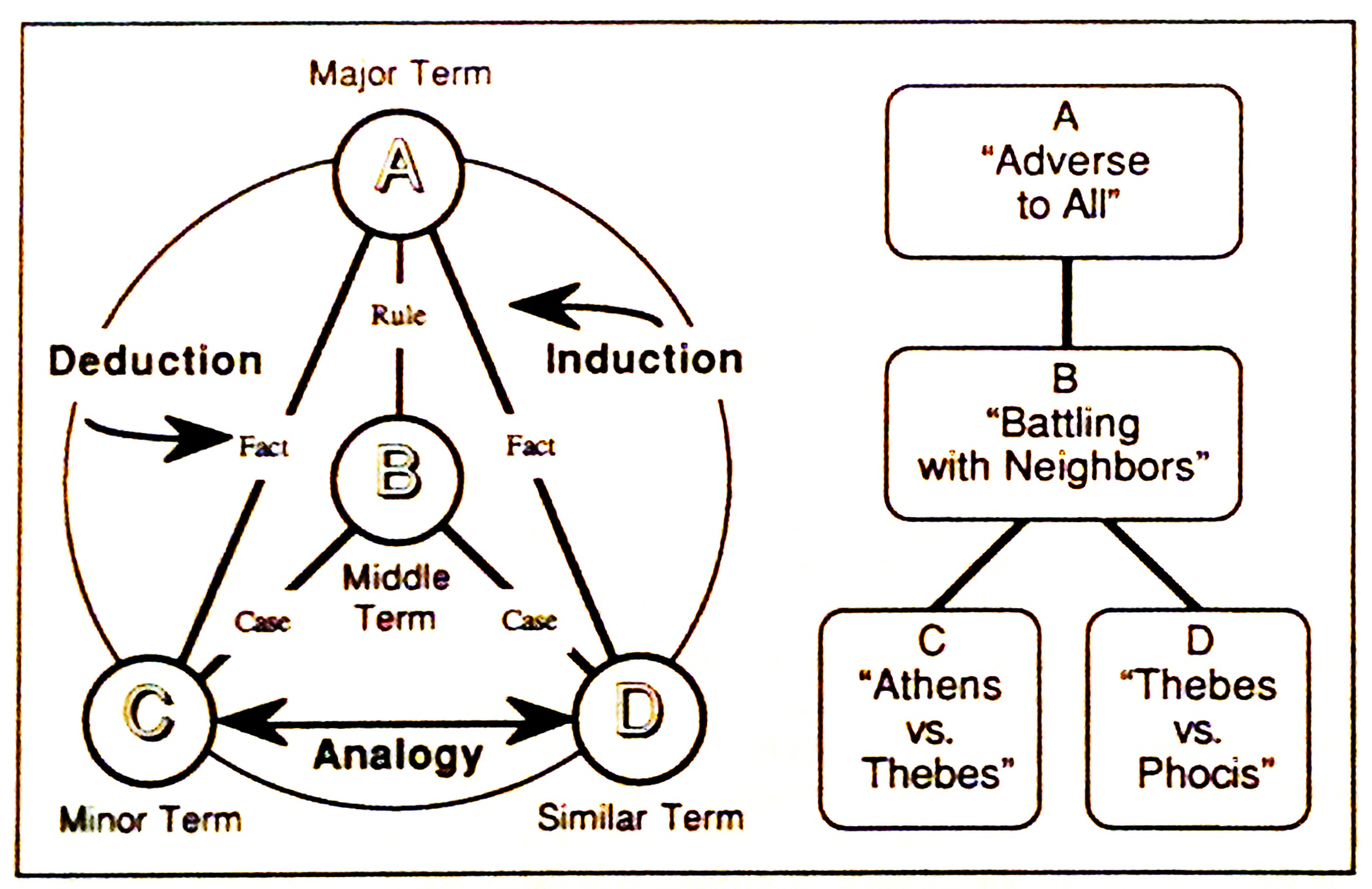
In contemplating the array of questions which come to mind I always find it helpful to ruminate on the diagram shown below — I might even call it a mandala for its wealth of symbolic features and its aid in organizing the pro‑&‑con‑fusion of mental impressions.

Aristotle's Paradigm

Aristotle’s “Paradigm”

Here is the corresponding text from Aristotle and the context that leads on to Peirce’s viewpoint.

Resources

cc: Academia.edu • Cybernetics • Laws of Form • Mathstodon
cc: Research Gate • Structural Modeling • Systems Science • Syscoi

#adaptive-systems, #analogy, #biological-systems, #c-s-peirce, #information, #inquiry, #inquiry-driven-systems, #learning-theory, #logic, #logic-of-science, #mathematical-models, #mathematics, #mental-models, #model-theory, #pragmata, #semiotics, #sign-relations, #triadic-relations, #visualization

Objects, Models, Theories • 3

Re: Objects, Models, Theories • (1) • (2)
Re: Peirce List • Tom Gollier

Here my task is to build bridges between several different classical and contemporary uses of the word model, so I don’t have the luxury of complete control over the words in play but have to start from the customary senses in the various communities of interpretation.  Of course I’m slyly working from a sign‑relational backdrop, but I have to be sleight‑handed about that and not hit people over the head with it.

You can probably guess I’m using object to cover sign‑relational objects, and theories are clearly syntacked together from complexes of sign‑relational signs, so all we have left to pin down is where the various kinds of model sit at the table set with the labels of Object, Sign, Interpretant.

In its theoretical sense, a model of a theory is anything the theory is true of, anything that satisfies the theory.  In that sense, a model is very like an object.  It is whatever the theory is talking about.  In the order of nature, indeed, models come before theories.  But there is another order, the order of art, and one may construct artificial models out of almost any stuff, even the stuff of signs.  So you see the kind of wiggle room we have to work with.

Things are easier outside of logic, in applied mathematics and the special sciences, where models are just things like analogues, icons, simulations, and similar representations of objects.  But that makes them objects serving as signs of other objects, and so you may find some semiotic subtlety lurking there.

Resources

cc: Academia.edu • Cybernetics • Laws of Form • Mathstodon
cc: Research Gate • Structural Modeling • Systems Science • Syscoi

#adaptive-systems, #analogy, #biological-systems, #c-s-peirce, #information, #inquiry, #inquiry-driven-systems, #learning-theory, #logic, #logic-of-science, #mathematical-models, #mathematics, #mental-models, #model-theory, #pragmata, #semiotics, #sign-relations, #triadic-relations, #visualization

Objects, Models, Theories • 2

Re: Gödel’s Lost Letter • The Graph Of Math

GLL:
Kurt Gödel is said to have been a latecomer to appreciating the power of Model Theory.  He was of course the greatest architect of Proof Theory, which stands in contrast to Model Theory.  Model Theory concerns itself with what could be true, while Proof Theory deals with what can be proved.  The latter sounds more definite, but they are supplementary:  a statement is capable of being true somewhere precisely when its negation cannot be proved.  The question is, where is that somewhere?  And when?

What — if anything — is the common sense that connects the different senses of the word model, as it has been used over the years in logic, mathematics, and the special sciences?  It’s a problem I’ve been running into for several decades now and I think I can trace the roots of it going back as far as Aristotle’s treatment of analogy.

Resources

cc: Academia.edu • Cybernetics • Laws of Form • Mathstodon
cc: Research Gate • Structural Modeling • Systems Science • Syscoi

#adaptive-systems, #analogy, #biological-systems, #c-s-peirce, #information, #inquiry, #inquiry-driven-systems, #learning-theory, #logic, #logic-of-science, #mathematical-models, #mathematics, #mental-models, #model-theory, #pragmata, #semiotics, #sign-relations, #triadic-relations, #visualization

Objects, Models, Theories • 1

Happy Birthday, Charles Sanders Peirce❢ — September 10, 1839

I return once more to a recurring subject.

Re: Artem Kaznatcheev • Three Types of Mathematical Models

In speaking of models one tends to find denizens of different disciplines talking at cross purposes to one another.  Logicians use the word to describe what may be distinguished as logical models, saying a model is whatever satisfies a theory — anything a theory holds true of — and that is the sense used in the logical subject of model theory.

Almost everyone else uses the word to describe what may be called analogical models, analogues being things holding enough properties in common with other things that learning about Thing 2 (the analogue system) can teach us about Thing 1 (the object system).

It is actually quite easy to integrate those two senses of the word model into a coherent picture of the whole situation, namely, the triadic relationship among objects, analogues, and theories.  We’ll get into that further as the discussion proceeds.

Resources

cc: Academia.edu • Cybernetics • Laws of Form • Mathstodon
cc: Research Gate • Structural Modeling • Systems Science • Syscoi

#adaptive-systems, #analogy, #biological-systems, #c-s-peirce, #information, #inquiry, #inquiry-driven-systems, #learning-theory, #logic, #logic-of-science, #mathematical-models, #mathematics, #mental-models, #model-theory, #pragmata, #semiotics, #sign-relations, #triadic-relations, #visualization

Survey of Theme One Program • 7

This is a Survey of resources relating to the Theme One Program I worked on all through the 1980s.  The aim was to develop fundamental algorithms and data structures for integrating empirical learning with logical reasoning.  I had earlier developed separate programs for basic components of those tasks, in particular, two‑level formal language learning and propositional constraint satisfaction, the latter using an extension of C.S. Peirce’s logical graphs as a syntax for propositional logic.  Thus arose the question of how well it might be possible to get “empiricist” and “rationalist” modes of operation to cooperate.  The long‑term vision is the implementation of an Automated Research Tool able to double as a platform for Inquiry Driven Education.

Wiki Hub

Documentation

Blog Series

Blog Dialogs

Applications

References

  • Awbrey, S.M., and Awbrey, J.L. (May 1991), “An Architecture for Inquiry • Building Computer Platforms for Discovery”, Proceedings of the Eighth International Conference on Technology and Education, Toronto, Canada, pp. 874–875.  Online.
  • Awbrey, J.L., and Awbrey, S.M. (January 1991), “Exploring Research Data Interactively • Developing a Computer Architecture for Inquiry”, Poster presented at the Annual Sigma Xi Research Forum, University of Texas Medical Branch, Galveston, TX.
  • Awbrey, J.L., and Awbrey, S.M. (August 1990), “Exploring Research Data Interactively • Theme One : A Program of Inquiry”, Proceedings of the Sixth Annual Conference on Applications of Artificial Intelligence and CD-ROM in Education and Training, Society for Applied Learning Technology, Washington, DC, pp. 9–15.  Online.

cc: FB | Theme One Program • Laws of Form • Mathstodon • Academia.edu
cc: Conceptual Graphs • Cybernetics • Structural Modeling • Systems Science

#algorithms, #animata, #artificial-intelligence, #automated-research-tools, #boolean-functions, #c-s-peirce, #cactus-graphs, #constraint-satisfaction-problems, #data-structures, #differential-logic, #equational-inference, #formal-languages, #graph-theory, #inquiry-driven-systems, #laws-of-form, #learning-theory, #logic, #logical-graphs, #mathematics, #minimal-negation-operators, #painted-cacti, #propositional-calculus, #propositional-equation-reasoning-systems, #spencer-brown, #visualization

Survey of Pragmatic Semiotic Information • 9

This is a Survey of blog and wiki posts on a theory of information which grows out of pragmatic semiotic ideas.  All my projects are exploratory in character but this line of inquiry is more open‑ended than most.  The question is —

What is information and how does it impact the spectrum of activities answering to the name of inquiry?

Setting out on what would become his lifelong quest to explore and explain the “Logic of Science”, C.S. Peirce pierced the veil of historical confusions obscuring the issue and fixed on what he called the “laws of information” as the key to solving the puzzle.

The first hints of the Information Revolution in our understanding of scientific inquiry may be traced to Peirce’s lectures of 1865–1866 at Harvard University and the Lowell Institute.  There Peirce took up “the puzzle of the validity of scientific inference” and claimed it was “entirely removed by a consideration of the laws of information”.

Fast forward to the present and I see the Big Question as follows.  Having gone through the exercise of comparing and contrasting Peirce’s theory of information, however much it yet remains in a rough‑hewn state, with Shannon’s paradigm so pervasively informing the ongoing revolution in our understanding and use of information, I have reason to believe Peirce’s idea is root and branch more general and has the potential, with due development, to resolve many mysteries still bedeviling our grasp of inference, information, and inquiry.

Inference, Information, Inquiry

Pragmatic Semiotic Information

Semiotics, Semiosis, Sign Relations

Sign Relations, Triadic Relations, Relation Theory

  • Blog Series • (1)
    • Discusssions • (1) • (2)

Excursions

Blog Dialogs

References

  • Peirce, C.S. (1867), “Upon Logical Comprehension and Extension”.  Online.
  • Awbrey, J.L., and Awbrey, S.M. (1995), “Interpretation as Action : The Risk of Inquiry”, Inquiry : Critical Thinking Across the Disciplines 15(1), 40–52.  Archive.  Journal.  Online (doc) (pdf).

cc: FB | Semeiotics • Laws of Form • Mathstodon • Ontolog • Academia.edu
cc: Conceptual Graphs • Cybernetics • Structural Modeling • Systems Science

#abduction, #c-s-peirce, #communication, #control, #cybernetics, #deduction, #determination, #discovery, #doubt, #epistemology, #fixation-of-belief, #induction, #information, #information-comprehension-x-extension, #information-theory, #inquiry, #inquiry-driven-systems, #inquiry-into-inquiry, #interpretation, #invention, #knowledge, #learning-theory, #logic, #logic-of-relatives, #logic-of-science, #mathematics, #philosophy-of-science, #pragmatic-information, #probable-reasoning, #process-thinking, #relation-theory, #scientific-inquiry, #scientific-method, #semeiosis, #semiosis, #semiotic-information, #semiotics, #sign-relational-manifolds, #sign-relations, #surveys, #triadic-relations, #uncertainty, #visualization

Survey of Cybernetics • 5

Again, in a ship, if a man were at liberty to do what he chose, but were devoid of mind and excellence in navigation (αρετης κυβερνητικης), do you perceive what must happen to him and his fellow sailors?

— Plato • Alcibiades • 135 A

This is a Survey of blog posts relating to Cybernetics.  It includes the selections from Ashby’s Introduction and the comment on them I’ve posted so far, plus two series of reflections on the governance of social systems in light of cybernetic and semiotic principles.

Anthem

Ashby’s Introduction to Cybernetics

  • Chapter 11 • Requisite Variety

Blog Series

  • Theory and Therapy of Representations • (1) • (2) • (3) • (4) • (5)

cc: FB | Inquiry Driven Systems • Laws of Form • Mathstodon • Academia.edu
cc: Conceptual Graphs • Cybernetics • Structural Modeling • Systems Science

#abduction, #c-s-peirce, #communication, #control, #cybernetics, #deduction, #determination, #discovery, #doubt, #epistemology, #fixation-of-belief, #induction, #information, #information-comprehension-x-extension, #information-theory, #inquiry, #inquiry-driven-systems, #inquiry-into-inquiry, #interpretation, #invention, #knowledge, #learning-theory, #logic, #logic-of-relatives, #logic-of-science, #mathematics, #peirce, #philosophy, #philosophy-of-science, #pragmatic-information, #probable-reasoning, #process-thinking, #relation-theory, #scientific-inquiry, #scientific-method, #semeiosis, #semiosis, #semiotic-information, #semiotics, #sign-relational-manifolds, #sign-relations, #surveys, #triadic-relations, #uncertainty