Information = Comprehension × Extension • Preamble

Perhaps the best perspective from which to bring the connection between the theory of signs and the theory of inquiry into its proper focus is Peirce’s own Theory of Information, which he began setting forth in lectures at Harvard and the Lowell Institute in 1865 and 1866.  Peirce encapsulates the elements of his theory in the following formula.

Information = Comprehension × Extension

In the Resources below I link to my study of Peirce’s 1865–1866 Lectures on the Logic of Science, with selections from the lectures and my commentary on them.

Ten summers ago I hit on what struck me as a new insight into one of the most recalcitrant problems in Peirce’s semiotics and logic of science, namely, the relation between “the manner in which different representations stand for their objects” and the way in which different inferences transform states of information.  I roughed out a sketch of my epiphany in a series of blog posts then set it aside for the cool of later reflection.  Now looks to be a choice moment for taking another look.

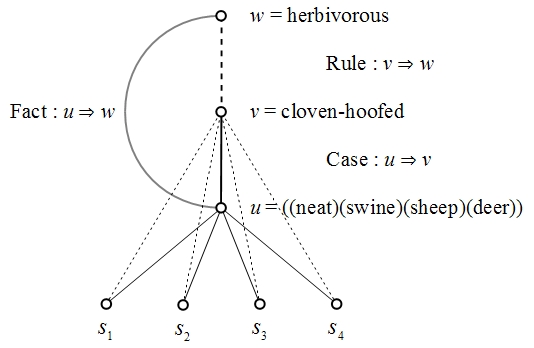
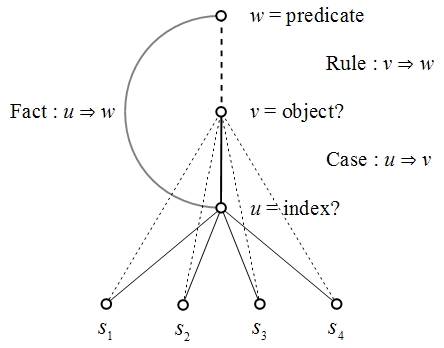
A first pass through the variations of representation and reasoning detects the axes of iconic, indexical, and symbolic manners of representation on the one hand and the axes of abductive, inductive, and deductive modes of inference on the other.  Early and often Peirce suggests a natural correspondence between the main modes of inference and the main manners of representation but his early arguments differ from his later accounts in ways deserving close examination, partly for the extra points in his line of reasoning and partly for his explanation of indices as signs constituted by convening the variant conceptions of sundry interpreters.

References

  • Peirce, C.S. (1866), “The Logic of Science, or, Induction and Hypothesis”, Lowell Lectures of 1866, pp. 357–504 in Writings of Charles S. Peirce : A Chronological Edition, Volume 1, 1857–1866, Peirce Edition Project, Indiana University Press, Bloomington, IN, 1982.
  • Peirce, C.S. (1867), “Upon Logical Comprehension and Extension”, Proceedings of the American Academy of Arts and Sciences, Vol. 7, pp. 416–432.  ArchiveOnline.

Resources

cc: Academia.eduCyberneticsLaws of Form • Mathstodon
cc: Research GateStructural ModelingSystems ScienceSyscoi
Perhaps the best perspective from which to bring the connection between the theory of signs and the theory of inquiry into its proper focus is Peirce’s own Theory of Information, which he began setting forth in lectures at Harvard and the Lowell Institute in 1865 and 1866.  Peirce encapsulates the elements of his theory in the following formula.

Information = Comprehension × Extension

In the Resources below I link to my study of Peirce’s 1865–1866 Lectures on the Logic of Science, with selections from the lectures and my commentary on them.

Ten summers ago I hit on what struck me as a new insight into one of the most recalcitrant problems in Peirce’s semiotics and logic of science, namely, the relation between “the manner in which different representations stand for their objects” and the way in which different inferences transform states of information.  I roughed out a sketch of my epiphany in a series of blog posts then set it aside for the cool of later reflection.  Now looks to be a choice moment for taking another look.

A first pass through the variations of representation and reasoning detects the axes of iconic, indexical, and symbolic manners of representation on the one hand and the axes of abductive, inductive, and deductive modes of inference on the other.  Early and often Peirce suggests a natural correspondence between the main modes of inference and the main manners of representation but his early arguments differ from his later accounts in ways deserving close examination, partly for the extra points in his line of reasoning and partly for his explanation of indices as signs constituted by convening the variant conceptions of sundry interpreters.

References

  • Peirce, C.S. (1866), “The Logic of Science, or, Induction and Hypothesis”, Lowell Lectures of 1866, pp. 357–504 in Writings of Charles S. Peirce : A Chronological Edition, Volume 1, 1857–1866, Peirce Edition Project, Indiana University Press, Bloomington, IN, 1982.
  • Peirce, C.S. (1867), “Upon Logical Comprehension and Extension”, Proceedings of the American Academy of Arts and Sciences, Vol. 7, pp. 416–432.  ArchiveOnline.

Resources

cc: Academia.edu • Cybernetics • Laws of Form • Mathstodon
cc: Research Gate • Structural Modeling • Systems Science • Syscoi

#abduction, #c-s-peirce, #comprehension, #deduction, #extension, #hypothesis, #icon-index-symbol, #induction, #inference, #information-comprehension-x-extension, #inquiry, #intension, #logic, #peirces-categories, #pragmatic-semiotic-information, #pragmatism, #scientific-method, #semiotics, #sign-relations

Animated Logical Graphs • 2

Re: Peirce ListJim Willgoose

It’s almost 50 years now since I first encountered the volumes of Peirce’s Collected Papers in the math library at Michigan State, and shortly afterwards a friend called my attention to the entry for Spencer Brown’s Laws of Form in the Whole Earth Catalog and I sent off for it right away.  I would spend the next decade just beginning to figure out what either one of them was talking about in the matter of logical graphs and I would spend another decade after that developing a program, first in Lisp and then in Pascal, that turned graph‑theoretic data structures formed on their ideas to good purpose as the basis of its reasoning engine.

I thought it might contribute to a number of long‑running and ongoing discussions if I could articulate what I think I learned from that experience.

So I’ll try to keep focused on that.

Resources

cc: Academia.eduCyberneticsLaws of FormMathstodon
cc: Research GateStructural ModelingSystems ScienceSyscoi

#abstraction, #amphecks, #analogy, #animata, #automated-research-tools, #boolean-algebra, #boolean-functions, #c-s-peirce, #cactus-graphs, #deduction, #differential-logic, #duality, #form, #graph-theory, #iconicity, #laws-of-form, #leibniz, #logic, #logical-graphs, #mathematics, #minimal-negation-operators, #model-theory, #peirces-law, #praeclarum-theorema, #proof-theory, #propositional-calculus, #propositional-logic, #semiotics, #spencer-brown, #theorem-proving, #topology, #visualization

Animated Logical Graphs • 1

For Your Musement …

Here are some animations I made up to illustrate several different styles of proof in an extended topological variant of Peirce’s Alpha Graphs for propositional logic.

  • Proof Animations
    • Double Negation
    • Double Negation

    • Peirce’s Law
    • Peirce's Law

    • Praeclarum Theorema
    • Praeclarum Theorema

    • Two‑Thirds Majority Function
    • Two‑Thirds Majority Function

A full discussion of logical graphs can be found in the following article.

Additional Resources

cc: Academia.edu • CyberneticsLaws of FormMathstodon
cc: Research GateStructural ModelingSystems ScienceSyscoi

#abstraction, #amphecks, #analogy, #animata, #automated-research-tools, #boolean-algebra, #boolean-functions, #c-s-peirce, #cactus-graphs, #deduction, #differential-logic, #duality, #form, #graph-theory, #iconicity, #laws-of-form, #leibniz, #logic, #logical-graphs, #mathematics, #minimal-negation-operators, #model-theory, #peirces-law, #praeclarum-theorema, #proof-theory, #propositional-calculus, #propositional-logic, #semiotics, #spencer-brown, #theorem-proving, #topology, #visualization

Survey of Pragmatic Semiotic Information • 9

This is a Survey of blog and wiki posts on a theory of information which grows out of pragmatic semiotic ideas.  All my projects are exploratory in character but this line of inquiry is more open‑ended than most.  The question is —

What is information and how does it impact the spectrum of activities answering to the name of inquiry?

Setting out on what would become his lifelong quest to explore and explain the “Logic of Science”, C.S. Peirce pierced the veil of historical confusions obscuring the issue and fixed on what he called the “laws of information” as the key to solving the puzzle.

The first hints of the Information Revolution in our understanding of scientific inquiry may be traced to Peirce’s lectures of 1865–1866 at Harvard University and the Lowell Institute.  There Peirce took up “the puzzle of the validity of scientific inference” and claimed it was “entirely removed by a consideration of the laws of information”.

Fast forward to the present and I see the Big Question as follows.  Having gone through the exercise of comparing and contrasting Peirce’s theory of information, however much it yet remains in a rough‑hewn state, with Shannon’s paradigm so pervasively informing the ongoing revolution in our understanding and use of information, I have reason to believe Peirce’s idea is root and branch more general and has the potential, with due development, to resolve many mysteries still bedeviling our grasp of inference, information, and inquiry.

Inference, Information, Inquiry

Pragmatic Semiotic Information

Semiotics, Semiosis, Sign Relations

Sign Relations, Triadic Relations, Relation Theory

  • Blog Series • (1)
    • Discusssions • (1)(2)

Excursions

Blog Dialogs

References

  • Peirce, C.S. (1867), “Upon Logical Comprehension and Extension”.  Online.
  • Awbrey, J.L., and Awbrey, S.M. (1995), “Interpretation as Action : The Risk of Inquiry”, Inquiry : Critical Thinking Across the Disciplines 15(1), 40–52.  ArchiveJournal.  Online (doc) (pdf).

cc: FB | SemeioticsLaws of FormMathstodonOntologAcademia.edu
cc: Conceptual GraphsCyberneticsStructural ModelingSystems Science

#abduction, #c-s-peirce, #communication, #control, #cybernetics, #deduction, #determination, #discovery, #doubt, #epistemology, #fixation-of-belief, #induction, #information, #information-comprehension-x-extension, #information-theory, #inquiry, #inquiry-driven-systems, #inquiry-into-inquiry, #interpretation, #invention, #knowledge, #learning-theory, #logic, #logic-of-relatives, #logic-of-science, #mathematics, #philosophy-of-science, #pragmatic-information, #probable-reasoning, #process-thinking, #relation-theory, #scientific-inquiry, #scientific-method, #semeiosis, #semiosis, #semiotic-information, #semiotics, #sign-relational-manifolds, #sign-relations, #surveys, #triadic-relations, #uncertainty, #visualization

Survey of Cybernetics • 5

Again, in a ship, if a man were at liberty to do what he chose, but were devoid of mind and excellence in navigation (αρετης κυβερνητικης), do you perceive what must happen to him and his fellow sailors?

— Plato • Alcibiades • 135 A

This is a Survey of blog posts relating to Cybernetics.  It includes the selections from Ashby’s Introduction and the comment on them I’ve posted so far, plus two series of reflections on the governance of social systems in light of cybernetic and semiotic principles.

Anthem

Ashby’s Introduction to Cybernetics

  • Chapter 11 • Requisite Variety

Blog Series

  • Theory and Therapy of Representations • (1)(2)(3)(4)(5)

cc: FB | Inquiry Driven SystemsLaws of FormMathstodonAcademia.edu
cc: Conceptual GraphsCyberneticsStructural ModelingSystems Science

#abduction, #c-s-peirce, #communication, #control, #cybernetics, #deduction, #determination, #discovery, #doubt, #epistemology, #fixation-of-belief, #induction, #information, #information-comprehension-x-extension, #information-theory, #inquiry, #inquiry-driven-systems, #inquiry-into-inquiry, #interpretation, #invention, #knowledge, #learning-theory, #logic, #logic-of-relatives, #logic-of-science, #mathematics, #peirce, #philosophy, #philosophy-of-science, #pragmatic-information, #probable-reasoning, #process-thinking, #relation-theory, #scientific-inquiry, #scientific-method, #semeiosis, #semiosis, #semiotic-information, #semiotics, #sign-relational-manifolds, #sign-relations, #surveys, #triadic-relations, #uncertainty

Survey of Inquiry Driven Systems • 7

This is a Survey of work in progress on Inquiry Driven Systems, material I plan to refine toward a more compact and systematic treatment of the subject.

An inquiry driven system is a system having among its state variables some representing its state of information with respect to various questions of interest, for example, its own state and the states of potential object systems.  Thus it has a component of state tracing a trajectory though an information state space.

Anthem

Elements

Background

Blog Series

  • Pragmatic Cosmos • (1)
  • Reflection On Recursion • (1)(2)(3)(4)
    • Discussions • (1)

Blog Dialogs

  • Architectonics of Inquiry • (1)

Developments

Applications

  • Conceptual Barriers to Creating Integrative Universities
    (Abstract) (Online)
  • Interpretation as Action • The Risk of Inquiry
    (Journal) (doc) (pdf)
  • An Architecture for Inquiry • Building Computer Platforms for Discovery
    (Online)
  • Exploring Research Data Interactively • Theme One : A Program of Inquiry
    (Online)

cc: FB | Inquiry Driven SystemsLaws of FormMathstodonAcademia.edu
cc: Conceptual GraphsCyberneticsStructural ModelingSystems Science

#abduction, #adaptive-systems, #analogy, #animata, #artificial-intelligence, #automated-research-tools, #c-s-peirce, #cognitive-science, #cybernetics, #deduction, #educational-systems-design, #educational-technology, #fixation-of-belief, #induction, #information-theory, #inquiry, #inquiry-driven-systems, #inquiry-into-inquiry, #intelligent-systems, #interpretation, #logic, #logic-of-science, #mathematics, #mental-models, #pragmatic-maxim, #semiotics, #sign-relations, #triadic-relations, #visualization

Survey of Abduction, Deduction, Induction, Analogy, Inquiry • 5

This is a Survey of blog and wiki posts on three elementary forms of inference, as recognized by a logical tradition extending from Aristotle through Charles S. Peirce.  Particular attention is paid to the way the inferential rudiments combine to form the more complex patterns of analogy and inquiry.

Anthem

Blog Dialogs

Blog Series

Blog Surveys

OEIS Wiki

Ontolog Forum

cc: FB | Inquiry Driven SystemsLaws of FormMathstodonAcademia.edu
cc: Conceptual GraphsCyberneticsStructural ModelingSystems Science

#abduction, #aristotle, #c-s-peirce, #deduction, #dewey, #discovery, #doubt, #fixation-of-belief, #functional-logic, #icon-index-symbol, #induction, #inference, #information, #inquiry, #invention, #logic, #logic-of-science, #mathematics, #morphism, #paradigmata, #paradigms, #pattern-recognition, #peirce, #philosophy, #pragmatic-maxim, #pragmatism, #scientific-inquiry, #scientific-method, #semiotics, #sign-relations, #surveys, #syllogism, #triadic-relations, #visualization