Information = Comprehension × Extension • Selection 3

Selection 3 opens with Peirce remarking a critical property of genuine symbols — the class of symbols is not closed under combinations.  In particular, there are logical conjunctions of symbols and logical disjunctions of symbols which are not themselves genuine symbols.

Applying this paradigm to terms, Peirce introduces two sets of examples under the headings of conjunctive terms and disjunctive terms designed to illustrate the correspondence between manners of representation and modes of inference.

Yet there are combinations of words and combinations of conceptions which are not strictly speaking symbols.  These are of two kinds of which I will give you instances.  We have first cases like:

man and horse and kangaroo and whale,

and secondly, cases like:

spherical bright fragrant juicy tropical fruit.

The first of these terms has no comprehension which is adequate to the limitation of the extension.  In fact, men, horses, kangaroos, and whales have no attributes in common which are not possessed by the entire class of mammals.  For this reason, this disjunctive term, man and horse and kangaroo and whale, is of no use whatever.  For suppose it is the subject of a sentence;  suppose we know that men and horses and kangaroos and whales have some common character.  Since they have no common character which does not belong to the whole class of mammals, it is plain that mammals may be substituted for this term.  Suppose it is the predicate of a sentence, and that we know that something is either a man or a horse or a kangaroo or a whale;  then, the person who has found out this, knows more about this thing than that it is a mammal;  he therefore knows which of these four it is for these four have nothing in common except what belongs to all other mammals.  Hence in this case the particular one may be substituted for the disjunctive term.  A disjunctive term, then, — one which aggregates the extension of several symbols, — may always be replaced by a simple term.

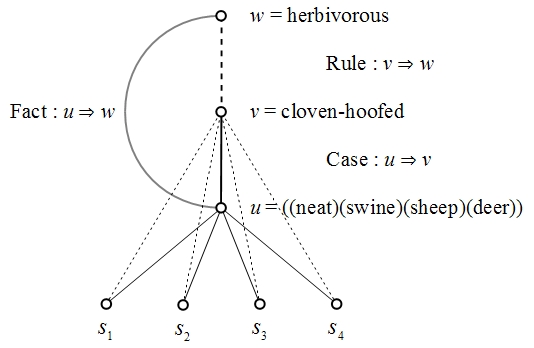
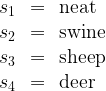
Hence if we find out that neat are herbivorous, swine are herbivorous, sheep are herbivorous, and deer are herbivorous;  we may be sure that there is some class of animals which covers all these, all the members of which are herbivorous.  Now a disjunctive term — such as neat swine sheep and deer, or man, horse, kangaroo, and whale — is not a true symbol.  It does not denote what it does in consequence of its connotation, as a symbol does;  on the contrary, no part of its connotation goes at all to determine what it denotes — it is in that respect a mere accident if it denote anything.  Its sphere is determined by the concurrence of the four members, man, horse, kangaroo, and whale, or neat swine sheep and deer as the case may be.

Now those who are not accustomed to the homologies of the conceptions of men and words, will think it very fanciful if I say that this concurrence of four terms to determine the sphere of a disjunctive term resembles the arbitrary convention by which men agree that a certain sign shall stand for a certain thing.  And yet how is such a convention made?  The men all look upon or think of the thing and each gets a certain conception and then they agree that whatever calls up or becomes an object of that conception in either of them shall be denoted by the sign.

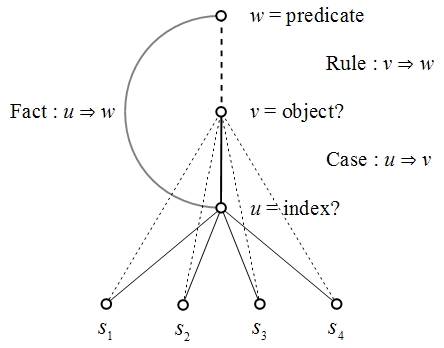
In the one case, then, we have several different words and the disjunctive term denotes whatever is the object of either of them.  In the other case, we have several different conceptions — the conceptions of different men — and the conventional sign stands for whatever is an object of either of them.  It is plain the two cases are essentially the same, and that a disjunctive term is to be regarded as a conventional sign or index.  And we find both agree in having a determinate extension but an inadequate comprehension.

(Peirce 1866, pp. 468–469)

References

  • Peirce, C.S. (1866), “The Logic of Science, or, Induction and Hypothesis”, Lowell Lectures of 1866, pp. 357–504 in Writings of Charles S. Peirce : A Chronological Edition, Volume 1, 1857–1866, Peirce Edition Project, Indiana University Press, Bloomington, IN, 1982.
  • Peirce, C.S. (1867), “Upon Logical Comprehension and Extension”, Proceedings of the American Academy of Arts and Sciences, Vol. 7, pp. 416–432.  ArchiveOnline.

Resources

cc: Academia.eduCyberneticsLaws of Form • Mathstodon
cc: Research GateStructural ModelingSystems ScienceSyscoi

#abduction, #c-s-peirce, #comprehension, #deduction, #extension, #hypothesis, #icon-index-symbol, #induction, #inference, #information-comprehension-x-extension, #inquiry, #intension, #logic, #peirces-categories, #pragmatic-semiotic-information, #pragmatism, #scientific-method, #semiotics, #sign-relations

Information = Comprehension × Extension • Selection 2

Over the course of Selection 1 Peirce introduces the ideas he needs to answer stubborn questions about the validity of scientific inference.  Briefly put, the validity of scientific inference depends on the ability of symbols to express superfluous comprehension, the measure of which Peirce calls information.

Selection 2 sharpens our picture of symbols as general representations, contrasting them with two species of representation whose characters fall short of genuine symbols.

For this purpose, I must call your attention to the differences there are in the manner in which different representations stand for their objects.

In the first place there are likenesses or copies — such as statues, pictures, emblems, hieroglyphics, and the like.  Such representations stand for their objects only so far as they have an actual resemblance to them — that is agree with them in some characters.  The peculiarity of such representations is that they do not determine their objects — they stand for anything more or less;  for they stand for whatever they resemble and they resemble everything more or less.

The second kind of representations are such as are set up by a convention of men or a decree of God.  Such are tallies, proper names, &c.  The peculiarity of these conventional signs is that they represent no character of their objects.

Likenesses denote nothing in particular;  conventional signs connote nothing in particular.

The third and last kind of representations are symbols or general representations.  They connote attributes and so connote them as to determine what they denote.  To this class belong all words and all conceptions.  Most combinations of words are also symbols.  A proposition, an argument, even a whole book may be, and should be, a single symbol.

(Peirce 1866, pp. 467–468)

References

  • Peirce, C.S. (1866), “The Logic of Science, or, Induction and Hypothesis”, Lowell Lectures of 1866, pp. 357–504 in Writings of Charles S. Peirce : A Chronological Edition, Volume 1, 1857–1866, Peirce Edition Project, Indiana University Press, Bloomington, IN, 1982.
  • Peirce, C.S. (1867), “Upon Logical Comprehension and Extension”, Proceedings of the American Academy of Arts and Sciences, Vol. 7, pp. 416–432.  ArchiveOnline.

Resources

cc: Academia.eduCyberneticsLaws of Form • Mathstodon
cc: Research GateStructural ModelingSystems ScienceSyscoi

#abduction, #c-s-peirce, #comprehension, #deduction, #extension, #hypothesis, #icon-index-symbol, #induction, #inference, #information-comprehension-x-extension, #inquiry, #intension, #logic, #peirces-categories, #pragmatic-semiotic-information, #pragmatism, #scientific-method, #semiotics, #sign-relations

Information = Comprehension × Extension • Selection 1

I am going to begin with six selections from Peirce’s Lectures of 1866 where he addresses the roles of signs informing sign relations and their relation to the rules of inference governing inquiries.

⁂ ⁂ ⁂

Our first text comes from Peirce’s Lowell Lectures of 1866, titled “The Logic of Science, or, Induction and Hypothesis”.  I still remember the first time I read those words and the light that lit up the page and my mind.

Let us now return to the information.  The information of a term is the measure of its superfluous comprehension.  That is to say that the proper office of the comprehension is to determine the extension of the term.  For instance, you and I are men because we possess those attributes — having two legs, being rational, &c. — which make up the comprehension of man.  Every addition to the comprehension of a term lessens its extension up to a certain point, after that further additions increase the information instead.

Thus, let us commence with the term colour;  add to the comprehension of this term, that of redRed colour has considerably less extension than colour;  add to this the comprehension of darkdark red colour has still less [extension].  Add to this the comprehension of non‑bluenon‑blue dark red colour has the same extension as dark red colour, so that the non‑blue here performs a work of supererogation;  it tells us that no dark red colour is blue, but does none of the proper business of connotation, that of diminishing the extension at all.  Thus information measures the superfluous comprehension.  And, hence, whenever we make a symbol to express any thing or any attribute we cannot make it so empty that it shall have no superfluous comprehension.

I am going, next, to show that inference is symbolization and that the puzzle of the validity of scientific inference lies merely in this superfluous comprehension and is therefore entirely removed by a consideration of the laws of information.

(Peirce 1866, p. 467)

References

  • Peirce, C.S. (1866), “The Logic of Science, or, Induction and Hypothesis”, Lowell Lectures of 1866, pp. 357–504 in Writings of Charles S. Peirce : A Chronological Edition, Volume 1, 1857–1866, Peirce Edition Project, Indiana University Press, Bloomington, IN, 1982.
  • Peirce, C.S. (1867), “Upon Logical Comprehension and Extension”, Proceedings of the American Academy of Arts and Sciences, Vol. 7, pp. 416–432.  ArchiveOnline.

Resources

cc: Academia.eduCyberneticsLaws of Form • Mathstodon
cc: Research GateStructural ModelingSystems ScienceSyscoi

#abduction, #c-s-peirce, #comprehension, #deduction, #extension, #hypothesis, #icon-index-symbol, #induction, #inference, #information-comprehension-x-extension, #inquiry, #intension, #logic, #peirces-categories, #pragmatic-semiotic-information, #pragmatism, #scientific-method, #semiotics, #sign-relations

Information = Comprehension × Extension • Preamble

Perhaps the best perspective from which to bring the connection between the theory of signs and the theory of inquiry into its proper focus is Peirce’s own Theory of Information, which he began setting forth in lectures at Harvard and the Lowell Institute in 1865 and 1866.  Peirce encapsulates the elements of his theory in the following formula.

Information = Comprehension × Extension

In the Resources below I link to my study of Peirce’s 1865–1866 Lectures on the Logic of Science, with selections from the lectures and my commentary on them.

Ten summers ago I hit on what struck me as a new insight into one of the most recalcitrant problems in Peirce’s semiotics and logic of science, namely, the relation between “the manner in which different representations stand for their objects” and the way in which different inferences transform states of information.  I roughed out a sketch of my epiphany in a series of blog posts then set it aside for the cool of later reflection.  Now looks to be a choice moment for taking another look.

A first pass through the variations of representation and reasoning detects the axes of iconic, indexical, and symbolic manners of representation on the one hand and the axes of abductive, inductive, and deductive modes of inference on the other.  Early and often Peirce suggests a natural correspondence between the main modes of inference and the main manners of representation but his early arguments differ from his later accounts in ways deserving close examination, partly for the extra points in his line of reasoning and partly for his explanation of indices as signs constituted by convening the variant conceptions of sundry interpreters.

References

  • Peirce, C.S. (1866), “The Logic of Science, or, Induction and Hypothesis”, Lowell Lectures of 1866, pp. 357–504 in Writings of Charles S. Peirce : A Chronological Edition, Volume 1, 1857–1866, Peirce Edition Project, Indiana University Press, Bloomington, IN, 1982.
  • Peirce, C.S. (1867), “Upon Logical Comprehension and Extension”, Proceedings of the American Academy of Arts and Sciences, Vol. 7, pp. 416–432.  ArchiveOnline.

Resources

cc: Academia.eduCyberneticsLaws of Form • Mathstodon
cc: Research GateStructural ModelingSystems ScienceSyscoi

#abduction, #c-s-peirce, #comprehension, #deduction, #extension, #hypothesis, #icon-index-symbol, #induction, #inference, #information-comprehension-x-extension, #inquiry, #intension, #logic, #peirces-categories, #pragmatic-semiotic-information, #pragmatism, #scientific-method, #semiotics, #sign-relations