Author Archives: antlerboy - Benjamin P Taylor

Daniel Schmachtenberger – Solving The Generator Functions of Existential Risks, Part 1 — Future Thinkers Podcast — Overcast
[very interesting podcast – he certainly packs a lot in!]
FTP057: Daniel Schmachtenberger – Solving The Generator Functions of Existential Risks, Part 1
0:0058:24

Daniel Schmachtenberger talks about the underlying generator functions of existential risks and how we can solve them. Show notes: http://futurethinkers.org/generator This episode is sponsored by: https://futurethinkers.org/qualia Support Future Thinkers: http://futurethinkers.org/support Check out our merch store: https://www.redbubble.com/people/futurethinkers
Calvin Pava’s Legacy: Sociotechnical Systems Design for the “Digital Coal Mines” – Douglas Austrom and Carolyn Ordowich
[Thanks to David Ing]
Calvin Pava
Sociotechnical Systems Design for the “Digital Coal Mines”
Douglas Austrom, Ph.D.
Kelley School of Business, Indiana University (daustrom@indiana.edu)
and
Carolyn Ordowich STS Associates, Princeton, NJ (carolord@comcast.net)
Submitted to:
Enduring Thoughts of the Thinkers of Organizational Change
Palgrave Macmillan
Change Thinkers
Handbook
(publication 2018)
Abstract
Calvin Pava made an extraordinary contribution to the future of work design and organizational change in the 21st century. He reconceptualized traditional STS methodology for nonroutine work analysis and design as the design of deliberations and discretionary coalitions focused on collaboration among disparate people where tension, disagreement, and conflict improve the value of the ideas, expose the risks inherent in the plan, and lead to enhanced trust among the participants. Pava provided us with a model for a flexible and scalable organizational architecture based on the precepts of self-regulation; it is a template for combining and integrating self-managing work teams (routine work), project teams (hybrid work) and discretionary coalitions (non-routine work) into a “network” organization. He also recognized that our increasingly turbulent environment requires viewing organizational change less as an event and more as an ongoing dynamic of iterative design.
Pava’s work in the 1970’s and early 1980’s is also an especially effective fit for the 21st century and a digital era that requires tapping into networks of value, connecting information sources, and bridging internal as well as external boundaries. He foresaw addressing more complex problems with sociotechnical design enhanced by information and communication technology leading to more robust solutions. But Pava also recognized the dilemma advanced technology posed: it could be designed for the flourishing of mankind or to manipulate people and engender passivity in the rest of society, and he strongly warned us to exercise organizational choice in order to disobey the new digital technocratic imperative.
Key Words
Sociotechnical Systems Design, Non-routine Knowledge Work, Deliberations, Discretionary Coalitions, Technocratic Imperative
Calvin Pava’s Legacy: Sociotechnical Systems Design for the “Digital Coal Mines”. Available from: https://www.researchgate.net/publication/319472658_Calvin_Pava’s_Legacy_Sociotechnical_Systems_Design_for_the_Digital_Coal_Mines [accessed Aug 09 2018].
Complicating the Narratives with PNI | PNI Institute
Complicating the Narratives with PNI

Helping people see the world through each other’s eyes, overcoming personal barriers, and connecting people to prevent or resolve conflict are core propositions of participatory narrative inquiry. So it is for good reasons that conflict resolution will be the October topic in our 2018 series of monthly PNI talks. So there must be a good reason to write a blog post on this topic now. Well, there is ….
Every once in a while an article emerges that stands out. Last week that was Complicating the Narratives by veteran journalist Amanda Ripley. She describes her inquiry into the role of journalism with respect to conflict.
Maybe it is best if you read the article first, but for those who don’t, I will briefly set the scene. Amanda starts her story with what happened when Oprah Winfrey hosted an episode of the television show 60 Minutes in which 14 people – half Republican, half Democrat – were invited to talk about topics of disagreement. For example: Twitter, President Trump, health care, and the prospect of a new civil war.
The attempt failed, largely due to Winfrey’s failure to address the contradictions and thereby enrich the conversation. The result was dull and superficial television. This set Ripley off into a (re)search project ranging from soul searching to talking with diverse people whose jobs involve handling conflict. She spoke to psychologists, mediators, lawyers, rabbis, researchers of conflict, and other people who know how to disrupt toxic narratives and get people to reveal deeper truths. Probably unknowingly, Ripley did a PNI project.
Central to her story is what that all means for the journalists’ role:
The lesson for journalists (or anyone) working amidst intractable conflict: complicate the narrative. First, complexity leads to a fuller, more accurate story. Secondly, it boosts the odds that your work will matter — particularly if it is about a polarizing issue. When people encounter complexity, they become more curious and less closed off to new information. They listen, in other words.
Complicating the narrative is – of course – something PNI excels at.
Complicating the narrative means finding and including the details that don’t fit the narrative — on purpose.
In the first half of the article, Ripley describes her voyage by citing the people she spoke to and commenting on her conversations. In her search for ways to enrich the journalist approach, she encountered ideas on how ‘intractable conflict’ emerges and how to handle it. She took 50 hours of conflict resolution courses. That opened her eyes to what she didn’t know and couldn’t do:
I’m embarrassed to admit this, but I’ve been a journalist for over 20 years, writing books and articles for Time, the Atlantic, the Wall Street Journal and all kinds of places, and I did not know these lessons. After spending more than 50 hours in training for various forms of dispute resolution, I realized that I’ve overestimated my ability to quickly understand what drives people to do what they do. I have overvalued reasoning in myself and others and undervalued pride, fear and the need to belong. I’ve been operating like an economist, in other words — an economist from the 1960s.
She also visited a Difficult Conversations Lab that studies the effect of reading prior information before entering a discussion and learned how to become a ‘conversation whisperer’. She concluded that is essential to revive complexity in a time of false simplicity. All very PNI like.
The question of course is how to revive complexity. In the second half of the article, Ripley lists six strategies journalists can use to complicate the narrative. All of these strategies feature nuance, fuel contradiction, and raise ambiguity.
The core of this article is an attempt to map these six strategies onto existing PNI practices. The article has two aims: to lay the foundation for PNI practitioners who want to reach out to journalists; and to connect to journalists who want to embrace PNI methods.
Continues in source: Complicating the Narratives with PNI | PNI Institute
The complexity of citizen experience: ‘system effects’ mapping for intervention design – Luke Craven
The complexity of citizen experience: ‘system effects’ mapping for intervention design
System Effects is a methodology developed by UNSW Canberra Researcher Dr. Luke Craven to explore the ‘user’ or citizen experience of complex phenomena, such as climate resilience, poor health, or job market access. The method is proving to be useful for citizen and user engagement worldwide, and Luke details its varied applications and processes for us here.
The System Effects methodology emphasises the varied nature of social phenomena, their causes and consequences, while at the same time giving policymakers tools to understand the complex nature of how those varied factors manifest at the community — or population — level. System Effects can be used to support the design, implementation and evaluation of interventions aimed at changing the structure of complex adaptive systems to drive particular outcomes. By beginning from the ‘user’ understanding of complex systems, the methodology helps to re-centre lived experience in social science and policymaking practice.
UNSW has produced a great video summary of the method, and Luke writes about it in detail for Power to Persuade below:
Developed as part of my PhD that focused on developing new tools to understand and address food insecurity from a systems-based perspective, System Effects is increasingly being applied to a whole range of issues by national, state, and local governments across the world. For example it is being used to:
- understand the barriers to job market entry in Oslo, in partnership with the Norwegian Labour and Welfare Administration (NAV);
- understand the systemic impact of disaster events in Sydney, in partnership with Resilient Sydney and the NSW Office of Emergency Management;
- support social workers to deliver systemic care to persons facing homelessness in Newcastle, UK, in partnership with Newcastle City Council;
- support the development of policy to prevent food borne disease in Cambodia, in partnership with the International Livestock Research Institute (ILRI) and USAID, and;
- support effective environmental stewardship in New York, in partnership with the US Forest Service.
The above is just a snapshot of the diversity of issues and decision contexts in which System Effects is currently used, with a more detailed picture in the map below.
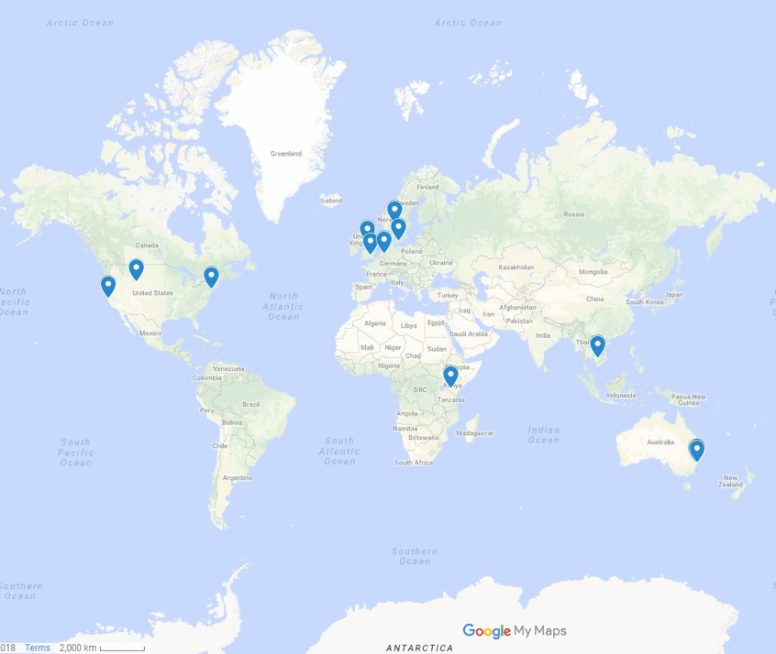
Figure: Where is System Effects being used?
But what exactly is System Effects and how does it work? The methodology draws on soft systems methodology, fuzzy cognitive mapping, and graph theoretical analysis. Its objective is to aggregate and quantify participant-generated system models of a given problem (e.g. poor health or malnutrition) and its determinants to inform intervention design.
The participant-led approach begins by asking research participants to visually map or depict the range of variables they perceive be causes of the problem at hand; drawing arrows between the variables to indicate causality.
Once completed, the researcher creates an adjacency matrix for each participant response, using a coding scheme to ensure consistency in the factors present across the community. The foundation of this method is that individual participant maps represent network diagrams, with the barriers between them acting as ‘nodes’ and the connections between them as ‘edges’ or links.
Continues in source: The complexity of citizen experience: ‘system effects’ mapping for intervention design | The Mandarin – The Mandarin
Slides and Podcasts – Cognitive Edge (Dave Snowden)
As much as possible, Dave Snowden records every speaking engagement and makes it available as a podcast accompanied by slides. They are listed in chronological order for your convenience.
EJOR Special Issue on Community Operational Research
EJOR Special Issue on Community Operational Research: Home
Special Issue of the European Journal of Operational Research

  |
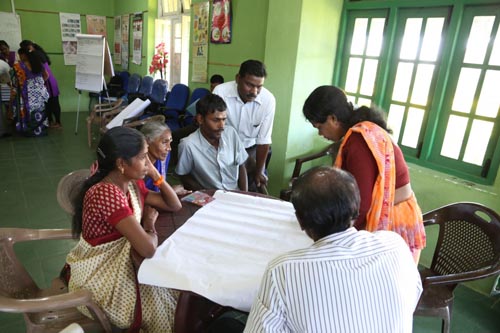  |
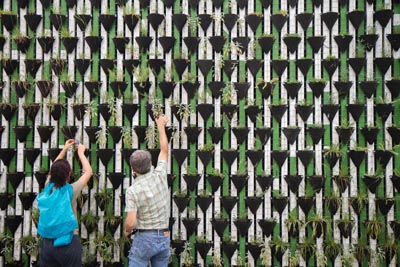
Community Operational Research (COR) is based on meaningful engagement with communities to bring about transformational research and practice along with community empowerment and social change. We work directly with communities to identify, formulate, model and solve problems in which decisions and choices are the core focus. Our training and practice cross disciplinary, application and methodological boundaries: we are planners, engineers, management scholars, policy analysts and many others. The purpose of this website is to introduce you to a special issue of European Journal of Operational Research titled “Community Operational Research: Innovations, Internationalization and Agenda-Setting Applications” which has appeared in August 2018. The 31 papers in this special issue address issues in rural development, theory and methodology, working with youth, urban planning and many other areas. They represent applications of decision modeling that are more familiar to persons with traditional training in operations research and the management sciences, as well as those that reflect progressive notions of how qualitative analysis and a systems view can support positive community change.
Sometimes the perspective of authors in this special issue is on what decisions to make to achieve particular outcomes: How can we design design an energy generation strategy for a small town that balances environmental sustainability, economic sustainability and local energy autonomy? What are new ways to ensure access to nutritious and affordable food in lower-income, primarily immigrant communities that combines behavior changes by residents with new services by stores and government agencies? How can we develop a peace education program in an area rife with political and other violence in which young people learn of alternatives to violence to solve conflicts?
Other times the authors in this special issue seek to examine events that have already occurred to learn how a community-engaged decision modeling perspective can explain what we have observed: If co-production of health care through community engagement and shared responsibility for health care fail in one place after succeeding in another place, could a better understanding of doctors’ professional identities combined with putting key stakeholders at the center of system redesign result in improved outcomes in the future? In the wake of a destructive tsunami and subsequent rebuilding, how can an arts-based methodology help us understand how a community in crisis draws on social networks, cultural practices and collective interventions to build from within?
Continues in source: Home – EJOR Special Issue on Community Operational Research – Research Guides at University of Massachusetts Boston
Action Research: Its Foundations in Open Systems Thinking and Relationship to the Scientific Method | John Barton, John Stephens, Tim Haslett
[A hugely valuable paper unearthed by David Ing]
ORIGINAL PAPER
Action Research: Its Foundations in Open Systems Thinking and Relationship to the Scientific Method
John Barton, John Stephens, Tim Haslett
Published online: 22 August 2009
Springer Science+Business Media, LLC 2009
Abstract
This paper considers those interpretations of action research that can be traced to Kurt Lewin at the Research Center for Group Dynamics at the University of Michigan,and the work in social ecology by Emery and Trist at the Tavistock Institute. It locates the logical basis of these interpretations in the philosophy of pragmatism, particularly as it relates to Peirce’s inferential logic and inquiry system. Drawing on this argument, and on the significant developments in approaches to systemic thinking over the past 40–50 years,a normative set of criteria is established for action research. The paper concludes that both positivist science (which relates to closed systems thinking) and action research (which relates to open systems thinking) are essential to any complete scientific approach.
Keywords
Action research, Open systems, Scientific method, Peirce, Pragmatism, Abduction
Full paper in source (academia.edu something-wall): Action Research: Its Foundations in Open Systems Thinking and Relationship to the Scientific Method | Tim Haslett – Academia.edu
Complexity Live: Systems Change – 10 August 6pm GMT / 1pm Eastern Time

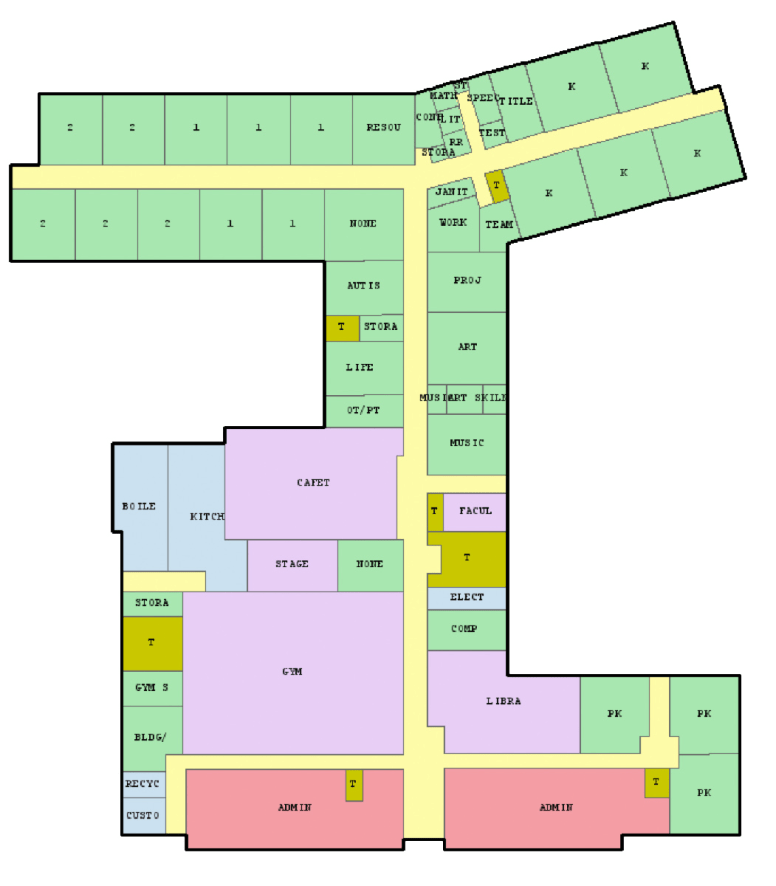
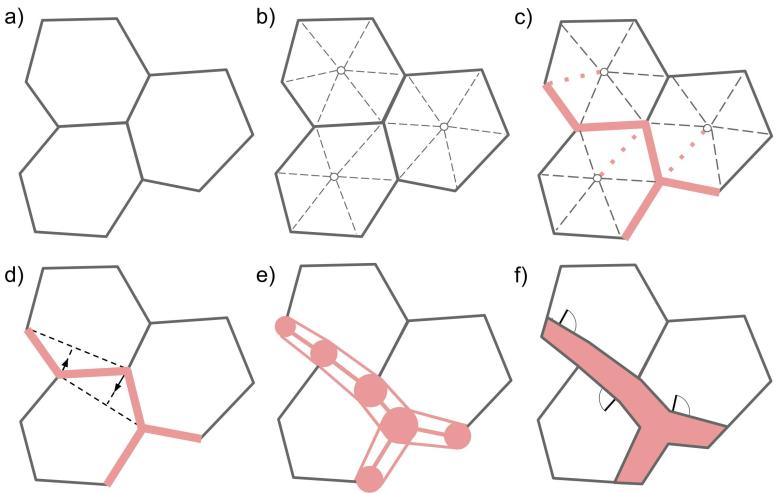
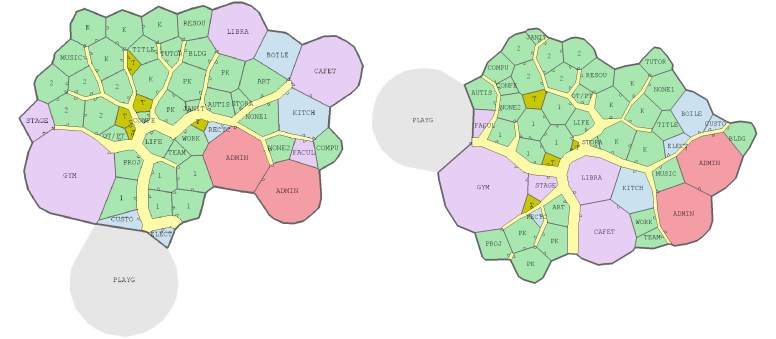
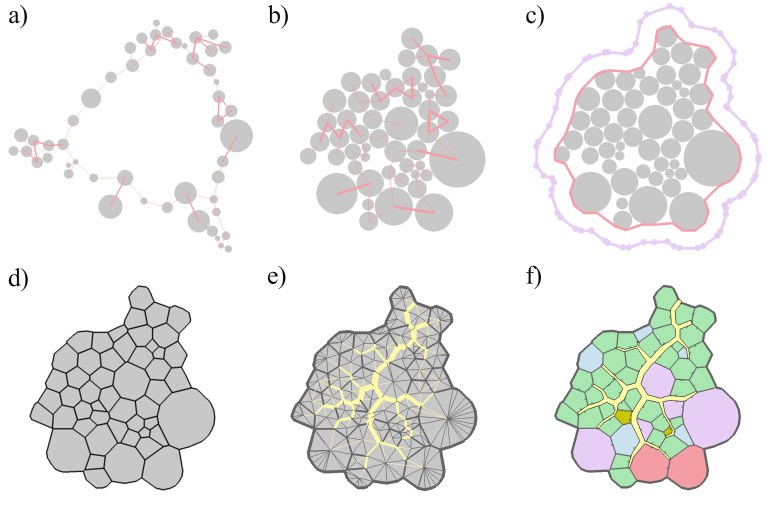
Joel Simon – evolving floorplans
infed.org | Chris Argyris: theories of action, double-loop learning and organizational learning

Chris Argyris: theories of action, double-loop learning and organizational learning. The work of Chris Argyris (1923-2013) has influenced thinking about the relationship of people and organizations, organizational learning and action research. Here we examine some key aspects of his thinking.
contents: introduction · life · theories of action: theory in use and espoused theory · single-loop and double-loop learning · model I and model II · organizational learning · conclusion · further reading and references · links · cite
Chris Argyris has made a significant contribution to the development of our appreciation of organizational learning, and, almost in passing, deepened our understanding of experiential learning. On this page we examine the significance of the models he developed with Donald Schön of single-loop and double-loop learning, and how these translate into contrasting models of organizational learning systems.
Continues in source: infed.org | Chris Argyris: theories of action, double-loop learning and organizational learning
General complexity: A philosophical and critical perspective

In this paper we argue that a rigorous understanding of the nature and implications of complexityreveals that the underlying assumptions that inform our understanding of complex phenomena are deeply related to general philosophical issues. We draw on a very specific philosophical interpretation of complexity, as informed by the work of Paul Cilliers and Edgar Morin. This interpretation of complexity, we argue, resonates with specific themes in post-structural philosophy in general, and deconstruction in particular. We argue that post-structural terms such as différance carry critical insights into furthering our understanding of complexity. The defining feature that distinguishes the account of complexity offered here to other contemporary theories of complexity is the notion of critique. The critical imperative that can be located in a philosophical interpretation of complexity exposes the limitations of totalising theories and subsequently calls for examining the normativity inherent in the knowledge claims that we make. The conjunction of…
View original post 60 more words
UK Cybernetics Society 50th anniversary conference – 22 September
|
50th Anniversary Conference |
The Conference will be held on Saturday 22nd September 2018
The Council Room, King’s College, 152-170 Strand, London WC2R 1ES
|
See more including speaker profiles and abstracts in source: The Cybernetics Society
Considering Appropriate spatial-temporal Scale — bigger and faster isn’t always better! Daniel Christian Wahl
Considering Appropriate spatial-temporal Scale — bigger and faster isn’t always better!
An excerpt from ‘Exploring Participation’ (D.C.Wahl, 2002)
In their book Ecological Design, Sim Van der Ryn and Stuart Cowan introduce the concept of ‘scale-linking’. They argue that since we traditionally have studied the world using the language, metaphors and tools of a single discipline at a time, we have been predisposed to “seeing process on a single scale”.
Van der Ryn and Cowan believe that this approach is insufficient in capturing the underlying phenomena, since:
“Nature’s processes are inherently scale linking, for they inherently depend on the flow of energy and materials across scales. … Global cycles link organisms together in a highly effective recycling system crossing about seventeen tenfold jumps in scale, from the ten-billionth of a meter (the scale of photosynthesis) to ten thousand kilometres (the scale of the Earth itself).”139
In their opinion:
“Scale-linking systems imply a holism in which everything influences, or potentially influences everything else — because everything is in some sense constantly interacting with everything else. Nature is infused with the dynamical interpenetration of the vast and minute, an endless dervish mixing. Matter and energy continually flow across scales, the small informing the large and the large informing the small …
Unless we work with nature’s own finely tuned scale-linking systems we endanger the stability of life on the planet… If we are to properly include ecological concerns within design, we must take seriously the challenge offered by scale linking. We need to discover ways to integrate our design processes across multiple levels of scale and make these processes compatible with natural cycles of water, energy, and material.”140
— Van der Ryn & Cowan
Van der Ryn and Cowan argue that fractal geometry provides a tool to study the geometry of scale linking, as it helps to connect remarkable ranges of scale “from twig to tree, from rivulet to watershed.”141 They see our failure not to pay attention to scale-linking and therefore not to match the human flows of energy and materials to the limits of a particular landscape as a critical cause of the current environmental crisis. [Note: This is an excerpt from my 2002masters dissertation in Holistic Science at Schumacher College. Be mindful that I wrote this 15 years ago and enjoy!]

Continutes in source: Considering Appropriate spatial-temporal Scale — bigger and faster isn’t always better!
Systems thinking open access articles from MDPI
See below for a rich list of articles. I note from a quick google that MDPI is a not entirely uncontroversial publisher (https://en.wikipedia.org/wiki/MDPI seems balanced) – broadly it seems that they are not on ‘predatory journals’ lists but their academic quality has sometimes been called into question. However, some interesting titles here and you can judge for yourself.




You must be logged in to post a comment.