
https://norabateson.wordpress.com/2021/11/04/aphanipoiesis/
Category Archives: Discussion
A view or perspective on the world
The Systemic Concept of Contextual Truth

Andrzej Bielecki
Foundations of Science volume26,pages807–824 (2021)
In this paper the truth is studied in the frame of autonomous systems theory. The method of the truth verification is worked out in its functional aspect. The verification is based on comparison of the predicted inner state of the autonomous agent, that is the cognitive subject, to the achieved inner state of the agent. The state is achieved as the result of performing the action in the real world—the agent’s environment. The action design is created on the basis of the agent’s model of the world. The truth is defined as the adequacy of the model of the real world in the context of the goal that is assumed to be reached as the effect of the performed action. The concepts of the cognitive subject, the truth bearings and the knowledge are redefined. The classical problems of aletheiology and epistemology are discussed…
View original post 46 more words
New documentary captures power of complexity to safeguard humanity’s future | Santa Fe Institute
New documentary captures power of complexity to safeguard humanity’s future | Santa Fe Institute
New documentary captures power of complexity to safeguard humanity’s future
OCTOBER 28, 2021
Will the 21st century be humanity’s greatest, or our worst? According to the award-winning new documentary “Solutions,” which was filmed on-location at the Santa Fe Institute, the answer depends on the decisions we make in the next couple of decades, and on our ability to work across disciplines and continents to find revolutionary solutions.
Making its U.S. debut at this year’s United Nations Association Film Festival (UNAFF) in Palo Alto, CA on October 31, “Solutions” captures a gathering of some of the world’s leading thinkers at SFI. Over 10 days, 20 visionary scientists and innovators examined the growing gap between physical technologies like automation and AI, and social institutions like governments and healthcare systems. Warning that “When society is detached from reality, bad things happen,” the film serves as an urgent call to action.
New documentary captures power of complexity to safeguard humanity’s future
New documentary captures power of complexity to safeguard humanity’s future | Santa Fe Institute
Jobs: Applied Complexity Fellowship in Scaling Theory for Social Systems | Santa Fe Institute
https://www.santafe.edu/about/jobs/Applied-Complexity-Fellowship-in-Scaling-Theory-fo
Winter Workshop on Complex Systems 2022, Jan 24-28, ‘in the East of France’
Winter Workshop on Complex Systems 2022 The Winter Workshop on Complex Systems is a one-week workshop where young researchers from all over the world gather together for discussing complex systems. The primary focus of the workshop is for participants to engage into novel research projects. This is the 7th edition of the WWCS and it will be held in East of France from January 24th to January 28th 2022. Previously it was held in Brussels, Madrid, Petnica, Utrecht, Zakopane, and Charmey.
Winter Workshop on Complex Systems 2022
Combining Historical and Philosophical Approaches to Understand the Concept of Information in Animal Behaviour Research – YouTube
Combining Historical and Philosophical Approaches to Understand the Concept of Information in Animal
Combining Historical and Philosophical Approaches to Understand the Concept of Information in Animal – YouTube
Santa Fe Institute
Talk by Kelle Dhein, University of Kentucky.
Abstract: Biologists regularly apply the concept of information in their work (e.g. echolocation gives bats information about their surroundings, DNA carries information about how to build an organism), and while their usage makes intuitive sense in context, it is difficult to articulate precisely what they mean when they invoke information. Some argue that Shannon’s technical, mathematically defined notion of information is the proper starting point for understanding informational content in biology. Others have sought to define content-presupposing concepts like information in terms of the historical selection processes that drive evolution. However, it is unclear whether these approaches have produced definitions that capture the way successful researchers in the behavioral sciences use content presupposing concepts like information. In this talk, I emphasize the importance of attending to scientists’ investigative practices and historical context when confronting problems about what scientists mean when they invoke the concept of information. First, I examine a successful, longstanding experimental tradition whose practitioners have consistently ascribed informational content to the neurosensory mechanisms of insects. By analyzing the way scientists design and interpret experiments to justify claims about information, I clarify the norms guiding scientists’ ascriptions of content to produce a pragmatic definition of information. I argue that the norms guiding scientists’ ascriptions of content bear some resemblance to formal information theory, that they rely upon a cybernetic notion of biological function, and that they have practical value for scientists. Second, I adjudicate the cognitive map debate in animal navigation studies. Mammalian navigation researchers have long held the cognitive map hypothesis to be an established fact. However, the cognitive map hypothesis has engendered an ongoing, decades-long debate among insect navigation researchers, especially those referenced in the last paragraph. By attending to the personal histories of the scientists leading the debate and the broader history of animal behavior research, I show how older debates about instinct vs. learning that were supposedly neutralized in the 20th century continue to motivate this debate over how insects process information. Finally, I ask a question that encompasses both problems addressed so far: What ever happened to cybernetics? In the late 1940s, the information age was most clearly heralded by the newly mobilized science of cybernetics, which promised to synthesize human, animal, and machine behavior using recently formalized notions of information, feedback, and control. As the 21st century drew nearer, most academics came to regard cybernetics as a dead movement. Nevertheless, some behavioral scientists continue to see revolutionary potential in the concept of information for synthesizing understandings of behavior, and although researchers continue to grapple with the problem of comparing animal and machine behavior, biologically-inspired advances in artificial intelligence seem to be realizing the cyberneticians’ prophesy. For example, the insect navigation research referenced in the last two paragraphs has been used to design autonomous robots. I conclude by arguing that current attempts to use information to compare human, animal, and machine behavior would benefit from historical and pragmatic contextualizations that reveal how such projects relate to their fore-bearers from the dawn of the information age. Learn more at https://santafe.edu Follow us on social media: https://twitter.com/sfisciencehttps://instagram.com/sfisciencehttps://facebook.com/santafeinstitutehttps://facebook.com/groups/santafein…https://linkedin.com/company/santafei… Subscribe to SFI’s official podcasts: https://complexity.simplecast.comhttps://aliencrashsite.org
The Power to Shift a System – 18 November 2021, 2pm GMT – the Rockwool Foundation
The Power to Shift a System Webinar: November 18th Join us for the first in this free webinar series on November 18th Time: 15:00-16:15 CET / 14:00-15:15 GMT / 9-10:15 EST
Invitation: The Power to Shift a System – 18 November – benjamin.taylor@redquadrant.com – RedQuadrant Mail
email:
 |
| The Power to Shift a System Webinar: November 18th |
Join us for the first in this free webinar series on November 18th Time: 15:00-16:15 CET / 14:00-15:15 GMT / 9-10:15 EST Charles Leadbeater and Jennie Winhall, from the Systems Innovation Initiative at the ROCKWOOL Foundation, outline a new framework to understand how people gain the power to reshape systems, in conversation with:Jeff Cyr, Raven Indigenous Capital Kenneth Bailey, The Design Studio for Social Intervention Afton Halloran, Sustainable Food Systems Transitions Register hereAs systems change becomes more urgent, so does the question of who has the power to shift systems. Does it lie with powerful insiders and institutions, or activists and social movements? Where does the power to initiate change come from and how can hard and soft power be harnessed together to shift a system? In this webinar we will share a new practical framework to help systems innovators identify in practice where power lies in a system, how it can be redirected and where the opportunities are to mobilise power in new forms to meet a new system purpose. The framework is set out in a new essay The Power to Shift Systems. Sign up to the webinar to receive an advance copy by email ahead of the event. Our paper Building Better Systems introduced four keys to unlock system innovation: purpose, power, relationships and resource flows. Through this webinar series over the next few months we will be sharing new frameworks to put these keys to work, and delving deeper into the issues involved with a host of inspiring systems innovation practitioners. When registering for this first event on power you can sign up to receive alerts for the subsequent events on purpose, relationships, resource flows and more. We hope you will join us in what will be the first of many interesting talks and discussions. Can’t make it? Subscribe to our mailing list here for future events and early access to new material. Best wishes, The ROCKWOOL Foundation |
New book from Chris Mowles: Complexity: a key idea for business and society
LinkedIn update:
Feed | LinkedIn
Published at the end of the month: Complexity – a key idea for business and society.
This book interprets insights from the complexity sciences
to explore seven types of complexity better to understand
the predictable unpredictability of social life. Drawing on
the natural and social sciences, it describes how complexity
models are helpful, but insufficient for our understanding
of complex reality. The book will be of interest to
researchers, professionals, academics and students in the
fields of business and management, especially those
interested in how taking the radical insights from complexity seriously can influence the functioning of businesses and organisations and how they manage and lead.
Systemic wisdom for and beyond systems change – A critical systems perspective convening not only indigenous traditions of wisdom – EUSG
source
Systemic wisdom for and beyond systems change – A critical systems perspective convening not only indigenous traditions of wisdom – EUSG
European School of Governance, position paper #108 (29.10.21) by Louis Klein
Embracing indigenous wisdom traditions promises to successfully meet the challenges of the Anthropocene in the 21st century. They seem to bring what is needed to overcome the limits of the project managerial activism associated with systems change. However, wisdom is an embodied understanding of our human potential and our humanity that grows from deeply reflected human experience. We find this in wisdom practices and traditions all over the world, like the in Southern African Ubuntu, the ancient Chinese Tianxia or the contemporary Moroccan Tamkeen. A critical systems perspective allows for exploring the universality of their understanding of the interconnectedness and interdependence of the flow of the world. And it facilitates convening the different wisdom practices and traditions, growing in their in-between a global dialogue trusting our human potential and our humanity realising the existentiality of love. Isn’t this already the systems change we want to see in the world?
Continues in source: European School of Governance, position paper #108 (29.10.21) by Louis Klein
Systemic wisdom for and beyond systems change – A critical systems perspective convening not only indigenous traditions of wisdom – EUSG
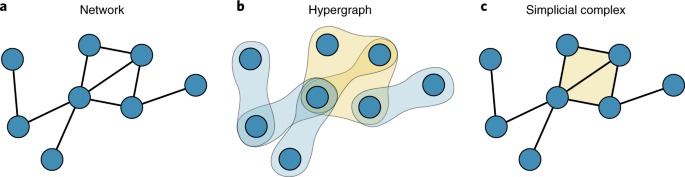
The physics of higher-order interactions in complex systems
Federico Battiston, Enrico Amico, Alain Barrat, Ginestra Bianconi, Guilherme Ferraz de Arruda, Benedetta Franceschiello, Iacopo Iacopini, Sonia Kéfi, Vito Latora, Yamir Moreno, Micah M. Murray, Tiago P. Peixoto, Francesco Vaccarino & Giovanni Petri
Nature Physics volume17,pages1093–1098 (2021)
Complex networks have become the main paradigm for modelling the dynamics of interacting systems. However, networks are intrinsically limited to describing pairwise interactions, whereas real-world systems are often characterized by higher-order interactions involving groups of three or more units. Higher-order structures, such as hypergraphs and simplicial complexes, are therefore a better tool to map the real organization of many social, biological and man-made systems. Here, we highlight recent evidence of collective behaviours induced by higher-order interactions, and we outline three key challenges for the physics of higher-order systems.
Read the full article at: www.nature.com
SYSTAC Global Meeting, 2-9 November 2021 – Systems Thinking for Strengthening Health Systems
SYSTAC Global Meeting 2 – 9 November 2021 The popularity of the Alliance flagship report Systems Thinking for Strengthening Health Systems, has endured for more than a decade. In a new global climate of manifold uncertainties, ambiguities and adaptations, systems thinking has never been needed more. In LMICs especially, and in policymaking and practice in particular, systems thinking still remains underused as an approach to strengthen health systems.
SYSTAC Global Meeting
Systems Approaches for Accelerating the SDGs and Building Back Better – November 17, 2021, 2-6pm GMT
| Wed, Nov 17, 2021 2:00 PM – 6:00 PM GMT |
Systems Approaches for Accelerating the SDGs and Building Back Better Wed, Nov 17, 2021 2:00 PM – 6:00 PM GMT
Registration

Systems Approaches for Accelerating the SDGs and Building Back Better
| Wed, Nov 17, 2021 2:00 PM – 6:00 PM GMT |
SDGs address some of the most fundamental issues that are at stake for systems transformation in the frame of tackling the global challenges of our times. These issues require action-oriented systemic interventions but, however, SDGs are not systemic by design. As we approach the mid-term of the implementation of the United Nations Agenda 2030, we would like to pause and reflect while asking this question: “How can systems approaches help accelerate the achievement of the SDG in the post pandemic context for building back better?” The purpose of this event is, therefore, to discuss the challenges and explore potential pathways for transformation to embed systems approaches into the (re)design, implementation and evaluation of SDG, so as to accelerate progress in the achievement of the United Nations Agenda 2030. This online event is jointly organized by a group of academic partners: EADA Business School, University of Hull’s Centre for Systems Studies, Presencing Institute, Blue Marble Evaluation and Ethos of Management Consulting with the support of the United Nations Development Coordination Office.
Hybrid Webinar: Engineering for climate stability | 4 November 2021, 2-4pm UK time (Glasgow or online)
A COP fringe event
Hybrid Webinar: Engineering for climate stability | Glasgow
Hybrid Webinar: Engineering for climate stability
Quaker Meeting House, Glasgow
04 November 2021
Overview
This trio of talks will demonstrate that sustainable engineering requires an integrated cross-sectoral approach to be most effective, and also that technology is only part of a wider solution to the environmental problems that we face. Join for an afternoon of lectures exploring what engineering for climate stability truly means.
The event will comprise the following three talks on sustainable engineering with the opportunity for questions and discussion.
Join us either in person in Glasgow or via the online link to hear and benefit from these presentations!
more and book at source: Hybrid Webinar: Engineering for climate stability
Hybrid Webinar: Engineering for climate stability | Glasgow
Key Theories of Humberto Maturana – Literary Theory and Criticism – Mambrol (2018)
Key Theories of Humberto Maturana BY NASRULLAH MAMBROL on FEBRUARY 24, 2018
Key Theories of Humberto Maturana – Literary Theory and Criticism
Cybernetics, planning and situated action – JellevanDijk.org
Cybernetics, planning and situated action
No way to respond on the blog that I can see, so I’ll (BT) just add here:
I don’t think the first objection to ‘planning’ has real merit as presented here:
- the word ‘plan’ or ‘planning’ is mentioned a grand total of three times in the Espejo and Gill piece which is the primary link in the referenced Anarchist Cybernetics piece
- the difference between embodied, reflexive/habitual/entrained action and intentional action is precisely what is embodied in the VSM, and presumably something like what Allenna Leonard refers to in “the control of a skier going down a hill”. Automatic actions take place at one level, conscious management of emergent results takes place at another – just as the piece argues (‘against’ cybernetics)
The second point, on embodiment and materiality, is certainly something worth considering across the whole cybernetics | systems | complexity field (it seems to me to be precisely the objection that Prof Mike Jackson raised to much that goes in the name of ‘complexity’: ‘if you abstract everything that is human and contextual out of human, contextual action, of course you have something comparable over scales’ – my paraphrased recollection). But my understanding of cybernetics is *precisely* that it is situated and contextual, so I’m just going to puzzle over that one some more.
 Systems Community of Inquiry
You must be logged in to post a comment.