
link: https://www.youtube.com/watch?v=H0WMwPEOqJY
Category Archives: Discussion
A view or perspective on the world
100 Years of Stafford Beer: Organisational Cybernetics – a legacy whose time has come – Eds Espinosa, Schwaninger, Perez-Rios (2026)
A collection of essays, reflections, and tributes from scholars, practitioners, and friends who gathered to celebrate the centenary of Stafford Beer — pioneer of management cybernetics, architect of the Viable System Model, and originator of Team Syntegrity. Free to read, free to share.
Edited by Angela Espinosa · Markus Schwaninger · José Pérez-Ríos
Peter Block: relationships, resistance and the relevance of ‘Flawless Consulting’
Celebrating 100 Years of Stafford Beer: playing the POSIWID cards
The Second Law of Technodynamics – Velitchkov (2026)
#SysPrac26 – Day 1 – Doug Belshaw
https://substrate.dougbelshaw.com/sysprac26-day-1
Lots of coverage of #SysPrac26, which sadly I missed – it sounds brilliant!
See
(I’m offering two online workshops free instead
https://stream.syscoi.com/2026/09/21/my-apologies-for-sysprac26-and-two-online-workshops/ )
Machines of Loving Grace

Objects, Models, Theories • 4
Re: Objects, Models, Theories • (1) • (2) • (3)
What are objects, models, theories, and how do they relate to one another?
Recurring questions about the relationship between objects, models, and theories take on a different aspect when viewed from the perspective of Peirce’s pragmatic semiotic, in other words, when cast within a framework of triadic sign relations.
In contemplating the array of questions which come to mind I always find it helpful to ruminate on the diagram shown below — I might even call it a mandala for its wealth of symbolic features and its aid in organizing the pro‑&‑con‑fusion of mental impressions.
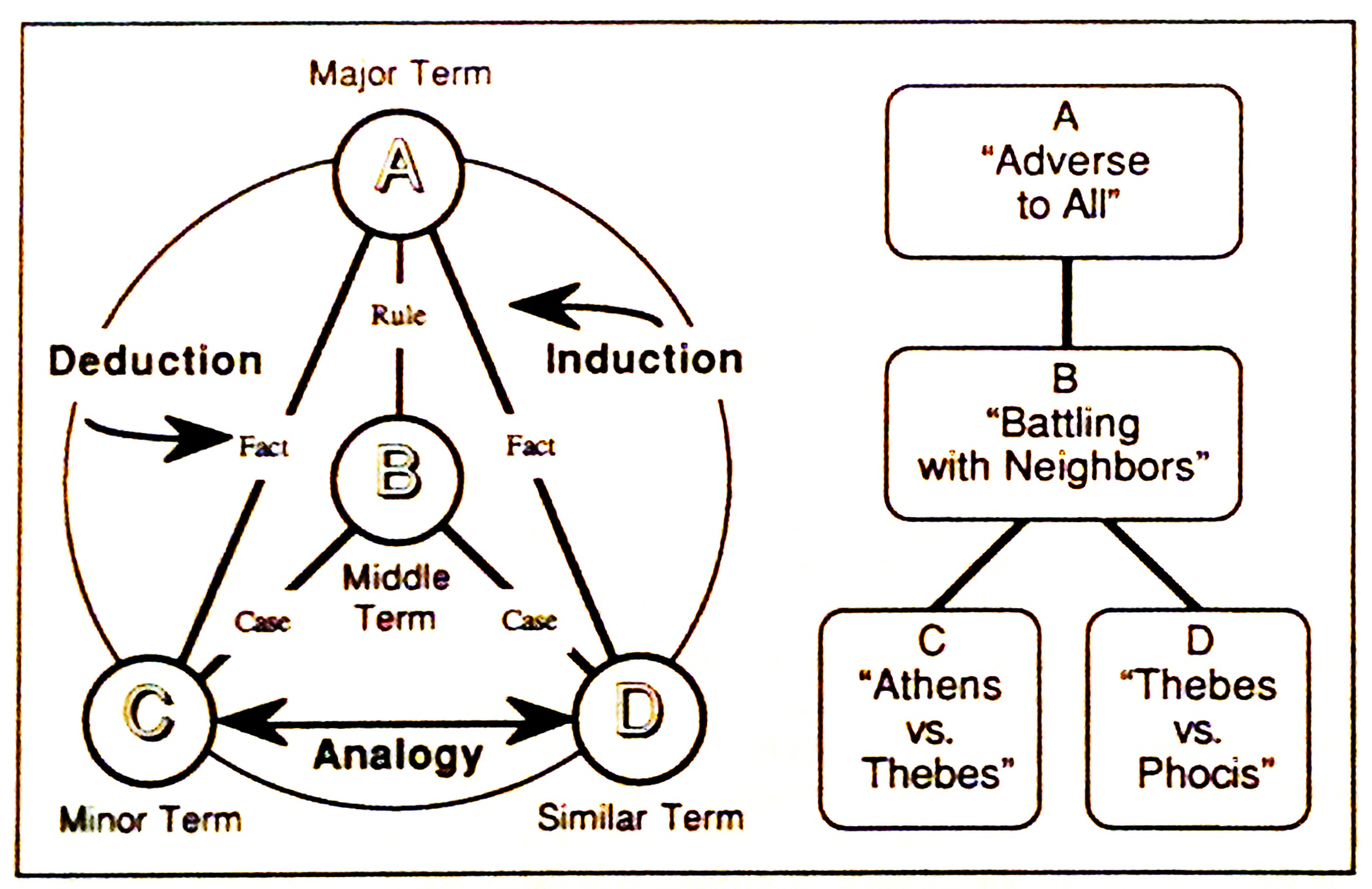
Aristotle’s “Paradigm”
Here is the corresponding text from Aristotle and the context that leads on to Peirce’s viewpoint.
Resources
cc: Academia.edu • Cybernetics • Laws of Form • Mathstodon
cc: Research Gate • Structural Modeling • Systems Science • Syscoi
Systems Thinking?
Systems Practice: Patrick Hoverstadt
https://www.linkedin.com/posts/lukecraven_it-turns-out-systems-change-people-love-a-share-7508018582304337920-5rLM/
The fly-bottle is where the work happens: systems | cybernetics | complexity, and changing the world from inside the world
I offered ‘a more useful fly-bottle – systems | cybernetics | complexity in six diagrams’, subtitled in the image as ‘How I think about, and work with, systems | complexity | cybernetics’, in the spirit of ‘a’ history of rock and roll, not intending to be definitive or (heaven help us) authoritative, and as a long-overdue response to a provocation from an over-simplifier of systems thinking who has ‘six diagrams’ in a similar way.
A more useful fly-bottle – systems | cybernetics | complexity in six diagrams
This covers contextual meaning-making, different ‘worlds’ and how they typically engage in organisation, a core definition of ‘work’, a particular approach to ‘triple loop learning’, four dynamics that need to be in dynamic relationship for a system to actively and constructively engage in the world and with other, five core practices to support organisational effectiveness through a developmental lens, viability under complexity, and a simple note on moving from insight to ongoing practice (plus various quotes I like that seem to sum important things up).
To undertake such a hubristic exercise is always:
- to oversimplify (in my experience): ‘five worlds’ are heuristic, simplified, ‘ideal types’, not the reality of sensemaking worlds. The ‘five core practices’ are bundles of inter-related, contextually dependent things. What constitutes the four dynamics… depends.
- personal: mine is about how people purposefully act together; I’m an OD kind of person at the end of the day.
- mine is inherently – and intentionally – contradictory at it’s heart: there’s no escape from the fly bottle, only another fly bottle.
And, if power defines truth, and legibility kills what it can’t read, a shadow lurks.
I was at least clear that these are helpful core concepts for me, not a complete meta-language or a basis for a position outside the situation.
However, it’s always a risk when you share something partial but in an overview sense that it can easily be seen as ‘the whole thing’.
__
Self-critique
Then, looking at it, I though I ought to emphasise the necessity of problematising these things – every view is partial, contextual (particularly in terms of ‘what you work on’), dependent on personal history and proclivities, and so on.
So I produced a critique: https://stream.syscoi.com/2026/09/11/a-critique-of-taylors-a-more-useful-fly-bottle-systems-cybernetics-complexity-in-six-diagrams-also-taylor-2026/
Here, I emphasised that:
- I am talking about purposeful collective engagement with context: organisation – yet of course all of that is power-laden and complex.
- ‘seeing differently’ isn’t sufficient if changes for the better don’t follow – ‘the fallacy of insight’, we might say. My response is that I offer practices that create possibilities, not guarantee results.
- while I talk about ‘shard understanding’, most of the time such common purpose is absent and not even necessary. Yet the dynamics of different perspectives and worlds and their natural schismogenesis do destroy our best efforts at partnership and deserve attention.
- we always have to test against the real world, real material constraints, and treat what in our context with our purposes and understandings etc ends up being complex different from what we find to be ordered.
- all the challenges of critical systems still apply, even if my methods give us some way to engage with them.
- viability is not the same as legitimacy, and while nothing survives without viability, it is not necessarily even a goal.
- engagement with human dynamics has no fixed recipe or solution, and my methods are about ways of discerning what interventions might make a difference.
- Introducing positive practices and learning opportunities should not overrule personal agency, autonomy, choice, self-presentation and necessary self-protection; we should not become bullies in the name of progress.
- ‘orchestration’ as a leadership or facilitation stance might not fit every context and also needs to be critically examined – and similarly, preferences for ‘effective coordination’, ‘shared progress against purpose’ etc are just that – preferences – no moral obligations.
- I am bringing together different traditions and inquiries with connections that make sense to me and seem useful in my work, but that could mean doing damage
And that my approach brings together very different things – pattern investigation, repertoires of organisational practice, a preference for human agency and collaboration, and so on…
__
Critique from the other
That self-critique drew a response from Dave Snowden, who was mentioned as one of my imaginary critical interlocutors. His ‘Matching repertoires’ (in the title, ‘an inhibiting constraint’) https://thecynefin.co/an-inhibiting-constraint/ argues that my six diagrams mislabel cybernetics as complexity.
It’s a very polite response and at the heart is that point, that I suspect we are never going to agree on, though we keep circling it. It also assumes the superior perspective of understanding, which I suspose is a hazard of the job – and one I may even fall into here. And the difference – as so often in these things, I think – is a difference of style and proclivities as much as it is of substance.
What’s most valuable is that we are both continuing to engage because there is, ultimately, something there to work on – on both sides.
Dave says ‘Ben’s own self-critique circles this same problem three times without ever settling on what it actually is!’ – my self-reflective concern (and three times without finalising it cheers me up enormously – I responded, I think, appropriately) is that this work – like the work I describe in the diagrams – depends on context, purpose, constraints. Dave’s analysis is different: “the six diagrams are not aware of or use complexity science. They are systems cybernetics, in the specific lineage of Ashby’s law of requisite variety and Beer’s Viable System Model, and that lineage was never built before modern advanced in complexity, and the cognitive sciences..” – he then goes on to describe Ashby’s law and management cybernetics as control theory and ‘not a theory of emergence’.
His argument depends on treating cybernetics as fixed responses to known disturbances, serving unchanged goals. I believe that the sources don’t support that reading, and specifically that that is front of mind in terms of my presentation of these ideas – and my work (and, as an aside, if you think control theory doesn’t address emergence, well, there’s a very nice introductory podcast I just came across – InControl).
Ashby’s law shows us the ‘natural’ limits on regulation. It doesn’t require advance knowledge of every disturbance or an unchanging repertoire. His wider work and management cybernetics more widely addresses adaptation and self-organisation. Developing the ability to respond is not the same as specifying each response beforehand.
Beer explicitly treats an organisation capable only of reacting as pathological. The viable system model includes autonomy and adaptation. Viability doesn’t require preserving today’s arrangements; nor does it settle whether an organisation deserves to survive. And Dave acknowledges that in his own reflective postscript.
On learning, Argyris’s double loop already questions governing policies and goals. He even used a thermostat to explain it. Disputed ‘triple-loop’ terminology doesn’t establish that changing purposes lies outside cybernetics. And second-order cybernetics includes the observer doing the framing. Reframing isn’t foreign territory. Indeed, I was careful to specify that ‘task’, ‘framing’, ‘identity’ are my working ‘triple loops’ (probably more after Bill Torbert than Argyris, or Bateson, but I think informed by both). It’s true that most of the time, in the contexts I work in, a change of identity is emergent from a change in practice and then framing – in VSM terms the E-S1 structural coupling changes the organisation. But that too is a form of emergent, and is real learning and real change.
Dave’s enabling/inhibiting distinction needs a context. A rule protecting a team’s experimental time inhibits its manager from commandeering it while enabling the team to try things. Enabling what, for whom, at which level? You can’t settle that by assigning whole intellectual traditions to opposite sides.
My four dynamics concern developing capabilities and changing relationships, including making room for dissent – and are explicitly driven from ‘encounter with the other’ in Oshry’s work. They don’t prescribe every possible future behaviour. The five worlds and boundary critique are integral to this account, not exceptions to detach so the remainder can be classified as control. (chosen path)
Nor does emergence universally mean ‘not previously possible’: Bedau’s weak emergence is a counterexample. The cognitive-science objection still needs a finding attached to a particular claim.
Safe-to-fail probes require people able to notice consequences and change course. Protecting their resources and discretion doesn’t predetermine what they discover. These are already concerns of my practice; they don’t become incompatible with emergence because I draw on cybernetics.
My self-critique examines what the diagrams claim and what they leave out. It doesn’t establish Dave’s diagnosis. Questions about completeness, the meaning of ‘balance’, and whose survival matters aren’t resolved by claiming there’s a hard dividing line between cybernetics with complexity science, especially across the entire field of practice.
__
Of flies and fly-bottles
I do think it’s true that there’s an inherent tendency going on, which Dave is pointing to – those who prefer to start with ‘what creates the stability I see all around me?’, and those who prefer to start with ‘what’s the reason for all this change?’. And that – where Dave is digging – there’s fruitful difference arising from that (I certainly see that that *is* one of the useful real divides in the systems | complexity | cybernetics field. And that both sides usually recognise, rightfully, that both sides are needed.
What I’m after is the ground (or groundlessness) on which both starting points rest – I currently find it in David Chapman’s Buddhist-originated ‘the world is infinite pattern and unending nebulosity’ (which I think Wittgenstein would have liked).
Describing how to work with emergence is a different task from explaining how it arises. In public services, my work includes asking whether the service itself is the problem, whose purposes we’re serving, and what people could do without us.
And my real grounding – touching grass – is working with real people in hierarchical, ‘legacy’ institutions under massive pressure, dealing with complexity and change, impacting people’s live and possibilities massively, and trying to help them to find new ways to shape the space they are in productively.
I haven’t put the existing bottle beyond question; the way out is to be able to find more and more fitting fly-bottles (and know that we have to keep changing and adapting) – because finding homeostatically-governed space within a world of infinite change and possibility is the only thing flies can do.
The consultant is in the system: a practice lab for helping without taking over – Benjamin P Taylor, Wednesday 30 September 2026, 12:15-13:45, online, free
Systems practitioners are trained to look at systems. We spend rather less time looking at what happens the moment we offer to help one.
The consultant is not outside the system. Every question, diagnosis, suggestion, contract changes the situation. And when things become difficult, helpers are easily pulled towards two familiar positions: become the expert who takes responsibility for solving the problem, or the servant who takes responsibility for doing what the client asks.
This highly interactive practice workshop explores another possibility. Working with live situations, we will practise inquiry, contracting, reframing, authenticity, working with resistance and keeping responsibility where it belongs. We will look for the client behind the client, the problem behind the problem, and the wider systemic patterns being reproduced in the consulting relationship itself.
Come prepared to practise rather than merely discuss consulting.
Book at
https://antlerboy.com/sysprac26/
The system is inside the practice: making relational, place-based public services ordinary – Benjamin P Taylor, Thursday 8 October 2026, 12:30-14:00, online, free
Many public service reforms produce good work in a protected bubble and then fail to become ordinary. A relational team learns to respond to people’s lives, while budgets, measures, professional boundaries, assurance, and decision rights continue to organise around institutions. The better the local workaround becomes, the easier it can be for the wider system to remain unchanged.
This 90-minute practice lab is about that second task: changing the conditions around the work while doing the work.
Using a short public-service case and participants’ own live situations, we will trace what happens as a person’s account of their life, strengths, and needs becomes an assessment, pathway, record, measure, and management decision. We will examine what each translation makes visible, what it loses, where authority sits, who carries the work of joining things up, and where learning stops.
Participants will then distinguish two linked interventions:
1 what must change in the live service situation, and
2 what must change in governance, money, roles, risk, evidence, or authority for the new practice to endure.
Each participant will redesign one practical learning-and-assurance loop between citizen, edge and centre, and formulate a small institutional experiment they can take back to work.
The final move is reflective: how are our own methods, contracts, categories and roles as systems practitioners part of the situation we are trying to change?
This is systems practice applied to the conditions of change itself.
Book here
https://antlerboy.com/sysprac26/


You must be logged in to post a comment.