
Nature Communications volume 14, Article number: 3685 (2023) Cite this article
paper: https://www.nature.com/articles/s41467-023-39107-y
Our new paper with Masanao Igarashi and
about the nonequilibrium thermodynamics of large, disordered networks (the asymmetric SK model) was just published in Nature Communications 😀 https://nature.com/articles/s41467-023-39107-y… Thread about the main ideas of the paper 
·
10.6K Views
40
Bookmarks

Tweet your reply!
Reply

·
Replying to
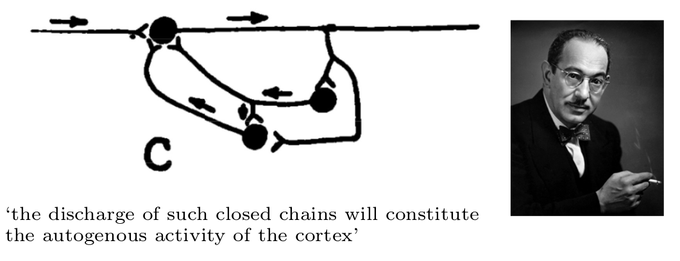
Brain circuits are generally asymmetrically connected, displaying reentrant connectivity and generating self-exciting activity. Perhaps one of the first to study it was Cajal’s student and cybernetic pioneer Lorente de Nó
1
2
·
Replying to
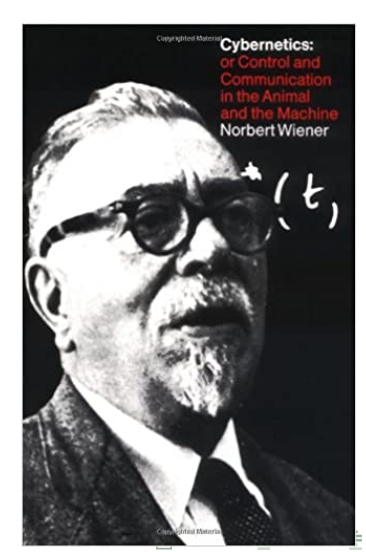
Lorente de Nó participated in the first Cybernetics meetings hosted by Norbert Wiener, who in the first chapter of his seminar book realizes that such asymmetric structures must be governed by the physics of nonequilibrium, irreversible processes
1
1
·
Replying to
A classic example of an irreversible process is a cup breaking. A movie of a cup breaking feels perfectly natural, but watching the same movie backward is strongly unintuitive. This is because of the emergence of an arrow of time of the entropy dissipated by the cup shattering

1
1
·
Replying to
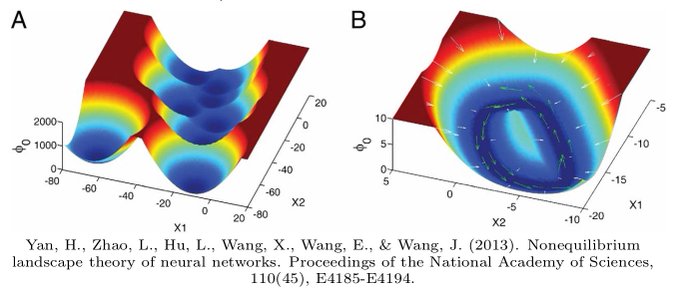
Neural and other networks can display a similar process. Networks in equilibrium (A) have attractors that organize the activity of the network, but behaviour is reversible. Networks out of equilibrium (B) can display interesting irreversible phenomena, like oscillations and chaos
1
2
·
Replying to
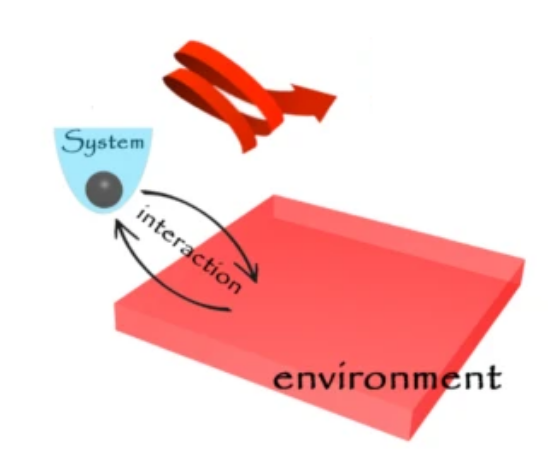
Thermodynamically, out-of-equilibrium dynamics must dissipate entropy to the environment to sustain such irreversible activity. Thus, entropy production is a measure of the emergence of such dynamical dissipative structures
1
1

 Newsletter giugno 2023/02
 Questa comunità è un vero e proprio ecosistema che si ispira ai valori del

 As a computational sociologist, Program Director Tamara van der Does studies how individual beliefs and identities are influenced by social and cultural contexts. She is driven by a desire to investigate fundamental theoretical questions using innovative empirical approaches. Through her work at the Santa Fe Institute, she explored how models from physics, economics, and computer science can help us understand the interplay between individual beliefs, group identities, and social networks.
 Project Coordinator Santiago Guisasola is a game theorist who specializes in mathematically modeling social and behavioral phenomena, with roles in both the private sector and in academia. Santiago served as the instructor for


 Systems Community of Inquiry
You must be logged in to post a comment.