
The Architecture of ComplexityHerbert A. SimonProceedings of the American Philosophical SocietyVol. 106, No. 6 (Dec. 12, 1962), pp. 467-482 (16 pages)Published By: American Philosophical Society
The Architecture of Complexity on JSTOR
pdf:
The Architecture of ComplexityHerbert A. SimonProceedings of the American Philosophical SocietyVol. 106, No. 6 (Dec. 12, 1962), pp. 467-482 (16 pages)Published By: American Philosophical Society
The Architecture of Complexity on JSTOR
pdf:
A Maturing of Systems Thinking? Evidence from Three PerspectivesFebruary 2004
Systemic Practice and Action Research 17(1):3-36DOI:10.1023/B:SPAA.0000013419.99623.f0Project: The relationship between systemic thinking and action researchAuthors:John BartonRMIT University Melbourne AustraliaMerrelyn EmeryConcordia University MontrealRobert FloodNorwegian University of Science and TechnologyJohn W. SelskyInstitute for Washington’s Future
(PDF) A Maturing of Systems Thinking? Evidence from Three Perspectives
Both quaintly anachronistic and depressingly contemporary…
Power, control, communities and health inequalities I: theories, concepts and analytical frameworks Jennie Popay, Margaret Whitehead, Ruth Ponsford, Matt Egan, Rebecca MeadHealth Promotion International, Volume 36, Issue 5, October 2021, Pages 1253–1263, https://doi.org/10.1093/heapro/daaa133Published: 31 December 2020
Power, control, communities and health inequalities I: theories, concepts and analytical frameworks | Health Promotion International | Oxford Academic
Wednesday, July 20, 2022
Boundary Objects and Artful Integration
I once did some data architecture and modelling for NHS Blood and Transplant. This is a UK-wide agency responsible for blood, organs and other body parts, managing transfers from donors to recipients.One of the interesting challenges for this kind of organization is the need for collaboration between different specialist disciplines. Some teams are responsible for engaging with potential and regular donors, encouraging and arranging donation sessions for blood and plasma. Meanwhile there are other teams who need an extremely precise biomedical profile of each donor, to ensure safety as well as identifying people with rare blood types. While there is a conceptual boundary between these two sets of concerns, the teams need to collaborate effectively and reliably across this boundary.So in terms of data and interoperability, we have an entity (in this case the donor) that is viewed in significantly different ways, but with a common identity. In the past, I’ve talked about two-faced entities or hinge entities, but the term that is generally used nowadays is Boundary Object.
CONTINUES IN SOURCE: Architecture, Data and Intelligence: Boundary Objects and Artful Integration
Book seriesContemporary Systems Thinking
Contemporary Systems Thinking | Book titles in this series
Feedback EconomicsEconomic Modeling with System Dynamics
Feedback Economics | SpringerLink
Economic Modeling with System Dynamics
Creating Conditions for Systems Change in Australia: Leadership Art and Practice
Registration

| Wed, Jul 27, 2022 2:00 PM – 3:30 PM BST |
Liz Skelton, CoFounder & Director, Collaboration for Impact Inequality in Australia is increasing, most notably showing up as persistent locational disadvantage where communities experience little change in issues such as unemployment, poverty, contact with the justice system, homelessness and child maltreatment, despite decades of investment. Locational disadvantage is a complex challenge. Addressing complex problems requires behaviour change to happen concurrently in many parts of the system. The nature of complex problems requires co-creation of solutions, with citizens, leaders and organisations agreeing to a common agenda and then aligning their efforts and resources to achieve measurable, large-scale change. There is growing acceptance that well-designed and effective systemic collaboration and systems leadership is at the heart of initiatives that bring about deep, lasting, large-scale social change. This way of working is counter to most institutions’ cultures, processes and what they incentivise. Without increased capacity and learning, most collaborative efforts revert back to status quo. Liz Skelton from Collaboration for Impact (CFI) will share learnings on the practice and methodology for building capacity in systemic thinking and leadership practice. This approach will be discussed in the presentation of Australian case studies where CFI is providing embedded capacity-building support to communities and multi sector stakeholders from community, government, service providers and business. From international evidence and our work to date, we know that investment needs to be made into building capacity to think and work systemically. There is potential and opportunity to accelerate the rate and quality of learning, capacity building and curation of the thinking, skills and structures required to achieve systems change. CFI is building the foundations for the development and application of Australian systems leadership practice, collaborative change practice and systemic impact measurement.

If you did a podcast, with an old friend, reflecting on your career and last 15 years’ work, what stories would inevitably come up? I was lucky …
Rick Torseth’s 10000 Swamp Leaders podcast with Benjamin P. Taylor
When Unfreeze-Move-Refreeze Isn’t Working: Doing, Thinking and Making Via Systems Changes LearningDavid Ing12 July 2022
When Unfreeze-Move-Refreeze Isn’t Working: Doing, Thinking and Making Via Systems Changes Learning | SCiO
Systems Leadership, Change, Theory and PracticeBenjamin Taylor11 July 2022
Systems Leadership, Change, Theory and Practice | SCiO
On Cybernetics / Stafford Beer
On Cybernetics / Stafford Beer – YouTube
Introduction to Cybernetics
Saturday August 13 at 10:30 am – 12:30 pm ACST $15
Introduction to Cybernetics – Interintellect
Start time where you are: Saturday August 13 – 2:00 AM
$15.00

Join Scott Davies for a salon on cybernetics from its foundations to present.
Cybernetics is, according to one of its pioneers, Norbert Wiener, concerned with “Control and communication in the animal and the machine.” Cybernetics is, as its core, the study of feedback models in social and biological systems. While most closely related to systems theory, AI and complexity science, cybernetics can be applied to all manner of topics as varied as biology, economics, management theory and even architecture and the arts.
In this Salon, returning host Scott Davies will provide an introduction and overview to a field of study which is often misunderstood and at times maligned as a result. Starting from its origins in the middle of the twentieth century with Norbert Weiner and the legendary Macy Conferences, through the field’s heyday in the 1960s and 1970s, this Salon will explore the field’s development up to the present day. We’ll discuss the field’s relevance in the modern day and whether this field of study can help provide insight and perspective to the challenges of our day.
Application of Systems Thinking to Health Policy & Public Health Ethics
Application of Systems Thinking to Health Policy & Public Health Ethics | SpringerLink
Public Health and Private Illness
See also
https://www.researchgate.net/publication/321616057_Application_of_Systems_Thinking_to_Health_Policy_Public_Health_Ethics_Public_Health_and_Private_Illness
and
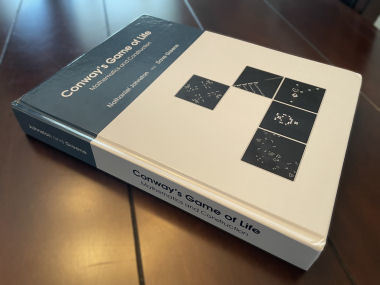
Nathaniel Johnston and Dave Greene
This book provides an introduction to Conway’s Game of Life, the
interesting mathematics behind it, and the methods used to construct
many of its most interesting patterns. Lots of small “building
block”-style patterns (especially in the first four or so chapters of
this book) were found via brute-force or other computer searches, and
the book does not go into the details of how these searches were
implemented. However, from that point on it tries to guide the reader
through the thought processes and ideas that are needed to combine
those patterns into more interesting composite ones.
While the book largely follows the history of the Game of Life, that
is not its primary purpose. Rather, it is a by-product of the fact
that most recently discovered patterns build upon patterns and
techniques that were developed earlier. The goal of this book is to
demystify the…
View original post 26 more words
Biological Robots: Perspectives on an Emerging Interdisciplinary Field
D. Blackiston, S. Kriegman, J. Bongard, M. Levin
Advances in science and engineering often reveal the limitations of classical approaches initially used to understand, predict, and control phenomena. With progress, conceptual categories must often be re-evaluated to better track recently discovered invariants across disciplines. It is essential to refine frameworks and resolve conflicting boundaries between disciplines such that they better facilitate, not restrict, experimental approaches and capabilities. In this essay, we discuss issues at the intersection of developmental biology, computer science, and robotics. In the context of biological robots, we explore changes across concepts and previously distinct fields that are driven by recent advances in materials, information, and life sciences. Herein, each author provides their own perspective on the subject, framed by their own disciplinary training. We argue that as with computation, certain aspects of developmental biology and robotics are not tied…
View original post 57 more words
#TIL than in 1998, some absolute MAD LADS at the BBC organised for some blind people to touch an elephant 😀
BBC Radio 4 Extra – 90 by 90 The Full Set, 1998: Touching The Elephant
https://bbc.in/3PqNeYA
Also on YouTube:
https://bit.ly/3O6bo9J

 Systems Community of Inquiry
You must be logged in to post a comment.