The Boundary Triage: A Systemic Leadership Tool

Conference Paper · July 2014Meeting of the International Society for Systems Science, At George Washington University, Washington DC, USA  Delia Pembrey MacNamara  University of Hull
Abstract
We live in an increasingly digitally networked world, with increasing complexity and uncertainty. Digital technologies offer the opportunities for innovation, knowledge management information gathering and analysis that have the potential to provide a community or organisation’s leading edge by harnessing human capital within and without the organisation. The digitally connected organisation has been coined the ‘boundaryless’ organisation, blurring both the vertical and horizontal boundaries of the organisation, seeing supply chains and organisation silos deconstructed. As new work practises and forms of organisation emerge, business leaders have to balance organisation and stability, with innovation, growth and market uncertainty. This technological ‘boundary-less’ environment reveals that we are in an increasingly ‘bounded’ world. Business leaders have to become competent ‘boundary spanners’ as they move from ‘command and control’ to ‘connect and collaborate’, enabling and encouraging participation and leadership at all levels. Yet this requires a new set of leadership skills, a ‘new’ way of thinking that has yet to be found that can deal with complexity in a sophisticated way, focussing on just a few key elements. My MBA research (2011) revealed that the adoption, implementation and success of social technologies for open innovation and collective intelligence were dependent on leaders’ personal boundary judgements toward social technologies. This paper introduces the Boundary Triage, a symbolic representation of the partial ontology of the Boundary concept that I abstracted from a transdisciplinary review of technology, innovation and leadership literature. The Boundary Triage aims to provide a theoretically grounded, easily understandable and deployable a systemic leadership development tool based on systems thinking to non-systems practitioners. The ‘Boundary Triage’ is still in its infancy and needs to be tested and developed further. In line with Maturana’s (1980) approach to coining the term ‘autopoiesis’, which was initially advanced as a proposition to be tested, by calling the partial ontology of Boundary the Boundary Triage it will have the freedom to be tested, explored and developed both as theory and as a practical tool. The partial ontology of Boundary proposes that a single Boundary is socially constructed and reinforced by environmental, physical, psychological, and physiological factors. Represented by the Boundary Triage, a Boundary consists of the interactions of a Creator (C), Acceptor(s) (A) and Reinforcing Factors (RF) that have an emergent effect on the Boundary. Two further concepts are to be used with the Boundary Triage: the Bounded Event (BE): the moment/time a Boundary is conceived, and the Bounded Object (BO): what is taken away from the BE moment and carried as a memory, belief, worldview or paradigm. In practise, the Boundary Triage as an immediate ‘triage’ when a boundary has been ‘crossed’ in a social context recognised either by language, gesture, feeling or atmosphere and quickly prioritizing the RF of the Observer and the Observed, and aiming to adjust them psychologically and through dialogue. As a personal heuristic, the Boundary Triage is also used by a leader to reflect on the ‘what’, ‘why’, ‘where’ and ‘who’ (BE) that created the BO causing the ‘mess’, critique the BO and review personal worldviews and paradigms. Informal empirical examples by individuals to date have reported improved performance, better communication and more self-awareness but the role of values and ethics is still to be determined. The Boundary Triage is purposely simple for the non-systems practitioner, but it is partial and needs to be developed further. Fieldwork is currently being conducted to develop the Boundary Triage as a viable systemic leadership tool.

The Boundary Triage: A Systemic Leadership Tool. Available from: https://www.researchgate.net/publication/264544229_The_Boundary_Triage_A_Systemic_Leadership_Tool [accessed Feb 28 2018].

Our Theory of Change « The Berkana Institute

Theory of Change

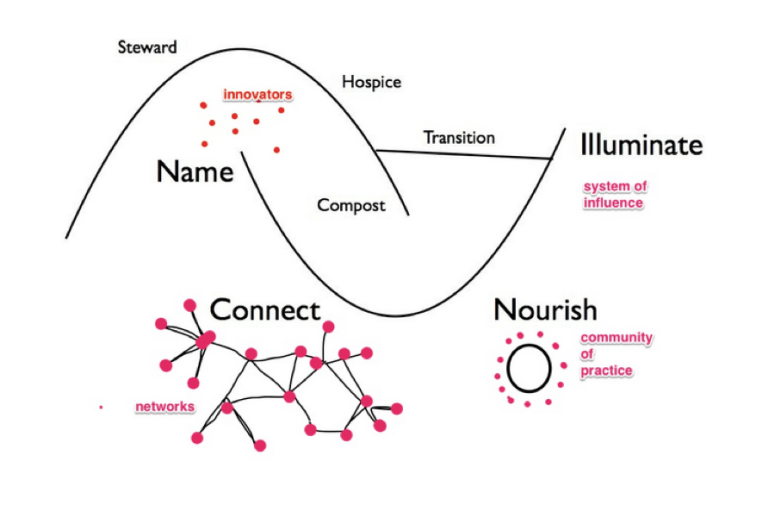
The two loops model has been a fundamental piece of The Berkana Institute’s theory of change. As one system culminates and starts to collapse, isolated alternatives slowly begin to arise and give way to the new. In this video Deborah Frieze, Berkana’s former co-president, explains the two loops theory and speaks about the way that our work to name, connect, nourish and illuminate has fit into this model. She also identifies some of the different roles we might play to hospice the dying system, usher in the alternative system and make clear the choice between the two.

We believe that no universal solution exists for the challenges of this time: increased poverty and disease, failing large-scale systems, ecological degradation. But widespread impact does become possible when people working at the local level are able to learn from one another, practice together and share learning with communities everywhere. We have observed that large-scale change emerges when local actions get connected globally while preserving their deeply local culture, flavor and form. And we have called this trans-local learning.

[Another explanation in more words at https://medium.com/@brittneebond/two-loops-model-9a3d52c7da4e ]

Two Loops Model

Exploring how systems change.

The Two Loops by Margaret Wheatley and the Berkana Institute has shaped the way I work with organizations. I’ll share my notes here on the model so you guys can keep passing it on.

Today we are living with the strong remnants of what’s called the Newtonian world view -> a mechanistic view.

Basically, if something breaks in our societal systems, we separate it into parts, analyze them, find the faulty part and switch it out for a better one. Except that doesn’t work. Rarely does it result in the kind of change leaders hope for. Instead, they were confronted by 8 new problems caused by their initial solution (and the initial solution might also be back and bigger this time.)

We can’t plan to avoid these consequences because we can’t see all the connections below the service.

When we take a step back, we realize we’re tugging at webs of relationships that are seldom visible… but always there.

In the last 100 years, we’ve progressed to realize a couple key points:

  • Our world view is constantly changing
  • Our world is quite adept to change
  • Living things operate differently than mechanical things

This mechanistic world view doesn’t work because:

Humans don’t function like machines.

That’s why we should now look at a new systems model called Two Loops.

It tells the story of how systems dies and new systems emerge constantly. It works on all levels and isn’t linear. As systems ascend and become more the more dominant system, they become more powerful and entrenched.

Using the fossil fuel economy as an example:

  • Oil was discovered
  • We found we could use it as an energy source
  • Over time the world economy was structured around fossil fuels

At the top of their game, life was great! The money was rolling in and the economy was booming. The people who hold this system up and fight to protect it are called stewards. They are comfortable in an established system. Stewards try to maintain the system as best they can for what they feel is the greater good of the system they are serving. (They are keeping it stable for the rest of us.)

All systems eventually begin to teeter and start to lose their significance. They enter hospice when they start to decline and are on their way to death. (We can only live off fossil fuels until it kills our climate or we run out of them.)

An interesting movement happens right at the peak of every system: some people drop out. (They realize as a fact that fossil fuels are a limited resource.) These pioneers walk out to start a new system. These pioneers look at the way things are, the deeply held beliefs that underpin the current system, and see that another way is possible.

This is a radical act; they are leaving the comfort of an established system at it’s peak and going alone to start a new one.

Ok, so now you have a bunch of divergents alone at the beginning of the new loop. It can be a really lonely time (picture scientists in their basements working on solar panels). What do they need to do to build this new system? To create a new movement? They need to find each other.

THey need to name themselves. They need to be able to google themselves (renewable energy, green economy, etc.)

Now we know what we are- next we need to connect with each other. We need to build a network and build social capital.

Once connection happens on a regular basis and is centered around progressive action, it becomes a community of practice. This includes failing forward together and upwards as the new system continues to emerge and build. It’s also a place to nourish the system so it can keep growing. New systems need: time, space, money, expertise and skill building.

Once the new system is on the upward swing, it hits an illumination stage (fossil fuel cars will be banned by 2040 in most European countries). This is where we tell the success stories to inspire the people in the old system to come over and transition into a new way of living. When, how and to whom we illuminate is a careful dance. Timing is everything.

BCSSS | Bertalanffy Center for the Study of Systems Science

The Center

The Bertalanffy Center for the Study of Systems Science (BCSSS) is an Austrian independent research institute, internationally acknowledged as an ambassador for the systems science heritage and present state-of-the-art applied systems research.

The Bertalanffy Center for the Study of Systems Science focuses on the Foundations of Systems Science, exploring and explaining the nature of the world, and Systems Design, understanding and deploying change in this world.

Systems Design Science

The objective of the BCSSS is to inspire the development of systems science by fostering systems research and supporting systems thinking. Given the global challenges of today, systems science is needed more than ever.

In particular, it revisits the General Systems Theory (GST) as founded by Ludwig von Bertalanffy and others in order to reassess it in the light of today’s global challenges and to illuminate the course of development systems science has taken since.

  • We execute and support use-inspired basic research projectsfocusing on the foundations of systems science, systems design and complexity management towards systemic sustainable innovative solutions.
  • We support the next generation of systems researchers with scholarships and awards.
  • We administrate the archive of Ludwig von Bertalanffy and other collections which are of interest to the systems movement and open the heritage to the public.
  • We execute and support international scientific forums like the European Meetings on Cybernetics and Systems Research (EMCSR) to foster global networks between researchers and practitioners.
  • We disseminate systems knowledge by executing and supporting lectures and workshops.
  • We disseminate systems knowledge by publishingthe book series Systems in co-operation with systems engineers and the Open Access Journal Systema: connecting matter, life, culture and technology.

The association by Austrian law is an active member of the International Federation for Systems Research (IFSR), the largest umbrella organization in the field of systems science.

[this is the front page, click through headline link to find more. I found this through Gene Bellinger, who posted the link to Maria Lenzi and Helene Finidori’s Systems Science and Pattern Literacy group on linkedin:

http://www.bcsss.org/research/fields-and-groups/systems-science-and-pattern-literacy/%5D

The Meme as Meme

Is memetics a science?  In Nautilus, Abby Rabinowitz asked Richard Dawkins, Daniel Dennett and Susan Blackmore.

… trawling the Internet, I found a strange paradox: While memes were everywhere, serious meme theory was almost nowhere. Richard Dawkins, the famous evolutionary biologist who coined the word “meme” in his classic 1976 book, The Selfish Gene, seemed bent on disowning the Internet variety, calling it a “hijacking” of the original term. The peer-reviewed Journal of Memetics folded in 2005. “The term has moved away from its theoretical beginnings, and a lot of people don’t know or care about its theoretical use,” philosopher and meme theorist Daniel Dennett told me. What has happened to the idea of the meme, and what does that evolution reveal about its usefulness as a concept?

[….]

From the perspective of serious meme theorists, Internet memes have trivialized and distorted the spirit of the idea. Dennett told me that, in a planned workshop to be held in May 2014, he hopes to “rehabilitate the term in a very precise kind of way” for studying cultural evolution.

According to Dawkins, what sets Internet memes apart is how they are created. “Instead of mutating by random chance before spreading by a form of Darwinian selection, Internet memes are altered deliberately by human creativity,” he explained in a recent video released by the advertising agency Saatchi & Saatchi. He seems to think that the fact that Internet memes are engineered to go viral, rather than evolving by way of natural selection, is a salient difference that distinguishes from other memes—which is arguable, since what catches fire on the Internet can be as much a product of luck as any unexpected mutation.

[….]

Susan Blackmore, a British professor who may be one of the last defenders of memetics as a scientific field. In a 2008 TED talk, Blackmore is an animated speaker, bright-eyed and wiry, her short grey hair dyed with streaks of blue. I reached her at her home in Devon, England, where she is occasionally joined in the garden by Dawkins and Dennett for meetings of the “meme lab.” “It’s only a bit of fun, nothing serious,” Blackmore said. Sometimes, members try experiments, like folding Chinese sailing ships from origami, itself a kind of meme. She remembered a March meeting in which the issue of Internet memes arose, saying, “Richard was upset because he invented the term, which shouldn’t just be about viral Internet memes. It’s a very powerful concept for understanding why humans are the way we are.”

For Blackmore, memetics is a science. An Oxford-educated psychologist, her early work was on telepathy, which she spent years investigating after an out-of-body experience at the age of 19. She subsequently found no evidence for the existence of paranormal phenomena, but she was no stranger to pushing scientific frontiers. It is perhaps unsurprising that she decided to flesh out memetics. Dawkins wrote that, with memes, he did not intend to “sculpt a grand theory of human culture.” In her 1999 book, The Meme Machine, Blackmore does just that. She argues that everything from the development of language to our big brains were products of “memetic drive.” This is perhaps her most radical claim: that memes make us do things.

“The Meme as Meme” | Abby Rabinowitz | Sept. 26, 2013 | Nautilus at http://nautil.us/issue/5/fame/the-meme-as-meme

The Meme as Meme

#meme

Von Clausewitz’s Center of Gravity concept

Sjon van ’t Hof is always worth reading, and this is no exception.

csl4d's avatarCSL4D

And its possible relevance to systems thinking

Von Clausewitz, the seminal 19th century Prussian military theorist, famously wrote that war is merely “the continuation of policy [with the addition of] other means” (mit Einmischung anderer Mitteln). This suggests that war is essentially about politics. Clausewitz also spoke of the so-called trinity in war of people, army and government, suggesting that Clausewitz’ ideas mainly apply to nation states, a concept that itself is now under attack because of the rise of non-trinitarian wars involving non-state fighters as in Vietnam, Afghanistan, Iraq, Syria, and Mali. The question is of course whether these countries were fully developed nation states (well, probably not) in the first place, and whether the nation state as a concept is in decline as suggested by current theorists such as Van Creveld. Clausewitz also used a second trinity – passion, chance, and reason – for his analysis…

View original post 1,266 more words

Helene Finidori – survey: Mapping the Landscape of Patterns Across Domains

23 February at 18:26

Patterns can be found in many domains of research and praxis: design, systems and complexity science, cognitive psychology and neuroscience, linguistics, architecture, computer science, information technology, artificial intelligence, engineering, environmental sciences, biology, education, mathematics and many more…

Researchers and practitioners in these domains have different understandings and approaches to patterns. Yet, could some coherence be found across domains?

I have just finalized a survey with the research group Systems Science and Pattern Literacy at the Bertalanffy Center for the Study of Systems Science.

Patterns it seems to me are not very central and acknowledged in systems science / systems thinking, or are they?

We will welcome the insights of this community on your understanding of patterns and their role in your activity.

Here’s the link: https://www.surveymonkey.com/r/MappingPatternsLandscape

Thanks 🙂
Mapping the Landscape of Patterns Across Domains Survey

4E Cognition Group | Embodied, Embedded, Extended, Enactive

Research group website. 

We are an interdisciplinary group of researchers united by a shared interest in recent approaches to cognitive science, often known as “4E cognition” to refer to their emphasis on embodied, embedded, extended, and enactive cognition.

Our research group is officially hosted by the Research Institute for Applied Mathematics and Systems (IIMAS) in the main campus of the National Autonomous University of Mexico (UNAM) in the southern parts of Mexico City.

We also have ties with the Centre for Complexity Sciences (C3), also at UNAM.

COORDINATOR

Tom Froese – http://froese.wordpress.com/

UPCOMING EVENTS

Enactivism
March 15, 2018 – March 17, 2018, Memphis
http://www.ummoss.org/enactivism18.html

4EC & Mental Disorder
April 5, 2018 – April 6, 2018, Exeter
https://www.joelkrueger.com/4e-conference

Reconceiving Cog.
June 27, 2018 – June 29 Antwerp, Belgium

ALIFE 2018
July 23, 2018 – July 27, 2018, Tokyo, Japan

Movement: Brain, Body, Cognition
July 27, 2018 – July 29, 2018, Harvard Medical School
https://movementis.com

Explaining the origins of the genetic code without vertical descent

Fascinating stuff!

The State of Cybernetics. The digitalisation of cities, bodies and communities – Amsterdam Institute for Social Science Research – University of Amsterdam

Conference

What do cities, robots, corporations, political organizations, human bodies, and ecosystems have in common? For the scientists involved in the development of cybernetics from the 1940s to the 1960s, this was all but an awkward question.

In their intellectual and hands-on experimentations, cyberneticians called forth a world in which machines, bodies and nature are entangled as complex and dynamic systems. They theorized that information would and should flow ever more effortlessly within and between these systems.

The purpose of the seminar is to revisit the legacy of cybernetics to shed light on contemporary digital politics. Many of the fundamental questions asked by cyberneticians regain salience today. What remains of liberal individualism when the boundaries between humans, machines and nature are blurred? What are the systemic properties and operating routines of democracy in a world in which machines and humans are increasingly entangled?

Programme

Scholars from fields as diverse as Philosophy, Anthropology, and Artificial Intelligence will give presentations. The speakers include Simon Marvin, Noortje Marres, Andrew Pickering, Willem Schinkel and Tsjalling Swierstra.

Registration

There is limited seating. Are you interested in taking part? Please inquire with Anne Hovingh: anne.hovingh@student.uva.nl. After you register you will receive a more detailed program with abstracts, locations and times.

Public event

The seminar will be concluded by a public event ,The Politics of a Cybernetic World, on Friday March 23 at 4PM at Crea with lectures by Luc Steels and Katherine Hayles, a theatrical performance prepared by Ricarda Franzen and concluding reflections by Andrew Pickering.

Funded by

The event is funded by the Netherlands Organisation for Scientific Research (NWO) as part of the research project Safeguarding long-term equal stakeholdership in the Smart City & the Center for Urban Studies of the University of Amsterdam as part of a collaboration with the Sheffield Urban Automation Institute.

Published by  AISSR

The event itself:

http://aissr.uva.nl/content/events/events/2018/03/the-politics-of-a-cybernetic-world.html

23 Mar 2018

The Politics of a Cybernetic World

A creative and engaging event exploring the politics of cybernetics with professor Katherine Hayles, professor Luc Steels, professor Andrew Pickering, and dramaturg Ricarda Franzen

Event

What forms of political subjectivity and social organization emerge when people and things are increasingly connected through digital infrastructures? What can robots teach us about inequality or democracy?

During this event, speakers and performers revisit the legacy of cybernetics to shed light on contemporary digital politics.

This is the concluding event of the two-day seminar The State of Cybernetics. The digitalization of cities, bodies and communities

Funded

This even is funded by the Netherlands Organisation for Scientific Research (NWO) as part of the research project Safeguarding long-term equal stakeholdership in the Smart City and the Center for Urban Studies of the University of Amsterdam as part of a collaboration with the Sheffield Urban Automation Institute

The programme

  • Theatrical performance directed by Ricarda Franzen
  • Lectures by Katherine Hayles and Luc Steels
  • Discussions with speakers, audience and Andrew Pickering

Venue

CREA ‘Muziekzaal’, Nieuwe Achtergracht 170, Amsterdam

Registration

Attendance is free of charge but seats are limited, so please register with Anne Hovingh: anne.hovingh@student.uva.nl

The speakers

Katherine Hayles is Professor and Director of Graduate Studies in the Program in Literature at Duke University, and Distinguished Professor Emerita at the University of California, Los Angeles. She teaches and writes on the relations of literature, science and technology in the 20th and 21st centuries. Amongst her distinguished works are How We Think: Digital Media and Contemporary TechnogenesisHow We Became Posthuman: Virtual Bodies in Cybernetics, Literature and Informatics, and Writing Machines.

Luc Steels is professor of computer science at the University of Brussels (VUB), co-founder and chairman (from 1990 until 1995) of the VUB Computer Science Department (Faculty of Sciences) and founder and first-director of the Sony Computer Science Laboratory in Paris. His main research field is Artificial Intelligence covering a wide range of intelligent abilities, including vision, robotic behavior, conceptual representations and language.

Andrew Pickering is an emeritus professor at the University of Exeter. He is internationally known as a leader in the field of science and technology studies. He is the author of Constructing Quarks: A Sociological History of Particle PhysicsThe Mangle of Practice: Time, Agency and Science and Kybernetik und Neue Ontologien. In his book The Cybernetic Brain: Sketches of Another Future, he analyses cybernetics as a distinctive form of life spanning brain science, psychiatry, robotics, the theory of complex systems, management, politics, the arts, education, spirituality and the 1960s counterculture, and argues that cybernetics offers a promising alternative to currently hegemonic cultural formations.

Ricarda Franzen works as a dra­maturg, sound artist and researcher at the University of Amsterdam. Coinciding with her interests in art practice, she is interested in aspects of sound in relation to its environment but also as being used in theatre and radio dramas. For the Rotterdam-based laboratory for Unstable Media she co-produced a performance based on the ideas of Buckminster Fuller and Marshall McLuhan. For the theatrical performance she developed for ‘the State of cybernetics,’ she similarly draws inspiration from a group of historical cutting-edge thinkers and tinkerers.

The organizers

Justus Uitermark is Associate Professor of Sociology at the University of Amsterdam. He is affiliated with the Center for Urban Studies and the Amsterdam Institute for Social Science Research. Uitermark’s research uses relational theorizing and network analysis to examine self-organization, political conflict, and the social organization of the city. With colleagues at the University of Amsterdam, he is currently researching the online/offline interface, utilizing data sourced from Twitter and Instagram to analyze subcultures and social movements. Recent publications include “Longing for Wikitopia. The study and politics of self-organization” (in Urban Studies) and Cities and Social Movements (co-authored with Walter J. Nicholls, Wiley).

Dorien Zandbergen is an anthropologist of digital culture and politics, currently working as a postdoc researcher at the Sociology Department of the University of Amsterdam. Her current work critically explores the politics of urban digitization. In the documentary In search of the Smart Citizen, which she co-produced with Sara Blom (Creative Commons 2015), she interrogates the vision of the “smart city.” She founded Stichting Gr1p  to support artistic and literary interventions that help make complex technological themes, visible, debatable and tangible for a broad audience. Her recent academic publications include “From data fetishism to quantifying selves” (with Tamar Sharon, New Media & Society, 2016) and “We Are Sensemakers.” The (Anti-)politics of Smart City Co-creation” (Public Culture, 2017).

Published by  AISSR

System viability of organizations and the aetiology of organizational crisis : A Quantitative Assessment of Stafford Beer’s Viable System Model

I think this is really a big deal – as Patrick Hoverstadt says: 
“Michael Pfiffner did a study across 137 organisations and found a -0.78 correlation between organisations ‘conforming’ to VSM as a normative model and organisational crisis – in other words the more VSMy the organisation, the less likely to end up in crisis and the less VSMy the more likely to end up in crisis with a predictability of almost 80% accuracy. I think that is significantly better than anything else I’ve seen as a general predictive model.”
System viability of organizations and the aetiology of organizational crisis : A Quantitative Assessment of Stafford Beer’s Viable System Model
Pfiffner, M.D.
(2017) Utrecht University Repository
(Dissertation)
Supervisor(s): Schruijer, Sandra; Boselie, Paul
Abstract
Subject of this dissertation is the aetiology of crisis processes which place organizations under existential threats and which often cause organizational demise and bankruptcy. To date, research on organizational crises (OC) has not succeeded in identifying the generic grounds for these detrimental processes in organizations. A minimal consensus can be … read more
Download/Full Text
Author keywords: System Viability, Organizational Crisis, Management Cybernetics, Early Recognition, Prevention, VSM
Publisher: Utrecht University

Embracing Complexity: towards fairness, sustainability and happiness – Jean Boulton

Embracing Complexity: towards fairness, sustainability and happiness

Complexity suggests a different approach to engaging with the world – a middle ground between control and laissez-faire.

We’ve chosen the wrong science to understand the social world.

On the one hand, there is an increasing focus for public sector organizations on defining detailed rules, standardizing methods, evidencing and measuring outcomes. The intention is to make the hospital or school work as an efficient, optimized, well-oiled machine. The belief is that if we tell people exactly what to do and check they do it exactly, then standards and efficiency will improve.

On the other hand, when it comes to commerce and the private sector, there is almost the opposite – increasing deregulation and laissez-faire driven by a strong belief in the invisible hand of the market and in the power of competition to lead to optimal outcomes. The economic world is still largely modelled as if it worked predictably and controllably, moving inexorably towards equilibrium.

What is remarkable is that these beliefs seem to harden and become ever-more entrenched despite the repeating crises facing our economies, ecologies, and societies. They persist in spite of the stark and often completely unexpected social eruptions and political crises that dominate the news. They persist even in the light of increasing evidence that policies are failing. For example, the UK – despite continuing focus on ‘machine thinking’ (defining detailed teaching methods and lesson plans, detailed measuring of performance of schools, teachers and pupils) – is near the bottom of 24 countries in relation to literacy and numeracy. And, despite neo-liberal free market policies and the promise of ‘trickle down’, inequality continues to rise; the UK is 28th out of 34 OECD countries in relation to income inequality and bottom of 37 countries in relation to difference in healthy eating between rich and poor children. If ever there was a need for fresh thinking, we are seeing it now. Yet most of the solutions that are attempted consist in propping up the status quo, doing more of the same, rather than thinking afresh and questioning underlying assumptions.

continues in headline link

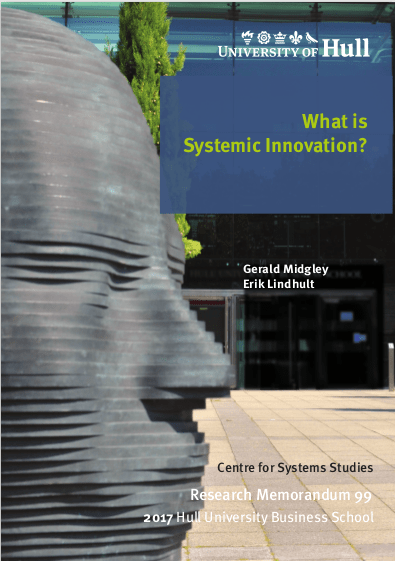
What is Systemic Innovation | Midgley & Lindhult | 2017

“Systemic innovation” is used in four ways:

1. … a type of innovation where value can only be derived when the innovation is synergistically integrated with other complementary innovations, going beyond the boundaries of a single organization.

2.  … the development of policies and governance at a local, regional or national scale to create an
enabling environment for the above kind of synergistic, multi-organizational innovations.

3. … when its purpose is to change the fundamental nature of society; for instance, to deliver on major transitions concerning ecological sustainability.

4. … how the people acting to bring about an innovation engage in a process to support systemic thinking,

Systems thinking has evolved over time:

1950s – 1960s: The early systems sciences (with cybernetics)

1970s – 1980s: The 1st paradigm shift: from real-world systems to ways of thinking in systems terms

1980s – 2000s: The 2nd paradigm shift: understanding power relations and mixing methods

The methodological progression is used to redefine systemic innovation (in the fourth way, above).

We can now move to formulate a new definition of systemic innovation, based on the foregoing
discussion. At its most basic, a systemic Innovation is one that emerges from a process that supports innovators and their stakeholders in using systems concepts to change their thinking, relationships, interactions and actions to deliver new value. The definition of stakeholders needs to happen within that same process.  [p. 19]

This fourth approach can be integrated with the field of systemic intervention.

“What is systemic innovation?| Gerald Midley; Erik Lindhult | 2017 | Research memorandum 99  | University of Hull. Business School at https://hydra.hull.ac.uk/resources/hull:14494

What is Systemic Innovation

#innovation, #systemic, #systems-thinking

Dave Snowden at TedX: A succinct overview of his groundbreaking work – from Sonja Blignaut’s blog

Dave Snowden at TedX: A succinct overview of his groundbreaking work

I first met Dave in 2002 when we were both employed by IBM.  I remember experiencing an immediate resonance with his work, especially the inherent integrity of honoring context and not mindlessly applying best-practice recipes as the big consultancies tend to do.

It is now 16 years later, and it has been a privilege to be part of his journey, and to see the thinking and methods become more and more coherent over time.  This talk is an excellent resource for anyone who wants an introduction to the thinking, or who wants to introduce others to it.

In less than 18 minutes, Dave manages to introduce complex systems theory; tell the children’s party story (3 mins 30 secs) and introduce a new theory of change based on the power of micro-narrative and vector measures enabled by Sensemaker (7 mins).

Watch it … It’s 18 minutes well spent.

Some stand-out nuggets:

On our over-focus on order and measurement (40 secs)

Order is hugely valuable to human beings, on a negative side a fear of chaos has been used to impose order unnecessarily and destroy creativity and freedom.

Over the last 40 or 50 years we’ve taken an engineering focus on society and an engineering metaphor. We’ve actually compounded order with excessive outcome based measurement. If you actually look at the history of last 40 or 50 years, everything has to have a target;  everything has to have a defined outcome and it has to be a number. Whether it’s KPI’s, number of published papers or whatever else.  The reality is all of the scientific evidence says that when human beings are pursuing explicit targets it destroys intrinsic motivation, there is no evidence to contradict that. 

Where do we most need intrinsic motivation? In health and education. And where do we impose the worst targets? In health and education so we need to start thinking differently about this and move away from a primitive dichotomy.

On managing Complex Adaptive Systems (2 mins):

Complex adaptive system:  it’s a system defined not by its structure by it by its connectivity. In a complex system everything is connected with everything else but many of the connections cannot be known. …

… Understanding how we manage them is critical and it’s not about control it’s about understanding the connections and changes in the linkages.

3 mins 30 secs: Children’s Party Story

6 mins 30 secs:

… what we manage is the emergence of beneficial coherence within attractors within boundaries and we manage the only three things that you can manage in a complex adaptive system: the boundary conditions; the probes and the amplification strategy.

Management and governance is much simpler when you understand the nature of the system and you stop trying to treat an ecosystem as if it was an engineering problem when it’s an ecological problem.

On micro-narrative and a new theory of change (7 mins 10 secs)

We need to understand what’s going on, and you can only understand a complex system by understanding the small particular parts of day-to-day interaction. For humans those are the anecdotal data of the school gate, the street stories, the beer after work; not the grand narratives of workshops but the day-to-day anecdotes of people’s existence.

And we need to understand them through the voice of the people who tell them not through an AI machine interpreting the text or an expert making them fit their cultural expectations.

The people’s own voice has to be subject to their own interpretation.

And then we need to allow those in power at any level of society to have direct access to the raw stories of the people they govern, without multiple levels of interpretation which allow them to hide from reality behind the guise of policy reports.

On change (nudging towards adjacent possibles) (15 min 40 sec)

… they can all nudge their systems in a direction appropriate to their context rather being subject to the tyranny of the average approach: the global campaign.

We need to start doing small things in the present rather than promising massive things in the future because that just leads to perpetual disappointment.

We are Dave’s exclusive South Africa partners, so if you want to explore how to implement these ideas in your own context, please contact us to find out more.

Restoring Information’s Body

In a 2011 talk, Lucy Suchman traces her research in anthropology and science studies through the Macy Conferences (via Geoffrey Bowker), her experiences at Xerox PARC, and criticisms in the popularization of design with Bruce Mau’s Massive Change exhibition.

Lucy Suchman’s Medea Talk explores recent developments in the study of digital media that recover the entanglements of bodies and technologies. Drawing on a series of examples from her own research and others within science and technology studies (STS) and design, she makes the case for an understanding of information as irreducibly social and material, virtual and real. In October, Lucy Suchman was also appointed as Honorary Doctorate at Malmö University.

How we became posthuman on Google BooksPhotographs in the presentation about the Macy Conferences are excerpted from “How We Became Posthuman: Virtual Bodies in Cybernetics Literature and Informatics” | N. Katherine Hayles | 1999 | U. of Chicago Press, listed on Google Scholar.

“Restoring Information’s Body: Remediations at the Human-Machine Interface—Lucy Suchman (Medea Talks #17)” | Karolina Rosenqvist | Sept. 28, 2011 | Medea, Malmö University at http://medea.mah.se/2011/09/medea-talks-presents-lucy-suchman/

“Lucy Suchman: Restoring Information’s Body – Remediations at the human-machine interface” | Oct. 2011 | MedeaTV at https://www.youtube.com/watch?v=Z3I-ndAXYWg

Lucy Suchman: Restoring Information's Body - Remediations at the human-machine interface on Youtube

#anthropology, #science-and-technology-studies

Prolog/Acknowledgement/History on Pattern Language

John C. Thomas, who has been awarded the 2018 SIGCHI Lifetime Research Award, provides some background on his interest in pattern language, in the preamble to the Context-Setting Entrance.

It occurs to me that some readers would like to know more about Pattern Languages; the pros and cons; pointers to the research; perhaps, how to write (or find) Patterns. I will do that soon on the basis of my current understanding. I’d like to put out a few more examples first though. I find that concepts such as “Pattern” and “Pattern Language” are much better defined by example than by rule. In the meantime, here below are some pointers to give a better flavor of what this odd creature, A Pattern Language, actually looks like and whether it can be housebroken or used for hunting. As you can tell by the list below, I have tried this creature in many different circumstances. To me, it seems quite happy and affectionate. I think that when it comes to trying to work with Pattern Languages, it is necessary to treat it something like a puppy. Your attitude will be an even more important a predictor of your success than your cleverness or knowledge of the Patterns.

Let every Pattern be “frisky” and let each Pattern explore and check out odd corners of the domain (and each other). There are cases where a Pattern doesn’t apply and there are cases where no Pattern applies just as your puppy can’t do anything they want. And, there are a few places where Pattern Languages are not at all appropriate just as there are places where no pets are allowed. For example, some situations are well enough understood that they can be characterized by a mathematical formula. No need for a Pattern (or a puppy) there, though it could still be fun.

A workshop at CHI2006 and  a position paper at CSCW2011 are cited.

John C. Thomas | “Context-Setting Entrance” | Feb. 13, 2018 | petersironwood at https://petersironwood.wordpress.com/2018/02/13/context-setting-entrance/

Via Vaiatres Quaerit 850 ans years


#pattern-language

s
search
c
compose new post
r
reply
e
edit
t
go to top
j
go to the next post or comment
k
go to the previous post or comment
o
toggle comment visibility
esc
cancel edit post or comment