Mary Midgley obituary by Jane Heal in The Guardian

[h/t Gerald Midgley – no relation]
Philosopher who brought a sharp critical intelligence and a gift for vivid metaphor to her writing on human behaviour
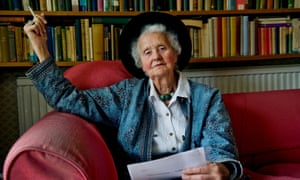
Mary Midgley in 2010. She campaigned for animal welfare and environmental awareness, and against the arms trade.
 Mary Midgley in 2010. She campaigned for animal welfare and environmental awareness, and against the arms trade. Photograph: Sarah Lee for the Guardian

Mary Midgley, who has died aged 99, was an important writer on ethics, the relations of humans and animals, our tendency to misconstrue science, and the role of myth and poetry. From the mid-1970s onwards she published many books and articles in which she identified the limitations of only trying to understand things by breaking them down into smaller parts and losing sight of the many ways in which parts are dependent on the wholes in which they exist. These atomist and reductive approaches are particularly unhelpful when it comes to human self-understanding and, in trenchant and witty style, Midgley pointed the way to a saner and more helpful overview of ourselves and our world.

Her first notable article was The Concept of Beastliness, published in the journal Philosophy in 1973. It impressed Max Black, professor of philosophy at Cornell University, who in 1976 invited her to lecture there and encouraged her to expand her ideas into a book. The result was Beast and Man (1978), which was warmly received. In this article and book, she opened discussion of a question to which she returned many times, namely the implications of advances in science and evolutionary theory for understanding human behaviour.

It is clear that human achievements have their roots in abilities and patterns of response which we share with other animals. So we are not (as some existentialist thinkers have imagined) totally free to create ourselves. But, Midgley insisted, we should not extrapolate from this insight to some depressing biological determinism. More careful reflection shows that our biological endowment includes a capacity to develop a shared culture, and our culture in turn sustains individual creativity.

Other ramifications of these ideas are discussed in her later books, including Heart and Mind (1981), Animals and Why They Matter (1983), Wickedness (1984), Biological and Cultural Evolution (1984), The Ethical Primate (1994), The Solitary Self: Darwin and the Selfish Gene (2010) and Are You an Illusion? (2014).

Often the original impulse to her writing was polemical. In a Guardian interview of 2001 she said, “I keep thinking that I shall have no more to say – and then finding some wonderfully idiotic doctrine which I can contradict.” Her friends noted with amusement that one of the targets she attacked with particular vigour was the regrettable liability of humans to fall into overly combative debate. And she could herself be guilty of unsympathetic interpretation of her opponents. But her major targets were the tempting muddles to which we are all prone, in particular when we do not keep in check our tendencies to simplify and exaggerate.

Her article Gene Juggling, which appeared in Philosophy in 1979, was the start of a famously acrimonious debate with Richard Dawkins in which Midgley was accused of wilfully misrepresenting his claims about the “selfish gene”. It is true (as she herself acknowledged) that her tone was intemperate and that she did not give weight to his explicit claim that the phrase was intended only as a metaphorical way of presenting ideas in evolutionary theory. Nevertheless, it may be that she was right to think that the overall message conveyed by Dawkins’ memorable coinage was the misleading idea that our genes doom us to individual selfishness.

Another topic, which came to the fore in her later books, is the prediction by some scientific writers of future utopias, when science and technology will answer all our questions and solve all our problems. Here she had important points to make about the limitations of science, the significance of poetic and religious vision and the need to integrate our many sources of insight into the human condition. These and related ideas are explored in Evolution as a Religion (1985), Wisdom, Information and Wonder (1989), Science as Salvation (1990), Utopias, Dolphins and Computers (1996), Science and Poetry (2001) and The Myths We Live By (2003).
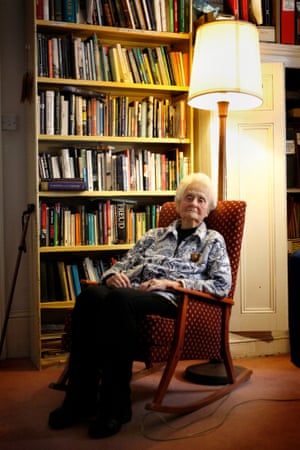
Mary Midgley at home in Newcastle, 2014.
Pinterest
 Mary Midgley at home in Newcastle, 2014. Photograph: Gary Calton for the Observer
Advertisement

Mary was born in London, the younger of two children of Lesley (nee Hay) and Tom Scrutton. Her father had served as a chaplain in the first world war and shortly after Mary’s birth became chaplain of King’s College, Cambridge. When she was five h moved to become vicar of Greenford, west London, where Mary and her elder brother, Hugh (later a distinguished art gallery director), were brought up.

In 1931, Mary was sent to Downe House. This progressive boarding school started in Charles Darwin’s old home, although by the time Mary was a pupil it had moved to Ash Green, near Newbury. She won a scholarship to Oxford to read Classical Greats and, arriving at Somerville College in 1938, became one of a strikingly able and forceful group of women philosophers. Elizabeth Anscombe had arrived at Oxford the year before, Iris Murdoch, who became a close friend, was an exact contemporary, and Philippa Foot arrived a year later. The work of this interesting quartet of thinkers has recently become the object of revived interest in the contribution of women to philosophy during the last century.

Mary graduated with a first in 1942 and for the remainder of the war worked mainly as a civil servant. From 1945-47 she was secretary to the classical scholar Gilbert Murray, after which she returned to philosophy, starting a thesis on the psychology of Plotinus. She tutored at Somerville and lectured at the University of Reading from 1948 until 1950.

At this point it looked as if an academic career of a familiar shape might be opening up. But instead, in 1950, she married a fellow philosopher, Geoffrey Midgley, whom she had first met in Oxford in 1945. He was lecturing at what later became the University of Newcastle upon Tyne, but was then King’s College of the University of Durham. He and Mary set up house together in Newcastle and had three sons over the next five years.

Mary turned to journalism, reviewing children’s books and novels for the New Statesman and the BBC Third Programme. She also read extensively in (among other things) psychology, anthropology, evolutionary theory and animal behaviour, becoming particularly interested in the views of such pioneers of ethology as Lorenz and Tinbergen. Her excellent autobiography, The Owl of Minerva (2005), gives a vivid account of this first half of her life.

It is unlikely that she would ever have become a professional philosopher in quite the mould of many of her contemporaries, since she had little taste for the logical and linguistic issues that were the focus of mainstream work in the 1950s and 1960s, and which remain the focus of much contemporary work. She said later that she was glad to have escaped when she did from the ambience of Oxford, finding it overly narrow and competitive.

Advertisement

The break in her career kept her very much aware of the need for philosophy in wider debate and, as she said herself, she was concerned “to bring academic philosophy back into its proper connection with life, rather than letting it dwindle into a form of highbrow chess for graduate students”.

In 1965 she returned to teaching philosophy, as a lecturer and later senior lecturer at Newcastle. It was not until this point, when she was over 50, that she began to publish the work for which she later became famous.

In 1980 she took early retirement to have more time to write and travel, and she was writing up to the end. Her final book What is Philosophy For? was published last month. Her work had already begun to be widely known at the time she retired, and she was invited to address numerous conferences and festivals. She became involved in campaigning for animal welfare (and for several years she chaired the RSPCA’s committee on animal experimentation), for environmental awareness and against the arms trade. She also appeared frequently on television and radio, presenting the case for animals and the environment and against scientific hubris. Her speaking and writing were always direct and vigorous and were informed by wide reading, a sharp critical intelligence and a gift for vivid metaphor. The drive of her thought is throughout sane and humane.

In 1995, she was awarded an honorary DLitt at Durham, in 2008 an honorary DCL from Newcastle and she was the recipient of the 2015 Edinburgh Medal.

For nearly half a century, she and her husband Geoffrey (himself a remarkable and admirable man) kept open house in Newcastle for friends, colleagues and pupils. At parties and frequent informal gatherings, tea, homemade beer and good whisky were freely dispensed while robust discussion flowed. She will be remembered and missed by many as an unfailing source of challenging ideas and generous friendship.

Geoffrey died in 1997. Mary is survived by their sons, Martin, Tom and David, and grandchildren, Tenzin, Sheridan and Jessica.

 Mary Beatrice Midgley, philosopher, born 3 September 1919; died 10 October 2018

Source: Mary Midgley obituary | Education | The Guardian

Notes on Stability-Diversity | strategic structures – Ivo Velitchkov

To be healthy, organisations – like human beings – have to operate in balance. Going temporarily out of balance is OK, but if this goes on for too long, it’s dangerous. Just like riding a bike, the balance is the minimum organisations need to be able to move forward.

What kinds of things need to be balanced? There are three essential balances. The first one is between autonomy and cohesion, the second is about maintaining both stability and diversity, and the third is balancing between exploration and exploitation. The important thing to recognise here is that the nature of each balance will differ between organisations. And what needs to be done to restore balance will change over time. So we can’t be prescriptive or learn “best practice” from others. We can only give people the glasses to see what is going on and the knowledge that will help them maintain the balances in their organisations.

I’ve been doing the Essential Balances workshop for four years now. During the workshop, all three of them seem relatively easy to get, yet a bit more difficult to work with as a matter of habit.  Based on the feedback I received from people actually using these glasses for organisational diagnosis and design, the first and the third balance, Autonomy-Cohesion and Exploitation-Exploration, come more naturally, while the second one, Stability-Diversity, creates some problems. All three of them and a few more will be explained in detail in the forthcoming book “Essential Balances in Organisations”, but until then, I’ll make some clarifications here. I hope it will be of use also for people who are not familiar with this practice.

Stability and Diversity. At first glance, it might be difficult to see it as a balance. In fact, it covers four dynamics. So, it might be easier to see it as four different balances. Different, yet somehow the same. And the key to it is exactly in these two words: different and same.

The main difficulty for understanding this balance comes from the fact that the concepts of stability and diversity operate in different dimensions. Stability is sameness in time, while diversity is difference in space (Time&Space is also another pair of glasses, used within the QUTE framework). When we say that the oil price is stable, we mean that it doesn’t change much over a certain period. Same for the temperature, sea level, people behaviour. Try searching for “is stable” in the news, and you’ll get mostly three types of results: one, applying it to the condition of a person in a hospital after some accident, second, referring to the political situation somewhere, and third about currency or growth rate.

Diversity, on the other hand, is used for difference in space. Specifically, it’s applied for the difference between separate things within something uniting or containing them. We use it for restaurant offerings, for teams when their members are of different ethnicity, age, and gender. And then in ecological context, we often hear the word “biodiversity”.

The balance between stability and diversity can be observed in the dimensions that they typically operate, in the opposite, or across. Before seeing that, it should be clarified that “balance” should not be understood only in terms of moderating between extremes. That’s why it is “Stability and Diversity”, not versus, or at least not always versus. This will become clearer when same and different is applied in time and space to reveal the four-in-one balances. And we start with the simplest case, taking only sameness and only time.

When sameness is used only in time, then stability can be seen as balance in itself. It can be applied to any other balance for being kept in time. The opposite of stability is instability. Instability is referring to stability, it is about stability. A plane flight is unstable when there is turbulence. In other words, instability is applied to flight, when stability is disturbed by turbulence. And here’s an important point. We would use instability only when there is a possibility for restoring the normal operation. We won’t apply it when there is a plane crash, for example. This would be the first (out of four) hidden balance: Stability (time) – Instability (time). Or, to use the other two words, maintaining the sameness, when it is challenged by difference. Maybe a more appropriate way of writing this variation would be with stability in the middle:

instability – stability – instability

It seems that using same and different in time and space works well so far. But that’s mainly because we allowed another pair of concepts to sneak in the game: good and bad. Stable is good, unstable is bad. Now, since good and bad have been revealed, let’s play with them. Let’s try for example to see stability – why not – as bad. The new combination looks like this: Stability (in time, is bad) – Diversity (in time, is good). It could be useful to see it this way for people who are comfortable wearing Stability-Diversity glasses, but not when communicating with people who are not. With those, something like “Rut – Innovation” would work better. And indeed, when organisations do something the same way and expect better results, that is not likely to happen. Worse, when they do that thing the same way, while their environment changes, they are increasingly unable to achieve the same results. Then a more neutral way to talk about this flavour of the balance would be as Stability-Change, while the biased versions Stability-Instability and Rut-Innovation retain their utility in specific contexts.

Just as it is with the other two essential balances, the scale matters here as well. Good and bad in “Stability (time, bad) – Diversity (time, good)” should be understood only at a certain scale. The way it is written above somehow implies a scale of years.  After some innovation is implemented, the new state needs to be stabilised. Then, and probably for a shorter period, it would be “Stability (time, good) – Diversity (time, bad)”.

We tried “Stability is bad”. If we do the same with difference in time, this will bring the statement “Innovation is bad”. It may sound strange, but it is an actual strategy for some healthcare practices, as well as for companies like General Motors, Ford and American Airlines. It even has a name, exnovation.

So far, we saw Stability-Diversity in time, which can be looked at as Stability-Change, Stability-Instability, and Rut-Innovation. The first one is neutral, the second is when we want to maintain stability, and the third when stability is maintained in spite of the need for change. Now, the analogue for Diversity in space would be to look at it as a balance in itself. This balance can be better understood if called Diversity-Homogeneity. Too much diversity might be bad for stability in some cases, in others – the more the better.

The fourth dynamic is between Stability and Diversity, where stability operates in time and diversity in both space and time. This dynamic is a bit more complicated and it probably won’t get clear without examples. I’ll leave that for another post. For now, here’s a short description: having more diversity (space) or trying out different things (diversity in time) could be very important for maintaining stability (time). However, too much diversity in some cases can destabilise.

I hope this makes Stability-Diversity feel more natural. If not, here’s another way to think about it, which both syntactically and semantically looks more like a balance:

Homeostasis – Heterostasis

The word homeostasis is coming from the Greek ὅμοιος homoios, “similar” and στάσις stasis, “standing still”, to suggest the idea of “staying the same”. Hetero- comes from ἕτερος [héteros], “another”, and is often used as a prefix meaning “different”. This would give another way of thinking about Stability-Diversity as the ability to “maintain sameness” balanced with the ability to “maintain difference”.

Source: Notes on Stability-Diversity | strategic structures

Ten Things to do in a Conceptual Emergency – the International Futures Forum

The Conceptual Emergency

We live in the age of the missing elephant. The American psychologist Don Michael was first to point out the implications of a world of boundless complexity, rapid change and uncertainty for the familiar tale of the blind men who if they could only pool their knowledge would have recognised the elephant. No longer. In today’s world there is little chance that any of us will ever know more than one small piece of the elephant, and there are now so many different pieces, they change so rapidly and they are all so intimately related one to another, that even if we had the technology to put them all together we would still not be able to make sense of the whole.


The missing elephant

The world we have created has outstripped our capacity to understand it. The scale of interconnectivity and interdependence has resulted in a step change in the complexity of the operating environment. These new conditions are raising fundamental questions about our competence in key areas of governance, economy, sustainability and consciousness. We are struggling as professionals and in our private lives to meet the demands they are placing on traditional models of organisation, understanding and action. The anchors of identity, morality, cultural coherence and social stability are unravelling and we are losing our bearings. This is a conceptual emergency.


One very human response is to give up the struggle to make sense of what is going on and to lapse into short term defensive strategies or longer term despair. Another is to strive to regain the comfort of control and coherence by reasserting old truths with more conviction and urgency, stressing fundamentals, ignoring inconvenient information, interpreting complexity in simple terms.


These responses can offer temporary adaptation and will quell anxiety for a while. But they can also dissolve into maladaptive neurotic and even psychotic routines. However understandable and human these responses are, they are pseudo-solutions, ultimately doomed to failure.


Not all responses to challenging times are dysfunctional. It is possible to face up to challenge and grow with and through it. Changed circumstances can be seized as opportunities for creative engagement and rather than generating resistance, generate a step change in learning and growth.


IFF, the International Futures Forum, is an international and multidisciplinary group originally convened in 2001 to come up with some touchstones of theory and practice to support a transformative response to today’s powerful times and to restore effectiveness in action. The following pages describe ten of the strategies that have emerged from this work to date: ten things to do in a conceptual emergency.

Source: The Conceptual Emergency

Principles of Systems – Jay W Forrester

Text and workshop chapters 1 through 10

pdf via Scribd

Source: Principles of Systems

A synthesis of systems, critical and design thinking

csl4d's avatarCSL4D

Better be armed to the teeth. It’s a mess, out there!

It occurred to me last week that systems thinking, critical thinking and design thinking are just aspects of the same thing, which is humans trying to gain control over the process of designing better ways to make the world more accommodating to their desires. Over the past weeks (and years) I produced a number of concept maps that could be helpful in making a final synthesis that seems to have been lacking so far, except perhaps in a tacit or subconscious form. The hominids that were our ancestors started doing this three to five million years ago, and we are the end result of these efforts. I am not claiming that below synthesis is perfect. I will be happy if it can be understood and somehow resonates with the reader’s own thinking experiences. Note of warning: the different thinking…

View original post 1,162 more words

Work and how to survive it: Lesson 2. Understand variation inside your organisation

The Stafford Beer papers at Liverpool John Moores University

Stafford Beer
Stafford Beer A selection from the papers of Stafford Beer (1926-2002), founder of management cybernetics

The Stafford Beer Collection consists of the personal library of Professor Stafford Beer, the founder of Management Cybernetics, who was appointed Honorary Professor of Organisational Transformation at LJMU in 1989.

An international consultant in the management sciences, employed by governments in over 20 countries and by a number of international agencies, Professor Beer, who died in August 2002, was the author of over 200 publications and held a number of academic posts as well as managerial positions at every level. He was also a published poet and held exhibitions of paintings.

Operations Room Chair
For more details or to discover how to see the materials in person please visit LJMU Special Collections and Archives.
Army Career (4)
Army Career Documents from Stafford Beer’s army career, 1944-1948   More…
United Steel (6)
United Steel Documents from Stafford Beer’s career at United Steel, 1956-1960   More…
Sigma (11)
Sigma Sigma (Science in General Management Ltd) was the OR consultancy set up by Beer in 1961.   More…
Launching Personal Consultancy (2)
Launching Personal Consultancy In 1969 Stafford Beer launched his own consultancy service.   More…
Dominion Bureau of Statistics, Canada (6)
Dominion Bureau of Statistics, Canada One of the first consultancy projects carried out by Stafford Beer, 1969-70   More…
Rome (4)
Rome Work done 1971-72 for the consultancy firm IFAP as part of a consultancy package for the IRI company   More…
Warburtons (8)
Warburtons Stafford Beer’s work with Warburtons, the Bolton-based bakers, in the 1970s   More…
Canadian Air Transportation Administration (CATA) (4)
Canadian Air Transportation Administration (CATA) Stafford Beer’s work with the Canadian Air Transportation Administration, 1971   More…
Chile (82)
Chile A selection of documents relating to Stafford Beer’s consultancy work for President Allende   More…
Mexico (13)
Mexico Work for the Mexican government, 1983   More…


Source: DigiTool – Collections

Francis Heylighen – Tale of Challenge, Adventure and Mystery: towards an agent-based unification of narrative and scientific models of behavior

Heylighen, F. (2012). A Tale of Challenge, Adventure and Mystery: towards an agent-based unification of narrative and scientific models of behavior (ECCO Working Papers No. 2012-06). Brussels, Belgium. Retrieved from http://pcp.vub.ac.be/papers/TaleofAdventure.pdf

Abstract: The scientific worldview is based on laws, which are supposed to be certain, objective, and independent of time and context. The narrative worldview found in literature, myth and religion, is based on stories, which relate the events experienced by a subject in a particular context with an uncertain outcome. This paper argues that the concept of “agent”, supported by the theories of evolution, cybernetics and complex adaptive systems, allows us to reconcile scientific and narrative perspectives. An agent follows a course of action through its environment with the aim of maximizing its fitness. Navigation along that course combines the strategies of regulation, exploitation and exploration, but needs to cope with often-unforeseen challenges. These can be positive (affordances, goals), negative (disturbances, anti- goals) or neutral (diversions). The resulting sequence of challenges and actions can be conceptualized as an adventure. Thus, the agent appears to play the role of the hero in a tale of challenge and mystery that is very similar to the “monomyth”, the basic storyline that underlies all myths and fairy tales according to Joseph Campbell [1949]. This narrative dynamics is driven forward in particular by the alternation between prospect (the ability to foresee challenges) and mystery (the possibility of achieving an as yet absent prospect), two aspects of the environment that are particularly attractive to agents. This dynamics generalizes the scientific notion of a deterministic trajectory by introducing a variable “horizon of knowability”: the agent is never fully certain of its further course, but can navigate depending on its degree of prospect.


Paper: http://pcp.vub.ac.be/Papers/TaleofAdventure.pdf


Abeba Birhane on Twitter: “The notion of “computing” according to von Foerster:… “

Awesome tweet stream from @Abeb (Abeba Birhane) covering:

  • computing
  • von Foerster
  • the danger of labels
  • epistemology
  • ethics
  • the Macy conferences
  • and loads!

A Short Introduction to Human and Organizational Performance (HOP) and Learning Teams – Andrea Baker | Safety Differently

A Convenient Story

 “Well, that’s a convenient story,” the company CEO bleared at me through his watery spectacled eyes.   This man was tired.  Not “I didn’t sleep enough last night” tired; he was

“I haven’t slept well in 20 years” tired.  Those eyes had seen too many cross faces in the board room, too many hours of a flickering computer screen, too many blurry digital displays reading 3AM, and now they were pointedly fixed on me.

“You’re trying to prove to us that this human and…human and ope…what is it called?”  he glanced down at his notes for the answer, red in the face, betraying that it was many years since he’d been at a loss for terminology in his own conference room. “You’re trying to prove that this Human and Organizational Performance concept is true,” he started back in, “that workers make errors because of their environment and we shouldn’t blame them, and so on and so on. And, in the story you just told, the employee broke a rule, but there were a lot of design problems and he clearly meant well.”  The CEO paused for a moment, folding his hands on the table anticipatorily for his calm argument punchline, “It’s very convenient for you tell that story because that’s not how life normally works.   Sometimes people just break rules because they are too lazy to do it the right way.  People don’t normally try to do right by the company, they aren’t normally ‘victims’ of their environment like you painted this guy to be.  This story is fictitious, or an anomaly. I’d imagine you’d be hard pressed to tell another story like it.”

The room of 25 had gone quiet.  Eyes traced my face for a response.  A woman sitting towards the back stifled a sneeze. Were people holding their breath?  I vaguely wondered if they were all nervous for me or just amused.  The CEO was waiting.  I smiled to myself, thinking back to how many times I have faced this same discussion.  Learning the New View is a bit like taking the red (or was it blue?) pill that reveals the Matrix; it pulls back the grimy film of biases and operational assumptions that distorts our reality.  The CEO’s watery eyes were being asked to stare into a version of the truth that was completely foreign to him.  He should be skeptical. He should ask for more proof, for more examples, for more stories.   And luckily for him, we have hundreds.  And so, looking back at the CEO, I said, “I understand the skepticism.  Let me give you another example.  Did I ever tell you about the time…”?

What is HOP?

When I am asked what Human and Organizational performance (HOP) is, I often define it at as cross between system design and psychology (full stop).  But that just isn’t enough (and not even the most accurate) words to define it…

HOP (also called the “New View” in some circles) is a global movement towards using the social sciences to better understand how to design resilient systems.

To all those out there that feel most comfortable with data and analytics, let me try to frame the concept with some engineering language: humans fail (make errors and break rules) with a known frequency that is affected by known influencing factors.  If we take those data inputs as a given, we design better systems – including better rules, and better methods of discipline.

For those that prefer to communicate using soft skills language, let me describe it a bit differently: we have biases that lead us to judge others’ decisions more harshly than our own.  We believe others have complete access to all necessary information and have full autonomy while making a decision…but they don’t.  This misunderstanding is magnified by the fact that we are living with the ghosts of a global industrial culture that undervalues its workers.  Combined, these factors have created a gap that is only bridged by the best of the best leaders across industries.

The New View gives us the terminology, the tone (the language) and the platform to disrupt the paradigms that hinder our ability to be transformational leaders.   The choices we make today about how we ask questions, how we create rules, how we react to failure (how we treat people) will directly impact our business performance in the future.

We cannot manage what we don’t understand.

  • What influences people to break rules? (it’s probably not what you think)
  • What is wrong with the concept of root cause? (How have we misunderstood causality?)
  • Why can’t a perfect procedure exist?
  • Why will one set of corrective actions work for some people and not for others?
  • Is complacency a choice?

Understanding the truth behind questions like these is crucial to good leadership.

We shouldn’t need to sell ourselves on the benefits of good leadership – the tangible (financial) benefit of leadership is well documented – but we should ask how learning HOP principles is any different from the plethora of leadership training on the market.  The success of the HOP movement is in part a “stickiness” that comes from highlighting important aspects of human psychology, which explain the science behind why even the most well-intentioned people routinely make large leadership blunders (indeed, the first step to change is acknowledging there is a need for it).  The HOP movement aims to affect a person’s belief system.  Meaning, when successful, a person does not simply “portray new behaviors” or “create new habits,” but rather their beliefs (about human nature) are altered in a lasting way. Individuals that have taken the time to wrestle with the principles report that the concepts “change how they see the world” and they “couldn’t go back to their old way of thinking if they tried.”  These individuals become change agents, working to create a positive movement of operational intelligence (understanding the reality of day to day work from the eyes of the worker), compassion, respect and recognition of human strength and limitation that translates into more resilient processes that can recover (quickly) from predicted and unpredicted upsets.

HOP is not a program

One of the most conceptually tricky aspects of HOP is that it is not a program.  The New View is a philosophy which, when adopted, creates a local culture change that leads to better system design.

The details of the philosophy are hard to capture completely in a short synopsis.  But, the results of that philosophy are not.  And perhaps the fastest way to explain them is through a (very) quick history discussion:

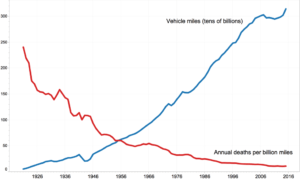
The principles behind HOP are grounded in the same philosophy that helped improve the design of our cars.  In the 1950s our cars did very little to protect us from our own errors; there were no seatbelts and no airbags; a head on collision sent the steering column through the driver’s chest and the engine into his lap.  Today, our cars are designed assuming the driver in the system will fail and the car will be crashed.  This thinking led to advances in technology that, throughout the years, have increased the ability for the driver to fail safely (survive a car crash), despite the increasing speed of travel and increasing numbers of the cars on the road.

The proof of the design effectiveness can be shown in car fatality data.  One chart on the subject is below.

US vehicle miles travels and proportionate fatality rates[1]

  “You can’t manage what you don’t understand” – E. Jacques

The mission of the HOP movement is to translate the philosophy that changed automotive design to the rest of the industrial world, with the aim of creating safety and quality systems that allow the human to fail safely (meaning, without resulting in unacceptable consequences).

Part of that translation is a recognition of an important truth: the automotive industry has a large advantage –almost every person on an automotive design team also drives.  This may seem like a minor point, but the details a driver (versus a non-driver) can bring to table have large design ramifications.

For example, if you’ve never driven a car, the rule to check your blind spot before changing lanes seems simple.  If you do drive, you recognize that despite knowing youshouldlook over your shoulder, every so often you forget, and you count on the driver in your blind spot hits his or her horn with enough time for you to avoid an accident.  A driversees the value in a blind spot warning sensor to help reduce the probability of a crash while changing lanes; value that a non-driver would struggle to see and most certainly not think to invent.

The level of operational intelligence (detail about driving) known by those on an automotive design team is often in stark contrast to the realities of the rest of the industrial world.  As an Environmental Health and Safety leader in a global company, part of my job responsibility was to create and enforce rules around driving forklifts…despite the fact that I had never driven a forklift in my entire career.   In our world, leaders are asked to manage process and systems they have had very little personal exposure to.  Part of what HOP teaches is that despite how normal this feels to us, you cannot manage what you don’t understand…not well, at least.

Operational Learning and Learning Teams

What do we do in light of this disadvantage? Enter Operational Learning stage right.  Operational Learning is a HOP based technique of learning from those closest to the work to gain operational intelligence (the detail we are missing from having never experienced the work first hand).  Operational Learning has proven to lead to the development of improvement actions that increase system resilience to human error by: addressing deviation prone rules, identifying error traps, and improving or adding defenses that reduce the consequences of human error.  One method of Operational Learning is conducting a Learning Team.  A Learning Team is a facilitated conversation between those that do the work and those that design the work to share operational intelligence between the two groups and improve system design.  A Learning Team can be used proactively (before we have had a failure) or reactively (after an event has occurred).

This brings us back to the story the CEO was so miffed by.   I was telling the story of one of the many post-event learning teams I have had the honor to be part of.  Rather than tell one of those stories here (they need more detail than a few pages can give justice to), let me instead share with you my experience around the arc of how a post-event learning team compares to a traditional investigation.

Investigation: An event occurs.  We ask our normal “investigation” questions.  We learn that someone made an error or broke a rule.  We have very few improvement options and are often left updating a procedure, or holding a safety “stand down,” or retraining some.  We end up frustrated with the employees for making a mistake or angry with them for breaking a rule.

Post-event Learning Team: An event occurs. We ask better questions that move us past the biases we have towards error and blame.  We learn an error was made or a rule was broken, but we also learn how the error was made and why the rule was broken.  We recognize we would have probably made a similar error or broken the same rule if we were doing the job, which in turn lets us acknowledge that the failure will inevitable be repeated unless we improve.  Our employees become our biggest asset in improving the system and we end up with a long list of possible improvement actions. Our working relationships and ability to solve problems improves.

The above description of a Post-event Learning Teams may seem like fabrication or fairytale to you (in fact, I’d be surprised if it didn’t).  This is part of the beauty of the HOP movement.  It only takes a few good conversations and a couple learning teams to show that it is true (seeing is believing) and the contrast between how we see the world before and after adopting the New View is so dramatic it can rewrite the rules of how we do business with each other (and even how we act in our personal lives).

The Skeptical CEO

How did the story with the skeptical CEO end? After an introduction to the New View mindset and seeing a learning team for himself, he became one of the biggest HOP advocates I have ever met, going as far as hiring a full time HOP expert to advise him and shape his company’s culture change.

And now he has hundreds of his own Learning Team stories to tell.

[1]http://www.newgeography.com/content/004892-is-suburbia-crashing-suburban-traffic-myths-refuted


Source: A Short Introduction to Human and Organizational Performance (HOP) and Learning Teams | Safety Differently

Open University Governing Complexity – developing appropriate praxis with citizens and organisations – recorded webcasts from June 2018

Governing Complexitiy
developing appropriate praxis with citizens and organisations

This event took place on 12th June 2018 at 9:30am (08:30 GMT)

09:30 Welcome. Professor Simon Lee, Director, Citizenship & Governance SRA.

09:40 Scene setting: why governing, why organizations; why citizens? Professor Ray Ison, OU Professor of Systems.]#

10:00 Insights from OECD case studies. Piret TõnuristOECD.

10:45 Table-based reflections: questions for the Pirect/OECD group and for framing the day.

11:30 Insights from employing a cadre of Systems Thinking Practitioners (STP): Professionalising, Contributions to Organizational Functioning. STP Employer Panel: Alice EvansLankelly Chase; Dave Kelly, Greater Manchester Police; Lee Hebert, Lloyds Bank.

12:15 Insights from being employed as a STP: Transforming organizational life…or not? STP Employee Panel: Dr Niki Jobson DSTL; John Rogers, Wiltshire Council.

13:30 Citizenship & Governance: Perspectives from policing; social enterprise & collaborative governing. Governing and Citizenship Panel 1. Professor Edoardo Ongaro; Dr Leslie Budd; Dr Karen Potter.

14:15 Plenary Discussion.

14:30 Researching STiP capability development – main findings. Governing as applied systems thinking in practice. Governing and Citizenship Panel 2. Dr Martin Reynolds & Dr Rupesh ShahEd Straw.

15:15 Plenary Discussion.

15:30 STP as an occupation: next steps. Alice Evans & Professor Ray Ison.

15:45 Reflections on the day. Piret Tõnurist & Professor Simon Lee.

16:00 Close.

Please select from replays below:

9:30 am Session 1
11:30 am Sesion 2
1:30 pm Session 3

Source: Governing Complexitiy – developing appropriate praxis with citizens and organisations

Unlocking Systems Change and Innovation In Housing – Louise Cannon (pdf)

Unlocking Systems Change and Innovation In Housing
Louise Cannon


(pdf) https://www.wcmt.org.uk/sites/default/files/report-documents/Canon%20L%20Report%202016%20Final.pdf


Webinar: System mapping as a tool for action | The Health Foundation

Webinar: System mapping as a tool for action

Interested in complex system mapping, but unsure about how it can help you find solutions to public health challenges in your own work?

Join our webinar for public health professionals on 4 December 2018. Hear practical examples of how system mapping has helped people tackle complex public health challenges, from the UK and further afield.

Hear the latest thinking about how to apply ‘system thinking’ in your own work, and discover how it can help you identify innovative ways to improve population health across the system.

Speakers

  • Professor Steven Allender, Professor of Public Health, Deakin University (via pre-record)
  • Debra Richardson, Consortium Strategic Lead, Derby a City on the Move, University of Derby
  • Professor Harry Rutter, Professor of Global Public Health, University of Bath

Register

Register for this webinar.

For more information, contact events@health.org.uk

Location details

Address: online event, accessed via PCs, smartphones and tablets

Source: Webinar: System mapping as a tool for action | The Health Foundation

About Strong Towns

[I’m a little bit in love with Strong Towns, a movement that is deeply systemic and deeply humanistic about the places we live (well, in the USA…). Check it out]

About Strong Towns

Learn about our history, our goals and how to get involved.

WHAT IS STRONG TOWNS?

Strong Towns is a media organization leading a national movement for change. We’re challenging every American to fundamentally rethink how our cities are built, and we’re shining a spotlight on an approach that will make us truly prosperous.

Curious? Learn more about what we do, our history and how to get involved in the tabs below.

What we do
History
Essential Reading and Listening
The Strong Towns Movement

WHAT WE DO

https://player.vimeo.com/video/118610305?wmode=opaque&api=1","url":"https://vimeo.com/strongtowns/curbsidechatintro","thumbnailUrl":"https://i.vimeocdn.com/video/505690174_295x166.jpg","resolvedBy":"vimeo"}” data-block-type=”32″>
https://player.vimeo.com/video/118610305?wmode=opaque&api=1” data-provider-name=””>

Here’s the introductory video in our Curbside Chat series, an essential Strong Towns analysis of why our cities are going broke and how we can build a better way forward. Watch the whole series here.

Why are so many cities and towns across North America going broke?Our roads are deteriorating. Our governments are in debt. No matter how much we increase them, our taxes aren’t enough to fix it all. And no one seems to be able to agree on how we got here — much less how to change the course. This isn’t just about numbers on a budget; it’s about the fate of the communities we love most and the real people in them.

At Strong Towns, our mission is to help cities, towns and neighborhoods become financially strong and resilient. And we’ve thought long and hard about the best way to do that. We firmly believe the most enduring changes are incremental and data-responsive, and can only happen from the bottom up — through the work of strong citizenslike you. What that means is, we won’t be handing you a blueprint.

Strong Towns will never produce a street design guide for engineers. We won’t tell you an ideal population density per acre. And we aren’t available for consultancy requests; we’re a nonprofit that’s doing something bigger than just helping one town or one county. Easy, one-size-fits-all solutions from the top down are what got American towns into the mess they’re in; we want to bring you something better.

“We aim to inspire readers to ask a different set of questions about the way their towns are built, and to encourage you to demand a better approach in the places you love.”

Instead, it’s Strong Towns’ goal to give you a process that can adapt to your community’s unique needs and change as your town grows stronger. We aim to inspire readers to ask a different set of questions about the way their towns are built, and to encourage you to demand a better approach in the places you love.

We publish daily written content, weekly podcasts, and interactive webcasts to keep you asking the hard questions, and show you some outstanding examples of people who have gotten it right. We bring live, community-specific events to towns across North America. And we foster an online community where Strong Towns members can organize, share resources, and keep inspiring one another to do more.

(Top photo by Joshuay04)

Source: About Strong Towns — Strong Towns

The Habit-forming Workshop to Becoming a Systems Thinker – Waters Foundation, 18 October, Arizona

The Habit-forming Workshop to Becoming a Systems Thinker

October 18 @ 9:00 am4:00 pm MST

$150

Date: October 18, 2018
Time: 9 a.m. – 4 p.m.
Location: Valley of the Sun United Way, 3200 E Camelback Rd #375, Phoenix, AZ 85018
Cost: $150/person. Includes lunch and all materials, including the Habit-forming Guide to Becoming a Systems Thinker book.
Facilitator: Sheri Marlin, Chief Learning Officer, Waters Foundation

Click here to register.

Click here to download the flier.

This workshop will use the book, The Habit-forming Guide to Becoming a Systems Thinker, to introduce the foundation of systems thinking.

A systems thinking point of view encourages individuals to step back and see the whole picture, rather than focusing on just its parts. When individuals have a clear and deep understanding of their jobs, departments, divisions or organizations as whole systems, they are better equipped to identify leverage actions that lead to improvements and desired outcomes.

Through highly interactive and innovative approaches, participants will learn and practice strategies that will inform the quality of day-to-day interactions and propel desirable outcomes.

Whether you are a student, professional, business leader, community volunteer, civic leader, or simply a lifelong learner, you will walk away with new ideas, insights and skills to impact your system.

The day will be filled with interactive, hands-on activities for participants to understand and practice systems thinking concepts, including:

  • Learning and applying the 14 Habits of a Systems Thinker in a variety of contexts.
  • Understanding the causal interdependencies that influence the behavior of complex systems.
  • Identifying mental models that may influence behavior and actions.
  • Discovering concrete strategies to impact systems.
  • Practicing problem solving, decision making, and communication within groups that are made up of diverse perspectives working toward a common goal.

A special THANK YOU to Valley of the Sun United Way for opening the doors of their facility for this workshop.

90

Details

Date:
October 18
Time:
9:00 am–4:00 pm
Cost:
$150
Website:
https://watersfoundation.wufoo.com/forms/pyjmfg012o5cho/

Organizer

Waters Foundation
Phone:
412-968-9700
Email:
info@watersfoundation.org
Website:
www.watersfoundation.org

Venue

Valley of the Sun United Way
3200 E Camelback Rd #375
Phoenix, AZ 85018 United States
+ Google Map

Use ctrl + scroll to zoom the map

Map data ©2018 Google

<img src="data:;base64,

<img src="data:;base64,

<img src="data:;base64,

<img src="data:;base64,
Map
Satellite


Source: The Habit-forming Workshop to Becoming a Systems Thinker – Waters Foundation

s
search
c
compose new post
r
reply
e
edit
t
go to top
j
go to the next post or comment
k
go to the previous post or comment
o
toggle comment visibility
esc
cancel edit post or comment