Bacteria Use Brainlike Bursts of Electricity to Communicate | Quanta Magazine


Source: Bacteria Use Brainlike Bursts of Electricity to Communicate | Quanta Magazine

Bacteria Use Brainlike Bursts of Electricity to Communicate

With electrical signals, cells can organize themselves into complex societies and negotiate with other colonies.

Olena Shmahalo/ Quanta Magazine

Bacteria have an unfortunate — and inaccurate — public image as isolated cells twiddling about on microscope slides. The more that scientists learn about bacteria, however, the more they see that this hermitlike reputation is deeply misleading, like trying to understand human behavior without referring to cities, laws or speech. “People were treating bacteria as … solitary organisms that live by themselves,” said Gürol Süel, a biophysicist at the University of California, San Diego. “In fact, most bacteria in nature appear to reside in very dense communities.”

The preferred form of community for bacteria seems to be the biofilm. On teeth, on pipes, on rocks and in the ocean, microbes glom together by the billions and build sticky organic superstructures around themselves. In these films, bacteria can divide labor: Exterior cells may fend off threats, while interior cells produce food. And like humans, who have succeeded in large part by cooperating with each other, bacteria thrive in communities. Antibiotics that easily dispatch free-swimming cells often prove useless against the same types of cells when they’ve hunkered down in a film.

As in all communities, cohabiting bacteria need ways to exchange messages. Biologists have known for decades that bacteria can use chemical cues to coordinate their behavior. The best-known example, elucidated by Bonnie Bassler of Princeton University and others, is quorum sensing, a process by which bacteria extrude signaling molecules until a high enough concentration triggers cells to form a biofilm or initiate some other collective behavior.

Continues in source: Bacteria Use Brainlike Bursts of Electricity to Communicate | Quanta Magazine


Information gerrymandering and undemocratic decisions

cxdig's avatarComplexity Digest

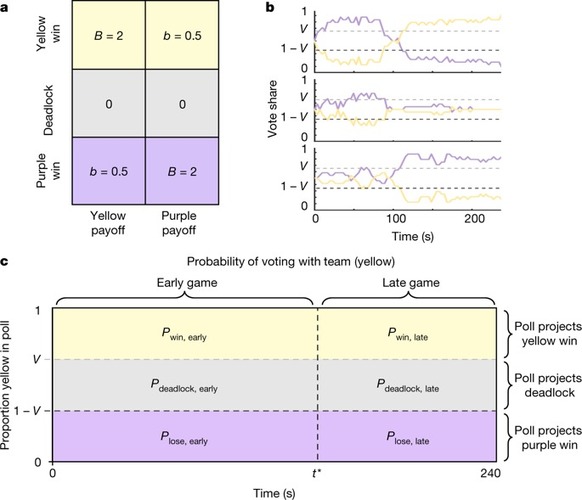
In a voter game, information gerrymandering can sway the outcome of the vote towards one party, even when both parties have equal sizes and each player has the same influence; and this effect can be exaggerated by strategically placed zealots or automated bots.

Information gerrymandering and undemocratic decisions
Alexander J. Stewart, Mohsen Mosleh, Marina Diakonova, Antonio A. Arechar, David G. Rand & Joshua B. Plotkin
Naturevolume 573, pages 117–121 (2019)

Source: www.nature.com

View original post

Scale-free networks – rare or…?

Paper: Scale-free networks are rare (Broido and Clauset, 2019) | Nature

A new study challenges one of the most celebrated and controversial ideas in network science. (See comments for reflections on the controversy)

Source: Scant Evidence of Power Laws Found in Real-World Networks | Quanta Magazine

Are scale-free networks rare or universal? Important or not? We present the recent research about degree distributions of networks. This is a controversial topic, but, we argue, with some adjustments of the terminology, it does not have to be.

Source: Rare and everywhere: Perspectives on scale-free networks, Petter Holme (2019) | Nature

Discussion and links: Scale-free networks are rare

A study’s failure to find scale-free networks where decades of research has documented their existence offers a cautionary tale on using search criteria that fails elementary tests.

Source: Love is All You Need – Albert-László Barabási responds


The Neuroscience of Reality

(Article unforunately paywalled)

cxdig's avatarComplexity Digest

  • The reality we perceive is not a direct reflection of the external objective world.
  • Instead it is the product of the brain’s predictions about the causes of incoming sensory signals.
  • The property of realness that accompanies our perceptions may serve to guide our behavior so that we respond appropriately to the sources of sensory signals.


The Neuroscience of Reality

Anil Seth

Scientific American

Source: www.scientificamerican.com

View original post

Haines Centre Australia – articles, eBooks & complimentary webinars 


Source: Resources – articles, eBooks & complimentary webinars | Haines Centre Australia

Resources – articles, eBooks & complimentary webinars

The powerhouse behind The Systems Thinking Approach is SystemsThinkingPress.com.

SystemsThinkingPress

SystemsThinkingPress

Complete the form below to receive a link to e-books.

Name(required)
Email(required)
Website
Comment(required)
eBooks – drop down list
Pearls of Wisdom
Destination Thinking
Strategic Thinking Handbook #1 – Top 10 Tools for Daily Problem Solving
Strategic Thinking Handbook #2 – Top 10 Everyday Tools for Strategic Thinking
Reinventing Strategic Planning – The Systems Thinking Approach
Strategic Planning Simplified (Workbook)
Strategic Thinking for Leaders – 50 One-minute Leadership Tips
Enhancing Your Strategic IQ – Winning Strategies from A to Z
The ABCs of Strategic Life Planning – Systems Thinking Approach to a Fulfilling Life and Career
The ABCs of Strategic Management
Executing Your Strategic Plan
Strategic and Systems Thinking
Templates:  Marketing and sale plan templates  Strategic Plan templates

Submit

RECORDED FREE WEBINARS:

Download links for the 12 part systems thinking conversation series: click HERE for summary article – each of the 12 characteristics of open systems.  Below are separate links each to as 45 minute recording: #1HOLISM#2OPEN SYSTEMS; #3SYSTEM BOUNDARIES#4LOOPS#5FEEDBACK#6MULTIPLE OUTCOMES#7EQUIFINALITY#8ENTROPY; #9NESTED SYSTEMS; #10INTER-CONNECTEDNESS; #11DYNAMIC EQUILIBRIUM; #12INTERNAL ELABORATION.

INTEGRATING RISK, GOVERNANCE AND STRATEGY: THE SYSTEMS THINKING APPROACH® PART 1: An Introduction click HERE

INTEGRATING RISK, GOVERNANCE AND STRATEGY: THE SYSTEMS THINKING APPROACH® PART 2: The board’s role Steps 1, 2 & 3 click HERE

COMPLIMENTARY ARTICLES:

Becoming a Strategic Thinker: Raising your Strategic IQ for every day success click HERE to download our 8 page article

Strategic & Systems Thinking: “The Natural Way the World Works” click HERE to download our 4 page article

Strategic ThinkingThe Winning Formula The Systems Thinking Approach® click HERE to download our 4 page article

Smart Start:Plan-to-Plan : Building Strong Foundations for Successful Strategic Planning click HERE to download our 8 page article

The Rollercoaster of Change: The natural, normal and highly predictable cycles of life – click HERE to download our 8 page article

The Parallel Involvement Process: People support what they help create – click HERE to download our 4 page article

Future Environment Scanning (FES): Scanning the Future Environment click HERE to download 4 page article

Effective Governance: Using the systems thinking approach – click HERE to download our 4 page article

Systems Thinking: Foundational Research – complimentary summary article – click HERE to download PLUS The BIG 4 CONCEPTS: Foundation research model – click HERE to download the model

The 12 Laws applied: Adapted from General Systems Theory – click HERE to download application guide

Structures Influence Behavior – The #1 Systems Thinking Leverage Point for Change – click HERE to download complimentary article

Systems thinking template worksheet – Blowing out bureaucracy exercise using the systems thinking approach – click HERE to download complimentary article

SIX SIGMA – The Systems Thinking Approach to Six Sigma – click HERE to download complimentary article

How to Avoid the Top Strategic Management Failures – click HERE to download complimentary article

STRATEGIC & SYSTEMS THINKING RESOURCES:

State-of-the-art summary of Leading Strategic Change – Click link HERE to download

State-of-the-art summary of Reinventing Strategic Planning – Click link HERE to download

The Pearls of Wisdom (eBOOK) : the systems thinking approach to facilitation (tools, tips and techniques for Group Leaders, Managers & Executives) – click link HERE to download a complimentary e-book
Author:  Stephen Haines

Destination Thinking (eBOOK):  A business planning guide and survival kit for Executives, Senior Management & Functional Area Team Leaders – to download a complementary summary article for Government/NFP click HERE and for private/commercial click HERE
Authors:  Stephen Haines with V. MacLeod and Terry Schmidt

Systems Thinking:  The New Frontier (eBOOK): This book is a culmination of his lifelong search for knowledge and a personal journey to understand and apply Systems Thinking to his life and work – click link HERE to download a free sample preview Author:  Stephen Haines

Strategic Human Resource Planning: The Systems Thinking Approach® to Strategic People Management Authors: Allan Bandt and Stephen Haines click link HERE to download a free sample preview

Strategic Thinking Handbook #1  – Top 10 Tools for Daily Problem Solving  
Author:  Stephen Haines

Strategic Thinking Handbook #2 – Top 10 Everyday Tools for Strategic Thinking  
Author:  Stephen Haines

Reinventing Strategic Planning – The Systems Thinking Approach
Author:  Stephen Haines with Jim McKinlay

Strategic Planning Simplified (Workbook)
Author:  Stephen Haines

Strategic Thinking for Leaders (eBOOK) – 50 One-minute Leadership Tips: A quick, easy guide to successful leadership using the systems thinking approach – Click HERE to download your complimentary copy.
Editor:  Stephen Haines

Enhancing Your Strategic IQ – Winning Strategies from A to Z
Authors:  Stephen Haines with Stephen Lin

The ABCs of Strategic Life Planning – Systems Thinking Approach to a Fulfilling Life and Career – Click HERE to download your complimentary copy
Author:  Stephen Haines

The ABCs of Strategic Management (Code: EBRSP) Download systems thinking strategy CANVAS click HERE

Haines Centre’s 25 Best Practices for installing a Strategic Management Yearly Cycle and System (Code: I25BP) Download your self-assessment tool HERE

Executing Your Strategic Plan (Code: EWC) Download systems thinking strategic implementation CANVAS click HERE

Strategic and Systems Thinking (Code: B-SST)


Source: Resources – articles, eBooks & complimentary webinars | Haines Centre Australia


Foucault on the art of distributions

Carlton Clark's avatarSocial Systems Theory

I’ve been trying to make connections between Luhmann and Foucault. In Discipline and Punish, Foucault writes,

In the first instance, discipline proceeds from the distribution of individuals in space. To achieve this end, it employs several techniques. [. . .]

But the principle of ‘enclosure’ is neither constant, nor indispensable, nor sufficient in disciplinary machinery. This machinery works space in a much more flexible and detailed way. It does this first of all on the principle of elementary location or partitioning. Each individual has his own place; and each place its individual. Avoid distributions in groups; break up collective dispositions; analyse confused, massive or transient pluralities. Disciplinary space tends to be divided into as many sections as there are bodies or elements to be distributed. One must eliminate the effects of imprecise distributions, the uncontrolled disappearance of individuals, their diffuse circulation, their unusable and dangerous coagulation; it…

View original post 430 more words

Wicked Problems: The Implications for Public Management, and Wicked Problems in Public Policy, both 2008


Source: Wicked Problems: The Implications for Public Management

January 2008


Source: Wicked Problems in Public Policy

January 2008

Brian Head

Cybernetics – Wikipedia

Quite a good intro

Source: Cybernetics – Wikipedia

CYBERSYN/Cybernetic Synergy – Chilean website

I can’t think that we’ve had this link before

Source: :::::CYBERSYN/Cybernetic Synergy::::

Leadership and Language in Regenerating Organizations – Paul Pangaro’s ‘Little Grey Book’


Source: Leadership and Language in Regenerating Organizations

TEXT

Notes on the Role of Leadership and Language in Regenerating Organizations

Overview


This small publication, “the little grey book”, applies cybernetic principles to customer relationships in changing markets. It was the result of close collaboration among Hugh Dubberly, Peter Esmonde, Michael C Geoghegan, and Paul Pangaro, produced for Sun Microsystems.

It has implications for organizations that face change—namely, every organization—and provides both an explanation for why great companies fail, and how they can avoid failure.

Click here for additional spreads of the book.

Publication


DownloadDownload (PDF)

Related Materials


Source: Leadership and Language in Regenerating Organizations

The physics professor (Neil Johnson) who says online extremists act like curdled milk | Science | The Guardian


Source: The physics professor who says online extremists act like curdled milk | Science | The Guardian


The physics professor who says online extremists act like curdled milk

Hate may be less like a cancer and more like bubbles, says Neil Johnson, who applies physics theory to human behavior

Hand pouring milk
‘If you have milk in the fridge, one day that milk suddenly curdles.’ Photograph: Tetra Images/Getty Images/Tetra images RF

Lone wolves. Terrorist cells. Bad apples. Viral infections.

The language we use to discuss violent extremism is rife with metaphors from the natural world. As we seek to understand why some humans behave so utterly inhumanely, we rely on comparisons to biology, ecology and medicine.

But what if we’ve been working in the wrong scientific discipline? What if the spread of hate is less like the spread of cancer through the proverbial body politic and more like … the formation of bubbles in a boiling pot of water?

That is the contention of Neil Johnson, a professor of physics at George Washington University and the lead author on a study published this week in Nature analyzing the spread of online hate. If that sounds like an odd topic for a physicist – it is. Johnson began his career at the University of Oxford, where he published extensively on quantum information and “complexity theory”. After moving to the US in 2007, he embarked on a new course of research, applying theories from physics to complex human behavior, from financial markets and conflict zones to insurgency and terrorist recruitment.

The interview has been edited and condensed for length and clarity.

Continues in source: The physics professor who says online extremists act like curdled milk | Science | The Guardian

Modeling Major Transitions in Evolution with the Game of Life – Peter D Turney (2019)


Source: [1908.07034] Modeling Major Transitions in Evolution with the Game of Life

Computer Science > Neural and Evolutionary Computing

Modeling Major Transitions in Evolution with the Game of Life

Maynard Smith and Szathmáry’s book, The Major Transitions in Evolution, describes eight major events in the evolution of life on Earth and identifies a common theme that unites these events. In each event, smaller entities came together to form larger entities, which can be described as symbiosis or cooperation. Here we present a computational simulation of evolving entities that includes symbiosis with shifting levels of selection. In the simulation, the fitness of an entity is measured by a series of one-on-one competitions in the Immigration Game, a two-player variation of Conway’s Game of Life. Mutation, reproduction, and symbiosis are implemented as operations that are external to the Immigration Game. Because these operations are external to the game, we are able to freely manipulate the operations and observe the effects of the manipulations. The simulation is composed of four layers, each layer building on the previous layer. The first layer implements a simple form of asexual reproduction, the second layer introduces a more sophisticated form of asexual reproduction, the third layer adds sexual reproduction, and the fourth layer adds symbiosis. The experiments show that a small amount of symbiosis, added to the other layers, significantly increases the fitness of the population. We suggest that, in addition to providing new insights into biological and cultural evolution, this model of symbiosis may have practical applications in evolutionary computation, such as in the task of learning deep neural network models.

Subjects: Neural and Evolutionary Computing (cs.NE); Populations and Evolution (q-bio.PE)
ACM classes: I.6.3; I.6.8; J.3
Cite as: arXiv:1908.07034 [cs.NE]
(or arXiv:1908.07034v1 [cs.NE] for this version)


Source: [1908.07034] Modeling Major Transitions in Evolution with the Game of Life


Empowering the Whole System – Distributed Leadership in Action, using Barry Oshry’s power+systems approach to see the power of context 1500-1700 BST, Tuesday 8 October (online)


Source: Empowering the Whole System – Distributed Leadership in Action Tickets, Tue 8 Oct 2019 at 15:00 | Eventbrite

Oct 8

Empowering the Whole System – Distributed Leadership in Action

by Future Considerations, JB Vista & Living Leadership

£70

Discover the power of Barry Oshry’s work
See how context shapes behaviour
Lead with systems insight

Barry Oshry‘s powerful work on system dynamics reveals how context shapes behaviour and consciousness – what we see, think and feel about ourselves and others.

Oshry’s work highlights that the problems we believe to be personal or interpersonal – “I’m not being effective in my role”, “If only I had a better boss, things would be OK”,”We’re not a good team“ – are not primarily personal problems. The workshop illuminates how our blindness to context kills trust, increases blame, corrodes potentially supportive and productive relationships and stops us from making a reality of distributed leadership.

This facilitated online workshop uses an experiential simulation to briefly immerse people in three leadership contexts that we encounter every day. We explore how we blindly fall into limiting patterns of behaviour and we highlight the empowering actions that are possible in each context. Distributed leadership sees an organisation as an interconnected whole where each part has unique power to contribute to the survival and vitality of the system. Oshry’s work throws new light on what constrains and enables distributed leadership.

What can you expect?

  • An engaging and thought-provoking workshop.
  • Experiential work and dialogue with some of the world’s leading practitioners of this approach.
  • Identifying next steps to deepen your systems leadership

By the end of the workshop you will:

  • Understand the impact of context on leadership behaviours and actions.
  • Gain new insights into how to make distributed leadership a reality.
  • Have tasted the breadth and depth of Barry Oshry’s work.

When?

1500-1700 BST, Tuesday 8 October.

This workshop time is particularly convenient for those in European, USA, Canada & South American timezones. (London BST 1500, Boston EST 1000, Chicago CST 0900, Vancouver PST 0800, Rio De Janeiro 1100).

Limited numbers, prior booking essential.

How long and where?

2 hour duration via Zoom online platform.

How much?

GBP £70 (approx USD $90). Limited bursaries available.

Who is leading the workshop?

John Watters is one of the leading authorities on Barry Oshry’s systems leadership work having worked closely with Barry Oshry for 20 years. John uses this framework in his consulting work with organisations of all sizes and sectors across the world. He specialises in working with complex challenges that involve multiple stakeholders; creating the conditions for fundamental shifts in performance and realising personal and organisational purpose. John is Managing Director of Living Leadership, Associate of Future Considerations and Senior Associate of Power+Systems.

Ali Warner is an Associate of Future Considerations and Living Leadership, and an experienced trainer in all of Barry Oshry’s frameworks. She specialises in arts-based facilitation practices including graphic harvesting, creating eye-catching hosting materials and leading voice & body work, which she offers in a wide range of contexts from large organisations to community groups. She also performs as a singer, with a particular focus on traditional song and experimental free improvisation.

Julie Beedon is Director of JBVista, an accredited trainer in the Organisation Workshop and a long-time collaborator of Barry Oshry. Julie brings a passion, energy and depth of experience in applying whole systems change principles and is a pioneer in the field of working with large groups. Julie is also a Director of the NTL UK OD Certificate Programme and on the Board of ODN Europe.

For any questions, please contact: angela@futureconsiderations.com

Participant feedback from first online ‘Empowering the Whole System’ workshop, 3 April 2019

“ Very apt and applicable to all types of organizations. And the learning is to find ways of improving clarity and communication to break the negative patterns”“The impact of the online activity – simple yet impactful”

“An interesting exercise with lots of insights to take away”

“Introduction of the core idea and research – clear, simple, thorough, friendly”

“ Interesting that it’s the same everywhere! Good to see a light at the end of the tunnel for changing how we work”.

“ We were 3 consultants from EU and US – and all saw these patterns in our client organizations”

“ That we all step in and out of these roles within our lives and there seems to be the possibility to empower ourselves in any moment by “seeing” our emergent responses and then asking what our “creative contributions” might be.

“Great event, got plenty of new ideas”

Testimonials about Barry Oshry’s Organisation Workshop

“Insightful, moving. The best training I’ve ever taken part in.”

Emma Kenny, Head of Strategy, National Citizen Service, UK

“It’s easy to underestimate the power of Oshry’s work until you have taken this workshop. It was a life changing experience. You will find instant applications to both your personal and professional life.”

Seema Malhotra, MP for Feltham and Weston, UK

“The Organisation Workshop is an astonishing and reliable process. I’ve experienced it in several different cultures and amongst very different people. It never fails to reveal the dynamics of leadership and power in organisations that are universal.”

Margaret J, Wheatley PhD, Author, Who Do you Choose to Be?

Source: Empowering the Whole System – Distributed Leadership in Action Tickets, Tue 8 Oct 2019 at 15:00 | Eventbrite

Complexity in Human Systems Symposium – Nov 7-8 2019, Washington DC, USA

I think that if this is, as Dave Snowden claims in explaining that he set up this event, truly focused on avoiding gurus and fads (“Generally each fad provides value but suffers by (i) rejecting everything that happened in the past and (ii) seeing to claim universal applicability”), and set up to “understand differences and commonalities and in general advance the field”, then that would be a good thing.


Source: Complexity in Human Systems Symposium


Nov 7-8, 2019 | JW Marriott, Washington DC

Complexity in Human Systems: Next Paradigm of Management?

Stephen Hawking famously said that this century would be the century of complexity. From its early days in the Santa Fe Institution, complex adaptive systems theory has increasingly moved from the world of academia to practice. Sometimes known as the science of uncertainty, it provides radically new ways to understand how to create organizations that are resilient and adaptive. This day-and-a -half symposium, a joint production of the Cynefin Centre for Organizational Complexity, Information Today, Inc. and Dysart & Jones Associates, brings together some of the leading academics, thinkers, and practitioners in the field of complexity to discuss a range of topics that include the following:

  • How can government and industry more effectively navigate the multiple uncertainties of a hyper-connected world?
  • What insights does complexity science give to the development of doctrine and strategy?
  • How does complexity transform our understanding of design and innovation from the linear processes of design thinking to something dynamic and radically creative?
  • What are the models of leadership appropriate for conditions of growing uncertainty?
  • What are the implications for individual development, agency, and organization growth that arise from complexity and cognitive science?
  • What is the role of art in human intelligence? Aesthetics and semiotics can have a profound impact on organizational change.
  • What are new ways of ensuring impact that avoid the gaming and misdirection of KPIs?

This is a chance to be there at the first major event to discuss and co-create a radical new sets of ideas. In keeping with the theme, the event will not be organized around traditional keynotes, but instead on multiple structured interactions between experts and attendees to allow new insights and understanding to emerge. Einstein stated that “The definition of genius is taking the complex and making it simple.” to which we can add “but not simplistic”. Watch the website for updates and new additions to our expert panels with whom you will get a chance to interact. Register and join the conversation at this exciting learning and networking event.

Facilitated By

Patrick Lambe, Partner, Straits Knowledge
Euan Semple, Author, Facilitator & Business Strategist

Faculty

Sonja Blignaut, Cognitive Edge
Kevin Dooley, Arizona State University & Sustainability Consortium
Glenda Eoyang, Executive Director, Human Systems Dynamics Institute
Alicia Juarrero, President and Founder, VectorAnalytica, Inc. and Author, Dynamics in Action: Intentional Behavior as a Complex System
Benyamin Lichtenstein, College of Management, U-Mass Boston
Michael Lissack, President, American Society for Cybernetics
Martin Reynolds, Systems Thinking, Open University
Dave Snowden, Chief Scientific Officer, Cognitive Edge
Tom Stewart, Author & Ohio State University
Mary Uhl-Bien, School of Business, Texas Christian University

Thursday, Nov 7

Complexity In Human Systems

Opening Keynote Panel – 2020 & Beyond: Creating Resilience In Organizations & Society

Thursday, November 7: 4:00 p.m. – 5:00 p.m.

We live in a world which promises infinite choice, but are we more trapped in the patterns of past practice than we care to think? Is the hierarchical or matrixed organization fit for purpose in a world of increased uncertainty and volatility? Governments have increasing legitimate demands on their resources from citizens and the wider needs of the planet, but few resources to deal with it. Ideology and belief seem at times to triumph over fact, evidence, and reason. Have we gone beyond even post-modernism into a new world with constantly shifting paradigms and increasingly less time to adjust to them? Our panel looks at these questions from the perspectives of knowledge and complexity. They discuss transforming and revolutionizing the way we do business as we move into an uncertain future, how we satisfy our clients in an ever-changing technological age, and how, in our complex societies, we provide value, exchange knowledge, innovate, grow and support our world. Our panel of experienced thinkers and doers shares their insights about what we should be doing to further develop a sustainable ecosystem in our organizations, communities, and world.

Speakers:Patrick Lambe, Principal Consultant, Straits Knowledge, Singapore

Dave Snowden, Chief Scientific Officer, Cognitive Edge

Tom Stewart, Executive Director, National Center for the Middle Market, Fisher College of Business, The Ohio State University

Alicia Juarrero, Founder and President, VectorAnalytica, Inc. and Author, Dynamics in Action: Intentional Behavior as a Complex System

Complexity In Human Systems Café: Networking Reception

Thursday, November 7: 5:15 p.m. – 7:00 p.m.

Speakers:Kevin Dooley, Professor, Arizona State University and Chief Research Officer, The Sustainability Consortium

Sonja Blignaut, Networks & Partnerships, Cognitive Edge

Glenda Eoyang, Executive Director, Human Systems Dynamics Institute

Alicia Juarrero, Founder and President, VectorAnalytica, Inc. and Author, Dynamics in Action: Intentional Behavior as a Complex System

Patrick Lambe, Principal Consultant, Straits Knowledge, Singapore

Benyamin Lichtenstein, College of Management, U-Mass Boston

Michael Lissack, President, American Society for Cybernetics and Executive Director Emeritus, the Institute for the Study of Coherence and Emergence; Professor of Design and Innovation at Tongji University, Shanghai

Martin Reynolds, Senior Lecturer in Systems Thinking, Open University

Euan Semple, Director, Conference Chair, & Author, Euan Semple Ltd

Dave Snowden, Chief Scientific Officer, Cognitive Edge

Tom Stewart, Executive Director, National Center for the Middle Market, Fisher College of Business, The Ohio State University

Mary Uhl-Bien, Professor of Management, Neeley School of Business, Texas Christian University

Friday, Nov 8

Complexity In Human Systems Symposium

Moving The Complexity Field Forward: Leadership

Friday, November 8: 8:30 a.m. – 10:15 a.m.

Direction/Strategy/Planning

Friday, November 8: 10:45 a.m. – 12:00 p.m.

Open Space Discussion

Friday, November 8: 1:00 p.m. – 2:15 p.m.

Resilience & The Future Through A Complexity Lens

Friday, November 8: 2:45 p.m. – 4:00 p.m.

Convergence & Manifesto

Friday, November 8: 4:00 p.m. – 5:00 p.m.

Registration Includes

The Complexity in Human Systems Symposium is co-located with KMWorld 2019 and is only available as a separate registration option. Please note that registration to the Complexity in Human Systems Symposium is NOT included with Platinum, Gold, or Full Conference pass types. Separate registration is required.

  • Access to Complexity in Human Systems Syposium sessions
  • Opening Keynote Panel* and Evening Networking Cafe & Reception on Thursday, November 7
  • Light Continental Breakfast, Breaks, and Lunch on Friday, November 8

*Attendees are invited to join the KMWorld 2019 Closing Keynote Panel on Thursday afternoon. The Symposium will kick off that same evening with an opening panel discussion and networking reception.

Source: Complexity in Human Systems Symposium


Systems Thinking Ontario – 2019-09-16 – Critical Systems Thinking

“The systems thinking community has an ecology of approaches. How can we make sense of when and where we might apply specific theories and/or methods?”


See source for images

Source: Systems Thinking Ontario – 2019-09-16

2019-09-16

September 16 (the third Monday of the month, taking account of schools starting up!) is the 71st meeting for Systems Thinking Ontario. The registration is on Eventbrite at https://systems-paradigms.eventbrite.com

The systems thinking community has an ecology of approaches. How can we make sense of when and where we might apply specific theories and/or methods?

Intervening in human systems has been a focus of Critical Systems Thinking. Categorizations of systems paradigms began with roots by Burrell & Morgan (1979), with four paradigms for the analysis of social theory. [SVG] [ODG]

A similar form can be seen in a grid of “ideal-type” problem contexts in Jackson (2003). [SVG] [ODG]

In a System of Systems Methodologies, systems approaches can be related to problem contexts in Jackson (2003). [SVG] [ODG]

Venue:

  • TBD

Suggested pre-reading:

Reading more systems thinking texts may not help your understanding! This is why we have Systems Thinking Ontario meetings. For the diligent, the principal references cited above are:

Agenda

[see source for images]

Post-meeting artifacts

Enthusiasts may be interested in further background from Burrell & Morgan (1979).

A scheme for analysing assumptions on the nature of social science. [SVG] [ODG]

Two theories of society: “order” and “conflict” [SVG] [ODG]

The regulation-radical change dimension [SVG] [ODG]

Source: Systems Thinking Ontario – 2019-09-16