Complicated & Complex Systems in Safety Management | Safety Differently

Worth going to the source to look at the comments

Source: Complicated & Complex Systems in Safety Management | Safety Differently

COMPLICATED & COMPLEX SYSTEMS IN SAFETY MANAGEMENT

When General Stanley McChrystal took over the U.S. Joint Special Operations Command[1] (JSOC) in Iraq during the mid-2000s, he inherited an organisation struggling to overcome the Al Qaeda insurgency plaguing the country. After a few weeks in the job, he realised his new team had been viewing their enemy through the wrong lens, and therefore had been using the wrong strategies to defeat them. Ultimately, this insight led him to revolutionise the Command’s structure, and challenge its very core beliefs about how it could win the war.

At the heart of McChrystal’s revolutionary strategy was an appreciation for the difference between systems that are complicated and those that are complex.[2]

When people describe something as complex, what they usually mean is they think it’s really complicated. This suggests that there is a continuum of ‘complicatedness’ and that the difference between a complicated and a complex system is one of degrees, rather than type. In reality, a complex system is fundamentally different from a complicated one. It’s critical that we understand how they are different, and why this knowledge is important if our goal is to manage the safety of a system.[3]

What is a system?

A system can be defined as anything that involves ‘a set of things working together as parts of a mechanism or an interconnecting network’.[4] Examples of systems include an analogue watch, an underground rail network, an air conditioner, a business, a car, a skeleton, an aeroplane, a person, or a government. The way we think about the systems around us influences the methods we choose to solve the problems they pose.

It’s complicated

Traditional thinking tends to lead us to see all systems around us as complicated. A complicated system is usually something technical or mechanical and has many interacting parts.

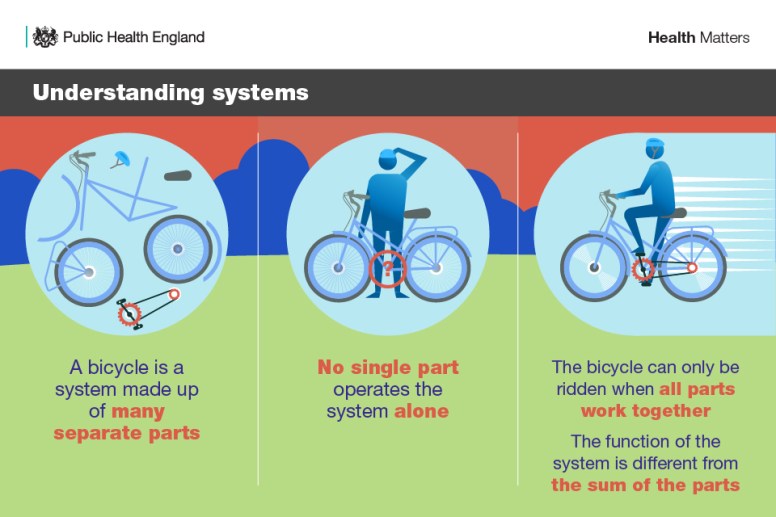
Think of a jet engine. It contains thousands of mechanical parts, and to understand how it works you can read a manual that will tell you everything you need to know. If it stops working, you can take it apart, locate the broken component, replace it, and return the engine to service. This type of problem-solving works well with complicated systems because they work in a linear way, and are fully knowable (with enough study). The whole is equal to the sum of its parts.[5]

In complicated systems, unwanted events and outcomes (e.g. oil leak) are usually the direct result of component failures. The possible range of outcomes is finite because the system has been carefully designed for a specific purpose.

Unfortunately, problems start to arise when we treat complex systems as if they were complicated. This is exactly where the JSOC found themselves in the fight against Al Qaeda when McChrystal took over. They had been imagining their adversary as a traditional, hierarchical army with clear lines of vertical command and control; a complicated system. In reality, Al Qaeda was a complex web of cells interacting and operating in unpredictable ways, for which traditional battle tactics were useless.

No, it’s complex!

Complex systems are fundamentally different from their complicated cousins. They contain the same technical components (e.g. physical equipment and computers) but also consist of human elements and vast social networks.

A prime example of a complex ‘socio-technical’ system is an organisation, such as an airline. Airlines consist of many technical elements, like the aircraft and the IT, but also many forms of social systems, like management teams, frontline workforces, and customers.

Systems typically become complex by default when individuals or groups of people are added to them. Returning to the example of the jet engine – which we recognise as a complicated technical system – as soon as we decide to perform some maintenance on that engine, the new system we’ve created, ‘jet engine maintenance’, automatically becomes complex. This new system contains human, social and organisational elements (policies, procedures, culture etc.), as well as technical parts.

In complex systems, unwanted outcomes do not occur solely due to individual component failure, but most often they emerge from the unpredictable interactions between the components. For example, the way an engineer interacts with company policies, procedures, goal conflicts, organisational culture, their team, the environment, etc. when maintaining an engine.

If we think of the total aviation system, acknowledging that it is complex, then we recognise that the millions of sub-systems within it (ATC, airports, airlines, manufacturers, maintainers, etc.) will all interact with each other in complex and unpredictable ways. That means that any attempt to assert control over the system will ultimately fail because complex systems cannot be controlled in the same way that complicated ones can.

Critically, in a complex system, the whole is greater than the sum of its parts because outcomes emerge in ways that cannot be totally controlled or predicted.

McChrystal helped his team to see Al Qaeda as a complex web of unpredictable and adaptive elements. This meant employing fundamentally different strategies of battle, which ultimately led to significantly greater success in their fight.

What does this mean for how we manage safety and risk?

It’s natural and normal for us to treat complex problems as if they were complicated; to reduce them down to their parts and change out the troublesome component. This is after all how most formal education teaches us to solve problems; by ‘analytical reductionism’.

But in 21st-century airline safety, most of the time we’re dealing with human work performed by pilots, engineers, ground staff, and cabin crew. We can’t truly understand human work – how it normally goes right and sometimes go wrong – using the same methods we use to understand technical objects.

This means that when we’re looking for strategies to solve human-centred safety problems, we need to apply complex systems thinking to the task. This means avoiding the temptation to disassemble the problem to find the broken ‘component’ (human).

As safety leaders and practitioners we should use the thinking, methods, and tools that help us to understand the complex and dynamic nature of the systems we operate. We need to study the interactions, patterns and feedback loops in our systems and identify how small changes can lead to disproportionately large and unintended consequences.

Whether we’re designing new policies and procedures, investigating a maintenance error, or risk assessing a new piece of equipment, we instead need to consider safety in the context of the overall system – to think holistically and embrace complexity.

When writing about systems, one can’t finish a piece without quoting the great Russell Ackoff. A little Ackoff wisdom goes a long way:

“To manage a system effectively, you might focus on the interaction of the parts rather than their behavior taken separately.”

References

[1] https://en.wikipedia.org/wiki/Joint_Special_Operations_Command

[2] https://tinyurl.com/y4vcogp9

[3] https://tinyurl.com/y2ty5wkw

[4] https://www.lexico.com/en/definition/system

[5] https://www.skybrary.aero/bookshelf/books/2882.pdf

Source: Complicated & Complex Systems in Safety Management | Safety Differently


The International Society for the Systems Sciences – time to join?

From what I’ve seen, there seems to be a great and positive increase in activity and engagement in the ISSS at the moment – no disrespect to past Presidents, but Peter Tuddenham seems to have kicked off a lot of activity – for example, weekly Special Interest Group Zoom calls internationally. Worth a look!

Website with membership: Register


Recent update summarising the ISSS 2019 conference and annual meeting below – some content available to members only…

ISSS 2019 Conference and Annual Meeting

This email is from Peter Tuddenham, as Past-President of ISSS.

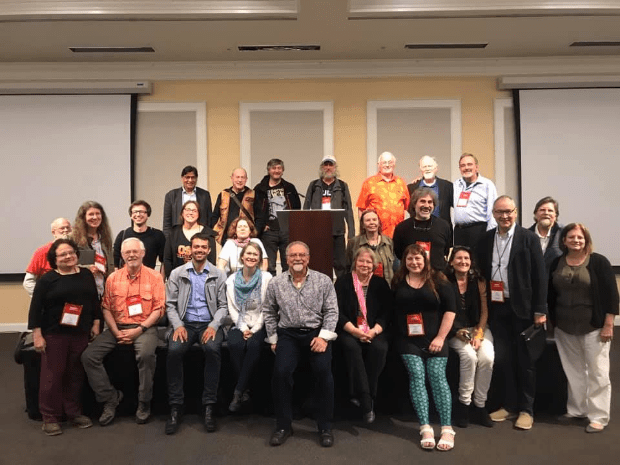
It is several  months now since the 2019 ISSS Conference and Annual Meeting at Oregon State University (OSU). Members from 17 countries attended: Argentina, Australia, Austria. Brazil, Canada, Colombia, Hong Kong, India, Japan, Republic of Korea, Mexico, New Zealand, South Africa, Switzerland, Taiwan, United Kingdom, and the United States.

Thanks to the team at OSU for all the support and to Jennifer Wilby and team for organizing and managing the whole conference. Thanks too for all the great presentations, papers, workshops, ideas, projects and commitments made during the conference.

The theme of Natures Enduring Patterns as a Path Towards Systems Literacy was explored in 16 plenary presentations. Over the four days there were 57 paper presentations and 28 workshops. Over four days there were four participatory plenary workshops when the whole conference engaged in a 3 step process (1. Appreciation/Scanning, 2. Influence opportunity/Focusing, 3.Control/Acting) of thinking about the purpose of ISSS and how it contributes to Systems Literacy and possible and actual projects and actions that can be put into practice to ensure the viability and development of ISSS worldwide. These exciting and energizing and details are below.

Please get involved, to do so you need to be a member of ISSS. Join or renew now here https://www.myisss.org/register/

All plenary speakers were recorded on video and you can view them on the members website at https://www.myisss.org/corvallis-2019/  You will need to be a member of ISSS to view them.

Photos. If you attended the conference please add your photos at https://www.myisss.org/photo-album/?view=list&album=5

ISSS Action Projects emerging and developing from the ISSS 2019 Conference.

Systems Literacy, Peter Tuddenham, Jennifer Makar, Gary Smith, Sue Gabriele, Lynn Rasmussen,This project began in 2015. A workshop was held on the afternoon of Monday July 1 in Corvallis. The aim is to have a draft document for ISSS 2020 in South Africa. More info at http://www.systemsliteracy.com

ISSS Futures. Meetings were held during ISSS 2019 to explore the future of ISSS. The group is meeting regularily online to secure the future of ISSS.

Email Image

Saturday Special Integration Group Sessions, – Deanna Burleson and John Vodonick. SIG Sessions on Saturdays were a regular feature of the 2018-2019 ISSS year. The 2019-2020 Saturday SIG Sessions have begun. More information  at https://www.myisss.org/sigs-sessions-on-saturdays/   Recordings from the 2018-2019 Sessions are at https://www.myisss.org/sig-sessions-recordings-2018-2019/  You will need to be a member of ISSS and login to myisss.org to view.

SIG Relations, – Gary Smith and Jennifer Makar. The SIG Sessions on Saturdays in 2018-2019 provided an opportunity for members to explore the relations between SIGS, how they might be integrated, and how they support the mission of ISSS. Attendees at the 2019 conference self-organized an evening workshop to develop integrative and synthesis actions related to SIGs. This work continues.

SuperOrganism Project, – Peter Corning. The objective of the ISSS Global Superorganism Project is for the ISSS as an organization to develop a demographic, economic, ecological, and political profile for each one of the world’s 195 countries – and an aggregate assessment for the species as a whole – with respect to four major questions: (1) its capacity to meet the basic biological needs of the human population, (2) each country’s interdependencies with other countries, (3) it’s vulnerabilities in a changing global environment, and (4) its governance capacity and efficacy.

Volunteer researchers will be sought from the ISSS community who are willing to select a country, or countries, then obtain the relevant data/information for each country and prepare a brief report.  The individual reports will then be aggregated and synthesized into a combined report for the annual ISSS meeting in 2020.  Specialized training or high-level analytical skills will not be required for this volunteer task. For more information, contact Peter Corning at: pacorning@complexsystems.org  

ISSS Podcasts, – George Mobus. This is a proposal to produce and distribute a podcast show dedicated to reaching out to general audiences discussing important issues that have systemic aspects. The intent is to do this with non-jargon-based discussions about real issues and real approaches to solutions using terminology that is systems-literate motivated, but not caught up in the technical aspects of explicit systems thinking. In other words, this is systems science and practice that is relatable by ordinary people. The podcasts would be hosted by ISSS and College of Exploration.  Each cast would have a theme and a discussion pair. One format would involve having an Systems Sciences “elder” and a younger up-and-coming member of the community engaged in a Q&A in which the elder is asked to explain some aspect of a problem from the perspective of systemness (a kind of sharing of wisdom or mentoring).

Project Krysthalis, – Steve Wallis.  Building cohesion in the next generation of systems thinkers and leaders with the forging and refinement of diverse systems theories into a framework that is suitable for application. Use video interviewing to record stories, histories and perspectives of elders and major contributors to the systems sciences.

Curation of SIG information – Marc Pierson.  Using software such at http://www.thebrain.com with the aim to collate and curate relevant information about each SIG. SIG Chairs are encouraged to contribute records and previous work to this online resource. Special emphasis is being placed on introduction to each Special Integration Group for new members of ISSS. Also, the Brain software allows for significant linking of ideas and documents, intelligent note-taking. non-linear file management and visualization of ideas and relationships.

VSM as a model for ISSS organization, – Allenna Leonard.  A group formed at ISSS 2019 and is exploring how Stafford Beer’s Viable System Model can help identify gaps and opportunities in the structure and process of ISSS organization and management.

Digital Cooperatives, – David Ing. New forms of digital presentation and information creation and curation were discussed in the plenary workshop sessions. Ideas using federated wikis and new forms of digital platforms were discussed.

ISSS Digital Records. – Roelien Goede. The records of the ISSS through the years is digitized and now ways are being explored on how best to make this information available.

ASC and ISSS Co-development, – Ray Ison and Ben Sweeting. Significant efforts went into coordinating the ISSS and American Society for Cybernetics conference in terms of dates and geographic location so that members of both organizations could easily attend both. This level of cooperation and coordination is continuing with discussions about how the respective history and contributions of both organizations can be more widely recognized.

ISSS 2020 Conference, – Shankar Sankaran, Roelien Goede, Rika Preiser have a team are planning the ISSS conference in South Africa. ISSS2020 will be held Saturday July 11th – Tuesday July 14th, 2020 at Stellenbosch University, Stellenbosch (near Cape Town), South Africa.

ISSS2021 location is not yet decided. If you wish to offer to host the conference in 2021 please contact the ISSS Office at enquiryisss@gmail.com

Renew or Join ISSS. If you are member of ISSS please consider indicating your interest in one or more of these projects in your profile https://www.myisss.org/update/?view=profile


Engaging Emergence – LILA FEB 2018 on Vimeo


Engaging Emergence – LILA FEB 2018

The members of the Learning Innovation Lab (LILA) were joined at their February 2018 gathering by visiting faculty Nora Bateson, Patricia Shaw, and Gail Taylor. This animation represents a small slice of our sense-making around their work as it relates to the work of our members and the theme of Emergence. At this gathering our focus was Engaging Emergence — how we might engage more intentionally with emergence to shape adaptive outcomes for our organizations, the world, and ourselves.

Comments


Introduction to the Modeling and Analysis of Complex Systems – Open SUNY Textbooks – Hiroki Sayama


Source: Introduction to the Modeling and Analysis of Complex Systems – Open SUNY Textbooks


Introduction to the Modeling and Analysis of Complex Systems

Author(s): 

Keep up to date on Introduction to Modeling and Analysis of Complex Systems at http://bingweb.binghamton.edu/~sayama/textbook/!

Introduction to the Modeling and Analysis of Complex Systems introduces students to mathematical/computational modeling and analysis developed in the emerging interdisciplinary field of Complex Systems Science. Complex systems are systems made of a large number of microscopic components interacting with each other in nontrivial ways. Many real-world systems can be understood as complex systems, where critically important information resides in the relationships between the parts and not necessarily within the parts themselves. This textbook offers an accessible yet technically-oriented introduction to the modeling and analysis of complex systems. The topics covered include: fundamentals of modeling, basics of dynamical systems, discrete-time models, continuous-time models, bifurcations, chaos, cellular automata, continuous field models, static networks, dynamic networks, and agent-based models. Most of these topics are discussed in two chapters, one focusing on computational modeling and the other on mathematical analysis. This unique approach provides a comprehensive view of related concepts and techniques, and allows readers and instructors to flexibly choose relevant materials based on their objectives and needs. Python sample codes are provided for each modeling example.

This textbook is available for purchase in both grayscale and color via Amazon.com and CreateSpace.com.

REVIEWS:

Hiroki Sayama’s book “Introduction to the Modeling and Simulation of Complex Systems” is … a unique and welcome addition to any instructor’s collection. What makes it valuable is that it not only presents a state-of-the-art review of the domain but also serves as a gentle guide to learning the sophisticated art of modeling complex systems. –Muaz A. Niazi, Complex Adaptive Systems Modeling 2016 4:3


… Sayamaʼs book is a very good instrument for students who want to read an introductory text on modeling and analysis of complex systems, and for instructors who need such a text in simple language for their complex systems courses and projects. The book offers a good introduction to the complex systems terminology and plenty of readily available examples with technical implementation details. … Overall, Introduction to the Modeling and Analysis of Complex Systems offers a novel pedagogical approach to the teaching of complex systems, based on examples and library code that engage students in a tutorial-style learning adventure. It is a solid tool that may become one of the primary instruments for teaching complex systems science and help the discipline to become more established in the academic world, triggering the necessary transition from a top-down tradition to a bottom-up complex systems approach.
-Stefano Nichele, Artificial Life 22(3): 424-427, 2016. www.mitpressjournals.org/doi/abs/10.1162/ARTL_r_00209


Facebooktwittergoogle_plusredditlinkedintumblrmail

I Preliminaries

1 Introduction

1.1 Complex Systems in a Nutshell

1.2 Topical Clusters

2 Fundamentals of Modeling

2.1 Models in Science and Engineering

2.2 How to Create a Model

2.3 Modeling Complex Systems

2.4 What Are Good Models?

2.5 A Historical Perspective

II Systems with a Small Number of Variables

3 Basics of Dynamical Systems

3.1 What Are Dynamical Systems?

3.2 Phase Space

3.3 What Can We Learn?

4 Discrete-Time Models I: Modeling

4.1 Discrete-Time Models with Difference Equations

4.2 Classifications of Model Equations

4.3 Simulating Discrete-Time Models with One Variable

4.4 Simulating Discrete-Time Models with Multiple Variables

4.5 Building Your Own Model Equation

4.6 Building Your Own Model Equations with Multiple Variables

5 Discrete-Time Models II: Analysis

5.1 Finding Equilibrium Points

5.2 Phase Space Visualization of Continuous-State Discrete-Time Models

5.3 Cobweb Plots for One-Dimensional Iterative Maps

5.4 Graph-Based Phase Space Visualization of Discrete-State Discrete-Time Models

5.5 Variable Rescaling

5.6 Asymptotic Behavior of Discrete-Time Linear Dynamical Systems

5.7 Linear Stability Analysis of Discrete-Time Nonlinear Dynamical Systems .

6 Continuous-Time Models I: Modeling

6.1 Continuous-Time Models with Differential Equations

6.2 Classifications of Model Equations

6.3 Connecting Continuous-Time Models with Discrete-Time Models

6.4 Simulating Continuous-Time Models

6.5 Building Your Own Model Equation

7 Continuous-Time Models II: Analysis

7.1 Finding Equilibrium Points

7.2 Phase Space Visualization

7.3 Variable Rescaling

7.4 Asymptotic Behavior of Continuous-Time Linear Dynamical Systems

7.5 Linear Stability Analysis of Nonlinear Dynamical Systems

8 Bifurcations

8.1 What Are Bifurcations?

8.2 Bifurcations in 1-D Continuous-Time Models

8.3 Hopf Bifurcations in 2-D Continuous-Time Models

8.4 Bifurcations in Discrete-Time Models

9 Chaos

9.1 Chaos in Discrete-Time Models

9.2 Characteristics of Chaos

9.3 Lyapunov Exponent

9.4 Chaos in Continuous-Time Models

II Systems with a Large Number of Variables

10 Interactive Simulation of Complex Systems

10.1 Simulation of Systems with a Large Number of Variables

10.2 Interactive Simulation with PyCX

10.3 Interactive Parameter Control in PyCX

10.4 Simulation without PyCX

11 Cellular Automata I: Modeling

11.1 Definition of Cellular Automata

11.2 Examples of Simple Binary Cellular Automata Rules

11.3 Simulating Cellular Automata

11.4 Extensions of Cellular Automata

11.5 Examples of Biological Cellular Automata Models

12 Cellular Automata II: Analysis

12.1 Sizes of Rule Space and Phase Space

12.2 Phase Space Visualization

12.3 Mean-Field Approximation

12.4 Renormalization Group Analysis to Predict Percolation Thresholds

13 Continuous Field Models I: Modeling

13.1 Continuous Field Models with Partial Differential Equations

13.2 Fundamentals of Vector Calculus

13.3 Visualizing Two-Dimensional Scalar and Vector Fields

13.4 Modeling Spatial Movement

13.5 Simulation of Continuous Field Models

13.6 Reaction-Diffusion Systems

14 Continuous Field Models II: Analysis

14.1 Finding Equilibrium States

14.2 Variable Rescaling

14.3 Linear Stability Analysis of Continuous Field Models

14.4 Linear Stability Analysis of Reaction-Diffusion Systems

15 Basics of Networks

15.1 Network Models

15.2 Terminologies of Graph Theory

15.3 Constructing Network Models with NetworkX

15.4 Visualizing Networks with NetworkX

15.5 Importing/Exporting Network Data

15.6 Generating Random Graphs

16 Dynamical Networks I: Modeling

16.1 Dynamical Network Models

16.2 Simulating Dynamics on Networks

16.3 Simulating Dynamics of Networks

16.4 Simulating Adaptive Networks

17 Dynamical Networks II: Analysis of Network Topologies

17.1 Network Size, Density, and Percolation

17.2 Shortest Path Length

17.3 Centralities and Coreness

17.4 Clustering

17.5 Degree Distribution

17.6 Assortativity

17.7 Community Structure and Modularity

18 Dynamical Networks III: Analysis of Network Dynamics

18.1 Dynamics of Continuous-State Networks

18.2 Diffusion on Networks

18.3 Synchronizability

18.4 Mean-Field Approximation of Discrete-State Networks

18.5 Mean-Field Approximation on Random Networks

18.6 Mean-Field Approximation on Scale-Free Networks

19 Agent-Based Models

19.1 What Are Agent-Based Models?

19.2 Building an Agent-Based Model

19.3 Agent-Environment Interaction

19.4 Ecological and Evolutionary Models

Bibliography

Index


Hiroki Sayama

Hiroki Sayama, D.Sc., is an Associate Professor in the Department of Systems Science and Industrial Engineering, and the Director of the Center for Collective Dynamics of Complex Systems (CoCo), at Binghamton University, State University of New York. He received his BSc, MSc and DSc in Information Science, all from the University of Tokyo, Japan. He did his postdoctoral work at the New England Complex Systems Institute in Cambridge, Massachusetts, from 1999 to 2002. His research interests include complex dynamical networks, human and social dynamics, collective behaviors, artificial life/chemistry, and interactive systems, among others. He is an expert of mathematical/computational modeling and analysis of various complex systems. He has published more than 100 peer-reviewed journal articles and conference proceedings papers and has edited eight books and conference proceedings about complex systems related topics. His publications have acquired more than 2000 citations as of July 2015. He currently serves as an elected Board Member of the International Society for Artificial Life (ISAL) and as an editorial board member for Complex Adaptive Systems Modeling (SpringerOpen), International Journal of Parallel, Emergent and Distributed Systems (Taylor & Francis), and Applied Network Science (SpringerOpen).


Source: Introduction to the Modeling and Analysis of Complex Systems – Open SUNY Textbooks

UPDATE: More News & Stuff from CoCreative

I’m a bit behind with material to post here, so this is a little out-of-date, but well worth signing up for

Source: UPDATE: More News & Stuff from CoCreative


Sample from this newsletter:

Fifty fine folks joined us on August 14th for a webinar on Collaborative Innovation: What It Is, How It’s Different & Why It Works.

Couldn’t make it? Find an archived recording of the webinar on our Vimeo channel and the slide deck we used. (Please note that some of the slides are animated, so it is best viewed in “presentation” mode.)


(Free) ebook on Decisions and Technical Leadership – and a lot of systems thinking

Ruth Malan is one of the most interesting twitterers on ‘architecture that’s not buildings’ (see https://www.ruthmalan.com/)


direct link (frequently updated):

Click to access 20190629SlideDocTechnicalLeadershipDecisions.pdf


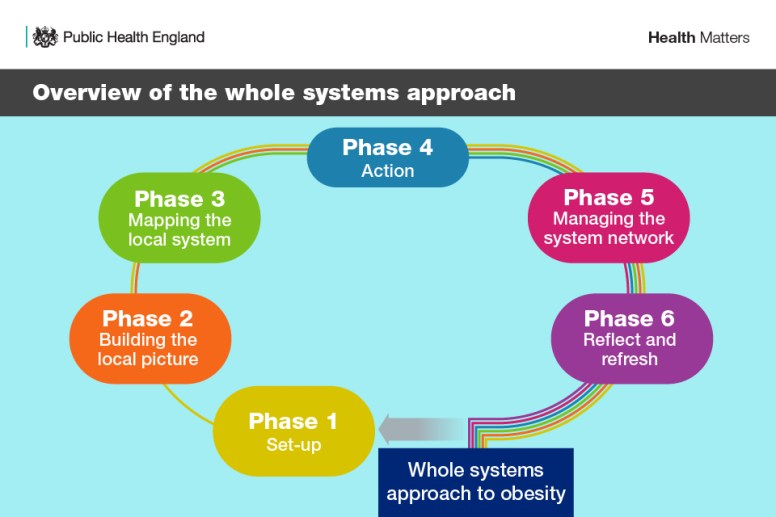
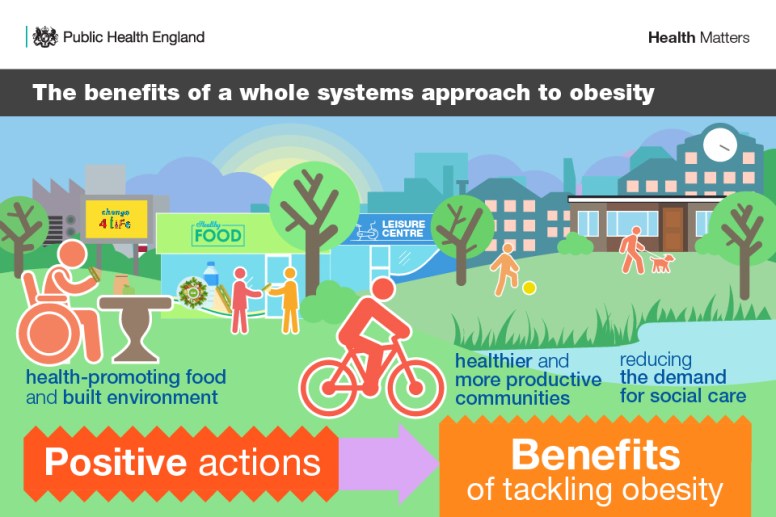
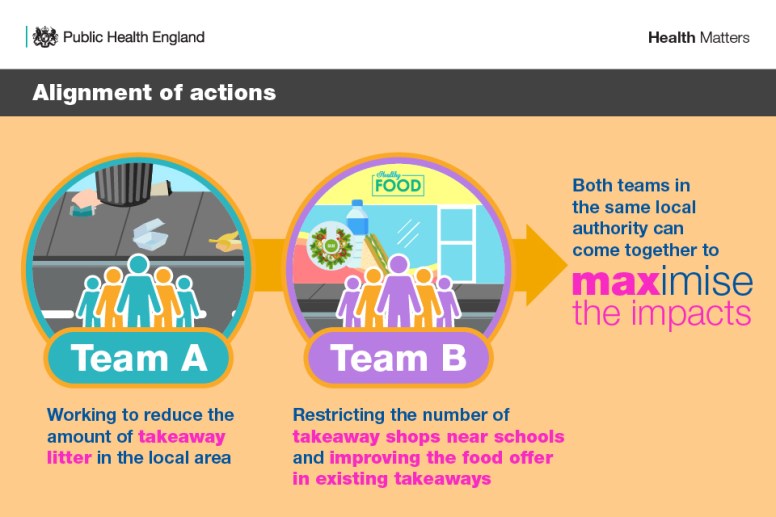
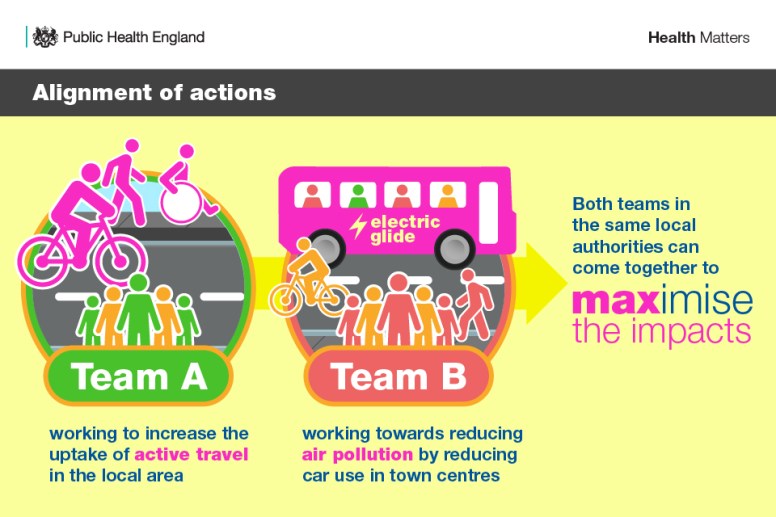
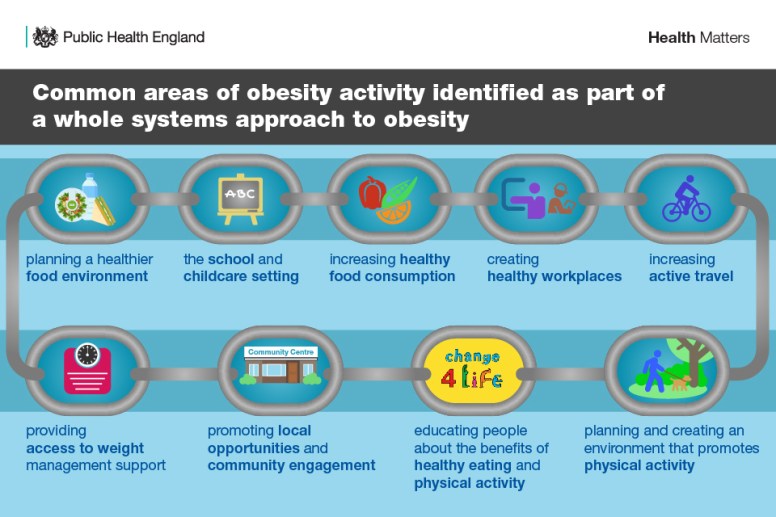
Health matters: whole systems approach to obesity – GOV.UK

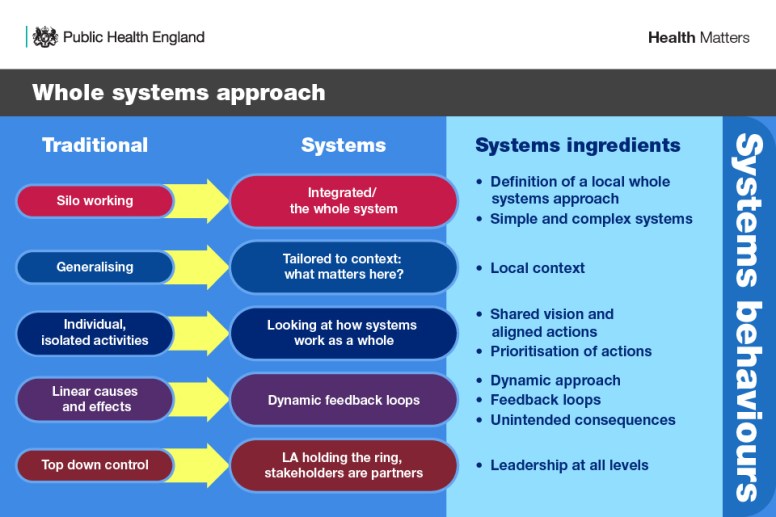
Public Health England’s (PHE’s) Whole systems approach to obesity: a guide to support local approaches to promoting a healthy weight is a professional resource that is designed to support local action to address obesity. The guide describes a ‘how to’ process, which can enable local authorities, and their partners, to start creating their own local whole systems approaches to reducing obesity and promoting a healthy weight. It can also support local areas who have already started this journey.

Source: Health matters: whole systems approach to obesity – GOV.UK


SCiO Open Meeting (All Welcome)- Autumn 2019, Manchester Tickets, Mon 14 Oct 2019 09:30-16:30


Source: SCiO Open Meeting – Autumn 2019, Manchester (All Welcome) Tickets, Mon 14 Oct 2019 at 09:30 | Eventbrite

OCT 14

SCiO Open Meeting – Autumn 2019, Manchester (All Welcome)

Open Meeting (open to all), a series of presentations of general interest to Systems & Complexity in Organisation’s members and others.

 SCiO organises Open Meetings to provide opportunities for practitioners to learn and develop new practice, to build relationships, networks hear about skills, tools, practice and experiences. The programme for 14th October is as follows:

9:30 – 10:00 Introduction to Viable System Model

10:00 – 10:30 SCiO notices and community exercise

10:30 – 11:30 To be confirmed

11:30 – 11:45 Break

11:45 – 12:45 Dynamic Intelligence and measure of self-awareness (Darren Stevens)

12:45 – 13:45 Lunch Break

13:45 – 15:45 Behavioural axioms for a successful co-operative system (John Carlisle)

15:45 – 16:00 Break

16:00 – 17:00 Systems thinking and organisational training programme defectiveness (Bryan Hopkins)

Does Dynamic Intelligence exist as a conceptual measure of self-awareness in the moment?

The theory of Constructed Development (as per Stevens’ 2019 PhD thesis) is a measure of a person’s awareness of their constructed intentions in the moment; this measure is time and context-specific and determines how much of their thinking is at choice. This choice leads to a number of possible responses in the moment. The individual’s capacity to choose their response in the moment informs personality and thus behaviour. When applying this theory to systems thinking, consider the people in the room, their capacity to construct meaning and the differences in results from different layers of the same organisation using the same systems theory. How does a mid-level manager construct their thinking and are they aware of this construction? Compare that to a CEO and the way s/he constructs themselves in a larger organisational environment, with the many facets informing their construction.

The Constructed Development Theory bridges the gap between Elliott Jaques’ work on organisational complexity and individual complexity. The more habituated aspects of personality are due to limited awareness of this construction of intention, and thus a more flexible response is indicative of a more adaptive personality. An output of the research was the creation of a scale for self-awareness, called the Thinking Quotient (TQ). To create the Thinking Quotient, Stevens used fifty Cognitive Intentions (CIs), re-purposed heuristics to deconstruct an individual’s thinking style. The relationship between these CIs is key to an individual’s self-awareness.

We will look at a number of these in the talk. This research also demonstrated that different combinations of CIs create differing Thinking Styles, and each style can be aligned with a level of adult development. Using the CIs, it is hypothesised that an individual’s Intention, Awareness, Choice and Response informs their Dynamic Intelligence which leads to predictable behaviours in context. From a systems practitioner perspective, it could be useful to be able to predict thinking and behavioural outcomes as you interact with your clients.

================================================================

About Darren Stevens

Darren Stevens is a leadership and change consultant and a cognitive developmental coach, working specifically with senior executive teams in enabling more effective strategy execution, change management, leadership and talent development. Darren’s powerful approach strengthens leaders’ and organisational capabilities through transformational learning and meta-systemic thinking. He presents new ways for executives, managers, and consultants to reflect on who they are as leaders, how they relate to and impact others, and how to challenge their organisation to reach new levels of excellence.

Darren’s developmental approach takes a ‘whole-person-in-role’ approach to leadership development using the Constructed Development Framework as a guide for senior executives to become deeper thinkers and experience transformational change on a personal as well as professional level.

http://stevensdevelopment.co.uk/

================================================================

Defeat from the jaws of victory or, why we need a collaborative strategy

In this highly interactive session, participants will get to experience the five behavioural axioms for a successful co-operative system. The method is that of heuristic learning as the exercise comprises 10 rounds of decision-making in small teams. The decisions made by any team affect every team and the levels of trust. The experience will illustrate the five axioms below are necessary:

1. Be clear, on the nature of the relationship you expect

2. Openness

3. Be provocable

4. Be forgiving

5. Be consistent

================================================================

About John Carlisle

John Carlisle is the past chair of the Deming Alliance, former Professor at Sheffield Business School and business owner of JCP. He has spent over 30 years studying organisations after having completed a major change programme in the copper mines in Zambia. Came to the UK in 1970s and taught negotiation to purchases worldwide and them moved into organisational consultancy where he met Dr. Deming. His main area of study is about negotiation and upstream (supply) organisations. He has co-authored a seminal book, Beyond Negotiation, which was the first to identify the productivity of a collaborative procurement strategy. John has introduced this strategy into blue chip companies internationally and over 200 major projects through his company JCP.

================================================================

Using systems thinking approaches to evaluate organisational training programmes.

Training is an investment, much like introducing new technologies or processes, that organisations make in order to improve their performance. However, it is harder to evaluate the success of training than of ‘hard’ changes like technology or process. Since the 1970s the training profession has largely drawn on variants of the so-called ‘Kirkpatrick framework’ to evaluate training, even though there is a general agreement in the profession that it does not really produce reliable or even particularly useful data.

Debate about training evaluation largely takes place within a boundary which limits discussion to ways of implementing Kirkpatrick. Although the original idea with my Ph.D. research was to see how systems thinking tools such as Viable System Model and Critical System Heuristics might work in this context, my emergent interest is in changing the boundaries for debate, and I am currently reviewing such issues as the lack of systemic thinking used in the whole training design process which makes evaluation problematic, boundary decisions about what constitutes a measure of training effectiveness and what role training plays in broader organisational learning.

I am hoping that my presentation will provoke ideas and discussion that will help me to further expand the boundaries of my thinking.

===============================================================

About Bryan Hopkins

Bryan Hopkins has worked in education and training since 1977, both internationally with governmental and inter-governmental agencies and NGOs, and in the United Kingdom private sector. He has worked with a number of United Nations agencies, including UNICEF, WHO, UNDP, ILO and UNAIDS amongst others, and for three years was Senior Learning Solutions Officer at the then newly-established UNHCR Global Learning Centre in Budapest, being responsible for internal development in training skills and monitoring the quality of training designed and delivered.

He specialises in identifying and training needs, designing and delivering bespoke training programmes and evaluating training initiatives. He has written a number of books about different aspects of training and learning, the two most recent looking at cultural aspects affecting workplace performance and using systems thinking approaches to identifying training needs and evaluate training.

Bryan has Master’s degrees in development studies and systems thinking, and is currently working towards a PhD with the Open University, looking at using systems thinking approaches to the evaluation of organisational training programmes.

www.bryanhopkins.co.uk

Book in source: SCiO Open Meeting – Autumn 2019, Manchester (All Welcome) Tickets, Mon 14 Oct 2019 at 09:30 | Eventbrite


WPI Systems Thinking Colloquium, Perspectives on Systems Thinking, 8:30am-6:00pm East Time (reception to follow), October 2, 2019, Worcester Massachusetts, US (or online)


Source: WPI Systems Thinking Colloquium


Register for WPI’s Systems Thinking Colloquium:

Perspectives on Systems Thinking

Wednesday, October 2, 2019
8:30 am to 6:00 pm (reception to follow)
WPI Campus, Gateway I

Space is limited. Registrations will be accepted on a first come, first serve basis.

Currently, there is no clear consensus on the definition of “Systems Thinking.” The colloquium objective is to clearly articulate the various different perspectives on Systems Thinking and facilitate a discussion among Systems Thinking experts about their perspectives.

Know someone who might be interested in this event? Share this page with them! 


Speakers include:


Gene Bellinger

Gene has been a passionate Systems Thinker for almost four decades. He is highly respected member of the systems thinking community, the author of several hundred articles, and over 700 videos on relationship and their implications, and a member of the System Dynamics Society. In 2013 Gene coauthored Beyond Connecting the Dots: Modeling for Meaningful Results with Scott Fortmann-Roe, the developer of Insight Maker. Gene shepherded the Systems Thinking World discussion group on LinkedIn to over 20,000 members focused on developing a better understanding of, and employing systems thinking principles. Gene is also the developer of the Systems-Thinking website. Presently Gene is actively engaged in developing learning threads on various aspects of relationships and their implications, conducting weekly internet sessions, and participating in various discussion groups on LinkedIn and Facebook.

Derek Cabrera

Derek Cabrera is a systems scientist, inventor, and social entrepreneur and is internationally known for his work in systems thinking, systems leadership, and systems modeling. He is currently visiting faculty at Cornell University where he teaches systems thinking and organizational leadership and design. He is senior scientist at Cabrera Research Lab, and Co-Founder and Chief Science Officer of Plectica. He is author of eight books including, Systems Thinking Made Simple: New Hope for Solving Wicked Problems (winner of the 2017 AECT outstanding book award), Thinking at Every Desk: Four Simple Skills to Transform Your Classroom, and Flock Not Clock: Design, Align, and Lead to Achieve Your Vision. Credited with discovering the underlying rules of systems thinking, Cabrera is co-editor of the Routledge Handbook of Systems Thinking. His work in public schools was documented in the full-length documentary film, RE:Thinking. He was Research Fellow at the Santa Fe Institute (SFI) for the Study of Complex Systems and National Science Foundation IGERT Fellow in Nonlinear Systems in the Department of Theoretical and Applied Mechanics at Cornell University. He serves on the United States Military Academy at West Point’s Systems Engineering Advisory Board. His contributions to the field of systems thinking have been integrated into NSF, NIH, and USDA-NIFA programs, K-12, higher education, NGOs, federal agencies, corporations, and business schools. His systems models are used by many of Silicon Valley’s most innovative companies. Systems Thinking Made Simple is used as an introductory text for undergraduate and graduate students in numerous colleges and universities including Cornell University and West Point Military Academy. Cabrera has developed and patented a suite of systems thinking tools for use in academia, business, and beyond.

Bob Cavana 

Associate Professor Bob Cavana is a Reader in Systems & Sustainability in the School of Management, Victoria Business School, Victoria University of Wellington, New Zealand. Bob is a past President of the NZ Operational Research Society, a past Vice-President for the International System Dynamics Society and a former Managing Editor of System Dynamics Review (2005-12). He has published in a wide range of international journals, and he is a co-author of Systems Thinking, System Dynamics: Managing Change and Complexity 2nd ed (Pearson Education, Auckland, 2007) and Introduction to Systems Thinking. Pearson Education NZ (Prentice Hall): Auckland, 2009.

Joe Kasser

Joseph Kasser has been a practicing systems engineer and engineering manager since 1970 in the USA, Israel, and Australia. He is a Fellow of the Institution of Engineering and Technology (IET) and an INCOSE Fellow. He is the author of “A Framework for Understanding Systems Engineering” and “Holistic Thinking: Creating innovative solutions to complex problems (Solution Engineering)” and many INCOSE symposia papers.
He gave up his positions as a Deputy Director and DSTO Associate Research Professor at the Systems Engineering and Evaluation Centre at the University of South Australia in early 2007 to move back to the UK to develop the world’s first immersion course in systems engineering as a Visiting Professor at Cranfield University. He is an INCOSE Ambassador and also served as the initial president of INCOSE Australia and as a Region VI Representative to the INCOSE Member Board. He is currently a principal at the Right Requirement Ltd. in the UK and a Visiting Associate Professor at the National University of Singapore.

Mike Radzicki

Professor Radzicki is an economist, creator of WPI’s program in system dynamics, and co-creator of WPI’s program in trading and investment system development. Professor Radzicki’s research focuses on predictive analytics, simulation science, and the application of techniques from these areas to problems in economics, finance, and management. He has been invited to speak around the world in venues such as the White House, the Royal Society, the New York Stock Exchange, the United States Departments of Energy, Transportation, and Homeland Security, and Sandia National Laboratories. He has also served on the editorial board of several professional journals and as a consultant to numerous Fortune 500 corporations. In 2006 he served as president of the System Dynamics Society.

Donna Rhodes

Donna Rhodes is a principal research scientist in MIT’s Sociotechnical Systems Research Center. She is the director of the Systems Engineering Advancement Research Initiative (SEAri), a research group focused on advancing theories, methods, and practices for the engineering of complex sociotechnical systems. She is a Past President and Fellow of the International Council on Systems Engineering (INCOSE), and associate editor of the journal Systems Engineering.  She has over 150 publications and is co-author of the book Architecting the Future Enterprise, published by MIT Press in 2015.  Her contributions in the systems field have been recognized by numerous publication awards, IBM Outstanding Innovation Award, Lockheed Martin NOVA Award and INCOSE Founders Award.

Khalid Saeed

Khalid Saeed is a professor of economics and system dynamics at WPI. Widely recognized for his work on computer modeling and experimental analysis of developmental, organizational, and governance-related issues, he has written two books and numerous articles and book chapters on a variety of developmental and management agendas, including sustainable economic development, infrastructure planning, political economy, supply chain management, and system dynamics modeling. He has worked as a consultant with UN-ESCAP, UNDP, Asian Development Bank, World Business Council for Sustainable Development, Booz Alan Hamilton, US Veterans Administration, U.S. Health Resources and Services Administration, and McKinsey Company, among other organizations. At WPI, Saeed served as department head of Social Science and Policy Studies from 1997 to 2007. During this period, he developed new major programs in economic science, psychological science, and system dynamics, as well as initiated graduate studies in the department.

David Peter Stroh

David Peter Stroh is a founding partner of Bridgeway Partners and a founding director of appliedsystemsthinking.com. He was also one of the founders of Innovation Associates, the consulting firm whose pioneering work in the area of organizational learning formed the basis for fellow co-founder Peter Senge’s management classic The Fifth Discipline. David is the author of the best-selling book Systems Thinking for Social Change: A Practical Guide for Solving Complex Problems, Avoiding Unintended Consequences, and Achieving Lasting Results (Chelsea Green, 2015) and of over 30 articles and book chapters including many in “The Systems Thinker”. David is internationally recognized for his work in enabling leaders to apply systems thinking to achieve breakthroughs around chronic, complex problems and to develop strategies which improve system-wide performance over time. David is committed to helping organizations and communities apply systems thinking to social change. Together with his wife Marilyn Paul, he has also written and consulted on how to reduce managerial and organizational overload, as well as authored an article on ‘The Learning Family’. David is a charter member of the Society for Organizational Learning.

Ricardo Valerdi

Ricardo Valerdi is a Professor in the Systems & Industrial Engineering Department at the University of Arizona. Previously he was a Research Associate at the Massachusetts Institute of Technology. Dr. Valerdi is a recipient of the Best Article of the Year Awards in the Systems Engineering Journal and Defense Acquisition Journal, and Best Paper Awards at the Conference on Systems Engineering Research, International Society of Parametric Analysts, and Conference on Predictive Models in Software Engineering.  He teaches courses in cost estimation, systems engineering, decision analysis, sports analytics, and the science of baseball. Dr. Valerdi is the Editor-in-Chief of the Journal of Cost Analysis and Parametrics and from 2009-2014 was the founding Editor-in-Chief of the Journal of Enterprise Transformation.  He served on the Board of Directors of the International Council on Systems Engineering, and is a Senior Member of the Institute of Electrical and Electronics Engineers.  Between 1999 and 2002, he worked as a systems engineer at Motorola and has been affiliated with the Aerospace Corporation’s Economic and Market Analysis Center.   He is also founder and Chief Scientist of the Science of Sport and a consultant to the Arizona Diamondbacks, Los Angeles Angels of Anaheim, San Diego Padres, Colorado Rockies, Washington Nationals, Atlanta Braves, Texas Rangers, Oakland Athletics, Los Angeles Dodgers, LA Galaxy, Seattle Sounders, Dallas Mavericks, Orlando Magic., Sugar Bowl, and College Football Playoff Foundation.  His work has been featured on ESPN, Fox Sports Arizona, and LA Times.  In collaboration with faculty in the UA College of Medicine he developed the first-ever concussion simulator for football for the NCAA.

Source: WPI Systems Thinking Colloquium


2019 International Conference on Information, Cybernetics, and Computational Social Systems – IEEE SMC, September 27-30, 2019, Chongqing, China


Source: 2019 International Conference on Information, Cybernetics, and Computational Social Systems – IEEE SMC

Source: 2019 International Conference on Information, Cybernetics, and Computational Social Systems – IEEE SMC

Professor Raul Espejo – ‘Enabling local people and groups to support global organisational development’, 2 October 2-3pm, University of Portsmouth, UK

Professor Raul Espejo – ‘Enabling local people and groups to support global organisational development’ 

Wednesday 2nd October 2020, 2pm – 3pm
Richmond Lecture Theatre 2, University of Portsmouth, PO1 3HE

(organised by the Systems and Information Systems Research Group, School of Computing)

Abstract
Our organisations emerge from networks of autonomous people engaged in interaction processes (Espejo & Foss, 2018). People, in collectives, use their skills, resources and capabilities to create and produce whatever outcomes they may wish to achieve. Collaboration in these interactions, to a significant degree, depend on processes of self-organization. In general there is no one with authority to tell people what to do and how to interact; they just interact. Often these interactions are inadequate and it is only through learning processes, which depend on cues and signals, that they proceed towards desirable outcomes. To a degree this is the dynamics of organisational development to respond to environmental, social, and economic pressures. Self-organising processes are at the core of their interactions. In today’s world technologies, digital and others, are transforming these interaction processes. New forms of communication and relationships are emerging between people and their environments; these are processes towards the constitution of effective organisational systems (Beer, 1979, 1985), (Espejo & Reyes, 2011). However, these systems are more than the outcome of bottom-up self-organisation; they are also, the outcome of guided self-organisation, which, through policies clarify purposes and help  to speed up learning processes by enabling relating fragmented resources. Organisational development and problem solving require of both; bottom-up and top-down interactions. The challenge is working out which interaction strategies are necessary to increase response capacity to make sense of an often overwhelmingly complex surrounding. These are aspects related to Ross Ashby´s law of requisite variety (Ashby, 1964). We learn to manage these interactions often at a high cost to people and organisation; hierarchical structures tend to concentrate responses to environmental challenges at the top of the organisation. On the other hand heterarchical organisations try to distribute response capacity and self-organisation throughout the collective, but often their local response capacity is limited by resources. However, current information and communications technologies are increasing the chances of making this distribution effective.

Biography
Professor Espejo is one of, if not the, most knowledgeable academic/practitioner of  the Viable Systems Model [VSM] and its subsequent developments. He played a prominent role in project Cybersyn at the behest of Allende, then President of Chile, who invited Professor Stafford Beer to reconfigure the Chilean economy using VSM. Beer was the Scientific Director and Raul Espejo was the operational Director of the project. This is probably the most important example of VSM in action.

The UKSS Management Team

www.ukss.org.uk 

Problem structuring methods – Wikipedia etc

Problem structuring methods

We haven’t included this at all, nor really anything on Operational Research, have we? Such a big universe!

Source: Problem structuring methods – Wikipedia


What’s the Problem? An Introduction to Problem Structuring Methods
Jonathan Rosenhead, 1996

https://www.researchgate.net/publication/247823670_What’s_the_Problem_An_Introduction_to_Problem_Structuring_Methods


The Non-Codified Use of Problem Structuring Methods and the
Need for a Generic Constitutive Definition
Mike Yearworth, Leroy White (pdf)

Click to access 79558699.pdf


OR competences: the demands of problem structuring methods, Richard John Ormerod (2014)

https://link.springer.com/article/10.1007/s40070-013-0021-6


Mark Johnson’s Improvisation Blog: Information Loss and Conservation


Source: Improvisation Blog: Information Loss and Conservation

Saturday, 7 September 2019

Information Loss and Conservation

One of the ironies of any “information system” is that they discard information. Quite simply, anything which processes large amounts of data to produce an “answer”, which is then acted on by humans, is attenuating those large amounts of data in various ways. Often this is done according to some latent biases within either the humans requesting the information, bias within the datasets that are processed, or bias within the algorithms themselves. Bias is also a form of attenuation, and the biases which have recently been exposed around racial prejudice in machine learning highlight the fundamentally dangerous problem of loss of information in organisations and society.

In his book “The human use of human beings” Norbert Wiener worried that our use of technology sat on a knife-edge between it either being used to destroy us, or to save us from ourselves. I want to be more specific about this “knife edge”. It is whether we learn how to conserve information within our society and institutions, and avoid using technology to accelerate the process of information destruction. With the information technologies which we have had for the last 50 years, with their latency (which means all news is old news) and emphasis on databases and information processing, loss of information has appeared inevitable.

Why Highly Diverse Work Teams Are Better at Untangling Complexity

hmm


Source: Why Highly Diverse Work Teams Are Better at Untangling Complexity

How Highly Diverse Teams Can Help Untangle Complexity

role of feelings in entrepreneurship

Top teams work best — and fastest — when they are based on the right criteria and include a highly diverse group of people from all levels across an organization, including outside stakeholders, write David Komlos and David Benjamin in this opinion piece. They are co-authors of Cracking Complexity: The Breakthrough Formula for Solving Just About Anything Fast. Komlos is the CEO and Benjamin is the chief architect of Syntegrity.

Leaders have been hearing for years that diverse teams are key to tackling big problems, to innovating better, and to overall performance. In practice, few leaders know how to configure teams with the specific diversity of talent required to resolve their top challenges; they aren’t clear on what qualifies as diverse in terms of “who” and “how many,” nor how to construct these teams. This is essential to mastering complexity. Let us explain.

Imagine walking into your office one morning and finding a ferocious lion on your desk. If you are like most people, in the blink of an eye you slam the door and run away as fast as you can. Deconstruct that blink of an eye — in less than a second you saw the lion, absorbed the implications, thought about your options, decided what to do, and implemented seamlessly. No confusion, no mixed messages, no consensus-building — just a very smooth path from sensing the lion to fleeing.

Organizations, business units, teams, joint ventures don’t work nearly as fast. Their challenges, like growing faster, taking out cost, merging, digitizing and transforming aren’t solved by any one individual, nor are the solutions executed by any one individual. It takes many people to sense, absorb, think, decide and then act in a unified way.

W. Ross Ashby, president of the Society for General Systems Research from 1962–1964, understood this. His Law of Requisite Variety states “Only variety can destroy variety,” which means that leaders who are faced with a multidimensional challenge must be as multidimensional as the challenge. That’s only possible by tapping into a much broader and deeper variety of people — beyond the usual suspects — who have the combined knowledge, experience and expertise to match the complexity, and whose buy-in is essential for execution. Short-changing requisite variety guarantees partial outcomes; starting with a partial understanding, followed by partial solutions, followed by weak execution.

The following framework enables rigorous examination of variety when constructing teams:

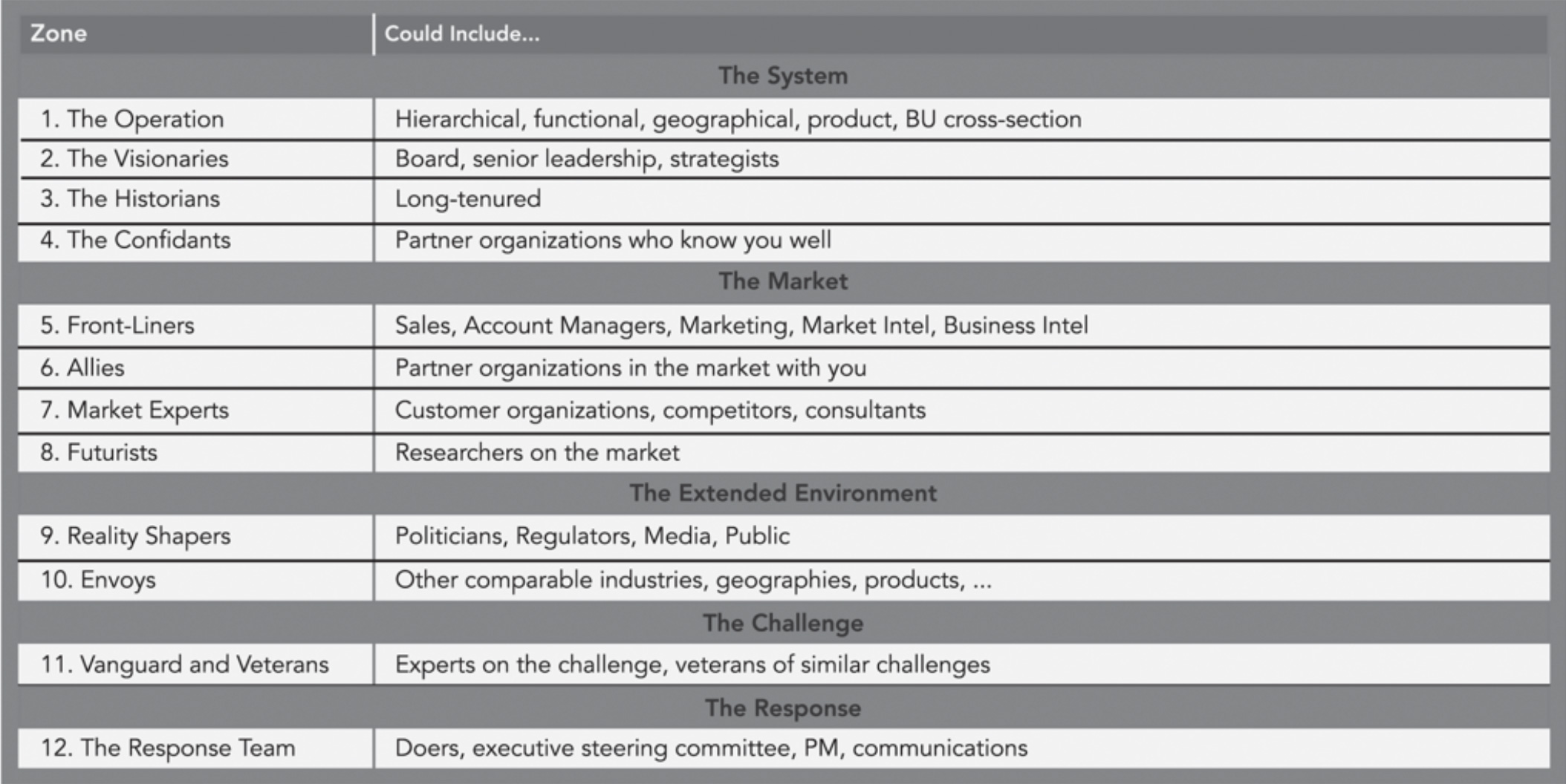
  • Twelve zones from which to choose people based on their role, perspective, knowledge and expertise;

twelve zones

The 12 Zones of Variety

  • Cross-checked against 13 Characteristics that span human dimensions like basic demographics, thinking style, personality, attitude and influence.

Different challenges require different zone and characteristic combinations.

Constructing a High-variety Team

Depending on the challenge — for example, improving Net Promoter Score (NPS), transforming manufacturing and supply chain, or securing customer trust and loyalty — start by taking a broad view of the organization, including its customers, stakeholders and partners. Think through each zone to identify the people you need to involve, and then layer in other considerations and characteristics. For example, if you’re choosing among the leadership team, who’s most open to change and willing to be challenged? If you’re choosing from the IT department, who’s going to be the most important doer and who’s the biggest skeptic? Among your agency partners and vendors, who always seems to listen first and come with great insights later? Strength lies in engaging those differences, all together, all at once.

Achieving the necessary variety with a minimal number of people is the trick. When it comes to the “requisite” word, it’s all about efficiency in your selections. Once you’ve listed specific names of people who collectively cover the desired zones and cross-checked the characteristics that are covered by those people, you’ve got a long list of candidates. Prune that list, remove the duplicates, replace three people who cover a few zones and characteristics with one who covers them all, and now you’ve got your high-variety team. Maybe as few as eight people, perhaps as many as 50 or 60.

Improving NPS

A large financial services firm was intent on greatly improving its NPS. They started down the path of their usual practice of involving mostly senior leaders and their reports, augmented by a few younger high-potential staff members. After using the 12 Zones and the idea of requisite variety to rethink the team they’d be convening to find solutions, they made room for strong representation from the field, a hierarchically diverse cross-section of key functions, several external experts, their PMO outsource partner, several customers, and their internal task force responsible for stewarding execution of the plan. As they thought through other key characteristics to bring into the group, they chose a couple of additional insiders who had dealt with a similar challenge but in other industries, switched some of the leaders they had first identified to get more demographic diversity, varied the mix of customers to be more reflective of key segments, and added one more field person with a reputation for being a real challenger.

Within six months, this carefully chosen combination of usual and non-usual suspects was credited with the firm’s NPS Score improvement from -15 to +28.

Transforming Manufacturing and Supply Chain

A conglomerate was able to transform its manufacturing and supply chain much faster than expected in large part because they involved many individuals who typically would not be engaged in figuring this out. All lines of business were represented as were several key functions. Also included were a few supply chain partners, customers, outside experts in supply chain transformation and data and analytics, and layers deep inside a geographically diverse set of plants and distribution centers. In choosing who to bring from the lines of business, intentional choices were made to ensure a mix of strong supporters for change and the biggest resisters. All of the “unusual suspects” commended leadership for having them involved in such an important discussion so early on, for the first time in their careers.

“Achieving the necessary variety with a minimal number of people is the trick.”

Securing Customer Trust and Loyalty

A health care organization that supplies life-essential products was able to elevate trust and reputation, and achieve market share dominance by deliberately involving external stakeholders with polar opposite views and motivations throughout its strategic planning cycles. These people, who were used to being involved through stakeholder-engagement meetings and market research interviews, found themselves instead in the center of strategy development, expressing their needs, voicing their concerns, and ultimately co-creating the way forward. With them at the table was a cross-section of the organization’s people, given full right to be outspoken, to challenge, to be vulnerable about what they felt could and could not be done, and to be open to the possibility that current internal processes and policies were wrong. In fact, in one particular strategy, the entire group realized existing national policy was wrong and aligned and took ownership of changing it. Most of those involved remarked on how they had not seen that coming, and that the need for change wouldn’t have been identified at all without the variety of people in the room that day.

The Difference-maker

In each of these instances, bringing requisite variety to bear was a key difference-maker in the quality of solutions and subsequent speed of execution. Of course, configuring and assembling requisite variety is necessary but insufficient. What you do when you bring them all together in the same place determines whether or not the team will successfully come up with a robust solution and truly buy-in to what they have co-created.

Complexity is the defining challenge of our times. The capability to leap past your biggest challenges and to seize the opportunity on the other side of those challenges is the single most important leadership and organizational capability today. The talent to do so isn’t scarce; it’s abundant and all around you. These people are relatively inexpensive, they’re part of the solution, and when mobilized in the right way, they’re extremely fast. Having a requisite-variety mindset and mastery in configuring special-purpose teams is the gateway.


Source: Why Highly Diverse Work Teams Are Better at Untangling Complexity

Scale Deep: Using A Feminist Approach to Shift Systems – a Tamarack Institute Webinar 13 September 2019 12pm Eastern Time with Tatiana Fraser and Pamela Teitelbaum


Source: Scale Deep: Using A Feminist Approach to Shift Systems


Scale Deep: Using A Feminist Approach to Shift Systems

Date: Friday, September 13, 2019 | 12:00 p.m. – 1:00 p.m. ET

Speakers: Tatiana Fraser and Pamela Teitelbaum


Systems change practice offers new approaches to leadership and collaboration that help leaders address complexity in new ways. Feminist approaches to change offer approaches to analyzing power and centering the experiences of marginalized communities. At MetaLab, we have been engaged in an inquiry exploring the question:  What is unique about feminist systems change practice? What can we learn when a gender lens is applied to a systems change initiative?

In this webinar, we will share our insights and a new systems change framework; including key practices, approaches and lessons learned about how gender equity organizations are doing systems change. We will reflect on how this framework illuminates the extent to which marginalized communities are positioned to lead systems change, and how these approaches align with and might be applied to other issue areas.


More info on speakers and book at source: Scale Deep: Using A Feminist Approach to Shift Systems