
I’m currently in a cybernetics twitter chat, which is fun. I shared, as I am wont to do, this link https://stream.syscoi.com/2019/06/09/a-first-lesson-in-meta-rationality-meaningness/
Which generated some really interesting responses –
@dei making the point that bongard games test the ability to infer the rule-space, so meta-contexuality is inference of the the connective context that define the rule space generation, andthen observing that, whilst bongard is small world, you’re still *technically* doing the process in the large world. (Some of this linked to a conversation on relevance realisation that I wasn’t participating in).
To which @misuaraboki said: so pure rationality can be meta-irrational as well, right
My reply:
yes, in fact it *must* be

(Slightly longer version:)
Look at
- Tarski’s undefinability theorem (https://stream.syscoi.com/2021/12/24/tarskis-undefinability-theorem-wikipedia/ – this is the champagne reference IMO – though Gödel usually gets the flowers)
- Lacan’s manque (I accidentally typed Lacan’s mangue – Lacan’s mango surely has memetic potential?)
- MacIntyre’s contextually dependent rationality
- David Chapman’s work (etc etc)
- Von Foerster, ‘the environment as we perceive it is our invention’
- Or MacLuhan https://stream.syscoi.com/2021/04/22/marshall-macluhans-tetrad-of-media-effects/
- or Beer’s transduction https://chosen-path.org/2021/10/06/transduction-a-powerful-and-important-concept-that-few-have-heard-of/ (this link also covers ‘What the Frog’s Eye Tells the Frog’s Brain’ https://stream.syscoi.com/2020/02/03/what-the-frogs-eye-tells-the-frogs-brain-ieee-journals-magazine/ ) – and indeed look at autopoiesis!
- Harish Jose – who you should all be reading – has a nice piece on alethic unfolding here https://stream.syscoi.com/2024/10/13/on-alethic-unfolding-in-systems-thinking-harishs-notebook-harish-jose/
And look at the original concept of ‘affordance’ – I have to find the recent (to me) podcast reference where they went into it deeply and thoroughly (maybe Brain Inspired? – aha! – found it – https://stream.syscoi.com/2026/05/10/how-really-should-affordances-be-understood-brain-inspired-podcast-223-vicente-raja-ecological-psychology-motifs-in-neuroscience/) but this in particular might link to Sean’s thinking. A reference that doesn’t completely catch the boundary concept: https://stream.syscoi.com/2022/08/06/the-visual-cliff-eleanor-gibson-the-origins-of-affordance/ but https://stream.syscoi.com/2021/01/13/the-world-is-not-a-theorem/ captures the irreducibility point.
And look also at polycontexturality https://stream.syscoi.com/2021/05/23/polycentricity-gerhard-guenther-and-more/ and heterachy https://stream.syscoi.com/2021/01/24/heterarchy-a-big-concept-with-lots-of-connections-mcculloch-and-onwards/ .
These theses come in different flavours but ‘truth in the formal model of the system cannot be defined within the system’, ‘language cannot express the world’. Lacan has three levels: the mirror stage where the child sees itself as unified before experiencing itself as coordinated, so the ego is constructed around an image of wholeness it never fully possesses, language as desires mediated through the ‘Other’ – society, parents, culture, symbolic systems. You start desiring through other people’s desires, and finally that the symbolic order is itself incomplete; there is no final signifier that explains everything.
And see transdisciplinarity for the way in which our sensors determine and limit our realities (Nicolescu – though I have a problem with his concepts around transcendence – is the best for this: https://stream.syscoi.com/2020/11/03/methodology-of-transdisciplinarity-levels-of-reality-logic-of-the-included-middle-and-complexity-nicolescu-2010/, where other phrasings treat transdisciplinarity more as recognition of the reality of different ‘levels’ and generally just more openness https://stream.syscoi.com/2022/02/19/manifesto-of-transdisciplinarity-1994-signed-by-b-nicolescu-e-morin-and-l-de-freitas/ – and yet others just talk about ‘different disciplines’).
In order to create and protect the ground for rational reasoning, you need shielding and transduction from the unending complexity and infinite pattern of reality. I love Chapman’s older diagram
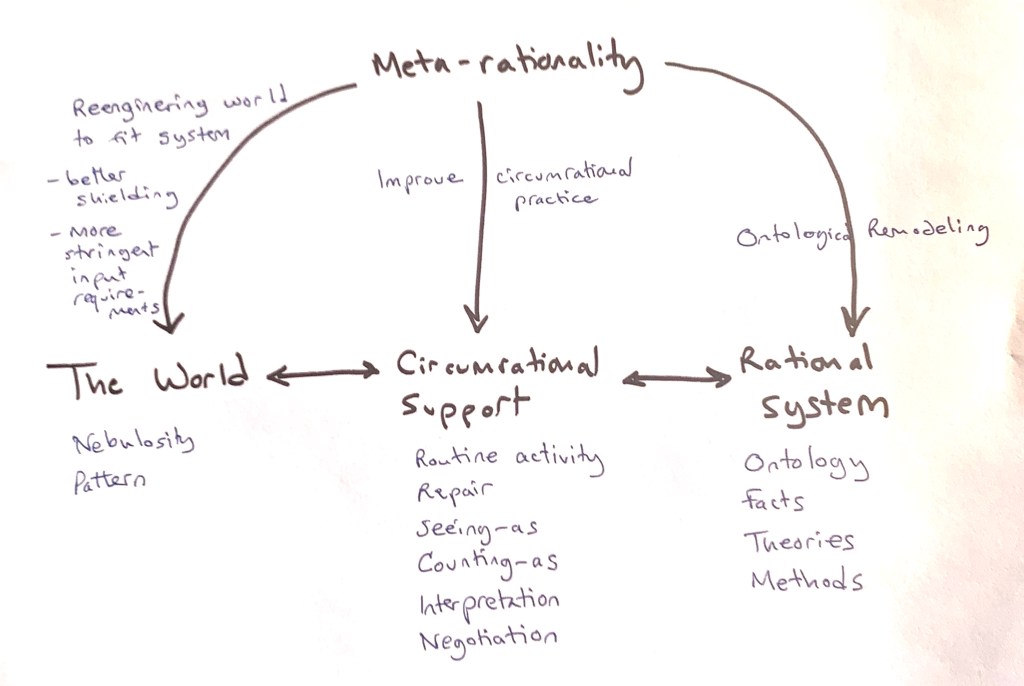
You’re right that Bongard Games unlock this – in my view it’s a powerful experiential tool (reminder of original link https://stream.syscoi.com/2019/06/09/a-first-lesson-in-meta-rationality-meaningness/). This link explains the issue from a particular point of view: https://stream.syscoi.com/2020/11/07/glimpse-at-the-metaphysics-of-bongard-problems-linhares-2000/ (concluding sentence of the abstract: “The resulting conclusion of this analysis is that in the case of Bongard problems there can be no units ascribed an a priori existence—and thus the objects dealt with in any specific problem must be found by solution methods (rather than given to them). This view ultimately leads to the emerging alternatives to the philosophical doctrine of metaphysical realism.”
My own ‘greebling series’ (see https://chosen-path.org/2021/06/24/in-world-of-infinite-overlapping-possibility-and-multiple-irreconcilable-differences-what-does-education-mean/ and xlinks in comments) tries to talk about this in ways that are available/relevant to me. I
This is the core metarational/postrational insight. As Chogyma Trungpa Rinpoche (problematic guru) said: ‘The bad news is you’re falling through the air, nothing to hang on to, no parachute. The good news is, there’s no ground.’
How you respond to this is of course a decent definition of the existentialist expression of agency. Do you take refuge in monist eternalism, accept your materiality in a nihilistic way or hold hope in a separate transcendant eternal? (These are Chapman’s Big Three Stances https://meaningness.com/big-three-stance-combinations). Or do you keep bringing your self back to the nebulosity of meaning and opt for basic cheerfulness? ( https://chosen-path.org/2021/10/20/what-gives-you-the-foundations-that-enable-change/ / https://meaningness.com/all-dimensions-schematic-overview )
Footnote: I asked ChatGPT out of interest if MacIntyre had ever written on Lacan, and the answer is very congruent with my drift above (and – despite MacIntyre’s metaphysical commitments – has a good concept of a telos that can be human-determined despite our limitations):
Yes, but not extensively in the sense of producing a major sustained critique or synthesis of Lacan. MacIntyre engaged with psychoanalysis throughout his career, and Lacan appears intermittently rather than centrally.
The clearest direct engagement is in the revised edition of The Unconscious: A Conceptual Analysis. In the new preface, MacIntyre explicitly discusses Lacan and compares Aristotle and Lacan on desire. https://www.taylorfrancis.com/books/mono/10.4324/9780203501955/unconscious-alasdair-chalmers-macintyre
That’s significant because MacIntyre rarely spent much time on French post-structuralism directly. He tended to regard large parts of postmodern theory as downstream symptoms of the moral fragmentation he diagnoses in After Virtue. But psychoanalysis interested him because it sits awkwardly between:
- scientific explanation,
- moral agency,
- narrative interpretation,
- and therapeutic practice.
Those are all core MacIntyre themes.
What’s interesting is where they overlap despite radically different metaphysical assumptions.
Lacan:
- the subject is constitutively split,
- desire emerges from lack,
- language precedes and structures the subject,
- reconciliation is impossible.
MacIntyre:
- the self is narratively constituted,
- practical reasoning is tradition-dependent,
- desire requires education toward goods,
- flourishing is teleological and communal.
So both reject the Enlightenment fantasy of the autonomous rational individual. Both think the self is socially and linguistically formed. Both think modernity produces distorted desire.
But they diverge sharply on whether human desire can ultimately be ordered toward genuine goods.
For Lacan, lack is structural and ineradicable. Desire endlessly circulates around absence.
For MacIntyre, desire can be educated through practices, virtues and participation in traditions toward a telos — an intelligible human good. Conflict and incompleteness remain, but they are not ontological voids in the Lacanian sense.
You could caricature the difference this way:
- Lacan: fragmentation is fundamental.
- MacIntyre: fragmentation is historically produced.
Or:
- Lacan radicalises Augustine’s restless heart into permanent constitutive lack.
- MacIntyre tries to rehabilitate Aristotle’s account of purposive flourishing without naïve harmony.
There’s also a deep tension over language.
Lacan inherits Saussure and structuralism. The symbolic order traps and constitutes the subject.
MacIntyre inherits Aristotle, Aquinas and post-Kuhnian historicism. Traditions of rational inquiry shape subjects, but language remains connected to practices and goods rather than floating endlessly in signification.
MacIntyre was certainly aware of Lacan’s importance. Some commentators note his familiarity with Lacanian psychoanalysis explicitly. (https://www.abc.net.au/religion/christopher-kaczor-remembering-alasdair-macintyre/105386744 ) But he never became a ‘MacIntyrean Lacanian’ in the way Žižek became a Lacanian Hegelian.
Honestly, they belong to different civilisational moods.
Lacan is the theorist of impossibility after the collapse of metaphysical confidence.
MacIntyre is trying to reconstruct rational moral life after that collapse. One diagnoses the ruins brilliantly.
The other asks whether inhabitable forms of life can still be rebuilt within them.
Additional note: other source and references (also ChatGPT)
von Foerster
The closest single von Foerster reference is ‘Objects: Tokens for (Eigen-)Behaviors’ (1976/1977; reprinted in ‘Understanding Understanding’). That is the one that most directly supports your claim that the world doesn’t arrive pre-cut into stable objects, categories and meanings. In observer-excluded epistemology we talk about ‘objects’; in observer-included epistemology these become tokens for stable behaviours. That is almost exactly your ‘reality doesn’t impose the bounds necessary to comprehend it; we make distinctions, frames, affordances and worlds’ point. (monoskop.org)
The second closest is ‘On Constructing a Reality’ (1973). That is the punchier, more quotable reference: ‘the environment as we perceive it is our invention’. Not ‘we invent reality’ in some silly idealist sense, but ‘we enact workable worlds through distinctions, bodies, histories, purposes and constraints’. (Kurt von Meier)
The third is ‘Notes on an Epistemology for Living Things’ (1972). This is the strongest for the meta-claim: a description of the universe implies someone describing it; therefore we need a theory of the observer. That is your Tarski/Gödel/Lacan/MacIntyre/Chapman line in cybernetic dress: no clean theory of reality without accounting for the observer who draws the distinction. (semiorganized.com)
Then ‘Ethics and Second-Order Cybernetics’ is the reference for the existential and ethical turn. Von Foerster’s ethical imperative, usually rendered as ‘Act always so as to increase the number of choices’, fits your ‘basic cheerfulness’ stance surprisingly well: not metaphysical certainty, but a disciplined increase in agency, possibility and responsibility. His aesthetic imperative, ‘If you desire to see, learn how to act’, is even closer to your practical systems line: seeing is not prior to action; seeing is changed by action. (Encyclopedia.com)
George Spencer-Brown, ‘Laws of Form’.
This is the big missing formal reference. ‘Draw a distinction’ is almost too neat, but it gives you the clean grammar of boundaries, indication and marked/unmarked space. It sits under von Foerster, Luhmann, Varela, Glanville, Kauffman and a lot of second-order cybernetics. Use carefully. It attracts mystical over-reading like jam attracts wasps.
Ernst von Glasersfeld, radical constructivism.
Very close to your claim that knowledge doesn’t ‘match’ reality but must ‘fit’ or prove viable in experience. It helps avoid both naïve realism and limp ‘anything goes’ relativism. Von Glasersfeld’s line is that knowledge is actively constructed and judged by viability in experience, not by access to an observer-independent God’s-eye reality. (pcp-net.org)
Louis Kauffman, ‘Eigenforms: Objects as Tokens for Eigenbehaviors’.
This is probably the best modern companion to von Foerster. Kauffman develops the idea that objects have apparent stability because of recursive processes of observation and action. It gives you a bridge from cybernetic epistemology to form, object, self, sign and world. (Docslib)
Humberto Maturana, ‘objectivity in parentheses’.
You have autopoiesis, but this is the sharper epistemological reference. Maturana’s point isn’t just living systems self-produce; it’s that objectivity without parentheses pretends to access reality from nowhere, while objectivity in parentheses recognises explanations as arising within domains of observer action, language and coordination. This fits your ‘different worlds, different validities, no final sovereign context’ move. (SciELO)
Francisco Varela, Evan Thompson and Eleanor Rosch, ‘The embodied mind’.
This is missing if you want to connect affordance, cognition, Buddhism, embodiment and enaction. It says cognition is not representation of a pregiven world by a pregiven mind. It is embodied action. That gives you a less cybernetic, more phenomenological route to the same place.
Niklas Luhmann, especially observation as distinction and indication.
His system/environment distinction, second-order observation, communication systems and operational closure belong here. He is strong for ‘what does this system make observable, and what does it have to make invisible in order to operate?’
Ranulph Glanville.
You need him more than the standard second-order cybernetics canon usually admits. Glanville’s work on objects, black boxes, design, conversation and second-order cybernetics is directly aligned with your practice orientation. He keeps epistemology close to making, designing and acting, not just knowing.
Robert Rosen, ‘Life itself’ and the modelling relation.
Rosen’s modelling relation is exactly about how systems, observers and models relate: encoding, inference, decoding, and the gap between formal systems and natural systems. It gives you a better bridge from Tarski/Gödel to systems modelling than most complexity literature does.
C. S. Peirce.
Peirce is probably the missing deep root for signs, inquiry, fallibilism, habit, abduction and reality as that which inquiry would tend toward under ideal conditions. He lets you avoid both correspondence realism and lazy constructivism. Also relevant to eigenforms: Kauffman explicitly notes resonances between von Foerster/eigenforms and Peirce. (Systems Community of Inquiry)
John Dewey, ‘Logic: The theory of inquiry’ and ‘Experience and nature’.
Inquiry starts in a problematic situation. Knowing is a way of transforming an indeterminate situation into a more determinate one. That is basically ‘systems practice’ without the cybernetic hat. Strong on action, practice, democracy and learning.
Michael Polanyi, ‘Personal knowledge’ and ‘The tacit dimension’.
Missing for tacit judgement. Your argument depends on the fact that rationality requires more than explicit rule-following. Polanyi’s ‘we know more than we can tell’ gives you the tacit substrate: skill, perception, connoisseurship, tradition and embodied judgement.
Merleau-Ponty, ‘Phenomenology of perception’.
This is the missing philosophical reference for embodied perception. Gibson gives affordances from ecological psychology. Merleau-Ponty gives the body-subject, perception as situated, and the world as lived before it is theorised. Useful if you want to keep ‘sensors create worlds’ from becoming too computational.
Wilfrid Sellars, ‘Empiricism and the philosophy of mind’.
The useful bit is the attack on ‘the myth of the given’. This is exactly your point that the world doesn’t arrive as self-interpreting data. Observation is already concept-laden, socially formed and inferentially placed. Excellent bridge into philosophy of mind and language.
Nelson Goodman, ‘Ways of worldmaking’.
Almost too on the nose. Goodman gives you a pluralist, constructivist account of world versions without making it all whim. His phrase ‘worldmaking’ is useful, though you’d need to handle it carefully so it doesn’t sound like TED-stage metaphysics with nice shoes.
Ian Hacking, ‘styles of reasoning’ and ‘the looping effects of human kinds’.
Strong for the public service angle. Categories don’t just classify people; they change the people classified, and the changed people then change the category. This is very relevant to service labels, needs, demand, eligibility, diagnosis, safeguarding, ‘complex families’, ‘vulnerability’, and the great administrative sausage machine.
Donna Haraway, ‘Situated knowledges’.
Haraway gives you the feminist epistemology version: no view from nowhere, but also not relativism. Knowledge is embodied, located, accountable. That fits your ethics and power thread.
Helen Longino, ‘Science as social knowledge’.
Good for avoiding the lone heroic observer. Knowledge improves through socially organised criticism, not purified individual objectivity. Useful for your ‘learning system’ and ‘constructive challenge’ practice.
Bowker and Star, ‘Sorting things out’.
Classification systems are moral and political technologies. They make worlds. They create residual categories, invisibilities, workarounds and suffering. Very close to your ‘a life becomes a case; a need becomes a form’ point.
Susan Leigh Star and James Griesemer, ‘boundary objects’.
You talk boundaries all the time. Boundary objects are the missing social mechanism: things plastic enough to adapt across worlds, robust enough to maintain identity. Excellent for commissioning, systems convening, partnership working, public service reform, and why everyone can agree to the same strategy document while meaning different things by every word.
Lucy Suchman, ‘Plans and situated actions’.
This is a must. It demolishes the fantasy that plans determine action. Plans are resources for situated action, not scripts that govern reality. It fits your anti-programmatic, ‘work in context’ line and your suspicion of transformation theatre.
Andrew Pickering, ‘The mangle of practice’.
Useful for ‘practice bites back’. Humans, machines, models, institutions and materials resist and accommodate each other. Knowledge and practice emerge through this mangle, not through clean implementation.
Nancy Cartwright.
Use for the argument that laws and models work in highly arranged circumstances, not everywhere. Good for your ‘shielding’ argument: rational models need nomological machines, set-ups, scaffolds, prepared worlds. This links very well to public service pilots, test environments, and why scaled roll-out so often goes to die.
Donald Schön, ‘The reflective practitioner’.
Almost too obvious, but still missing from the philosophical spine. Reflection-in-action is one of the cleanest practice references for acting under uncertainty, uniqueness and value conflict.
Chris Argyris and Donald Schön.
Connect learning loops to the metarational argument: single loop changes action; double loop changes governing variables; triple loop touches identity, purpose and form of life. Your slides already link triple loop learning to identity and results.
Mary Douglas, ‘How institutions think’.
Institutions classify, remember, forget, legitimate, and make certain thoughts easier than others.
Charles Taylor, ‘social imaginaries’.
Useful for the background picture of what is possible, normal, legitimate and desirable. It’s a richer cultural version of context cues.
Hans-Georg Gadamer, ‘Truth and method’.
This is your hermeneutic missing piece. Understanding is historically effected. We don’t stand outside tradition; we work through horizons, prejudice, interpretation and conversation. Good bridge to MacIntyre.
Michael Oakeshott.
Probably useful as a counterweight. His distinction between technical and practical knowledge fits your loathing of method worship. Also useful for the critique of rationalism in politics.
Bruno Latour.
Use selectively. ‘We have never been modern’ and actor-network theory give you translation, mediation and networks of humans/nonhumans. But don’t let Latour eat the whole argument. He does that. Like bindweed with tenure.
Isabelle Stengers.
Worth adding for ecology of practices, cosmopolitics, and resisting imperial knowledge forms. Good for transdisciplinarity without Nicolescu’s transcendence problem.
Annmarie Mol, ‘The body multiple’ and ‘The logic of care’.
Mol shows realities being enacted differently in different practices. ‘The logic of care’ also supports your critique of clean choice/consumer models.
Karen Barad, ‘Meeting the universe halfway’.
Potentially useful for ‘agential realism’, intra-action and apparatuses making phenomena. But handle with tongs. There’s good material there, and also a fog machine.
What you’re underplaying
Power.
You have it, but this argument needs it nearer the surface. If worlds are made through distinctions, then the right to draw distinctions is political. Who gets to say ‘need’, ‘risk’, ‘outcome’, ‘efficiency’, ‘case’, ‘failure’, ‘choice’, ‘evidence’, ‘vulnerability’? Your power notes already have the right Flyvbjerg line: power includes the freedom to define what counts as truth and reality.
Gendered and colonial epistemology.
Haraway, Longino, Harding, Santos, Mignolo, Linda Tuhiwai Smith. Not to genuflect to the citation police, but because your argument is about whose reality-making counts. Leaving this out weakens the ethics.
Institutional technologies.
Forms, metrics, classifications, eligibility rules, scripts, case-management systems, dashboards. These are not administrative trivia. They are reality engines. Bowker and Star, Suchman, Mol and Hacking help you say that cleanly.
[Which makes me think to add cultural technologies, norms etc more strongly – and therefore Erving Goffman]


You must be logged in to post a comment.