
SYSTAC EUROPEAN HUB
SYSTAC European Hub – Geneva Centre of Humanitarian Studies

SYSTAC EUROPEAN HUB
SYSTAC European Hub – Geneva Centre of Humanitarian Studies
Systems Approaches to Strengthening Health Care Resilience: Key Concepts & Lessons from COVID-19
Webinar Registration – Zoom
10Webinar – Systems approaches to strengthening health system resilience: Key concepts and lessons from COVID-19Date: February 10, 2022 12:09 PM – 2:00 PM CETOnline event: https://unige.zoom.us/webinar/register/WN_AdqMGV4aSWuyxATZAK7OMQDropdownAdd to calendar10Days21Hours10Minutes05Seconds
Save the date!!
On 10 February 2022, 13:00 – 14:00 CET join us for the webinar: Systems approaches to strengthening health system resilience: Key concepts and lessons from COVID-19.
The seminar will present the key concepts of health system resilience and stages of a shock as they relate to systems thinking, and will discuss strategies for building resilience from the evidence and lessons learned during COVID-19 in the European region.
Facilitators:
Prof. Karl Blanchet, Geneva Centre of Humanitarian Studies, and Dr Dell Saulnier, Lund University, Co-leads of SYSTAC European Hub.
Panellists:
Prof. Steve Thomas Trinity College Dublin. Prof. Thomas is the Edward Kennedy Professor of Health Policy and Management and Director of Health Policy and Engagement for the School of Medicine. He is the lead author of the ’Strengthening health systems resilience: Key concepts and strategies’ report from the European Observatory.
Anna Sagan London School of Economics and Political Science. Anna is a Research Fellow at LSE and an Honorary Research Fellow at the London School of Hygiene and Tropical Medicine. Her research areas include health system resilience, health insurance, and health system value. She is the Editor of the ’Health systems resilience during COVID-19: Lessons for building back better’ report from the European Observatory.
Register in advance for this webinar:
https://unige.zoom.us/webinar/register/WN_AdqMGV4aSWuyxATZAK7OMQ
How to contact the organizer
Systems Thinking Accelerator (SYSTAC)dell.saulnier@med.lu.se
Tuesday, February 22, 2022 UN-Common Sense: Understanding Value Engineering with Tom Gilb
UN-Common Sense: Understanding Value Engineering with Tom Gilb | Meetup
Jullien views propensity in Chinese philosophy, as a counterpart to causality in Western philosophy. Some unpacking of his writing in digests may be helpful.
Jullien, François. 1995. The Propensity of Things: Toward a History of Efficacy in China. Translated by Janet Lloyd. Zone Books.
How can we conceive of the dynamic in terms of the static, in terms of “disposition”? Or, to put it another way, how can any static situation be simultaneously conceived in terms of historical movement? [p. 11]
A single Chinese word, shi1`will serve as our guide as we reflect on this matter, even though it is a relatively common term gen erally given no philosophical significance. The word is itself a source of confusion, but it was out of that confusion that this book emerged. [pp. 11-12]
1 The term shi (勢) is the same as…
View original post 10,305 more words
Do you want to learn the basics of the System Dynamics method and how this can be used to explain how change takes place, why people misunderstand change, and why so many policies fail to solve problems? Free Online Course GEO-SD662 opens February 1.
System Dynamics Modelling and Analysis
System Dynamics Modelling and Analysis | Continuing Education | UiB
source and booking (disclaimer: this link is an affiliate link: the Public Service Transformation Academy will benefit from any sales):
Leading Self, Leading Systems Tickets, Thu 31 Mar 2022 at 09:00 | Eventbrite
MAR 31
by Living Leadership & Partners
£180 – £300
Highly engaging two-session online leadership workshop (31 Mar & 7 Apr) drawing on the ground-breaking work of systems theorist, Barry Oshry
Times of great disruption and volatility are also moments of great possibility and transformation. To realise the potential of this moment we must strengthen two critical leadership capacities:
These workshops combine a rare combination of frameworks and practices that will deepen both your personal insight and your systems sight.
We draw on the profound and practical thinking of systems theorist, Barry Oshry, and his five decades of research into the nature of human systems and the drivers of human behaviour. One of the revelations in Oshry’s work is that many of the problems we believe are primarily personal or interpersonal – “I’m not effective in my role”, “If only I had a better manager (partner/Prime Minister/President) then things would be fine”, “We are not a good team” – are not just personal. Context matters too. Many of us don’t see our contexts and the power of context to shape consciousness and behaviour. This blindness to context increases blame, kills trust, and corrodes potentially supportive and productive relationships. We get stuck.
This online workshop includes two highly engaging, enjoyable and thought-provoking sessions spaced a week apart to allow you to immediately apply the frameworks and practices in your everyday working life.
Session 1, 0900-1130 BST, Thursday 31 March
Session 2, 0900-1300 BST, Thursday 7 April
The workshop fee covers both sessions.
Online on Zoom
Standard fee: £250 plus VAT (UK sales tax)
Reduced fee: £150 plus VAT (UK sales tax)
The workshop fee cover both sessions: on 31 March and 7 April.
We aim to offer our programmes to a wider range of people and organisations, including in different regions of the world. To widen accessibility to our programmes we offer a reduced fee option. Please choose the fee that fits your economic circumstances.
“A game changer in online experiential learning”
“The possibility to empower ourselves in any moment by ‘seeing’ our emergent responses and then asking what our ‘creative contributions’ might be.
“Simple yet impactful.”
“Very apt and applicable to all types of organizations”
“Exceptional online learning – I was immediately able to see opportunities to grow and build on my work and the projects and teams I am working with.”
“Experiential, immersive, illuminating.”
John Watters is a Founding Director of Living Leadership and one of the world’s leading authorities on systems theorist Barry Oshry’s work. John had the joy and privilege of a twenty-year collaboration and partnership with Barry Oshry accrediting trainers, consultants and coaches worldwide and introducing Oshry’s work into Europe and to organisations as diverse as UNESCO, NATO, Shell, Roche, public sector bodies, global and local charities.
John’s leadership and organisational consultancy work focuses on connecting individuals, teams and whole systems with their full potential. John specialises in facilitating breakthrough on complex issues and finding common ground in stuck and conflicted situations. In doing this work he pays special attention to holding space for our full humanity to be present, creating conditions to get to the heart of the issue and strengthening our capacity to listen deeply to ourselves, others and the whole system. Clients describe John’s way of working as courageous, challenging, warm-hearted and inspiring. John lives in Shoreham-by-Sea, UK.
Lauren Isla is an Associate of Future Considerations and a Director of Hope, Curiosity, Determination. Lauren is accredited in Barry Oshry’s Organisation Workshop and has delivered client programs using this framework in Vietnam, Cambodia, Hong Kong, Jakarta, Singapore and Bangladesh.
Lauren helps organizations map out where they are against an ideal of having leaders and teams connecting, communicating and collaborating regularly across functions. Using proprietary tools and processes she helps organisations find out if their leaders and teams are networking as they should. Lauren’s spatial intelligence, analytical mind and ability to recognize patterns serve her in good stead as a Social Network Analyst (SNA). Trained by Valdis Krebs, a US-based consultant specializing in organisational network analysis, her work in SNA has provided the leaders of client organizations with insights into gaps in connections among and between their employees, teams and departments, allowing them to map and measure the amount of teamwork, communication, information flow, and knowledge-sharing that happens – or not – within their company, team, department, division or group. Lauren lives in Manila in the Philippines.
“Working with John Watters has been among the most productive partnerships I have known”. Barry Oshry PhD, Author of Seeing Systems, Unlocking the Mysteries of Organizational Life
“It is easy to underestimate the power of Oshry’s work until you have taken this workshop. It was a life changing experience. You will find instant applications to your personal and professional life”. Seema Malhotra, Member of Parliament for Feltham & Weston, UK
Thu, 31 Mar 2022, 09:00 BST
source and booking (disclaimer: this link is an affiliate link: the Public Service Transformation Academy will benefit from any sales):
Leading Self, Leading Systems Tickets, Thu 31 Mar 2022 at 09:00 | Eventbrite
Schools and the pandemic: Simulation model allows for safe operation
Schools and the pandemic: Simulation model al | EurekAlert!
27-JAN-2022
Developed during the ongoing pandemic, but adaptable to different needs: Austrian scientists develop simulation model for keeping schools open safely during a pandemic.Peer-Reviewed Publication
COMPLEXITY SCIENCE HUB VIENNA
next Systems at Play Meetup with a great long time Systems Thinker, Gene Bellinger When: Thursday, February 24, 2022: 12:00 PM to 1:30 PM AEDT Where: Systems at Play Community – Free Online Event
Post | Feed | LinkedIn
We are excited to announce next Systems at Play Meetup with a great long time Systems Thinker, Gene Bellinger
When:
Thursday, February 24, 2022:
12:00 PM to 1:30 PM AEDT
Where:
Systems at Play Community – Free Online Event
Gene will share his insights from more than four decades of experience and musings. And they’re not just any insights — these are learnings that, after his own reflection, he has found have served him well in his career. Gene is a storyteller, so you’ll have the chance to learn in an interesting way, and explore how constituent parts of systems interrelate and how those systems work over time. This will reveal implications related to the ‘disciplines’ in the CHOL community, which can ultimately have a positive impact on your organisation’s culture.
About the Speaker
Gene Bellinger is a highly respected member of the systems thinking community, the author of hundreds of models and articles, creating over 1,500 videos about relationships and their implications, and from time to time a member of the System Dynamics Society. Gene spent several years working with the developers of both Insight Maker and Kumu. In 2013, he co-authored “Beyond Connecting the Dots: Modeling for Meaningful Results” with Scott Fortmann-Roe, the developer of Insight Maker.
We Look forward to seeing you at the meetup and your participation in the discussion.
if you haven’t join the Systems at Play yet, join from here first:
https://www.meetup.com/systems-at-play/
To register for free event, RSVP from here:
https://www.meetup.com/systems-at-play/events/283474856/
source
A function map of the food supply landscape – YouTube
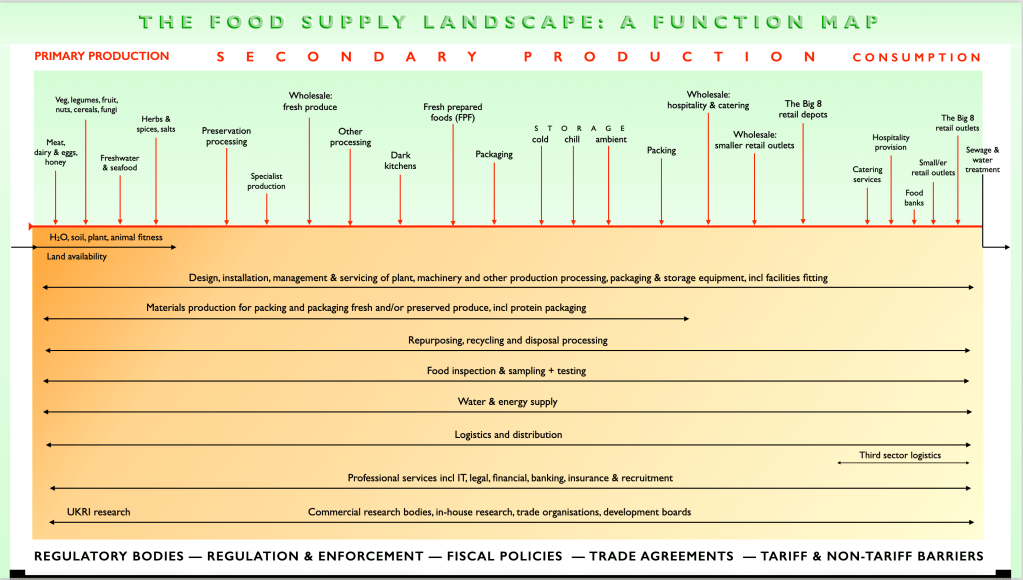
It takes a huge operation to get sufficient, safe, nutritious food to all of us. Although the food system touches our lives every day, we see only a minute part of it.
My piece jointly with Kate Cooper of the Birmingham Food Council:
By Benjamin Taylor and Kate Cooper | 13 December 2021
https://www.themj.co.uk/A-surprising-new-role-for-local-government/222213
System approaches in governmental public health: Findings from an analysis of the literature Jason M. Orr,Jonathon P. Leider,Margaret J. Gutilla First published: 28 December 2021
System approaches in governmental public health: Findings from an analysis of the literature – Orr – – Systems Research and Behavioral Science – Wiley Online Library
Distinguishing the Observer: An Attempt at Interpreting Maturana German Version published in: V. Riegas & C. Vetter (eds.) Zur Biologie 125.2 der Kognition. Frankfurt, Germany: Suhrkamp, 281–295, 1990. This paper was downloaded from the Ernst von Glasersfeld Homepage, maintained by Alexander Riegler. It is licensed under the Creative Commons Attribution-NonCommercial-NoDerivs License. To view a copy of this license, visit http://creativecommons.org/licenses/by-nc-nd/2.0/ or send a letter to Creative Commons, 559 Nathan Abbott Way, Stanford, CA 94305, USA. Preprint version of 4 Mar 2006
Text:Distinguishing the Observer: An Attempt at Interpreting Maturana – DigiVis
and pdf at
http://vonglasersfeld.com/125.2
Thinking like a State – Embodied intelligence in the deep history of our collective minds AUTHORS Avel GUÉNIN–CARLUT
OSF Preprints | Thinking like a State – Embodied intelligence in the deep history of our collective minds
Improvising Out of Algorithmic Isolation Michael Garfield Mar 25, 2021
Improvising Out of Algorithmic Isolation | by Michael Garfield | Medium
Goes with
https://michaelgarfield.bandcamp.com/track/seeing-like-a-state
source
Cybernetics and Systems

Alfonso Reyes, Universidad de Ibagué
areyes@unibague.edu.co
Sandro Luis Schlindwein, Federal University of Santa Catarina
sandro.schlindwein@ufsc.br
Submit a Manuscript to the Journal Cybernetics and Systems For a Special Issue on Redesigning Education and Governance in the Anthropocene
Cybernetics and Systems
hmm… HBR doing what it do…
Taming Complexity
Make sure the benefits of any addition to an organization’s systems outweigh its costs. by
From the Magazine (January–February 2020) Tatiana Plakhova Summary.
It can be cognitively demanding to understand how a system or organization made up of many very different interconnected elements actually works. But the fact that such systems or organizations are difficult to understand doesn’t make them inherently bad. In addition to its more obvious costs, complexity confers critical benefits, especially in dynamic and uncertain environments. The authors draw on their experience and perspectives in business, biology, and physics to offer some reflections on the nature, benefits, and costs of complexity and provide some guidance on managing it. Their recommendations: In growing your organization, make sure that it remains modular in structure and that all components and connections conform to a small number of simple operating principles. Embed a bias for change, avoid imposing too many controls on your people, and let the market judge which changes work. Finally, always optimize your organization globally and keep fixing, repairing, and pruning.
Taming Complexity
Taming Complexity

 Systems Community of Inquiry
You must be logged in to post a comment.