FOOTPRINT Spring/ Summer 2021 | All is in Formation: Architecture, Cybernetics, Ecology

Vol. 15 No. 1 (2021): Issue # 28 | Spring/ Summer 2021 | All is in Formation: Architecture, Cybernetics, Ecology Footprint #28 examines the relation between cybernetics and architecture by focusing on a problem they both share: the production, consumption and flow of information, or, in other terms, of meaning. Therefore, cyberneticisation can set the foundations for a relational account that examines how signs are communicated and how meaning is produced and experienced within systems. This third-order cybernetics extends beyond the original scope of living organisms and their environments in order to include ecologies of ideas, power, institutions, media and so on. In this sense, cyberneticisation is radically environmental, positing the primacy of relations over fixed terms, binary oppositions and linear logics, making it high time for architectural and urban studies to take into consideration its ground-breaking potentials. Issue’s editors: Stavros Kousoulas and Dulmini Perera DOI: https://doi.org/10.7480/footprint.15.1 Published: 2021-06-29

Vol. 15 No. 1 (2021): Issue # 28 | Spring/ Summer 2021 | All is in Formation: Architecture, Cybernetics, Ecology | FOOTPRINT


Footprint 28
 is out now. This issue, edited by Stavros Kousoulas and Dulmini Perera, is dedicated to the theme “All is in Formation: Architecture, Cybernetics, Ecology”.

This issue includes research articles by Christian Girard; Rachel Armstrong and Rolf Hughes; Tanja Herdt; Tim Gough; Contingent Collective; Zach Mellas; and Tewfik Hammoudi. It also includes review articles by Liz Gálvez; Iris Giannakopoulou Karamouzi; and Juliana Yat Shun Kei. The issue closes with a dialogue between Jon Goodbun and Ben Sweeting.

You can find the issue online in the following link to our platform:

https://journals.open.tudelft.nl/footprint/issue/view/880

Systemic praxis for water governance: Unnecessary or essential? Online, Open Univetsity – Tue 27 Jul 2021 at 12:00 UK time

JUL 27 Systemic praxis for water governance: Unnecessary or essential? by The Open University, Faculty of STEM

Systemic praxis for water governance: Unnecessary or essential? Tickets, Tue 27 Jul 2021 at 12:00 | Eventbrite

The Systems in Evaluation Topical Interest Group – new website

source:

Home – Systems in Evaluation
The Systems in Evaluation
Topical Interest Group
 
Visit the New SETIG Website
 
The Systems TIG has launched Its new website. The site has been constructed using WordPress to provide greater flexibility and functionality for TIG members and others interested in systems and evaluation. We will be transitioning all current TIG information and activities to this site, so bookmark it now and visit often.

It’s easy to become a member of the site – you’ll find a registration box on the right side of the home page under News and Announcements. You may use the site without registering, but, if you wish to post comments, resources, or other materials to the site, you will need to register as a member.

We envision the site as an evolving home on the web for those of us with an interest in systems, evaluation, and the intersection of the two. Many of our plans for the site revolve around supporting the Systems TIG and helping members stay connected between annual meetings.

We’ll be adding new features as we go along, so come visit us and bookmark the site to keep up with developments. We can be found at www.systemsinevaluation.com. If you have any questions, suggestions, or run into problems, feel free to contact our webmaster Jan Noga

Who We Are

The Systems in Evaluation TIG (SETIG)
 formed as the result of a series of sessions on systems thinking in evaluation offered during AEA’s 2002 annual meeting in Washington, DC. 

Created to provide a forum for ongoing conversation about the use of systems thinking and systems theory in evaluation, the TIG has greatly expanded in size and scope, with membership exceeding 450.

The TIG focuses on the use of systems thinking and systems theory as a framework for evaluation planning, design, implementation, analysis, and reporting, across a wide range
of content areas, and using a diverse array of evaluation approaches, research methods,
and data collection and analysis tools.

Areas of interest to TIG members include:
Evaluation approaches that use systems theory to plan, design, and implement evaluation Discussion about how to ground evaluation methods and approaches in systems thinking and theory The contributions of diverse perspectives in understanding issues related to the use of systems thinking and theory in evaluation


Join Us for Our Second Systems (Un)Conference in June

The SETIG Leadership Team is pleased to announce the second Systems in Evaluation (Un)Conference to be held June 21.  Go to the (Un)Conference page on the Systems TIG website for more information or contact us

The Systems in Evaluation Topical Interest Group

Home – Systems in Evaluation

Australasian Change Days 2021 #acdc2021 3 Day Virtual Event 9-11 September 2021

Australasian Change Days 2021 #acdc2021 3 Day Virtual Event Tickets, Thu 09/09/2021 at 3:00 pm | Eventbrite

SEP 09-11

Australasian Change Days 2021 #acdc2021 3 Day Virtual Event

by Sarah Glenister – Change that matters 

Following$352 – $440

Event Information

Theme: Steering into and embracing complexity. How might we navigate the true challenge of change with intention and direction.

About this event

Join Change Makers, Managers, Activists, Leaders and Trainers from all over the world as we explore our topic over three days Thursday 9th September and Friday 10th September (3pm – 8:30pm GMT+8) and our Super Saturday that caters for more timezones to join, 11th September 7:30am – 6pm (GMT +8)

What to bring?

  • curiosity
  • generosity of spirit
  • passion for connecting and collaborating
  • FUN!

There has been a shift in the last 12 months in the conversations that are happening on the global stage which have certainly been influenced by the escalation of involvement in political and social movements as well as the increase in polarising opinions and extremism.

We would like to explore this shift with you from your role as a Change professional through our theme for #acdc2021: Steering into and Embracing Complexity and to consider how we navigate the true challenge of change with intention and direction.

**Look out for our post conference workshops (face to face in Perth) which will be held on Sunday 12th September 2021.

more and booking at

Australasian Change Days 2021 #acdc2021 3 Day Virtual Event Tickets, Thu 09/09/2021 at 3:00 pm | Eventbrite

SCiO – SC101. Viable System Model – A Beginners Workshop in VSM Modelling with Patrick Hoverstadt, Sat 10 Jul 2021 all day UK time

SC101. Viable System Model – A Beginners Workshop in VSM Modelling Tickets, Sat 10 Jul 2021 at 09:30 | Eventbrite

JUL 10

SC101. Viable System Model – A Beginners Workshop in VSM Modelling

by SCiO – Systems and Complexity in Organisation Following£20 – £50

Event Information

A whole day workshop designed for those relatively new to VSM and provides basic training in building a model of an organisation using VSM.

About this event

The Workshop

This is a whole day workshop designed for those relatively new to the Viable System Model and provides basic training in building a model of an organisation using VSM. The workshop will run from 10am – 5pm (UK time) and will be run online.

The attendees work together in groups to develop their model of a case study organisation and to diagnose weaknesses. The workshop follows a structured approach, with a series of steps that take the groups through a modelling process in (relatively !) easy stages.

The case study is based on a real organisation – a medium sized IT and office supplies company and provides a platform for developing the skills needed to take normal organisational information, show how that relates to the VSM and how the VSM can provide a set of new insights into the company.

The workshop will be run by Patrick Hoverstadt of Fractal.

Booking

The workshop is open to members and non-members of SCiO. The fee for SCiO members and students of TU811 is £20 and for non-members is £50.

Places are limited, so please book early.

book at:

SC101. Viable System Model – A Beginners Workshop in VSM Modelling Tickets, Sat 10 Jul 2021 at 09:30 | Eventbrite

Splitting a Domain Across Multiple Bounded Contexts – Varraes and Wirfs-Brock

source

Splitting a Domain Across Multiple Bounded Contexts

Splitting a Domain Across Multiple Bounded Contexts

How designing for business opportunities and the rate of change may give you better contexts.

Published on 14 June 2021 by Mathias Verraes and Rebecca Wirfs-Brock

Imagine a wholesaler of parts for agricultural machines. They’ve built a B2B webshop that resellers and machine servicing companies use to order. In their Ubiquitous Language, an Order represents this automated process. It enables customers to pick products, apply the right discounts, and push it to Shipment.

Our wholesaler merges with a competitor: They’re an older player with a solid customer base and a huge catalog. They also have an ordering system, but it’s much more traditional: customers call, and an account manager enters the order, applies an arbitrary discount, and pushes it to Shipment.

continues in source:

Splitting a Domain Across Multiple Bounded Contexts

Mapping Toronto’s Systems Innovation Landscape | Si Network – Aug 11th, 12:00 – 1:15 pm EDT 

Mapping Toronto’s Systems Innovation Landscape | Si Network

Mapping Toronto’s Systems Innovation Landscape

Zoom Meeting

Add to Calendar

Zoom Link

Over the past decades, Toronto has emerged as one of the world’s leading cities for social and systems innovation. It has multiple communities rich in diverse expertise but as yet, not well connected into something greater than the sum of its parts. It is a city with huge potential to have a greater impact by leveraging its networks, but lack of connectivity and awareness of what this community looks like limits our capacity for collaboration and development.

The Systems Innovation Toronto Hub has been set up as a platform for developing this ecosystem in Toronto. We believe this starts with getting a view of the whole. To this end, we’ll be hosting a 75-minute co-creation “Mapping Toronto’s Systems Innovation Landscape”. We hope this will be the start of a conversation on how we can enable collaboration and the emergence of a much more robust community over time.

This will be an opportunity for you to network with people interested in innovation and systems change. You will also come away with a co-created map of Toronto’s Systems innovation landscape.

Date : Aug 11th, 12:00 – 1:15 pm EDT 

book at source (in Mighty Networks) Mapping Toronto’s Systems Innovation Landscape

Mapping Toronto’s Systems Innovation Landscape | Si Network

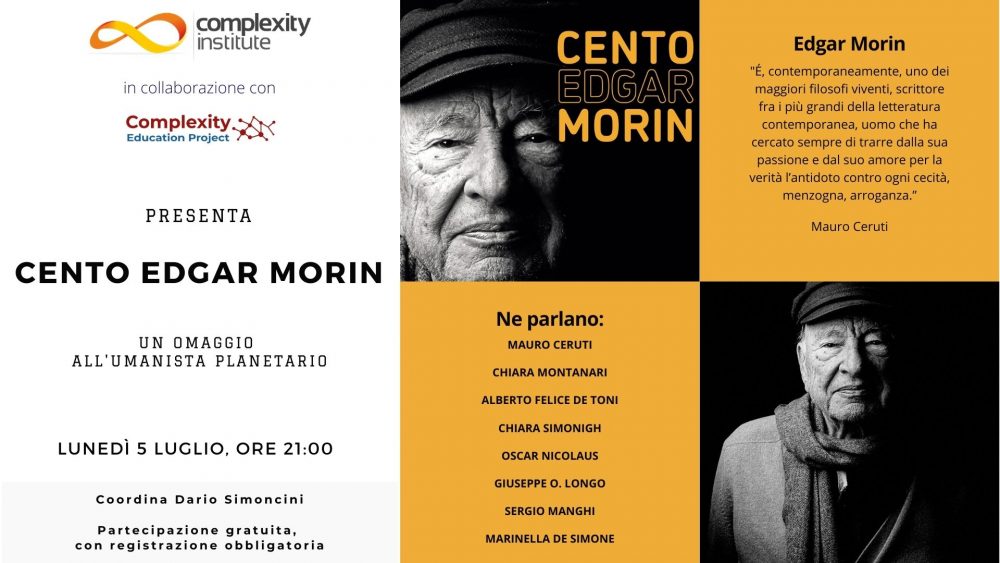
Cento Edgar Morin – Un omaggio all’umanista planetario – Complexity Institute, Italy – 5 luglio 2021 21.00-22.30, Italian time

source:

Cento Edgar Morin – Un omaggio all’umanista planetario – Complexity Institute

Cento Edgar Morin – Un omaggio all’umanista planetario

Cento Edgar Morin 

Un omaggio all’umanista planetario


Dialogo a più voci con alcuni autori del volume 

Cento Edgar Morin

100 firme italiane per i 100 anni dell’umanista planetario

a cura di Mauro Ceruti

Cento e più ragioni per onorare lo studioso, il maestro e l’amico, che oggi, nel pieno di questa gravissima crisi mondiale, indica l’orizzonte di un nuovo umanesimo planetario e continua a motivare alla resistenza contro ogni forma di barbarie, per costruire insieme reti e oasi di solidarietà, di fraternità, di pensiero creativo. Per uscire, insieme, da questa “Età del ferro dell’Era planetaria”.

Quando:

5 luglio 2021 21.00-22.30

Web Meeting

continues in source:

Cento Edgar Morin – Un omaggio all’umanista planetario – Complexity Institute

Linguistic Clues for Spotting Feedback Loops in the Wild – Kastens and Shipley

(pdf)

Click to access CC2021_LinguisticClues.pdf

System Dynamics Conference | FROM INSIGHTS TO ACTION: RESILIENCE TO GLOBAL PROBLEMS – fully virtual conference July 25-30, 2021 System Dynamics Society

July 25 – 30, 2021 A Fully Virtual Conference

System Dynamics Conference | System Dynamics Society

The Handbook of Handbooks for Decentralised Organising – Richard D Bartlett

The Handbook of Handbooks for Decentralised Organising

The Handbook of Handbooks for Decentralised Organising – HackMD

Intransitivity – Wikipedia

Intransitivity From Wikipedia, the free encyclopedia Jump to navigationJump to search This article is about intransitivity in mathematics. For other uses, see Intransitive (disambiguation). In mathematics, intransitivity (sometimes called nontransitivity) is a property of binary relations that are not transitive relations. This may include any relation that is not transitive, or the stronger property of antitransitivity, which describes a relation that is never transitive.

Intransitivity – Wikipedia

Counterintuitive behavior of social systems | Forrester (1971)

Counterintuitive behavior of social systems

Counterintuitive behavior of social systems | SpringerLink

Counterintuitive behavior of social systems

Theory and Decision volume 2, pages109–140 (1971)

Abstract

This paper addresses several issues of broad concern in the United States: population trends; the quality of urban life; national policy for urban growth; and the unexpected, ineffective, or detrimental results often generated by government programs in these areas.

The author does attempt to indicate how multiloop feed-back systems (to which our social systems belong) mislead us because our intuition and judgement have been formed to expect behavior different from that actually possessed by such systems. At times programs cause exactly the reverse of desired results.

It is now possible to explain how such contrary results can happen. There are fundamental reasons why people misjudge the behavior of social systems. There are orderly processes at work that frequently lead people to wrong decisions when faced with complex and highly interacting systems. Until we come to a much better understanding of social systems, we should expect that attempts to develop corrective programs will continue to disappoint us.

Stages and Dimensions of Systems Intelligence – Jones and Corner (2011)

Stages and Dimensions of Systems Intelligence

Stages and Dimensions of Systems Intelligence – Jones – 2012 – Systems Research and Behavioral Science – Wiley Online Library

Stages and Dimensions of Systems Intelligence

Rachel JonesJames Corner

First published: 03 June 2011 

https://doi.org/10.1002/sres.1090

Abstract

Following the footsteps of emotional, social, cultural and other types of intelligence, systems intelligence offers a new perspective on how individuals act with a lesser or greater degree of intelligence within physical and social systems. First appearing in the published literature in 2004, systems intelligence has resonated with the related fields of decision making, communication and leadership, among others. However, to date, a taxonomy for considering systems intelligence has yet to be described. Building off Kegan’s framework for human development and Hämäläinen and Saarinen’s recent levels, we offer a new taxonomy of systems intelligence and describe its stages and dimensions. We focus on the three stages of attentive, active and inspired systems intelligence, incorporating three, four and eight dimensions, respectively. This taxonomy serves as a useful conceptualization for the future development of measurement tools for systems intelligence and as a basis for understanding how individuals might transition between stages. Copyright © 2011 John Wiley & Sons, Ltd.

https://onlinelibrary.wiley.com.sci-hub.se/doi/abs/10.1002/sres.1090

Second order cybernetics – Glanville (2008) in Systems science and cybernetics. Encyclopedia of life support systems