
I’m pleased to say that I have a piece on ‘six ways to see systems leadership’ in Gabriele Bammer’s excellent Integration and Implementation Insights blog today:
https://i2insights.org/2021/06/22/systems-leadership/
That piece sets out an attempt to provide a light classification for the very wide and undefined phrase ‘systems leadership’.
In this companion piece, I want to give references and examples and comment a bit more critically on what I see as the risks of the popularity of ‘systems leadership’. I should say from the start that I have tended to include ‘systems change’ methods and approaches (see https://stream.syscoi.com/2020/05/10/what-is-systems-change-the-start-of-aggregating-information-a-stub/) as well as ‘systems leadership’ because there is such significant overlap. I am setting out early thinking that will, no doubt, beg some questions!
My six categories as in the other piece, with examples and references:
1. Systems leadership as a form of better, inclusive, wider leadership.
Examples:
• Peter Senge piece ‘the dawn of systems leadership’ https://ssir.org/articles/entry/the_dawn_of_system_leadership
Emphasises seeing the system, generative conversation, co-creation.
• The United Nations System Leadership Framework
https://unsceb.org/united-nations-system-leadership-framework
Which emphasises norms, principles, inclusivity, accountability, multidimensionality, transformation, collaboration, and self-application, with four ways of working: achieving impact, driving transformational change, employing systems thinking, and co-creating solutions
My concern is that this may easily revert back to ‘individual development masquerading as leadership development’. It could be radically challenging, but appears likely to attract lip service without critical challenge.
2. Systems leadership driven externally from outside the system
3. Facilitative system leadership, supporting change to emerge from within the system
The risk of both is, frankly colonialist do-gooding (or intentional meddling).
The possibility of (2) is a real external drive and positive disruption which reframes a system or multiple systems by identifying an alternative locus from the current power base which comes to be perceived as legitimate from within the system. The possibility of (3) is real self-determination when the facilitators do not exercise control.
This is a fine distinction which cannot easily approaches, because as you can see, how they are done will be as important as which approach is selected.
Approaches which fit within these two categories include:
• Systems Leadership – Harvard Kennedy School (https://www.hks.harvard.edu/centers/mrcbg/publications/fwp/crisept2019 ) which focuses on ‘individual, community, and system’ and has the steps: convene and commit; look and learn; engage and energise; act with accountability; and review and revise.
• System-of-interest with complexity – ‘wicked problems’/messes etc (UK systems leadership in children’s services model – Public Value Theory, Grint’s Wicked Problems and Adaptive Leadership)
• System-of-interest with outcomes – often turning an unstructured/un-organised system into a structured/organised one – more likely an understand – plan – do (with some kind of review) purposive model – (Collective Action, Collaborate, Systems Stewardship, outcome-based commissioning)
• Advocacy and support for network, collaborative, co-operation, peer, permaculture, and other alternative organisational forms
• The water of systems change (https://www.fsg.org/publications/water_of_systems_change) – for funders of ‘systems change’ – looks at structural, relationships, paradigms levels.
Definitely aiming to be in the (3) camp:
• Whole swathes of futures/design ‘whole system’ or ‘representative of whole system’ co-creation approaches – (FutureSearch, Theory U)
• Asset-based community development type approaches, mobilising/enabling those considered the ‘constituents’ of the system to shape change.
4. Systems leadership for systems innovation.
Examples:
• ‘6 Ways to Make Your Work More Effective, From Entrepreneurs Who Want To Change The World’ – by Rachel Sinha and Ella Saltmarshe
• Rachel Sinha – mapping the world of systems innovation (unpublished)
• Leyla Acaroglu – a manifesto for design-led systems change
• Anna Birney, Laura Winn, Corina Angheloiu and Zahra Davidson – The School of System Change as a systemic endeavour (working paper)
• Forum for the Future – A ‘How To’ for system innovation – by Anna Birney
• Forum for the Future – Cultivating System Change – A Practitioner’s Companion – by Anna Birney
• The work of Collaborate CIC in ‘funding and commissioning in complexity’
• Social Innovation Change, Social Innovation Generation, Forum for the Future, and the Systems Studio – Funding Systems Change: Challenges and Opportunities
• Hamoon Ekhtiari – don’t build a start-up, become a systems entrepreneur
• The work of the Ashoka Foundation
There is a set of interventions in collaboration in systems change – exemplified by CoCreative – which illustrates the strong link between this kind of systems innovation and (4) facilitative systems change, in that it intentionally bridges from ‘entrepreneurial’ movements which provide challenge bottom-up to connect them into a more effective alternative system leadership.
The risk in this space, of course, is that these approaches are too small, too local, too hard to support as ‘alternative’ system leadership in a world in which they provide an alternative to the dominant power base, and fizzle out. They could, of course, divert attention to small, non-threatening alternative power bases and away from challenging existing structures at their heart (‘systems leadership theatre’, we might say).
5. Systems leadership as leadership of complex systems.
Examples:
• Barry Oshry’s Organic Systems Framework
• Stafford Beer’s Viable Systems Model
• Organisation within environment, including with ‘partners’ etc – (Hoverstadt and Loh, and health systems work UK)
• Collaborate CIC – Building Collaborative Places: Infrastructure for System Change / Behaving Like A System – the preconditions for place-based system change
• USAID GKI Systems-Leadership-Brief (http://globalknowledgeinitiative.org/) – strong on actors, linkages, environment though with a naïve ‘root cause’ element.
• Institutional system within an environment – (UK NHS and much mapping)
• Macdonald Associates’ Systems Leadership Theory (from the Elliot Jacques heritage)
This is my preferred ‘home ground’, so it’s harder for me to criticise this flavour of systems leadership. Certainly, though, it can be accused of:
• An assumption of ‘systematicity’ or bringing things into the scope of ‘creating a functioning system’ which may not be warranted.
• Challenges where elements of the system overlap in terms of geography and levels of hierarchy.
• A starting point in the locus of what is considered ‘legitimate power’ in the status quo which may weaken the critical perspective.
6. Organic types of systems leadership
Examples:
• Network weaving, from June Holley https://networkweaver.com/, an approach fundamentally predicated on connection, self-organisation, and ongoing change;
• Nora Bateson’s work, particularly around Warm Data Labs https://batesoninstitute.org/warm-data-labs/ which is emergent and concerned with engaging the ongoing effort and learning embedded in existing system patterns
• Systems convening, forthcoming from Bev and Etienne Wenger-Trayner, https://wenger-trayner.com/systems-convening/), which identifies the ‘leadership’ which emerges in its own right from within or across systems, which is embedded and situated and yet organically developing change through network approaches.
• I would likely add the Systems Changes group convened by David Ing here (www.systemschanges.com), though in many ways this is a meta-approach which could encompass any of the above.
A concern is that these approaches may be ‘sidelined’ to reduce radical challenge, kept to a limited field and directly opposed by those benefiting from the existing system because their potentially radical challenge can be dismissed due to lack of legibility of purpose and method. Yet these approaches can potentially ‘get under the wire’ and exert subtle influence for the same reasons.
Summary and an attempt to structure these approaches
I have very clearly linked across from systems change into systems leadership, by making an assumption that all these approaches have two complementary goals:
• Ensuring that the system is ‘led’ in a way that is considered broadly beneficial, ethical, legitimate.
• Focusing on the system ‘working’ in an effective, functional way.
This suggests a way to attempt to structure the approaches together by illustrating their focal points, and perhaps affinities, connections, and potential ‘bridging’ between approaches:
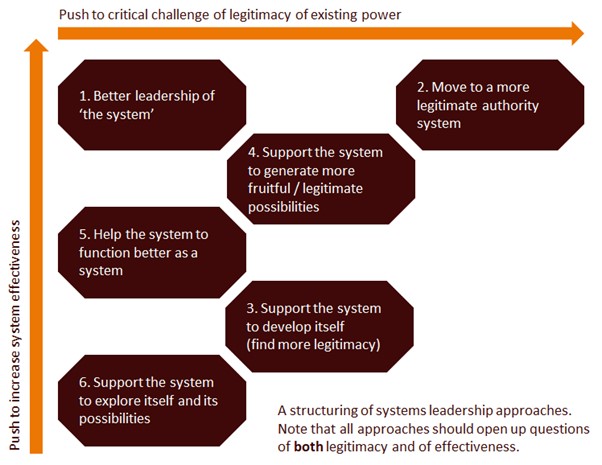
(Original piece adapted from earlier drafts at https://stream.syscoi.com/2020/08/03/what-might-systems-leadership-be-and-how-does-it-relate-to-systems-change-a-happily-tentative-essay/ and a comment at https://i2insights.org/2021/04/13/systems-thinking-and-leadership/)




 Systems Community of Inquiry
You must be logged in to post a comment.