JRC Publications Repository: Managing complexity (and chaos) in times of crisis. A field guide for decision makers inspired by the Cynefin framework – Snowden and Alessandro (2021)

I’m pleased to say that the JRC of the EU Commission has just published a new fieldguide to managing in Complexity (and Chaos). Will be organising webinars to brief people on this next week and happy to handle any group or other requests for similar. You may agree or disagree with the underlying theory but this is significant for the wider complexity community in terms of acknowledgement

(As Dave Snowden said in the Complexity Explorers group on Facebook)

source:

JRC Publications Repository: Managing complexity (and chaos) in times of crisis. A field guide for decision makers inspired by the Cynefin framework
Managing complexity (and chaos) in times of crisis. A field guide for decision makers inspired by the Cynefin framework
Authors: SNOWDEN DAVERANCATI ALESSANDRO
Publisher: Publications Office of the European Union
Publication Year: 2021
JRC N°: JRC123629
ISBN: 978-92-76-28844-2 (online),978-92-76-28843-5 (print)
ISSN: 1831-9424 (online),1018-5593 (print)
Other Identifiers: EUR 30569 EN
OP KJ-NA-30569-EN-N (online),KJ-NA-30569-EN-C (print)
URI: https://publications.jrc.ec.europa.eu/repository/handle/JRC123629
DOI: 10.2760/353
10.2760/164392
Type: Books
Abstract: This field guide helps to navigate crises using the Cynefin framework as a compass. It proposes a four-stage approach through which we can: – assess the type of crisis and initiate a response; – adapt to the new pace and start building sensing networks to inform decisions; – repurpose existing structures and working methods to generate radical innovation; – transcend the crisis, formalise lessons learnt and increase resilience. The guide stresses the importance of setting and managing boundaries, building informal structures, keeping options open, distributing engagement and keeping an ongoing assessment of the evolving landscape. Action items, real life examples and demonstrations complement the references to the developing theoretical framework.
JRC Directorate:Joint Research Centre Corporate Activities

full document in source:

JRC Publications Repository: Managing complexity (and chaos) in times of crisis. A field guide for decision makers inspired by the Cynefin framework

Legendary Physicist David Bohm on the Paradox of Communication, the Crucial Difference Between Discussion and Dialogue, and What Is Keeping Us from Listening to One Another – Brain Pickings

Another one I’m squeezing in because, although it’s probably not possible to formally call this ‘systems thinking’, it has come up so many times for me in the last week alone that I feel a need to document this very significant source of inspiratoin for so many int the community.

Brainpickings: https://www.brainpickings.org/2016/12/05/david-bohm-on-dialogue/

Dialogue – a proposal (1991) pdf https://www.humiliationstudies.org/documents/BohmDialogue.pdf

Bohmian Dialogue: A Promising Pedagogy for Transformation Learning? McBride et al (2003) pdf https://core.ac.uk/download/pdf/37774232.pdf

The Art of Dialogue according to David Bohm

On the foundations of meaningful communication (2019)

https://organicstrategies.de/en/the-art-of-dialogue-according-to-david-bohm/

Wikpedia:

https://en.wikipedia.org/wiki/Bohm_Dialogue

Stafford Beer masterclass Q and A – Cybernetics, VSM (Viable System Model), Chile, Allende etc – YouTube

STAFFORD BEER masterclass Q and A – Cybernetics, VSM (Viable System Model), Chile, Allende etc – YouTube

STAFFORD BEER masterclass Q and A – Cybernetics, VSM (Viable System Model), Chile, Allende etc

Hairy Bear

Professor Stafford Beer responding to questions submitted after a masterclass in Liverpool. Unfortunately I do not know the date. This was recorded by Roger Harnden at Stafford’s cottage in Wales. I added the picture because I like it – taken at Aberaeron around 1976. “The purpose of a system is what it does.”

source:

STAFFORD BEER masterclass Q and A – Cybernetics, VSM (Viable System Model), Chile, Allende etc – YouTube

visualcomplexity.com

source:

visualcomplexity.com | About

“Functional visualizations are more than innovative statistical analyses and computational algorithms. They must make sense to the user and require a visual language system that uses colour, shape, line, hierarchy and composition to communicate clearly and appropriately, much like the alphabetic and character-based languages used worldwide between humans.”Matt Woolman
Digital Information GraphicsGoalVisualComplexity.com intends to be a unified resource space for anyone interested in the visualization of complex networks. The project’s main goal is to leverage a critical understanding of different visualization methods, across a series of disciplines, as diverse as Biology, Social Networks or the World Wide Web. I truly hope this space can inspire, motivate and enlighten any person doing research on this field.Not all projects shown here are genuine complex networks, in the sense that they aren’t necessarily at the edge of chaos, or show an irregular and systematic degree of connectivity. However, the projects that apparently skip this class were chosen for two important reasons. They either provide advancement in terms of visual depiction techniques/methods or show conceptual uniqueness and originality in the choice of a subject. Nevertheless, all projects have one trait in common: the whole is always more than the sum of its parts.

source:

visualcomplexity.com | About

Cybernetics, Computer Design, and a Meeting of the Minds – IEEE Spectrum

source:

Cybernetics, Computer Design, and a Meeting of the Minds – IEEE Spectrum

09 Feb 2021 | 14:00 GMT

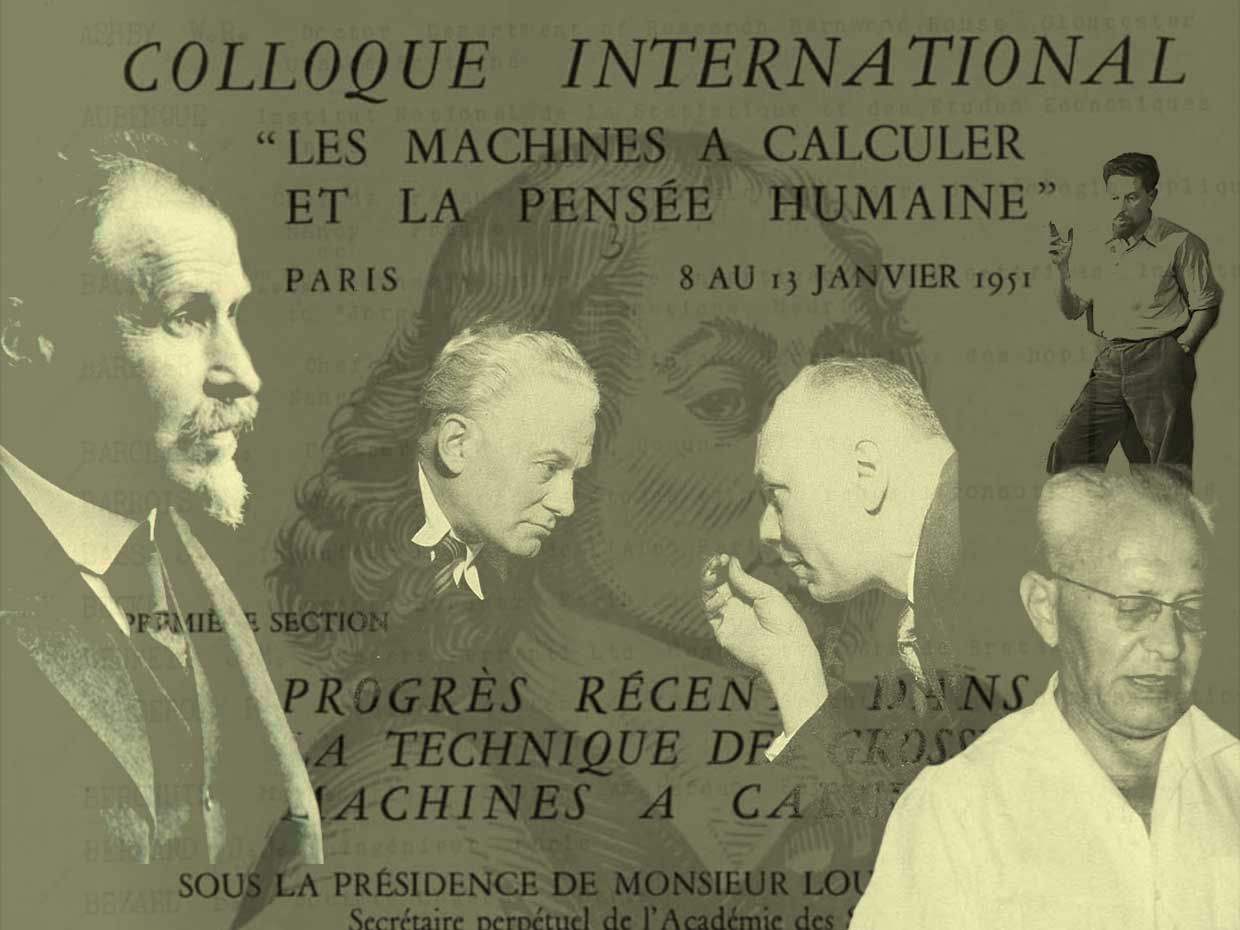
Cybernetics, Computer Design, and a Meeting of the Minds

An influential 1951 conference in Paris considered the computer as a model of—and for—the human mind

By David C. Brock

LES MACHINES A CALCULER ET LA PENSEE HUMAINE; 1951
Photo-illustration: IEEE Spectrum

AdvertisementEditor’s PicksThe Brain as Computer: Bad at Math, Good at Everything ElseFirst Programmable Memristor ComputerUntold History of AI: The DARPA Dreamer Who Aimed for Cyborg Intelligence

Suggested Wiley-IEEE Reading

Dynamic Spectrum Access Decisions: Local, Distributed, Centralized, and Hybrid Designs

In Paris. Exactly seventy years ago.

continues in source:

Cybernetics, Computer Design, and a Meeting of the Minds – IEEE Spectrum

The Fractal Geometry of Nature – Benoit Mandelbrot (full book)

A ‘characterful’ scan:

Click to access a165185.pdf

CybSights Insights: “What’s my Motivation?” A cybernetic question and its dramatic enactment – YouTube

CybSights Insights: “What’s my Motivation?” A cybernetic question and its dramatic enactment – Prof Tom Scholt, Percetual Control Theory, Method of Levels

The Insights Series is an eclectic and learned collection of monthly events on the 4th Tuesday of each month hosted by the Secretary of the Cybernetics Society, Angus Jenkinson. Cybernetics is the science of design and achievement, the great fusion discipline of our time. In this session, Prof Tom Scholte, an acclaimed film and theatre director, Vice-President of the American Society for Cybernetics, and a Professor of Acting and Directing at the University of British where his centre deals with social challenges and conflicts in organisations. This business-savvy and human-centred immersive experience was a fine exploration of motivation and human behaviour through the media of drama, conversation and reflection. It also introduced the discipline of perceptual control theory (PCT), a discipline with affinities and connections to cybernetics. Discover the real nature of behaviour and how it is self- managed. Relevance to business and social practice is evident. The session was also held in association with IASCYS, the PCT network.

source:

CybSights Insights: “What’s my Motivation?” A cybernetic question and its dramatic enactment. – YouTube

Full text of Challenge to Reason by CW Churhman, 1968 – plus W. Ulrich | A Tribute to C.W. Churchman

full text of Challenge to Reason: http://www.ask-force.org/web/Discourse/Churchman-Challenge-Reason-1-223-1968.pdf

tribute on Ulrich’s page

C.W. Churchman | W. Ulrich | Ulrich’s Home Page: A Tribute to C.W. Churchman
Werner Ulrich’s Home Page:  C.W. Churchman 
    
    
  A Tribute to C. West ChurchmanC. West Churchman (ca. 1995) © A. Schultz   
    
    
HOMEWERNER ULRICH’S BIOPUBLICATIONSREADINGS ON CSHDOWNLOADSHARD COPIESCRITICAL SYSTEMS HEURISTICS (CSH)CST FOR PROFESSIONALS & CITIZENSA TRIBUTE TO C.W. CHURCHMAN –SUBPAGES:• INTRODUCTION• OBITUARY NOTICE
(25 MARCH 2004)
• AN APPRECIATION OF C.W. CHURCHMAN• A BIBLIOGRAPHY OF C.W. CHURCHMAN’S
WRITINGS, 1938-2001
• FUTURE-RESPONSIVE MANAGEMENT• IN MEMORY OF C.W. CHURCHMAN: REMINISCENCES, RETROSPECTIVES, AND REFLECTIONS (PDF)• C.W.CHURCHMAN
(1913-2004)
PICTURE OF THE MONTH
OF APRIL 2004
• CHURCHMAN’S PROCESS OF UNFOLDING [IN PREP.]LUGANO SUMMER SCHOOLULRICH’S BIMONTHLY(formerly Picture of the Month)COPYRIGHT NOTEA NOTE ON PLAGIARISMCONTACTSITE MAP 
 C. West Churchmanwas one of the founding fathers of the fields of operational research, management science (two closely connected fields often referred to as OR/MS), and the “systems approach.” Yet he also remained one of their major critics – he wanted us to remain faithful to the self-reflective, interdisciplinary and ethical spirit that stood at the beginning of OR/MS and the systems approach.West (his preferred second first name) was born in 1913. In 2003, he celebrated his 90th birthday. This tribute section of my home page originally was a modest attempt to honor my former teacher’s 90 years. After the news of his death on 21 March, 2004, it gained an unintended new significance. In remembrance of West Churchman, I would like to offer the following tribute articles.1)KEY WORDS: C.W. Churchman – biography; C.W. Churchman – bibliography; C.W. Churchman – appreciation; systems approach; systems thinking; future-responsive management; process of unfoldingC. W. Churchman (1913-2004)Obituary NoticeIn memory of West Churchman, my former teacher and mentor at the University of California, Berkeley, I offer this Tribute section of my home page. After his passing in March, 2004, two additional tribute essays were published in autumn, 2004 (see my list of publications).Copyright © 2002-2019
Suggested citation: Ulrich, W. (2002). A tribute to C. West Churchman (rev. version, 5 Nov 2015). Werner Ulrich’s home page, https://wulrich.com/cwc.html .

source:

C.W. Churchman | W. Ulrich | Ulrich’s Home Page: A Tribute to C.W. Churchman

Systems & Design Thinking: A Conceptual Framework for Their Intergration – Pourdehnad, Wexler, Wilson (2011)

source:

Systems & Design Thinking: A Conceptual Framework for Their Intergration

Systems & Design Thinking: A Conceptual Framework for Their Intergration

  • July 2011
  • This paper explores the relationship between Systems and Design Thinking. It specifically looks into the role of Design in Systems Thinking and how looking at the world through a systems lens influences Design. Our intention is to show the critical concepts developed in the Systems and Design Thinking fields, their underlying assumptions, and the ways in which they can be integrated as a cohesive conceptual framework. While there are many important distinctions that must be considered to understand the similarities and differences of these concepts, gaining a complete understanding of these factors is more than can be covered in this paper. Nevertheless, the most critical classifying variable used to distinguish these concepts will be discussed in order to make their integration possible. This variable, the recognition of purposeful behavior, will be used to develop a conceptual vision for how a combined approach can be used to research, plan, design and manage social systems…Systems in which people play the principle role.

full article in source:

Systems & Design Thinking: A Conceptual Framework for Their Intergration

a collection of collective systems facilitation and delivery techniques

A revival of an old link from model.report –

https://model.report/s/np0uvr/a_collection_of_collective_systems_facilitation_and_delivery_techniques/comments/lizbqi

Because I’m again thinking about the links and connection between the MG Taylor Method and Future Search, and Beer’s Team Syntegrity, and indeed Tavistock and Trist and Jacuqes and post-WW2 army leader selection.

Anyway, some more collective/large group facilitation links:

ART OR ARTIST? AN ANALYSIS OF EIGHT LARGE-GROUP METHODS FOR DRIVING LARGE-SCALE CHANGE
Svetlana Shmulyian, Barry Bateman, Ruth G. Philpott and Neelu K. Gulri

Click to access add8f9b084b526100166a6971c0fbfa8bd15.pdf

(covers: AmericaSpeaks, Appreciative Inquiry, Conference Models, Decision Accelerator, Future Search, Participative Design, Strategic Change Accelerator/ACT (IBM), and Whole-Scalet Change)

US Patent application (2001, abandoned) for “System and method for augmenting knowledge commerce” – Matt and Gail Taylor
A system and method for addressing the paradoxes and problems associated with the Knowledge Economy, and the transition to it. The system and method of the present invention create a unified experience of work that scales from individual thought processes to the building and using of a global system of commerce. Described in several levels of recursion, the system and method of the present invention integrate, into a single system and method several discrete Sub-Systems and methods that comprise a myriad of now unintegrated tools and processes that are conducted across contradictory and non-collaborative environments.
https://patents.google.com/patent/US20040006566A1/en
(pdf) https://patentimages.storage.googleapis.com/11/a8/0b/73254778a0bb42/US20040006566A1.pdf

D5.1 Plan for Innovation Procedures in ROADIDEA (bear with me!) – part of a European funded project (5 million euros?!) to study the potential of the European transport service sector for innovations, to analyse available data sources, to reveal existing problems and bottlenecks, and to develop better methods and models to be utilized in service platforms. These were to be capable of providing new, innovative transport services for various transport user groups, while trialling a formal innovation process to achieve this. The central issue was the Innovation Process itself and its value in undertaking this important task. (Overview https://trimis.ec.europa.eu/project/road-map-radical-innovations-european-transport-services#tab-outline)
This is the innovation process: https://cordis.europa.eu/docs/projects/cnect/5/215455/080/deliverables/ROADIDEA-D5-1-Innovation-Plan-V1-1.pdf

‘Comprehensive review of collaboration technologies’ (it’s not): http://www.collaborationlabs.net/index.html

Dee Brook – Towards a practice of collaborative sustainable innovation design – foresight enhancement and the designshop process
Submitted to OCAD University in partial fulfillment of the requirements for the degree of Master of Design in STRATEGIC FORESIGHT AND INNOVATION Toronto, Ontario, Canada, April, 2019

Click to access Brooks_Dee_2019_MDES_SFI_MRP.pdf

Redesigning Our Theories of Theories of Change, Peter H Jones + Ryan J A Murphy (ST-ON 2020/11/19) – Coevolving Innovations

source:

Redesigning Our Theories of Theories of Change, Peter H Jones + Ryan J A Murphy (ST-ON 2020/11/19) – Coevolving Innovations

Redesigning Our Theories of Theories of Change, Peter H Jones + Ryan J A Murphy (ST-ON 2020/11/19)

 February 5, 2021  daviding 0 Comments

While the term “theory of change” is often used by funders expecting an outcome of systems change for their investment, is there really a theory there?

The November 2020 Systems Thinking Ontario session was an opportunity for Peter H. Jones (OCADU) and Ryan J. A. Murphy (Memorial U. of Newfoundland) to extend talks that they had given over a few days for the Relating Systems Thinking and Design (RSD9) Symposium.

The talks covered some early research and conversation on deepening the understanding of “theories of change”.  After our usual round of self-introductions by meeting attendees, the core content starts in the web video recording after 12m45s.

The video file is also viewable and downloadable at the Internet Archive,

VideoH.264 MP4
November 9
(1h56m)
[20201109_ST-ON_Jones_Murphy_TheoriesOfTheoriesOfChange.m4v]
(FHD 203kbps 276MB) [on archive.org]

The digital audio was extracted from the video, and transcoded to MP3.

Audio
November 9
(1h56m)
[20201109_ST-ON_Jones_Murphy_TheoriesOfTheoriesOfChange.mp3]
(40MB) [on archive.org]

Here is the original abstract from the Systems Thinking Ontario November 9, 2020, session.

— begin paste —

Redesigning Our Theories of Theories of Change

Peter Jones presents a customized talk from the RSD9 plenary session for ST ON. Ryan Murphy joins with a full presentation of his RSD9 talk.

We often use the model of “theories of change” to argue for the process by which envisioned change programs might achieve their goals. Essentially these are the working theories by which we explain the logic of system change outcomes, and we often include quasi-systemic logic models to communicate them. ToCs are as ubiquitous in social innovation and philanthropy as business models are in startups and VCs. “Systems change” has emerged as a major movement in the worlds of impact investing, philanthropy, and the NGOs they fund, and the proposals expected to advance studies and change programs embrace the language of the theory of change.

  • Do Theories of Change reflect coherent models of change that we can observe or assess in real social systems? If so, are logic models sufficient (do they correspond to reality)?
  • How do we Represent Transformation? Framework of four Sensemaking Logics
  • What are the meanings, purposes, effectiveness, basis in systemics, their common applications, uses and misuses of Theories of Change?
  • Can we produce better theories for change through systemic design rationale

Suggested pre-reading:

source:

Redesigning Our Theories of Theories of Change, Peter H Jones + Ryan J A Murphy (ST-ON 2020/11/19) – Coevolving Innovations

Gregory Bateson, Ecology of Mind and Double Binds – Nora Bateson on YouTube (2012)

source:

Gregory Bateson, Ecology of Mind and Double Binds – YouTube

Gregory Bateson, Ecology of Mind and Double Binds 458 views•1 Dec 2020 6 0 SHARE SAVE jude lombardi 264 subscribers SUBSCRIBED Two excerpts from the 2012 American Society for Cybernetics. One by Nora Bateson on the Ecology of Ideas and the other one man’s story about his experience with a Double Bind.

Gregory Bateson, Ecology of Mind and Double Binds – YouTube

Shape of things to come: From the ‘laws of form’ to management in the post-growth economy | ephemera – Reichel (2017)

Shape of things to come: From the ‘laws of form’ to management in the post-growth economy | ephemera

Shape of things to come: From the ‘laws of form’ to management in the post-growth economy

Organizing for the post-growth economyarticleAndré ReichelPDF icon17-1reichel.pdfKeywords  post-growththeory of the firmsystem theorylaws of formNiklas Luhmannabstract

Departing from George Spencer-Brown’s Laws of form and the works of German sociologist Dirk Baecker, a formal model of the firm in the post-growth economy is developed. In following a post-classical approach – and some reference to system theory by Niklas Luhmann as well as the works on autonomous systems by Francisco Varela – we, first, show the explanatory power of Spencer-Brown’s indicational notation for conceptualizing organizational and managerial problem situations, thus contributing a novel approach to the theory of the firm. Secondly, model insights about the nature of the firm, its management, and its relation to a changing environment with limits to economic expansion and increased societal demands are contrasted with existing strands of more classical managerial research and their findings. Thus, it is possible to theoretically substantiate new perspectives on the future ‘hard core’ of management practice around the notions of ethics, values, and collaboration, while also describing the scope and direction of changes in the firm’s societal, economic, and ecological environments.

source:

Shape of things to come: From the ‘laws of form’ to management in the post-growth economy | ephemera

A survey of some good links on Heifetz and Linksy’s Adaptive Leadership

Eagle-eyed readers will notice that I am ‘clearing the decks’ today.

Linksy and Heiftez’s Adaptive Leadership is an approach which I see a lot of value in, and some risk. It’s not truly systems thinking at all, I don’t think – but is a relevant practice (arguably), and is used by many in a form of institutional structure ‘systems leadership’

Heifetz talking about leadership:

A four-minute overview from Adriano Pianesi (with dramatic music):

A Survival Guide for Leaders
by Ronald Heifetz and Marty Linsky
HBR (June 2002)
https://hbr.org/2002/06/a-survival-guide-for-leaders

Leading with an Open Heart (2002)
(pdf) http://docshare02.docshare.tips/files/9240/92401968.pdf

Leadership in a (Permanent) Crisis
by Ronald Heifetz, Alexander Grashow, and Marty Linsky
HBR (July–August 2009)
https://hbr.org/2009/07/leadership-in-a-permanent-crisis

Becoming an adaptive leader (an overview not by the originators)
(pdf) https://www.lifelongfaith.com/uploads/5/1/6/4/5164069/becoming_an_adaptive_leader.pdf

Leadership on the Line: Staying Alive Through the Dangers of Leading
5/28/2002
It’s not enough to lead everyone out of the mud. As a leader you need to ask yourself—honestly—what you did to get everyone into a bad spot to begin with. In this excerpt from their new book Leadership on the Line: Staying Alive Through the Dangers of Leading, two Harvard University’s John F. Kennedy School of Government faculty pool ideas to look deeper at the hard work of leading others.
by Ronald A. Heifetz and Marty Linsky
https://hbswk.hbs.edu/archive/leadership-on-the-line-staying-alive-through-the-dangers-of-leading

David Hume on Personal Identity

Hume on identity over time and persons PHIL 20208 Jeff Speaks October 3, 2006 Hume on identity over time and persons

A Treatise of Human Nature (1739) Book I: Of the understanding Part IV: Of the sceptical and other systems of philosophy Section VI: Of Personal Identity by DAVID HUME This text is in the PUBLIC DOMAIN and may be freely reproduced. Paragraph numbering was not included in the original text and has been added for ease of reference.

David Hume on Personal Identity