Call for papers to a special issue of the Scandinavian Journal of Management on
The Great Reset of management and organization theory
Proponents
Steffen Roth, Full Professor of Management, La Rochelle Business School, France, and Adjunct Professor of Economic Sociology, University of Turku, Finland [corresponding proponent].
Wojciech Czakon, Full Professor of Strategic Management, Jagiellonian University, Cracow, Poland
Wolfgang Amann, Professor of Strategy and Leadership, HEC Paris in Qatar, Qatar
Léo-Paul Dana, Full Professor of Entrepreneurship, Montpellier Business School, France
This changes everything. Still a wishful thought and claim rather than a certainty, the title of Naomi Klein’s (2015) report on the battle between capitalism and the climate blends well into observations of the repeatedly declared 2020 war against the coronavirus and its tremendous impact on what is already being described as our “old-normal” lives. Many agree now that the coronavirus has exposed the weaknesses of neoliberal institutional designs, financial austerity policies, and a…
Systems-Centered Training (SCT) is a practical and innovative systemic approach to personal and organizational development, group dynamics and therapy. Pioneered by Yvonne Agazarian, SCT begins with the idea that we are always in a system, be it the system of ourselves as a person, a couple, a family, a team, or a whole organization. SCT posits that these different systems heavily influence how we function within them. Our ongoing challenge is how to contribute to building the kind of systems in which we want to live and work. This conference will explore what helps and what gets in the way as we take up this very human challenge.
SCT introduces tools for therapists, coaches, educators, leaders, and whole organizations that focus on development, change and innovation in relation to the wider context, which includes explicitly weakening obstacles to resolving conflicts in the service of the system goals.
The following are some of the central concepts and applications in SCT:
SCT introduces the functional subgrouping method for working with differences and building a system that uses differences as resources for reaching our goals. Watch video of functional subgrouping.
SCT uses the force field, based on Kurt Lewin, for tracking how effectively a system is working towards its goal and for identifying the blocks to development or change.
SCT introduces a model for shifting perspectives from personalizing to seeing the larger context.
SCT introduces a map of the phases of a system’s development that guides consultants and managers in pacing work and influencing change by weakening the phase-specific restraining forces.
SCT also works with the SAVI (System for Analyzing Verbal Interaction) model for coding communications in terms of their probability of transferring information.
Educational Applications: SCT is also being increasingly applied in educational contexts in universities, schools and pastoral education as well as using SCT principles and methods in SCT training and running the Annual Conference.
Reading about SCT: the Readings pages on the SCTRI website contain reading suggestions in the different fields in which SCT is applied. Some titles are available for download.
Systems-Centered Training Annual ConferenceMarch 13-19, 2021 In a Different World: Dealing with Differences DifferentlySCTRI is presenting this online conference through its Training and Resource Center
Our world has seen enormous and disruptive change affecting individuals, families, communities and nations as a whole. In this light, at the 2021 Systems-Centered Training Annual Conference, we will explore how human systems respond to difference and how SCT’s theory-driven perspective provides interventions for growth and development of those systems.
At a neurobiological level, novelty – difference – can evoke curiosity. If the difference is too different, as in our world today, it arouses fear and anxiety. This hard-wired response, while useful in keeping us alert to changing conditions, keeps us from engaging with differences. Instead, we may fight with differences or try to keep them out or get depressed about them. When faced with change, having curiosity and exploring small differences helps systems grow and develop. As differences are integrated, adaptation occurs in every aspect of life, from grocery shopping, social interactions, how we meet with clients, work in our communities and how we work in the virtual world.
The focus of the 2021 SCT Conference will be practical methods for ourselves and our clients to work with differences.
Expect to:
See how the world is different when we see systems rather than just people
Learn skills, methods and practical tools to support collaboration so that groups can achieve their goals
Experience how the method of functional subgrouping changes how groups typically deal with differences
Learn how to recognize and work with group dynamics as they arise, and how to contribute to the development of a well-functioning group
Experience protocols to reduce anxiety and tension and work productively with frustration, all of which are a natural part of any group
Full program and online registration will be available from November.
Our goal is to co-create an open and fun climate that allows us to discover new learnings for ourselves and for our work.
This Conference is open to professionals in the fields of mental health, organizational development, education, pastoral care and to those who wish to explore.
Please note that many trainings in this Conference are experiential and some participants may find these challenging. If you have any questions about this, feel free to contact Dayne Narretta at daynenarretta@gmail.com
Janneke Maas, Dayne Narretta, Jane Steinberg, and Debbie Woolf 2021 Conference Co-Directors
Living human systems survive, develop, and transform from simple to complex through a developing ability to recognize differences and integrate them.
Systems-Centered theory explains how living human systems contain their energy within functional boundaries and direct it towards their goals: the primary goals of survival and development and the secondary goals of environmental mastery.
Systems-Centered theory can be applied clinically to individual, group, couples and family therapy. It can also be applied to all levels of the system in organizations.
Systems-Centered Training
Systems-Centered training teaches how to understand and influence living human systems and how to take up one’s role as an agent of change, both for the self and for other living human systems.
Members in Systems-Centered training learn how to bring their energy into the here-and-now and focus it on the goals. This is accomplished by crossing the boundaries from the outside into the inside, from the past and the future into the present, from fantasy into reality, and into the role of membership.
Innovations in Systems-Centered Theory & Training
SCT members learn through experience. By exploring rather than explaining, members learn to tell the difference between comprehensive understanding (words first, experience second) and apprehensive understanding (experience first, words second).
Learning this skill leads to “containing” the energy that frustrations and conflicts arouse rather than discharging, binding, or constricting it in defenses of symptoms. Energy in SCT groups is understood as the ability to work towards the goals between, within, and among all the different living human systems in the hierarchy of systems.
In SCT training groups, all members work in functional subgroups rather than work alone. Subgroups contain both sides of every issue in the group-as-a-whole which frees the individual to choose which side of the conflict has therapeutic salience for their work.
Yvonne M. Agazarian developed the theory of human living systems and its systems-centered practice. To find out more, visit the Readings pages.
Functional Subgrouping, the core method of SCT, developed by Yvonne M. Agazarian
Yvonne Agazarian developed a theory of living human systems and its systems-centered therapy and training (SCT) (Agazarian, 1997). As Anne Alonso wrote on the back cover of Yvonne’s 2006 book (Agazarian, 2006):
Dr. Agazarian has done what few of us have dared. She has developed, watered, weeded and grown her own theory of systems and groups, and woven her work into a broad-based training environment that spans the globe… We could ask for no better gift to the Academy, or for all of us trying to know and help people in groups.
Yvonne’s seminal work has been anchored in the field of group psychotherapy, yet it has far-reaching implications that go beyond group per se to a theory that helps us work with our common humanity. Her theory can be applied to any living human system—as small as a person, a couple, a family, a therapy group, a work group or team, a whole organization or even as big as a nation. The heart of her theory posits that discriminating and integrating differences is the major change process by which all living human systems survive, develop, and transform.
Foucault Plays Habermas: An Alternative Philosophical Underpinning for Critical Systems Thinking
John Brocklesby and Stephen CummingsThe Journal of the Operational Research SocietyVol. 47, No. 6 (Jun., 1996), pp. 741-754
Abstract
Critical Systems Thinking (CST) has traditionally sought its philosophical underpinning in the work of German theorist Jurgen Habermas. We suggest that CST need not necessarily be informed by Habermas, and present the thought of Michel Foucault as one possible alternative. This paper traces the historical development of the relative positions of Habermas and Foucault and examines the differences between the two with regard to systems. Our aim is to spark and inform debate within the systems/OR community as to the relative merits of each as a basis for CST.
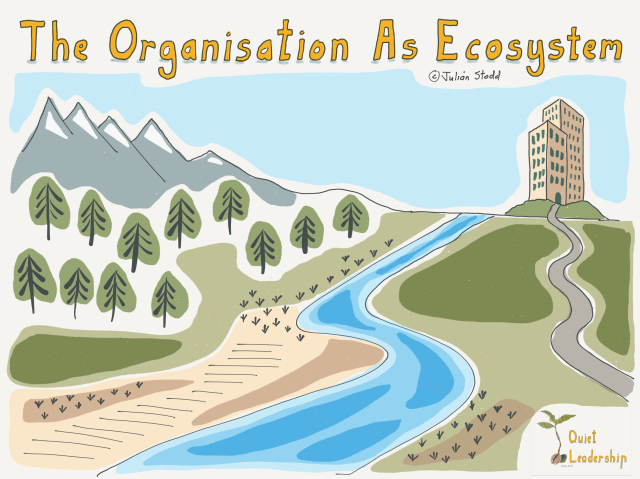
Today i am #WorkingOutLoud to share more of the emerging illustrations from the Quiet Leadership work: this one explores the ‘Organisation as Ecosystem’, a theme i have circled around from a number of directions in my broader work, but which i position at the centre of this journey.
The premise is that, beyond the formal structure, our Organisations behave like ecosystems, with each piece both drawing upon, and impacting upon, the others. Through these myriad interactions, meta-effects emerge (like ‘culture’). The ecosystem idea also allows me to bring in a central context of individual vs collective responsibility: we can each, through gentle action, care for one part of the forest, but none of us can tend for it all. Or to put it another way, all of us tend to it all: we can only sustain a healthy ecosystem if our energy and activity is aligned within…
A creative methodology for software developer un-bias
Kelsie Nabben & Michael Zargham 14 November 2020
“Wisdom is knowledge about certain principles and causes.” — Aristotle, 350 B.C.
The origins of infrastructure matters in relation to the social outcomes it supports, enables or undermines. Yet, as emerging technologies become more enmeshed in everyday life — and more powerful: it is rarely highlighted how crucial it is for technology developers to be aware of the values in which they imbue into their creation
Model-dependent realism is a view of scientific inquiry that focuses on the role of scientific models of phenomena.[1] It claims reality should be interpreted based upon these models, and where several models overlap in describing a particular subject, multiple, equally valid, realities exist. It claims that it is meaningless to talk about the “true reality” of a model as we can never be absolutely certain of anything. The only meaningful thing is the usefulness of the model.[2] The term “model-dependent realism” was coined by Stephen Hawking and Leonard Mlodinow in their 2010 book, The Grand Design.[3]
The simplest way to explain the behaviour of any bureaucratic organisation is to assume that it is controlled by a cabal of its enemies.
The aphorism strikes me as so profound and relevant that I have often tried to verify its attribution. Conquest was a renowned historian of the Soviet Union, so his opinions on the politics of organisations carry considerable credibility.
Several readers have asked me for Robert Conquest’s Three Laws of politics. As best I can remember, they are:1. Everyone is conservative about what he knows best.2. Any organization not explicitly and constitutionally right-wing will sooner or later become left-wing.3. The behavior of any bureaucratic organization can best be understood by assuming that it is controlled by a secret cabal of its enemies.
The problem with this is that the second of these three laws appears to come not from Robert Conquest but John O’Sullivan, a former advisor to Margaret Thatcher.
In March 2019 the PCP established a mental wellbeing network to explore and learn about mental wellbeing in their community in order to surface and engage with leverage points for change. The work is ongoing and currently focused on engaging with young people to better understand their needs and ambitions, particularly related to social connectivity and mental wellbeing for communities impacted by drought and bushfire. Tiana and Glenn will share about their journey in systems thinking and using the systems change framework to improve outcomes for mental wellbeing in their community.
Scientists Find Vital Genes Evolving in Genome’s Junkyard
Even genes essential for life can be caught in an evolutionary arms race that forces them to change or be replaced.3
READ LATER
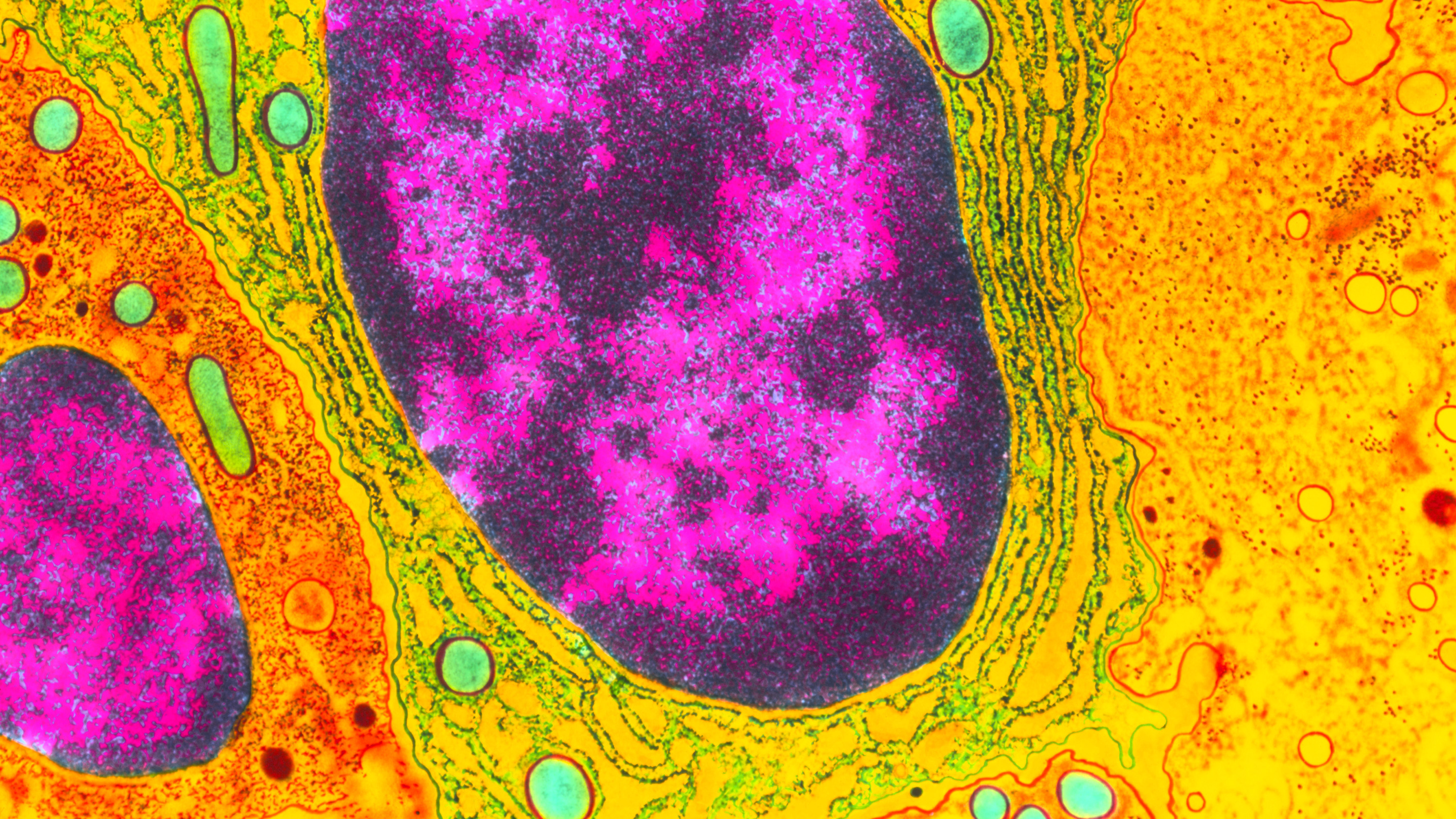
Inside the nucleus of a cell, most of the active genes are in the portion of the DNA called euchromatin (magenta). The more condensed DNA of the heterochromatin (black) is mostly genetically inert, but researchers are learning how new genes can evolve there.Dr. Gopal Murti / Science Source
Essential genes are often thought to be frozen in evolutionary time — evolving only very slowly if at all, because changing or dying would lead to the death of the organism. Hundreds of millions of years of evolution separate insects and mammals, but experiments show that the Hox genes guiding the development of the body plans in Drosophila fruit flies and mice can be swapped without a hitch because they are so similar. This remarkable evolutionary conservation is a foundational concept in genome research.
But a new study turns this rationale for genetic conservation on its head. Researchers at the Fred Hutchinson Cancer Research Center in Seattle reported last week in eLife that a large class of genes in fruit flies are both essential for survival and evolving extremely rapidly. In fact, the scientists’ analysis suggests that the genes’ ability to keep changing is the key to their essential nature. “Not only is this questioning the dogma, it is blowing the dogma out of the water,” said Harmit Malik, a Howard Hughes Medical Institute investigator who oversaw the study.
“This work is so beautiful,” said Manyuan Long, an evolutionary geneticist at the University of Chicago. “The researchers found that rapidly changing heterochromatin drives the evolution of new essential genes. Just amazing!”
Metafuture is an educational think tank that explores alternative and preferred futures and the worldviews and myths that underlie them. Through presentations, workshops and research, Metafuture helps local and global organizations and institutions create alternative and preferred futures. It is hosted by Sohail Inayatullah and Ivana Milojević.
a new thing… looks to be Portuguese-based, environmental activisim / economics / arts, many member oranisations, the vision is ‘a new vision’, not 100% clear what the activity will be
Systems change is the emergence of a new pattern of organization or systems structure. (Birney, 2015) It is both a process and an outcome.
We are facing unprecedented economic, social, and environmental crises, and current reforms offer ineffective solutions.
Naomi Klein has called for a movement of change that “connects the dots” to address the root causes of all current crises facing people and planet.
Systems Change Alliance connects the dots between individuals, groups and organizations working in different fields to collaborate, educate, advocate and implement positive systemic change.
Intrinsic value of nature — Economic liberation and true sustainability will arise when people and nature are no longer viewed as mere commodities for sale in the marketplace.
Regeneration and protection — Regeneration of renewable resources and the vital protection and recycling of non-renewable resources.
Bioeconomics — Long term, economic systems change with a restructured economy where privatizing profits and socializing the environmental costs are no longer possible.
To work toward an integrated social system based on shared political and cultural values, economic democracy, decentralization and sustainability.
Mission Statement
To advocate for just political, ecological and economic reforms, through organizing movements, workshops and conferences; publishing articles and newsletters; conducting research and developing policy proposals.
The whole-systems understanding of the world acknowledges that a whole is always more than the simple sum of its parts, paying attention to the diversity of elements, the quality of interactions and relationships, and the dynamic patterns of behaviour that often lead to unpredictable and surprising innovations and adaptations.
Many of the interrelated problems we face, as change agents in the transition towards a more sustainable human presence on Earth, have their root cause in a way of thinking that has not paid enough attention to whole systems and their dynamic interconnectedness, dynamic relationships and context.
Experts and specialists are important contributors to most sustainability projects, but we also need integrators and generalists who can help to put the contribution of each discipline into systemic relationships and help to contextualize the contributions made by the specialists.
Whole-systems thinking has to be a transdisciplinary activity that maps and integrates relationships, flows and perspectives into a dynamic understanding of the structures and processes that drive how the system behaves. Experts and specialists are important contributors to most sustainability projects, but we also need integrators and generalists who can help to put the contribution of each discipline into systemic relationships and help to contextualize the contributions made by the specialists. Too often we employ limited progress indicators or inadequate measures of success based on the dominance of a particular discipline or perspective.
One way to define the word ‘system’ is as a set of interconnected elements that together form a coherent pattern we can refer to as a ‘whole’. Such a system exhibits properties of the whole that emerge out of the interactions and relationships of the individual elements. This systems definition could be applied to a molecule, a cell, a human being, a community or the planet. In many ways a system is less a ‘thing’ than a pattern of relationships and interactions — a pattern of organization of constituting elements. The Greek root of the word system is ‘synhistanai’ and literally means ‘to place together’.
We can reduce the world to a whole just as easily as we can reduce it to a collection of parts.
Systems thinking and systemic intervention is a possible antidote to the unintended and dangerous side-effects of centuries of focusing only on reductionist and quantitative analysis informed by the narrative of separation. Yet, it is important to maintain the awareness that the systems view itself is also just another map that, as Alfred Korzybski put it, should not be confused with the territory. We can reduce the world to a whole just as easily as we can reduce it to a collection of parts. Neither the whole nor parts are primary; they come into being through the dynamic processes that define their identity through relationships and networks of interactions.
One of the most important questions in any systemic approach is to ask ‘what is the system in question’. In doing so we define boundaries that provide us with the necessary ‘enabling constraints’ to make sense of a situation. Yet, these boundaries are themselves a way of seeing that make a distinction between the system in question and its environment. We should regard the boundaries that delineate one system from another as places of connection and exchange rather than barriers that separate or isolate.
Whole-systems thinking invites us to see complex issues from multiple perspectives, to suspend our judgement by questioning our own assumptions, and to honour insights from different disciplines and different ways of knowing.
In more general terms, whole-systems thinking invites us to see complex issues from multiple perspectives, to suspend our judgement by questioning our own assumptions, and to honour insights from different disciplines and different ways of knowing. Thinking in this way helps us to pay attention to the fertile ground of synergistic, whole-systems solutions. It can help us to more clearly see the opportunities in the multiple converging crises around us.
Whole-systems thinking stops us from seeing ecological, economic and social constraints as irreconcilable challenges. It invites us not to view different stakeholder perspectives in a competitive, win-lose frame of mind, and encourages us to explore win-win-win solutions that improve the overall health and sustainability of the system as a whole.
Whole-systems thinking is living systems thinking. I believe that a systemic understanding of processes by which life continuously regenerates conditions conducive to life offers a pathway to creating regenerative businesses and organizations within a regenerative economy as enabling factors of a regenerative culture. We will explore many examples in subsequent chapters. Here are some questions to contemplate when dealing with systems:
What is the system in question and how are we defining what belongs to the system and what does not?
What is the wider context that the system in question operates in?
What are the key agents whose interactions and relationships define the system structure and drive the system’s behaviour?
How is our perspective of the system in question shaped by our worldview and value system?
What are the key ‘emergent properties’ of the system that could not have been predicted by simply looking at the individual ‘parts’ of the system?
How does our participation in the system and our way of describing it affect what we are observing?
Daniel Christian Wahl — Catalyzing transformative innovation in the face of converging crises, advising on regenerative whole systems design, regenerative leadership, and education for regenerative development and bioregional regeneration
Daniel Christian WahlDaniel Christian Wahl originally trained as a biologist and holds degrees in Biology (BSc. Hons., Univ. of Edinburgh), Holistic Science (MSc.,Schumacher College) and Natural Design (PhD., Univ. of Dundee).


 Systems-Centered Training (SCT) is a practical and innovative systemic approach to personal and organizational development, group dynamics and therapy. Pioneered by Yvonne Agazarian, SCT begins with the idea that we are always in a system, be it the system of ourselves as a person, a couple, a family, a team, or a whole organization. SCT posits that these different systems heavily influence how we function within them. Our ongoing challenge is how to contribute to building the kind of systems in which we want to live and work. This conference will explore what helps and what gets in the way as we take up this very human challenge.






 Systems Community of Inquiry
You must be logged in to post a comment.