
Metaphorum
Toolshero
Wikipedia
https://en.wikipedia.org/wiki/Viable_system_model
A view or perspective on the world
Metaphorum
Toolshero
Wikipedia
https://en.wikipedia.org/wiki/Viable_system_model
Thursday, July 7, 20229:00 AM to 10:30 AM BST
An Open Systems Thinking perspective on Agile transformation, Thu, Jul 7, 2022, 6:00 PM | Meetup
Joining the group is free, text of the invite:
Thursday, July 7, 2022
An Open Systems Theory and Sociotechnical Systems (STS) Perspective on the success or challenges of agile transformation and scaling agile in the enterprise
As an agile practitioner, you can use OST for three purposes:
Agile Manifesto is more than 20 years old and almost all industries have now tried adopting some version agile way.
Agile practices have won their place but are organisations being more agile or have adopted an agile mindset? Has this really lead to more business agility, happier employees, better and more sustainable business outcomes, customer satisfaction and better treatment of our social and environmental responsibilities?
The results are less than ideal and there are very few credible theories that explains the causes of the current problematic situations, let alone ways of addressing the challenges.
OST is a powerful way of making cultural change. Its power derives from its comprehensive, internally consistent theoretical framework, developed over many years. It is the framework called open-systems theory or thinking (Emery, F. 1981), OST for short.
The theory has been evolving and field tested over 50 years and have been tried in various industries, countries, and different sizes of organisations.
## About the presenters
## Peter Aughton
Since 1993, Peter has worked with managers and employees, from both the private and public sectors, to design sustainable organisations that significantly increase employee engagement, innovation, and organisational performance. These outcomes are realised from the application of methodologies that have been translated from Open Systems Theory (OST) – a socio-ecological (people-in-system-in-environment) body of knowledge, which relates people and their organisations to their environments.
Peter has applied these OST transformation methodologies and improvement techniques in many different organisations, from SMEs to large corporations. He has also trained management and staff across the globe in the application of these methodologies, so their organisations have the in-house capability to sustain performance improvement in rapidly changing environments.
Before becoming an OST practitioner, Peter held various research and management positions with the Exxon and Mars Corporations. Peter has a Bachelor of Applied Science (Chemistry) and Post Graduate Qualifications in Education and Business Science from the RMIT, Melbourne, and Victoria Universities respectively.
## Trond Hjorteland
Trond is an IT architect and sociotechnical facilitator from the consulting firm Scienta.no and has many years’ experience working with large, complex, and business critical systems, primarily as a developer and architect on middleware and backend applications. His main interests are service-orientation, domain-driven design, event driven architectures, and open sociotechnical systems, working in industries like telecom, media, TV, and public sector. His mantra: great products emerge from collaborative sense-making and design
In the face of escalating social and ecological breakdown, populations around the world are calling for a fundamental system change. Codes for a Healthy Earth offers a unifying whole-system healing framework to support people and communities in working together across national, cultural and ideological boundaries for radical system transformation and rapid social and ecological regeneration.
Whole-System Health | Codes for a Healthy Earth
via Jeremy Lent at https://deeptransformation.network/
source:
Overview | Creative Systems Theory
Creative Systems Theory presents a comprehensive framework for understanding change, purpose, and interrelationship in human systems with special pertinence to making sense of the times in which we live and the challenges before us. It is significant both for the practical usefulness of its ideas and for the fact that it represents the kind of conceptual perspective that will be increasingly essential in times ahead.
We can think of CST’s importance as having three layers. First it represents a practical set of tools for thinking systemically about human process. Its unique perspective helps us answer all kinds of questions difficult to address, or to address with adequate subtlety with more conventional formulations.
The second layer of importance pertains more specifically to the times in which we live. CST provides big-picture perspective for making sense of our time. The concept of Cultural Maturity is a specific notion within Creative Systems Theory. The concept of Culturla Maturity articulates a simple, yet not simplistic “guiding story” for our time, one that helps us get beyond conflicting ideologies. Creative Systems Theory goes on to provide detailed perspective for understanding what today we see around us, for developing good future policy, and for identifying where our formulations may fall short.
The third kind of importance concerns the kind of understanding that CST represents. CST argues that our times defining challenges require not just new ideas, but fundamentally new kinds of ideas. Culturally mature conception.requries a fullness and complexity of thought not before needed—or possible. Such conception is new in that it is more systemic than conventional thought, and thus better able to capture nuance and interrelationship. It is also better able to honor the living dynamism of human experience. CST makes the argument for such new ways of thinking—both why they are needed and what they entail. And it itself succeeds as Culturally Mature conception. Just how it does provides both overarching perspective and the capacity to make detailed culturally mature discernments.
source:
Overview | Creative Systems Theory
UPDATE — slides, video, notes now in edited post at https://www.linkedin.com/posts/antlerboy_systems-convening-systems-practice-systems-activity-6942014940794789888-c6He
Today I’m doing a one-hour talk (see https://q.health.org.uk/event/systems-convening-systems-thinking-and-systems-practice-with-ben-taylor/ – you can still join if you see this when I publish – and you can see the board at bit.ly/systems3board at any time) on how systems practices and systems thinking can link in to the wonderful social learning that Bev and Etienne Weger-Trayner identified in their Systems Convening book.
They discovered people who make a difference:
“You may not have heard about them; what they do is rarely in their job description. You may not even be aware of what they do; they tend to act as enablers rather than taking credit or seeking the spotlight. But they are here— working on sustainable change, across challenging silos, in complex social landscapes, amid changing circumstances. We call them systems conveners.
“Their stance is both visionary and pragmatic. They look at the social landscape…
View original post 276 more words
Design Needs Complexity Theory
Kasey Klimes
Aug 13, 2021131
Despite Christopher Alexander’s notable application of complexity theory in design during the 60’s and 70’s, the two fields have mysteriously grown apart. The contemporary design world demonstrates little interest in complexity theory, and design is generally absent in the world of complexity theory. I think this separation is not only a missed opportunity, but also a tragic error for humanity on a larger scale.
Continues in source: Design Needs Complexity Theory – by Kasey Klimes
On intentionality | Gaining Systemic Insight
I recently said: Everything we do with intention is not systemic. I can’t really remember in what context I said it but I remember that I was surprised myself when hearing me say that. So here a bit of an exploration of this statement.
Continues in source: On intentionality • Buttondown
I needed a video presenting the historical development of ideas behind the complexity and network science in 20 minutes—an impossible task of course (especially since I couldn’t spend too much time on prepping it). Anyway, someone out there would be interested, so here it is:
Some credits not stated in the video: The starling murmuration video comes from NYT (travel section April 4, 2022), the Boids-like simulation from Complexity Explorables. All photos except the book covers, come from Wikipedia. The network picture comes from Helen H Jennings (1959), Sociometry of group relations. The Odum & Odum book is really called The Energy Basis for Man and Nature.
Climate, Covid, Conflict? Community…Sue Pritchard assesses risks and opportunities for a resilient food system26th May 2022
Climate, covid, conflict – Food, Farming and Countryside Commission
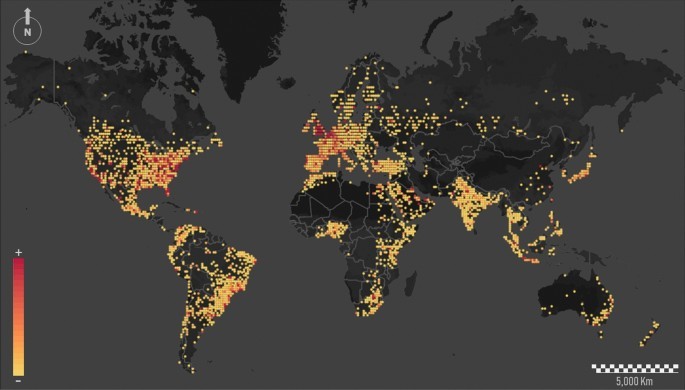 José Balsa-Barreiro, Mónica Menendez & Alfredo J. Morales
Scientific Reports volume12, Articlenumber:9037 (2022)
The social space refers to physical or virtual places where people interact with one another. It decisively influences the emergence of human behaviors. However, little is known about the nature and complexity of the social space, nor its relationship to context and spatial scale. Recently, the science of complex systems has bridged between fields of knowledge to provide quantitative responses to fundamental sociological questions. In this paper, we analyze the shifting behavior of social space in terms of human interactions and wealth distribution across multiple scales using fine-grained data collected from both official (US Census Bureau) and unofficial data sources (social media). We use these data to unveil how patterns strongly depend upon the observation scale. Therefore, it is crucial for any analysis to be framed within the appropriate context to avoid biased results and/or misleading conclusions…
View original post 43 more words
While Geoffrey Vickers and Gregory Bateson both worked with human systems, the background philosophies on ethics were different.
— begin paste —
Beginning with The Art of Judgment and culminating in 1983 with Human Systems Are Different, Vickers was concerned to avoid the narrowing of scope that had become a remarkably powerful force in both the theoretical and empirical study of organized human activity. His concept of appreciation was a pivotal element of this effort. Gregory Bateson (1972) also wished to keep the sense of “system” more open than was the norm. Yet while Vickers and Bateson admired one another’s work, they parted intellectual company on the origin and role of ethics.
View original post 661 more words
11.09, Thursday 9 Jun 2022 Link to this postIt turns out that chickens use their eyes quite differently. (I’ve been skimming paper abstracts.)The left eye distinguishes between strangers and friends – and more generally is a novelty detector.The right eye categorises and figures out what action to take.(So a chicken looking only with its right eye is poor at telling novelty.)Chickens, having eyes on the sides of their heads, look with only one eye at a time.If I wasn’t sitting here baking in the heat I would be thinking about the general lesson here – that these two ways of seeing make up the totality of how to see the world. One a process that looks for metaphors and stereotypes; the second a novelty switch. Organisations and bureaucracies need these two ways of seeing. Machines and software too.Anyway. The avian brain. Did dinosaurs specialise their eyes too?Here’s the abstract.Vallortigara, G., & Andrew, R. J. (1994). Differential involvement of right and left hemisphere in individual recognition in the domestic chick. Behavioural processes, 33(1-2), 41–57. https://doi.org/10.1016/0376-6357(94)90059-0
Idle thoughts sitting by the pool in the hot sun (Interconnected)
Growing Workforce Capacity & Capabilities for System Leadership
Growing Workforce Capacity & Capabilities for System Leadership Tickets, Tue 12 Jul 2022 at 12:00 | Eventbrite
Message received by email:
A webinar with our ImpACT research group.
12pm – 1pm (BST)
Tuesday 12 July
In this final in the series, we will draw on examples from organisation and system transformation working with National, Regional and System partners.
Hosted by Jonathan Webster, Professor of Practice Development & Co-Director ImpACT Research Group, UEA.
Featuring speakers and contributors:
This event is hosted by UEA Health and Social Care Partners’ ImpACT research group, which looks at sharing best practice to reinvigorate health and social care settings, seeking to enable flourishing systems, workforce and communities.
Subscribe to the ImpACT research group’s YouTube channel, where you can catch up on the previous webinars hosted by ImpACT.
Numbers are limited, so please register here.
This event will be recorded and circulated for those unable to join.
Conversations that Challenge: Failure: Does fear hold us back from changing systems?Thursday, July 712pm – 1pm
Conversations that Challenge: Failure: Does fear hold us back from changing systems? – New System Alliance
A Time for Heretics, orginal for 1996, rejected by IIBDavid Hawk1996, Transcript of Annual Meeting of EIBA
(23) A Time for Heretics, orginal for 1996, rejected by IIB | David Hawk – Academia.edu


You must be logged in to post a comment.