
Socialist Cyborgs Victor Petrov How Bulgaria tried—and failed—to save communism by computerizing the 1980s generation.
Socialist Cyborgs
Category Archives: Discussion
A view or perspective on the world
The Cybernetic Ethos of Cryptocurrencies – Doria (2020)
The Cybernetic Ethos of Cryptocurrencies: Economic and Social Dimensions Doria, Luigi.Partecipazione e Conflitto; Milan Vol. 13, Iss. 1, (2020): 384-408. DOI:10.1285/i20356609v13i1p384
The Cybernetic Ethos of Cryptocurrencies: – ProQuest
Also at
http://siba-ese.unisalento.it/index.php/paco/article/view/21994/18566
Which leads me to the definition of ‘cybernetization’:
https://second.wiki/wiki/kybernetisierung
And (via the source, Evgeny Morozov)
also leads me to
https://www.the-syllabus.com/about
which (published also by Morozov) looks deeply cybernetic..
notes and links from ‘When meaning loses its meaning’, with Nora Bateson & Dave Snowden
Original post was here:
Update email with links etc:
| We’d like to start by saying a huge thank you to all who either attended or listened back to the conversation between Dave and Nora last week. For those of you with the URL open awaiting an opportune moment to listen in, you’re in for a treat! “The margins of meaning… is where novelty emerges” During this first open dialogue, Nora and Dave weaved a concoction of theory, practice, and of course story around the “necessary blur” and ambiguity required in the exploration of living systems. Tracing the frictions around attempts to remove uncertainty through organisational complexity and the sometimes trivialisation of the body of theory as it transfers across contexts, they entangled and disentangled concepts and mobilising metaphors such as “abduction”, “hope” and “rigour” through culture, time and place. |
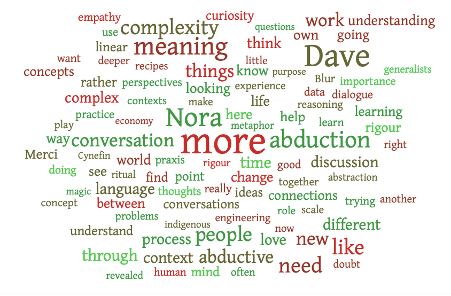
| Unsurprisingly, although the chat function was switched off – due to the numbers of those attending and the desire to allow people to fully focus in – there was a lovely buzz in the Q&A, as can be seen in the wordcloud below. For those of you who shared comments and questions, we have these saved and will be using them to guide future conversations… so please watch this space and we will follow up very soon with the next event. |
| For now, we share a list of references mentioned for you all to get your teeth into. Charles Sanders Peirce, the original reference on the abductive process. This is an encyclopaedic source, but his original writings are easily discoverable for anyone who wants to dig deeper: The children’s party story and how we all know how to deal with complexity in daily lifeThe NHS Sensemaking Series Part one: Foundations for Complexity with Nora Bateson and Dave Snowden Jürgen Moltmann, Theology of Hope: On the Ground and the Implications of a Christian Eschatology, translated by Margaret Kohl Hope without Optimism by Terry EagletonGregory Bateson on abduction, from Mind and Nature; A Necessary unityWarm Data Lab and People Need People (online) training with Nora Bateson: https://warmdatalab.net/ Warm Data and Iced Lemonade: A deeply human response to complexity is possibleEva Jablonka on epigeneticsBook extractFree-to-access paper published by the Royal Society: The Journey (film)Small changes around climate change: The project that started it alland the Cynefin Centre climate change programmeR. S. Thomas, The Bright FieldDavid Graeber and David Wengrow, The Dawn of EverythingA New Word to Describe an Aspect of Living Systems: Aphanipoiesis by Nora BatesonSymmathesy: a word in progress by Nora Bateson. Proceedings of the 59th Annual Meeting of the ISSS 2015. Flexuous curves: Flexuous focusFlexuous flightReference on the Numinous: Rudolf Otto and The Idea of the HolyIntroduction to poetry, by Billy CollinsExaptation Boisot on abstraction and codification To finish with a lovely reminder from Nora: “life is not like a wristwatch”, so let’s all take a leaf out of Alice’s book and keep ourselves open to as many impossible things before breakfast as we “possibly” can…until we meet again (all credit goes to one of our participants for this quote!). |
On Hayek’s “Kinds of Order in Society”
Piece by Donald J Boudreaux:
Original piece:
https://oll.libertyfund.org/page/hayek-on-kinds-of-order-in-society
Systems Sciences | Things thinkers should discuss — four expert systems science views of humanity’s growth trap from ISSS | Jessie Henshaw on Facebook
Things thinkers should discuss — four expert systems science views of humanity’s growth trap. Join ISSS.org, where a real future is taking shape. All systems develop by growth, but do they all grow till they die? Bill Rees – it’s a system, stupid https://vimeo.com/653271779?embedded=true… Joe Tainter – declining innovation https://vimeo.com/653477237?embedded=true… Jessie Henshaw – natural growth https://vimeo.com/621095242?embedded=true… Charlie Hall – limits to growth – https://vimeo.com/621095242?embedded=true…
Systems Sciences | Things thinkers should discuss — four expert systems science views of humanity’s growth trap | Facebook
The Theory of Graceful Extensibility: Basic rules that govern adaptive systems – Woods (2018)
The Theory of Graceful Extensibility: Basic rules that govern adaptive systems December 2018Environment Systems and Decisions 38(5) Follow journal DOI: 10.1007/s10669-018-9708-3 David D Woods
(PDF) The Theory of Graceful Extensibility: Basic rules that govern adaptive systems
The Theory of Graceful Extensibility: Basic rules that govern adaptive systems
- December 2018
- Environment Systems and Decisions 38(5)
- Follow journal
Remembering Ralph Stacey

The following is a longer obituary of Ralph Stacey which was commissioned by Group-analytic Contexts, and which I share here with their permission. It turns in particular on his relationship with the group analytic community, but some of his key ideas about complexity may be relevant for people working in other contexts.
Obituary Ralph Stacey 10/9/42 – 4/9/21
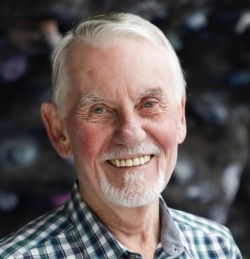
Ralph Stacey, economist, group analyst, Professor of Management at the University of Hertfordshire (UH) for 30 years, and much loved husband, partner, father, grandfather and colleague, died in September this year a few days short of his 79th birthday. His death was sudden and shocking, although for many years previously he had experienced quite chronic ill health. Physically frailer than some in their late 70s, Ralph was nonetheless intellectually robust right till the end. As an internationally renowned academic who developed pioneering ideas about the importance of the complexity sciences…
View original post 3,174 more words
IT’S NOT ALL IN THE NUMBERS: GREGORY CHAITIN EXPLAINS GÖDEL’S MATHEMATICAL COMPLEXITIES
IT’S NOT ALL IN THE NUMBERS: GREGORY CHAITIN EXPLAINS GÖDEL’S MATHEMATICAL COMPLEXITIES
Gregory Chaitin“In any non-trivial axiomatic system,” stated Austrian mathematician and logician Kurt Gödel (1906 – 1978), “there are true theorems which cannot be proven.”
This finding forms the basis of Gödel’s groundbreaking Incompleteness Theorem, demonstrating that the establishment of a set of axioms encompassing all of mathematics would never succeed.
When it was first made public in 1931, the theorem revolutionized the field of mathematics and logic, disproving the prevailing belief that mathematics could be explained with the correct set of axioms.
Gregory Chaitin is at the IBM Thomas J. Watson Research Center in Yorktown Heights, New York. He is the discoverer of the celebrated Omega number, and has devoted his life to developing a complexity-based view of incompleteness. He calls this subject “algorithmic information theory,” and has published eleven books and numerous papers, some of which may be found on his website at http://www.cs.umaine.edu/~chaitin.
Continues in source:
https://web.archive.org/web/20091106003330/http://simplycharly.com/godel/gregory_chaitin_interview.htm
#43: Mixing metaphors – by Luke Craven – Pig on the Tracks
Metaphors are popular cognitive and conceptual tools in the worlds of systems and complexity, and boy do we like to fight about them! Take this discussion, for example, about the limits of understanding the organisation as a human body. Even if you agree with the premise (which I do, the metaphor has its limits) the collective conclusion still strikes me as remarkable: that somehow we will find a single metaphor (meadow, estuary or octopus) that sufficiently explains the phenomena under investigation.
#43: Mixing metaphors – by Luke Craven – Pig on the Tracks
Readings for Education | The Future of Education: Edgar Morin — Observatory | Institute for the Future of Education
Readings for Education | The Future of Education: Edgar Morin Andrés García BarriosNovember 24, 2021 In this new installment of “Readings for Education,” Andrés García Barrios reflects on three major concepts: future, complexity, and uncertainty, through the ideas of Edgar Morin.
Readings for Education | The Future of Education: Edgar Morin — Observatory | Institute for the Future of Education
methods for systemic change by the systems school (Australia) – paid training April-May 2022
methods for systemic change by the systems school
methods for systemic change Tickets, Wed 06/04/2022 at 3:00 pm | Eventbrite
A Causal Simulation of the ADHD Brain and How Mindfulness and Exercise Can Change Everything, by Naomi Most (2021)
http://nthmost.net/adhdbrain_loopy.html
Thirteen dilemmas and paradoxes in complexity | Marco Valente on LinkedIn
Thirteen dilemmas and paradoxes in complexity Published on December 3, 2021
(3) Thirteen dilemmas and paradoxes in complexity | LinkedIn
Thirteen dilemmas and paradoxes in complexity
- Published on December 3, 2021

Status is onlineMarco ValenteConsultant at Cultivating Leadership27 articles Following
As readings and reflections on complexity and its applications grew over the years, increasingly my head got spinning with apparent contradictions and paradoxes. Complexity seemed to be a land of both/ands and of polarities, where statement A and its opposite statement B seemed both true under different circumstances. This below is a list of apparent dilemmas, paradoxes, polarities in complexity, by no means exhaustive but the first that came to mind.
1. Complexity is really difficult AND it is easier at the same time. Yes, complexity seems like a hard subject to deal with, and yet as long as we drop some of our inadequate tools it can actually appear easier -but it still needs a lot of rigor (see below).
Read: Jennifer Berger’s Mindtraps, and her forthcoming papers and interviews.
2. We are hopelessly biases in our perception of complexity AND we have ancient, built-in ways to deal with it. Name me one popular psychology book or leadership book that does not run you through an account of how biased we are as humans. While this has become commonplace, it is easy to mistake being “biased” for being hopeless in the face of uncertainty. It turns out that ancient wisdom, time-tested heuristics, grandma sayings are actually very robust in the face of the unknown
Read: Taleb, Gigerenzer, and the disputes between the heuristics and biases and the naturalistic approaches.
3. We need more information to navigate uncertainty AND less is more to sort through the noise. We are blind to a worldview behind evidence-based decision making: that more information is always better, which we inherited from the Enlightenment and got a reprise with Carnap. This would work well in situations where information is reliable and where a complete understanding of our system can be achieved. In reality we need more (in certain situations) and we need discernment and better Occam’s razors in uncertainty too.
Read: Gigerenzer’s paper The Beauty of Simple Models, among other things he has written.
4. We need a clear vision of the future AND we need adaptability and flexibility for a future we cannot predict. Berger and Johnston have written cogently about strategy in complexity: we need an inspiring vision while at the same time we need to recognize the irreducible uncertainty so the vision becomes more like a set of boundaries and guardrails within which to experiment. Again, both statements are true in spite of their apparent contradiction.
Read: Berger and Johnston’s Simple Habits for Complex Times.
5. We need to rely more on rigorous scientific approaches AND we need to recognize irreducible causal opacity. How can you advocate for more and less science at the same time? I am advocating for more and better science, and yet more epistemic humility so that we can recognize how strong our predictions can be, and what to do in the face of irreducible uncertainty.
Read: a good place to start is Radical Uncertainty by King and Kay
6. We need centralized sense-making about certain key variables and weak signals AND we need to distribute the capacity to make sense and decide locally. In the book Team of Teams* this apparent dilemma found a workable solution. They devised ways to display real time information on a centralized screen while at the same time they had sensing systems that were necessarily distributed. You can centralize some structures and rituals for a system to make meaning of what is going on, while acknowledging that data is necessarily distributed, local, and contextual.
Read: Team of Teams by Gen Mac Chrystal. (*The US aggression in the Middle East in the early 2000’s was a bad mistake in my view, but the book contains useful ideas).
7. We need more, better coherence AND we need to acknowledge the generative importance of lack of coherence. We need better ways of aligning on our sense of coherence around certain hypothesis about what is going on in the system at any given time, and at the same time we need to take the opportunity that lies in the moments of confusion: they can be times of proving us wrong, of innovation in the scientific field (why does this drug work in spite of our expectations?) and so on.
Read: Dave Snowden’s blog posts that mention aporia, and the notion of coherence by Thagard.
8. We need to rely on sound models more AND less at the same time. It is hard to make sense of this, but models are more important in complexity to project potential scenarios (see projections of infections, etc.) and we need to bring more epistemic humility to their predictive powers as well, especially in fat tailed distributions where small errors in the input of our models make them horribly wrong. What does this mean in practice? Use them for exploring the space of possibilities without taking any of them as the final ‘truth’ (unless they have a track record of sound predictions or a controllable environment).
Read: softly pro-models, The Model Thinkers, by Scott Page. Against models: Taleb.
9. Leadership in complexity should be often more decisive AND more accepting of uncertainty and ambiguity too. Our systems incentivize leaders who have the answers and promise us some future outcomes with a degree of certainty. But we should rather be inspired by the values that they stand by, while it is hard to make promises about certain future outcomes that nobody can know about. Leaders can still commit to radical learning in conditions of ambiguity though.
10. We need more specialized knowledge in certain fields AND we need more generalists. Dave Snowden is exactly right on this point. Silos of expertise are not bad per se -they are essential, in fact. We need them desperately while we also need to bridge across context and tend to the interrelationships between ideas, departments, and worldviews.
Read: for inspiration, Range by David Epstein.
11. We need more experimentation at the edges AND we need rigorous hypothesis testing alongside our experimental approach. You learn about a complex system by ‘poking’ it first. You pinch a blob of jelly with a fork and see how it wobbles. You can not hypothesize what will happen without touching the jelly. But this should not translate into an ‘anything goes’ reminiscent of Feyerabend. We need rigorous testing of what hypothesis is behind each intervention as a way to reliably learn from our experience.
12. Complexity is a highly specialized field AND it is not a “field” but a worldview that permeates other disciplines. It is possible that in two or three decades from now complexity will become a highly specialized field with degrees and university curricula. But complexity is also a lens through which we can look at the world, not a “thing” that can be studied in isolation.
13. Complexity science is novel and unique AND it is rooted in ancient wisdom that did not survive against the Cartesian/Newtonian consensus. Jean Boulton and Peter Allen in their great book Embracing Complexity retrace some of the story of how complexity ideas were permeating ancient traditions in both the East and the West. You can just as easily argue that the modern understanding of reality as a set of linear causes is the outlier that took prominence over the last four / five centuries since Decartes and Newton, and that our culture has been used to complexity more than it has been familiar with the mechanistic understanding of the world.
Read: Embracing Complexity.
What would you add?
https://www.linkedin.com/pulse/thirteen-dilemmas-paradoxes-complexity-marco-valente/
Journal of Awareness-Based Systems Change – Moving From Transactional To Relational: Volume 1, Issue 2 – News – Presencing Institute
BACK SHARE Moving From Transactional To Relational: Volume 1, Issue 2 Nov 30, 2021 Journal of Awareness-Based Systems Change – Issue #2
Moving From Transactional To Relational: Volume 1, Issue 2 – News – Presencing Institute
Kuleshov Effect: Everything You Need to Know – NFI
link https://www.nfi.edu/kuleshov-effect/
https://en.wikipedia.org/wiki/Kuleshov_effect
 Systems Community of Inquiry
You must be logged in to post a comment.