This is the Wiki site for the Systems Science Working Group (SSWG) of INCOSE. The SSWG is led by Javier Calvo_Amodio (Javier.Calvo at oregonstate.edu), with James Martin (martinqzx at gmail.com) and Swami Natarajan as co-chairs (swami.n.natarajan at gmail.com). The purpose of the SSWG is to promote the advancement and understanding of Systems Science and its application of Systems Theories to SE. We have the following objectives: Encourage advancement of Systems Science principles and concepts as they apply to Systems Engineering. Promote awareness of Systems Science as a foundation for Systems Engineering. Highlight linkages between Systems Science theories and empirical practices of Systems Engineering. The WG has about 250 members who have access to the Discussion List at syssciwg@googlegroups.com, which can be reached through the hyperlink on the lower left. If you wish to become a member of this WG, please send a request to systems-science@incose.org, or you can join directly from our discussion list page.
The International Council on Systems Engineering (INCOSE) is a not-for-profit membership organization founded in 1990. Our mission is to share, promote and advance the best of systems engineering from across the globe for the benefit of humanity and the planet. This WG is a joint activity of INCOSE and the International Society for the Systems Sciences (ISSS). See the joint agreement MOU here.
Brief Strategic and Systemic Therapy European Review N. 1 – 2004
Arezzo, 2004 – 19 – The Part-of-the-World Position of Heinz von Foerster Monika Bröcker Abstract Among many other fields such as that of learning and teaching, the that of management, etc., Heinz von Foerster has been of enormous influence on the development of systemic family therapy. Paul Watzlawick, for example, was very much influenced by Heinz von Foerster’s thinking and has in his own work, in his writings and his lectures about family therapy and philosophy, often referred to Heinz’s ideas, particularly those concerning constructivism, cognition, communication and second-order cybernetics. Today, many family therapists around the world refer to Heinz von Foerster’s insights. This paper sheds light on the position of Heinz von Foerster in the field of psychotherapy
I was introduced to this paper by Bojan Radej who in a LinkedIn comment said:
In my view, the concept of a ‘complex system’ has a rather limited focus. One can, of course, identify and study phenomena that are in the same instance systemic and complex, such as transport systems or the system of public governance. Yet, systemic approaches do not possess the ability to delve into the essence of complex matters that are *equally systemic and antisystemic”. Maldonado and Mezza-Garcia (2016) explicitly claim that the sciences of complexity are sciences of the anarchic, in the sense that they deal with non-governable matters that cannot be meaningfully framed as systems. The fact that a given complex phenomenon contains systemic characteristics does not mean that complexity can be best explained as a system.
This is a long piece, which as Barry Oshry says about his workshops, ‘starts off with some good-sized claims’. (In the abstract, anarchy is explicitly applied to both the subject of the science and to the field itself). Then there are some slightly confusing ways of framing the fundamental assertions; ‘Kuhn’s interepretation of the history of science… is a common place‘, and ‘The sciences of complexity, openly or tacitly, are a scientific revolution7,8,9—a new science10. The very concept the sciences of complexity was donned early on at the Santa Fe Institute by the scientists, researchers and theoreticians devoted on the field meaning a radical shift vis-à-vis classical reductionist linear science.’ – I would also note that, rightly or wrongly but without comment, the very extensive citation contains only (along with Kropotkin, Bakunin, Chomsky, Tolstoy, Bookchin, Proudhon) those texts from the systems/cybernetics/complexity field that have been annointed with the branding of ‘complexity’ – so, ok, you know where the paper is coming from. (We know, for example, that ‘heterarchy’ is going to be used in the sense of ‘multiple leadership points rather than a single hierarchy’, instead of in McCulloch’s original terms ‘some way of dealing with circularity of value preferences’ https://stream.syscoi.com/2021/01/24/heterarchy-a-big-concept-with-lots-of-connections-mcculloch-and-onwards/)
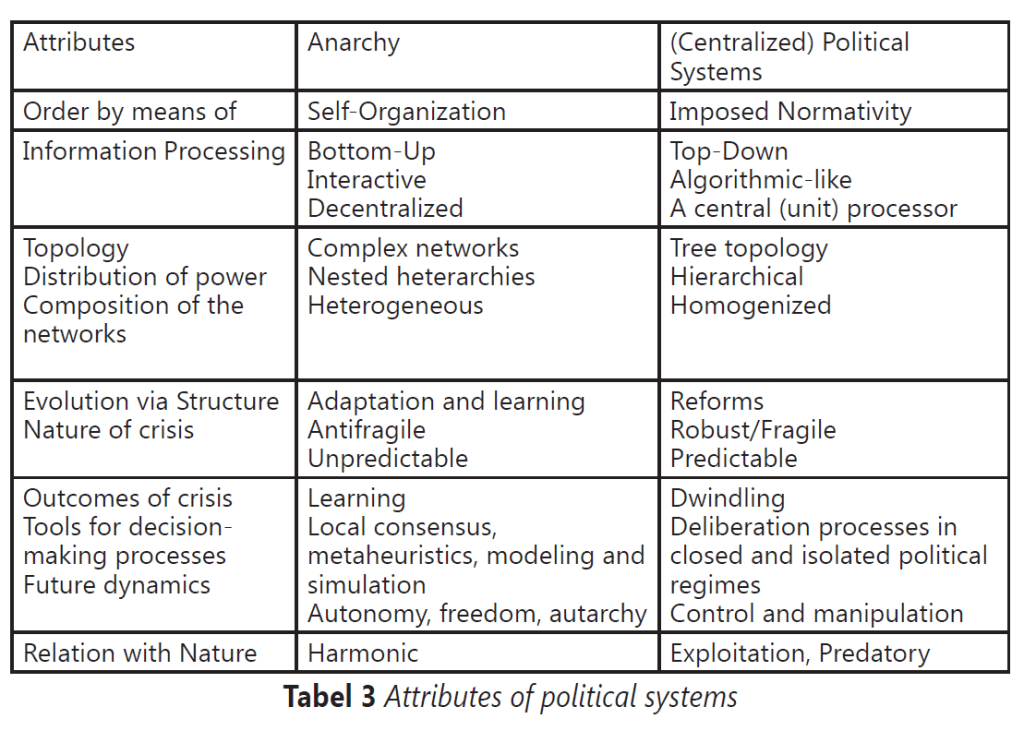
Oh, and it’s also got one of those ‘left column good, right column bad’ tables – .
My only actual comments pending a chance to be able to read this properly are:
a prior assumption of ‘ordering’, ‘systemicity’ etc would seem to be madness in any approach to a situation, so,there’s that
this appears to be lacking a second-order perspective (though I may not have read it closely enough to be right)
there seems to be an assumed equivalency here which is explicit but not queried of ‘systematicity’ with ‘top-down hierarchical control’ (and nor is there an exploration of hierarchy in emergence/ecoystems, or any other understanding of ‘hierarchy’ other than top-down control)
from the introduction, the claim ‘that there is a strong conceptual and theoretical relationship between complexity and anarchism’ is supported by four arguments:
‘firstly, complexity entails a scientific revolution, hence a radical shift in science. Such a scientific revolution can help manage complex human social systems. We do not dig into the rationale of the epistemology and history and philosophy of science but we focus on the implications of such a radical turn the complexity sciences entail.’ – well, that’s begging a lot of questions but if ‘ Such a scientific revolution can help manage complex human social systems.’ then there’s something there – a claim of organisational principles or structures or systems within anarchism – which is a form of systematicity, just perhaps at a diffeent order (but if you’ve stripped yourself of the concept of levels of order because it feels like ‘hierarchy’, then you can’t see that…) – for me, systems/complexity/cybernetics can equally identify/support/set up structured, command-and-control hierarchies (say, Jacques’ Stratified Systems Theory), and the conditions for ‘pure self-organisation’. The distinction is not a paradigm shift, the paradigm shifts are seeing the organisational potential within the system (from whatever source), seeing the role of the observer, and critical boundary judgements.
(the second ‘argument’ is to understand anarchism ‘properly’ – didn’t think I’d be reading Bakunin but one day…)
‘Thirdly, the reasons supporting why complexity is, or leads to, anarchy are offered, that make clear the problematic stance of control when dealing with increasingly complex systems.’ I give you Taylor’s Law: if you expunge control from your theoretical framework, in the next paragraph you will be talking about control, without recognising it. Honestly, there’s something big I’m trying to get at here around mistaking the pointing finger and the moon – the claim there’s a paradigm shift from ‘systems and command-and-control’ to ‘complexity and anarchy’ is not actually an enlarging of thinking, it’s a mistaken narrowing. You can make an assumption of systematicity and choose to focus on ‘hierarchical control’, you can equally make an assumption of non-systematicity and choose to focus on ‘anarchy’ (in each case, two choices, not one). But if you do the latter, you are just applying the thinking forms of systematicity, quite appropriately, at a different logical level – which reveals that the tools of cybernetics and systems were already able to undertake analysis with that framing. If you don’t see that, you won’t explore cybernetics and systems thinkers and see that they were already doing this. https://stream.syscoi.com/2020/04/21/bringing-together-some-reason-and-old-threads-on-systemsthinking-is-complexity-is-cybernetics/ (And often were quite preoccupied with a better question: given hierarchies and control are inescapable in human systems, how can we make them justified, distributed, truly democratic, anarchistic?)
Oh, and the fourth argument is ‘Finally, the match is made the other way round as the paper shows why and how anarchy is seeded in complexity science, or also how the various features that characterize complexity can be taken up as features of anarchism.’
I’ll try to return to this, and didn’t expect it to become such a rant. I accept that a lot of systems/cybernetics/complexity is used, naively and with the assumption of systematicity (or a requirement to *enforce it*) to sustain top-down command-and-control. And, even more so, that much of the practice of management, government, organisation, fits many or all of the criteria of *unhealthy* top-down command-and-control.
But the ‘paradigm shifters’ who don’t see the lines of continuity between their ‘new thinking’ and the old thinking will just repeat the mistakes they criticise; from the very beginnings of our field, the subtletly of thinking needed to support human freedom and flourishing in the way they call for have been available, we only have to grapple with the real complexities, not be side-tracked by naive ‘breakthroughs’.
That means, as these authors state, grappling with anarchism, so this is likely an interesting paper to explore!
Funding: Nathalie Mezza-Garcia is funded by Fundación CEIBA under the Rodolfo Llinás Doctoral Fellowship.
Anarchy and complexity
Carlos Maldonado
Universidad del Rosario
Bio:
Carlos Eduardo Maldonado has a Ph.D. in Philosophy from KULEuven (Belgium). He has been visiting professor and visiting research scholar at the University of Pittsburgh, the Catholic University of America (Washington, D.C.), and the University of Cambridge. He holds an honorary doctorate from the University of Timisoara (Romania). He is currently Research Professor at the School of Political Science and International Relations at Universidad del Rosario (Bogotá, Colombia).
Nathalie Mezza-Garcia
University of Warwick
Bio:
Nathalie Mezza-Garcia is a PhD student at the Centre for Interdisciplinary Methodologies at the University of Warwick and a Rodolfo Llinás, Fundación CEIBA, Doctoral Fellow. She is interested in complexity science and her research studies how can internet-based technologies guide the self-organisation of human social systems and the biosphere. Her proposal is to have political systems with heterarchical topological networks, human decision-making based on interactive computation and automatic responses to real life data gathered with the Internet of Things. She is currently exploring open source legislation and how artificial intelligence and virtual worlds could help prevent crimes in the physical world (n.mezza-garcia@warwick.ac.uk).
Abstract
This paper draws a philosophical parallel between the characteristics of anarchism with the sciences of complexity. The absence—??, an—of a ruling principle—arche, ????—is the conditio sine qua non, it is claimed, for a further search for ground and fundament. The most basic features common to both anarchism and complexity are the absence or critique to control as well as the importance of self-organization. Embracing the theory of complexity inevitably leads towards the acceptance of anarchy. A spirit of anarchy pervades complexity science even if: a) it has not been explicitly thematized, or b) it has not been the explicit concern of researchers and scholars working in the field.
Introduction
The future is undetermined, and as Bohr once pointed out, predicting is difficult especially when it is about future. Contemporary world is characterized by a constant fluctuation of events, and increasing uncertainty—in many levels and domains, systems and layers of reality. As it has been said, societies witness an increase in the degrees of freedom—which, by and large, is a positive feature—whilst experiencing transitions away from hierarchical control1. This means that, increasingly, the world is becoming more and more unpredictable—at least by the means of the traditional models of classical science.
Nowadays, cutting-edge science is providing new mechanisms of explication for many types of social phenomena. The sciences of complexity are located within these sciences, and they are responsible for introducing more accurate and sophisticated models for understanding non-linearity and shed new lights on the understating and explanation of phenomena characterized by irreversibility, sudden changes, surprise, turbulence and fluctuations, for instance. To be sure, social interactions in human social systems are characterized by such features, particularly in the current non-zero sum world.
This paper argues that there is a strong conceptual and theoretical relationship between complexity and anarchism that has not been sufficiently seen and worked out in the literature about complexity. The claim is supported by four arguments, thus: firstly, complexity entails a scientific revolution, hence a radical shift in science. Such a scientific revolution can help manage complex human social systems. We do not dig into the rationale of the epistemology and history and philosophy of science but we focus on the implications of such a radical turn the complexity sciences entail. On this basis, the paper concentrates on the proper understanding of anarchism; this is the second section of the paper. Various explanations and levels are provided. Thirdly, the reasons supporting why complexity is, or leads to, anarchy are offered, that make clear the problematic stance of control when dealing with increasingly complex systems. Finally, the match is made the other way round as the paper shows why and how anarchy is seeded in complexity science, or also how the various features that characterize complexity can be taken up as features of anarchism. At end, several (open) conclusions are drawn.
If the following rings true, then this blog series may be for you.
I am working my hardest to create the change I wish to see in my community, but it feels like I am fighting against complex and powerful forces that are beyond my control, hard to comprehend and constantly changing. I am disheartened that I never see any real or lasting change.
That feeling of swimming against the current is all too common for people and organisations working towards sustainable change in their communities. The cause of this frustration is often not because the change models you are using are wrong, but because the majority of them have not been created to deal with problems that are complex and evolving by nature. Nor have they been built to create system-level change.
That sentiment is what drove the school leaders of Reach Academy Feltham, an all-through school that has 900 pupils aged 2 to 18, to try something different. Their view was that a child’s chance for opportunity in life is often affected by things that are outside the remit and scope of the school. Therefore, quickly following the school’s opening in 2012, they established the Reach Foundation to fund and deliver activities for children, young people and families beyond the gates of the school. However, they recognized that efforts to tackle recurring problems for children and young people often fail, not due to a lack of passion or effort, but because the individual responses are too isolated and static to influence the current systems and structures around educational institutions in a meaningful way. Thus, inspired by Strive Partnerships in the US, the Feltham Convening Project was born to have local education professionals and community members drive change beyond the reach of the academy and foundation, and do so in a way that shifts the engrained and hard-to-see patterns that affect the lives of young people in Feltham.
The Feltham Convening Project (FCP) is a 7-year project that aims to use systems-based approaches to deliver substantial, sustainable improvements to the lives of local children, young people and families in the Feltham community.
Join us on this series of blogs, as we capture practical insights and experiences to drive discussions and learning for people curious about systemic approaches for community-led initiatives.
Continues in source: https://www.wasafirihub.com/community-innovation-systems-change-1-education-at-the-heart/
Wasafiri is a global consultancy, incubator and institute helping leaders and organizations tackle some of the world’s most complex problems. From our offices in Kenya, UK and the USA, we bring a well-established track record of helping our clients achieve impact at scale on the systems related to conflict and governance, extreme poverty, food insecurity, and environmental sustainability. Together, we’re helping build a more peaceful, equitable and sustainable world.
We are proud of the work we do and looking to invest in a Systems Change Lead who can bring new energy, ideas and capacity to help us have even greater impact in our work.
SUMMARY OF THE ROLE
Purpose: To help Wasafiri scale our impact through the Wasafiri Institute – a platform through which we share public knowledge goods about how to create system change. The Institute demonstrates our commitment to serving an eco-system of change makers, serves as our platform to be thought leaders, educators, and storytellers about change, and provides a commercial channel to our consultancy services.
Salary: GBP 40,000 – 45,000 plus package – depending on experience. This will be a year-long position (with intention for renewal) with a 3-month trial period.
Reporting To: Kate Simpson, Director of the Institute
Working Arrangements: Flexible
Location: Flexible – We have offices in Nairobi, Kenya; Brighton, UK and Asheville, USA.
We are flexible on where the candidate is located. However, we require they live 2-3 hours from one of our offices.
Movement Building and Campaigns Lead (full-time/part-time, permanent) https://financeinnovationlab.org/careers/
Apply by noon on 2 June 2021
We’re looking for a Movement Building and Campaigns Lead to develop our programme to grow purpose-driven finance, building the financial system of the future – one that puts people and planet first.
To truly transform the financial system, we need financial organisations that put social and environmental purpose at the centre of their mission, not profit. This role will develop our campaign to rapidly scale up the exciting ecosystem of organisations that do this already so that they become the mainstream. They will work with our dynamic community of purpose-driven finance leaders to overcome regulatory and policy barriers, change public perceptions, and help them work together to change the financial system for good.
As Movement Building and Campaigns Lead you will build on strong foundations, a dynamic community and great collaborative relationships, and will inject energy, new ideas and drive to create meaningful change.
Movement Building and Campaigns Lead (full-time/part-time)
Finance Innovation Lab
Salary: Salary range: £40,480 to £50,600 p.a. pro rata (depending on relevant experience) + benefits
Location: London / flexible within the UK
Role posted – 1:08pm, 8th Apr 2021 BST
Job Description
About the Lab
The Finance Innovation Lab is a UK charity working to transform the financial system for people and planet.
Dysfunctions in the financial system lie at the root of many of today’s challenges, from climate change and economic crises, to poverty, marginalisation, and inequality.
We believe it doesn’t have to be this way.
We work for deep, lasting change to the financial system to make it democratic, sustainable, just and resilient.
We create this change by building the power of a community of systems-changemakers and developing ambitious initiatives that transform the financial system for people and planet.
This role will head our programme to build the financial system of the future, today.
About the role
To truly transform the financial system, we need financial organisations that put social and environmental purpose at the centre of their mission, not profit. You will develop our campaign to rapidly scale up the exciting ecosystem of organisations that do this already so that they become the mainstream. You will work with our dynamic community of purpose-driven finance leaders to overcome regulatory and policy barriers, change public perceptions, and help them work together to change the financial system for good.
As Movement Building and Campaigns Lead you will build on strong foundations, a dynamic community and great collaborative relationships, and will inject energy, new ideas and drive to create meaningful change.
In this role you will:
develop the Lab’s programme to grow purpose-driven finance to help build the financial system of the future, that puts people and planet first. You will work with leaders in the field and allies to grow the scale and impact of financial organisations that have a social and environmental mission, supported by purpose-driven models of governance, ownership, leadership and culture.
devise an effective strategy for systems change, working to remove key barriers to growth of purpose-driven finance. This could include raising public awareness, tackling the power of the mainstream status quo, and changing government policies.
Some key activities in this role are to:
drive the Lab’s strategy to grow purpose-driven finance, including developing our campaigns to change public perceptions, remove regulatory barriers, and tilt the playing field towards purpose.
build alliances and coalitions with leaders in the field, experts and allies.
grow your programme, including identifying funding targets, developing new initiatives, tracking the impact of your work, and recruiting new members of staff.
support the Lab’s other exciting programmes, including helping design a Fellowship programme to support the leadership and organisational development of purpose-driven financial organisations.
This is a new role, and we are open to discussion about what the best job title should be.
Working with us
The Lab aims to embody the kind of organisations we think should be the norm – fully human, collaborative and compassionate. Working at the Lab will feel like a mix of work, play and vocation. You’ll build relationships with colleagues you respect and admire and who feel the same way about you. You’ll feel part of a broader community of inspiring change-makers.
We are committed to:
flexible working arrangements – time and location (see also below). This is a full-time role, but we are open to applications from those looking to work from 0.6 FTE to 1.0 FTE (21-35 hours per week), or job-sharing applications.
investing in personal growth – everyone has a £1,000 p/a training budget, an average of 1 day a month to complete learning, plus up to eight days per summer to complete a specific learning project.
You will also get a 5% pension contribution and 25 days holiday (+ public holidays).
A bit more on location: This role is UK-based but does not need to be London-based – but you should expect to travel to our office in London 1-2 times a month if needed.
The team will be working remotely until at least July due to Covid-19 restrictions. Longer-term, we’re expecting to spend at least 50% of our time working from home – but that can flex depending on the needs of each role and individual.
We can only accept applications from those with the right to work in the UK.
My first book, Out of Control, still in print from Amazon and available online in full text since 1995, was always imperfect in my eyes. I had wanted to fill it with illustrations. But it was so large (230,000 words) and so overdue (by years), that illustrating it in detail was never feasible. Among the illustrations I had hope to include were photographs of the folks I interviewed, of which I had captured many.
Reading a book on a website is not ideal, so I am happy to announce that I am releasing a PDF version of Out of Control. This is a free PDF which also has the option of displaying contextual ads if you want to see them. See my earlier experiment with this Adobe/Yahoo program for full details on how it works, but briefly it goes like this: if you have Acrobat Reader 9 you can opt in to allow context appropriate ads delivered by Yahoo to appear adjacent to the pages of the book. If readers click on the ads, I share some small fractional revenue, just as I do on my website ads. You won’t see these small text ads off to the side unless you opt in via the dialog boxes on opening the file.
The PDF version of Out of Control is the full book, with the full annotated bibliography, redesigned with new subheads not present in the book, new Table of Contents, and lots of color photos of the scientists I spoke to. Some like Rod Brooks, Marvin Minsky, Danny Hillis, and Ted Nelson are more well known now than back then. They all look so young! I wish I could have added all the other graphic material I had on hand then but that is a job too big to redo now.
In many ways, this version is better than the book. It is searchable, it has color illustrations, it has better navigation, it is free, and it has surprising contextual ads, which I find interesting.
It is still not perfect. To be an ideal book, it should have tons of charts and diagrams, and the text should be massively hyperlinked, and the bibliography linked to Amazon.
continues and with link in ource – Out of Control, The Illustrated Edition
As a complement to the philosophy of language, the cybernetics of language-is to synthesise a picture of language as a whole; and runs into-(descriptive) difficulties where (at any one time) we can only speak about bounded portions of the world (Wittgenstein). This same difficulty permeates the short history of cybernetics in the concern for wholistic representation, and thus the concern of the cybernetics of language leads to (or arises in) the concern for the language of cybernetics. It becomes resolvable in the context of Second order cybernetics (i.e. the cybernetics of’ describing as well as described systems (von Foerster)). The difficulty and the possibility of its resolution are introduced in terms of differences between Russell and Wittgenstein; in terms of the second order cybernetic discussions of the black box (seen as capturing Wittgenstein’s silence and, in general, interpretation) and distinctions (G. S. Brown); and in terms of the distinction between natural and artificial languages and the problem of describing description (self-reference). Here the cybernetics of language concerns the nature of inquiry into our descriptive abilities and activities, and determines what we can and what we cannot (objectively) speak about. The notions of ‘the function of language’ and ‘the existence of language’ (presupposed in a first order description) are shown to be mutually interdependent, giving rise to a paradox of means (and giving rise to the question of the ‘origin of language’). This paradox is resolved where a language is seen as constructed (for a particular purpose), and thus the circularity is unfolded, considering that (i) in terms of a constructive function of language, there is no language (something is in the process of being constructed); (ii) in terms of a communicative function of language, such a construction is in the process of being accepted (something is being negotiated); (iii) in terms of an argumentative-function of language, a language (accepted, eg. having, been negotiated) is used to negotiate things distinct from-this language. Language is seen as comprising the interaction between these activities. The cybernetics of language is developed in terms of the requirements for an observer to construct, communicate and argue: a language is constructed for the description of these processes in terms of the; complementarity between description and interpretation (underlying the process of construction) and the complementarity between saying and doing (enabling an observer to explore, eg. question, test and explain his construction and distinguish another observer; and enabling two or more observers to negotiate and accept relations and argue by distinguishing both a language and the things this is used to describe).
Description:
This thesis was submitted for the degree of Doctor of Philosophy and awarded by Brunel University.
This newslett er features numerous signifi cant contributions related to Gregory Bateson, Cybernetics and Perceptual Control Theory.
Reprint / Copyright notice
Due to the historic signifi cance and educational value of the discussions embodied in Continuing the Conversation, all issues (#1, Spring 1985 through #24, Spring 1991) have been recreated complete by Dag Forssell in 2009. This newslett er is now available free to anyone interested. It was published in an era when agreements between authors and the newslett er editor/publisher were very informal. The original consent to publish contributions in the printed newslett er can be construed as extending to this complete digital reprint, but in the spirit of the copyright statements embodied in the newslett er, major contributors have been contacted for agreement where possible. The dozen who have responded have all been enthusiastic in their approval. In case of concern, contact Dag Forssell . posted at www.pctresources.com and www.asc-cybernetics.org
AN INTELLECTUAL HISTORY OF THE SCHOOL FOR DESIGNING A SOCIETY – ROBERT WHITE SCOTT (2011)
DISSERTATION Submitted in partial fulfillment of the requirements for the degree of Doctor of Philosophy in Educational Policy Studies in the Graduate College of the University of Illinois at Urbana-Champaign, 2011
Some very interesting ‘intellectual history’ of cybernetics too – from the immortal line ‘Humberto Maturana did not attend’ to the presence of Werner Erhard AND James G. Miller AND a mime troupe at an ASC conference…
General complexity
A philosophical and critical perspective
June 30, 2018 · Philosophy
Print ArticleCitationPDF, XML
Email
Authors
Minka Woermann
Oliver Human
Rika Preiser
In this paper we argue that a rigorous understanding of the nature and implications of complexity reveals that the underlying assumptions that inform our understanding of complex phenomena are deeply related to general philosophical issues. We draw on a very specific philosophical interpretation of complexity, as informed by the work of Paul Cilliers and Edgar Morin. This interpretation of complexity, we argue, resonates with specific themes in post-structural philosophy in general, and deconstruction in particular. We argue that post-structural terms such as différance carry critical insights into furthering our understanding of complexity. The defining feature that distinguishes the account of complexity offered here to other contemporary theories of complexity is the notion of critique. The critical imperative that can be located in a philosophical interpretation of complexity exposes the limitations of totalising theories and subsequently calls for examining the normativity inherent in the knowledge claims that we make. The conjunction of complexity and post-structuralism inscribes a critical-emancipatory impetus into the complexity approach that is missing from other theories of complexity. We therefore argue for the importance of critical complexity against reductionist or restricted understandings of complexity.
Leading, managing, and changing organizations is hard. And it’s made harder by the constant whirl of new methods and models. What if there were a way of understanding and improving organizations that was timeless and fundamental? A way of seeing and acting that transcended the passing fads and fashions? GET THE BOOK





 Systems Community of Inquiry
You must be logged in to post a comment.