We are honored to be able to premiere the extended trailer for this documentary film project:
Christopher Alexander: Life in Buildings The film is an insightful profile of one of the most important and fascinating figures in the design world over the last half century. It is a comperehensive exploration of Christopher Alexander’s ideas, building project, publications, influence, and legacy, with extensive details and interviews. Sections will deal with his remarkable influence on the software world, as well as his more recent work and its potential significance.
The full documentary is still under development. Donations in support of its completion (including travel to conduct interviews and complete photography of works) will be gratefully received (see below).
Christopher Alexander’s “fifteen properties” of lifelike beautiful geometry is so extremely relevant to my current research of trying to understand why typical computer-generated “mind maps” feel too slick, skeletal, soulless to really do justice to minds
Lately I became interested in nuclear reactors. Well, nuclear reactor disasters to be exact. This led me to read about the nuclear reactor incidents happened in the last 60 years or so and slowly a pattern started to emerge.
A lot of the accidents may seem like they have a human hand in them but if you look at them closely you will find errors caused by the system and human errors are just a natural extension of the system and were preventable most of the time. At least, the consequences could have been much less.
I am not a nuclear reactor expert and this article is not about the pros and cons of nuclear energy; nor is it about better nuclear reactor design. It is, however, about systems thinking, the importance of understanding a system, and the errors that a system causes to implement a continual improvement culture.
I chose 3 nuclear disasters from 3 different countries to show that culture does not play a role when it comes to ignoring errors coming from a system.
The first of a series of three 30 minute videos produced by the American Society for Cybernetics and Change Management Systems, directed by Pille Bunnell, 1998. This one is about Science and Reality.
What Is an Individual? Biology Seeks Clues in Information Theory.
To recognize strange extraterrestrial life and solve biological mysteries on this planet, scientists are searching for an objective definition for life’s basic units.
What is an individual? Researchers are using information theory to develop a more general, objective definition that encompasses the kinds of relationships that individuals as different as a single animal, a colonial organism or a weather phenomenon have with their environment.Tamas Tuzes-Katai, Bianca Ackerman, Nikolas Noonan
More than half a billion years ago, during the Ediacaran Period, a surreal world of life overran the ocean floor. Its bizarre, soft-bodied animals had physical forms that defy the imagination: quilted blobs and ribbed discs, segmented tubes and upturned bells, tapered spindles and slender cones. They were perhaps the planet’s first large multicellular organisms — but they soon went extinct without leaving behind any modern descendants; trace fossils in ancient slabs of sandstone and quartzite are all that remain of those utterly weird and fantastical creatures.
Because of that weirdness, paleontologists still debate even the most basic questions about them: how they developed, how they ate and reproduced, even where one fossilized individual leaves off and another begins. Were those animals single organisms or colonies of smaller individuals, akin to the Portuguese man-of-war? Where did their jellylike bodies end and their environment begin?
The task of distinguishing individuals can be difficult — and not just for scientists aiming to make sense of a fragmented fossil record. Researchers searching for life on other planets or moons are bound to face the same problem. Even on Earth today, it’s clear that nature has a sloppy disregard for boundaries: Viruses rely on host cells to make copies of themselves. Bacteria share and swap genes, while higher-order species hybridize. Thousands of slime mold amoebas cooperatively assemble into towers to spread their spores. Worker ants and bees can be nonreproductive members of social-colony “superorganisms.” Lichens are symbiotic composites of fungi and algae or cyanobacteria. Even humans contain at least as many bacterial cells as “self” cells, the microbes in our gut inextricably linked with our development, physiology and survival.
Call for papers to a special issue of the Scandinavian Journal of Management on
The Great Reset of management and organization theory
Proponents
Steffen Roth, Full Professor of Management, La Rochelle Business School, France, and Adjunct Professor of Economic Sociology, University of Turku, Finland [corresponding proponent].
Wojciech Czakon, Full Professor of Strategic Management, Jagiellonian University, Cracow, Poland
Wolfgang Amann, Professor of Strategy and Leadership, HEC Paris in Qatar, Qatar
Léo-Paul Dana, Full Professor of Entrepreneurship, Montpellier Business School, France
This changes everything. Still a wishful thought and claim rather than a certainty, the title of Naomi Klein’s (2015) report on the battle between capitalism and the climate blends well into observations of the repeatedly declared 2020 war against the coronavirus and its tremendous impact on what is already being described as our “old-normal” lives. Many agree now that the coronavirus has exposed the weaknesses of neoliberal institutional designs, financial austerity policies, and a…
Systems-Centered Training (SCT) is a practical and innovative systemic approach to personal and organizational development, group dynamics and therapy. Pioneered by Yvonne Agazarian, SCT begins with the idea that we are always in a system, be it the system of ourselves as a person, a couple, a family, a team, or a whole organization. SCT posits that these different systems heavily influence how we function within them. Our ongoing challenge is how to contribute to building the kind of systems in which we want to live and work. This conference will explore what helps and what gets in the way as we take up this very human challenge.
SCT introduces tools for therapists, coaches, educators, leaders, and whole organizations that focus on development, change and innovation in relation to the wider context, which includes explicitly weakening obstacles to resolving conflicts in the service of the system goals.
The following are some of the central concepts and applications in SCT:
SCT introduces the functional subgrouping method for working with differences and building a system that uses differences as resources for reaching our goals. Watch video of functional subgrouping.
SCT uses the force field, based on Kurt Lewin, for tracking how effectively a system is working towards its goal and for identifying the blocks to development or change.
SCT introduces a model for shifting perspectives from personalizing to seeing the larger context.
SCT introduces a map of the phases of a system’s development that guides consultants and managers in pacing work and influencing change by weakening the phase-specific restraining forces.
SCT also works with the SAVI (System for Analyzing Verbal Interaction) model for coding communications in terms of their probability of transferring information.
Educational Applications: SCT is also being increasingly applied in educational contexts in universities, schools and pastoral education as well as using SCT principles and methods in SCT training and running the Annual Conference.
Reading about SCT: the Readings pages on the SCTRI website contain reading suggestions in the different fields in which SCT is applied. Some titles are available for download.
Systems-Centered Training Annual ConferenceMarch 13-19, 2021 In a Different World: Dealing with Differences DifferentlySCTRI is presenting this online conference through its Training and Resource Center
Our world has seen enormous and disruptive change affecting individuals, families, communities and nations as a whole. In this light, at the 2021 Systems-Centered Training Annual Conference, we will explore how human systems respond to difference and how SCT’s theory-driven perspective provides interventions for growth and development of those systems.
At a neurobiological level, novelty – difference – can evoke curiosity. If the difference is too different, as in our world today, it arouses fear and anxiety. This hard-wired response, while useful in keeping us alert to changing conditions, keeps us from engaging with differences. Instead, we may fight with differences or try to keep them out or get depressed about them. When faced with change, having curiosity and exploring small differences helps systems grow and develop. As differences are integrated, adaptation occurs in every aspect of life, from grocery shopping, social interactions, how we meet with clients, work in our communities and how we work in the virtual world.
The focus of the 2021 SCT Conference will be practical methods for ourselves and our clients to work with differences.
Expect to:
See how the world is different when we see systems rather than just people
Learn skills, methods and practical tools to support collaboration so that groups can achieve their goals
Experience how the method of functional subgrouping changes how groups typically deal with differences
Learn how to recognize and work with group dynamics as they arise, and how to contribute to the development of a well-functioning group
Experience protocols to reduce anxiety and tension and work productively with frustration, all of which are a natural part of any group
Full program and online registration will be available from November.
Our goal is to co-create an open and fun climate that allows us to discover new learnings for ourselves and for our work.
This Conference is open to professionals in the fields of mental health, organizational development, education, pastoral care and to those who wish to explore.
Please note that many trainings in this Conference are experiential and some participants may find these challenging. If you have any questions about this, feel free to contact Dayne Narretta at daynenarretta@gmail.com
Janneke Maas, Dayne Narretta, Jane Steinberg, and Debbie Woolf 2021 Conference Co-Directors
Living human systems survive, develop, and transform from simple to complex through a developing ability to recognize differences and integrate them.
Systems-Centered theory explains how living human systems contain their energy within functional boundaries and direct it towards their goals: the primary goals of survival and development and the secondary goals of environmental mastery.
Systems-Centered theory can be applied clinically to individual, group, couples and family therapy. It can also be applied to all levels of the system in organizations.
Systems-Centered Training
Systems-Centered training teaches how to understand and influence living human systems and how to take up one’s role as an agent of change, both for the self and for other living human systems.
Members in Systems-Centered training learn how to bring their energy into the here-and-now and focus it on the goals. This is accomplished by crossing the boundaries from the outside into the inside, from the past and the future into the present, from fantasy into reality, and into the role of membership.
Innovations in Systems-Centered Theory & Training
SCT members learn through experience. By exploring rather than explaining, members learn to tell the difference between comprehensive understanding (words first, experience second) and apprehensive understanding (experience first, words second).
Learning this skill leads to “containing” the energy that frustrations and conflicts arouse rather than discharging, binding, or constricting it in defenses of symptoms. Energy in SCT groups is understood as the ability to work towards the goals between, within, and among all the different living human systems in the hierarchy of systems.
In SCT training groups, all members work in functional subgroups rather than work alone. Subgroups contain both sides of every issue in the group-as-a-whole which frees the individual to choose which side of the conflict has therapeutic salience for their work.
Yvonne M. Agazarian developed the theory of human living systems and its systems-centered practice. To find out more, visit the Readings pages.
Functional Subgrouping, the core method of SCT, developed by Yvonne M. Agazarian
Yvonne Agazarian developed a theory of living human systems and its systems-centered therapy and training (SCT) (Agazarian, 1997). As Anne Alonso wrote on the back cover of Yvonne’s 2006 book (Agazarian, 2006):
Dr. Agazarian has done what few of us have dared. She has developed, watered, weeded and grown her own theory of systems and groups, and woven her work into a broad-based training environment that spans the globe… We could ask for no better gift to the Academy, or for all of us trying to know and help people in groups.
Yvonne’s seminal work has been anchored in the field of group psychotherapy, yet it has far-reaching implications that go beyond group per se to a theory that helps us work with our common humanity. Her theory can be applied to any living human system—as small as a person, a couple, a family, a therapy group, a work group or team, a whole organization or even as big as a nation. The heart of her theory posits that discriminating and integrating differences is the major change process by which all living human systems survive, develop, and transform.
Foucault Plays Habermas: An Alternative Philosophical Underpinning for Critical Systems Thinking
John Brocklesby and Stephen CummingsThe Journal of the Operational Research SocietyVol. 47, No. 6 (Jun., 1996), pp. 741-754
Abstract
Critical Systems Thinking (CST) has traditionally sought its philosophical underpinning in the work of German theorist Jurgen Habermas. We suggest that CST need not necessarily be informed by Habermas, and present the thought of Michel Foucault as one possible alternative. This paper traces the historical development of the relative positions of Habermas and Foucault and examines the differences between the two with regard to systems. Our aim is to spark and inform debate within the systems/OR community as to the relative merits of each as a basis for CST.
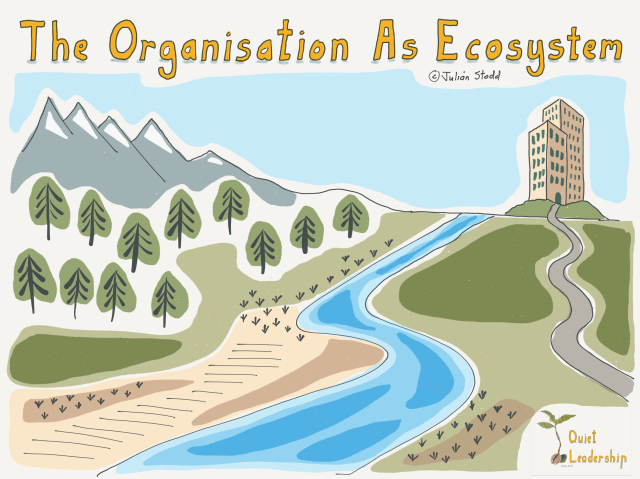
Today i am #WorkingOutLoud to share more of the emerging illustrations from the Quiet Leadership work: this one explores the ‘Organisation as Ecosystem’, a theme i have circled around from a number of directions in my broader work, but which i position at the centre of this journey.
The premise is that, beyond the formal structure, our Organisations behave like ecosystems, with each piece both drawing upon, and impacting upon, the others. Through these myriad interactions, meta-effects emerge (like ‘culture’). The ecosystem idea also allows me to bring in a central context of individual vs collective responsibility: we can each, through gentle action, care for one part of the forest, but none of us can tend for it all. Or to put it another way, all of us tend to it all: we can only sustain a healthy ecosystem if our energy and activity is aligned within…
A creative methodology for software developer un-bias
Kelsie Nabben & Michael Zargham 14 November 2020
“Wisdom is knowledge about certain principles and causes.” — Aristotle, 350 B.C.
The origins of infrastructure matters in relation to the social outcomes it supports, enables or undermines. Yet, as emerging technologies become more enmeshed in everyday life — and more powerful: it is rarely highlighted how crucial it is for technology developers to be aware of the values in which they imbue into their creation


 Systems-Centered Training (SCT) is a practical and innovative systemic approach to personal and organizational development, group dynamics and therapy. Pioneered by Yvonne Agazarian, SCT begins with the idea that we are always in a system, be it the system of ourselves as a person, a couple, a family, a team, or a whole organization. SCT posits that these different systems heavily influence how we function within them. Our ongoing challenge is how to contribute to building the kind of systems in which we want to live and work. This conference will explore what helps and what gets in the way as we take up this very human challenge.



 Systems Community of Inquiry
You must be logged in to post a comment.