Model-dependent realism is a view of scientific inquiry that focuses on the role of scientific models of phenomena.[1] It claims reality should be interpreted based upon these models, and where several models overlap in describing a particular subject, multiple, equally valid, realities exist. It claims that it is meaningless to talk about the “true reality” of a model as we can never be absolutely certain of anything. The only meaningful thing is the usefulness of the model.[2] The term “model-dependent realism” was coined by Stephen Hawking and Leonard Mlodinow in their 2010 book, The Grand Design.[3]
The simplest way to explain the behaviour of any bureaucratic organisation is to assume that it is controlled by a cabal of its enemies.
The aphorism strikes me as so profound and relevant that I have often tried to verify its attribution. Conquest was a renowned historian of the Soviet Union, so his opinions on the politics of organisations carry considerable credibility.
Several readers have asked me for Robert Conquest’s Three Laws of politics. As best I can remember, they are:1. Everyone is conservative about what he knows best.2. Any organization not explicitly and constitutionally right-wing will sooner or later become left-wing.3. The behavior of any bureaucratic organization can best be understood by assuming that it is controlled by a secret cabal of its enemies.
The problem with this is that the second of these three laws appears to come not from Robert Conquest but John O’Sullivan, a former advisor to Margaret Thatcher.
In March 2019 the PCP established a mental wellbeing network to explore and learn about mental wellbeing in their community in order to surface and engage with leverage points for change. The work is ongoing and currently focused on engaging with young people to better understand their needs and ambitions, particularly related to social connectivity and mental wellbeing for communities impacted by drought and bushfire. Tiana and Glenn will share about their journey in systems thinking and using the systems change framework to improve outcomes for mental wellbeing in their community.
Scientists Find Vital Genes Evolving in Genome’s Junkyard
Even genes essential for life can be caught in an evolutionary arms race that forces them to change or be replaced.3
READ LATER
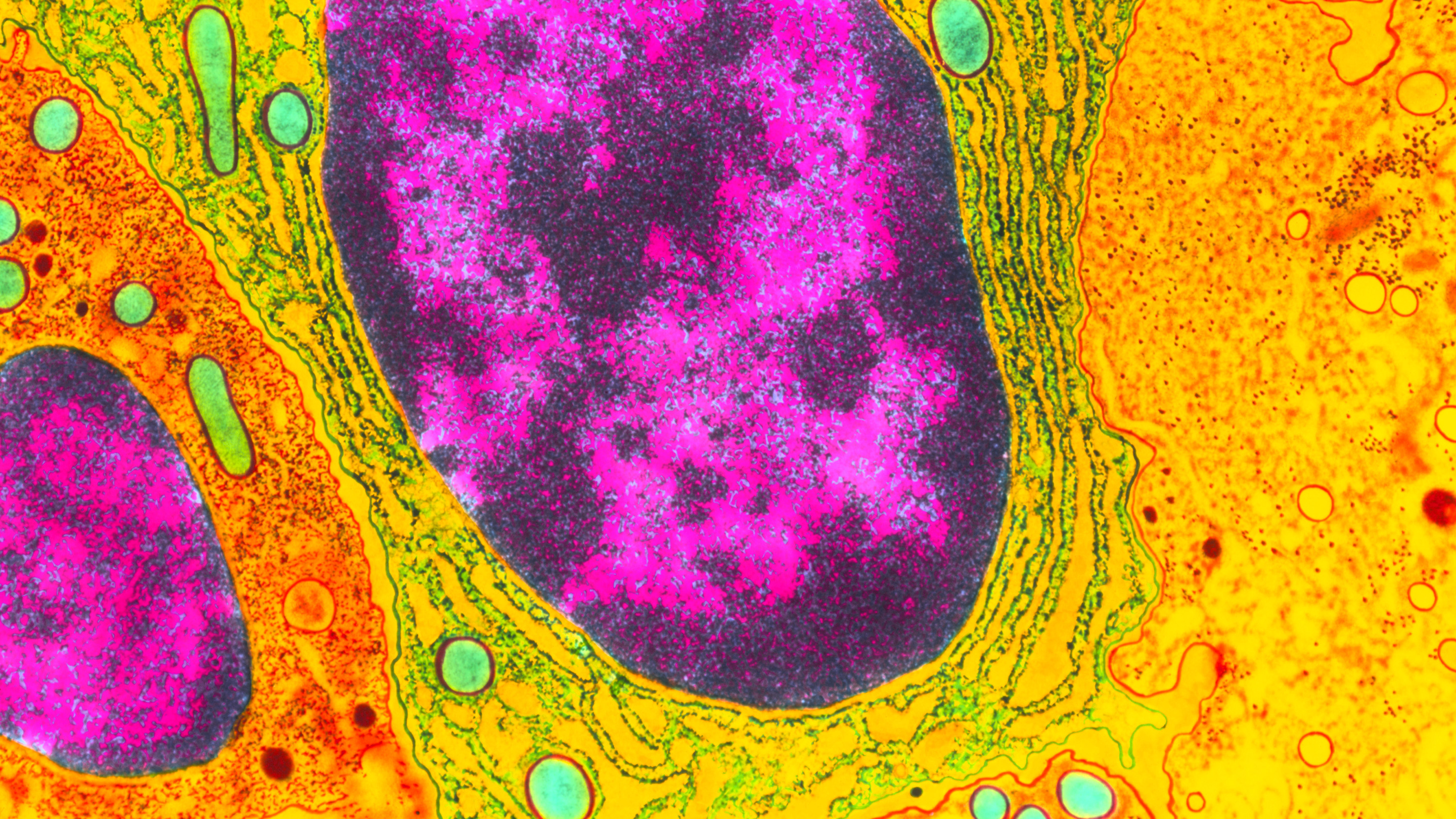
Inside the nucleus of a cell, most of the active genes are in the portion of the DNA called euchromatin (magenta). The more condensed DNA of the heterochromatin (black) is mostly genetically inert, but researchers are learning how new genes can evolve there.Dr. Gopal Murti / Science Source
Essential genes are often thought to be frozen in evolutionary time — evolving only very slowly if at all, because changing or dying would lead to the death of the organism. Hundreds of millions of years of evolution separate insects and mammals, but experiments show that the Hox genes guiding the development of the body plans in Drosophila fruit flies and mice can be swapped without a hitch because they are so similar. This remarkable evolutionary conservation is a foundational concept in genome research.
But a new study turns this rationale for genetic conservation on its head. Researchers at the Fred Hutchinson Cancer Research Center in Seattle reported last week in eLife that a large class of genes in fruit flies are both essential for survival and evolving extremely rapidly. In fact, the scientists’ analysis suggests that the genes’ ability to keep changing is the key to their essential nature. “Not only is this questioning the dogma, it is blowing the dogma out of the water,” said Harmit Malik, a Howard Hughes Medical Institute investigator who oversaw the study.
“This work is so beautiful,” said Manyuan Long, an evolutionary geneticist at the University of Chicago. “The researchers found that rapidly changing heterochromatin drives the evolution of new essential genes. Just amazing!”
Metafuture is an educational think tank that explores alternative and preferred futures and the worldviews and myths that underlie them. Through presentations, workshops and research, Metafuture helps local and global organizations and institutions create alternative and preferred futures. It is hosted by Sohail Inayatullah and Ivana Milojević.
a new thing… looks to be Portuguese-based, environmental activisim / economics / arts, many member oranisations, the vision is ‘a new vision’, not 100% clear what the activity will be
Systems change is the emergence of a new pattern of organization or systems structure. (Birney, 2015) It is both a process and an outcome.
We are facing unprecedented economic, social, and environmental crises, and current reforms offer ineffective solutions.
Naomi Klein has called for a movement of change that “connects the dots” to address the root causes of all current crises facing people and planet.
Systems Change Alliance connects the dots between individuals, groups and organizations working in different fields to collaborate, educate, advocate and implement positive systemic change.
Intrinsic value of nature — Economic liberation and true sustainability will arise when people and nature are no longer viewed as mere commodities for sale in the marketplace.
Regeneration and protection — Regeneration of renewable resources and the vital protection and recycling of non-renewable resources.
Bioeconomics — Long term, economic systems change with a restructured economy where privatizing profits and socializing the environmental costs are no longer possible.
To work toward an integrated social system based on shared political and cultural values, economic democracy, decentralization and sustainability.
Mission Statement
To advocate for just political, ecological and economic reforms, through organizing movements, workshops and conferences; publishing articles and newsletters; conducting research and developing policy proposals.
The whole-systems understanding of the world acknowledges that a whole is always more than the simple sum of its parts, paying attention to the diversity of elements, the quality of interactions and relationships, and the dynamic patterns of behaviour that often lead to unpredictable and surprising innovations and adaptations.
Many of the interrelated problems we face, as change agents in the transition towards a more sustainable human presence on Earth, have their root cause in a way of thinking that has not paid enough attention to whole systems and their dynamic interconnectedness, dynamic relationships and context.
Experts and specialists are important contributors to most sustainability projects, but we also need integrators and generalists who can help to put the contribution of each discipline into systemic relationships and help to contextualize the contributions made by the specialists.
Whole-systems thinking has to be a transdisciplinary activity that maps and integrates relationships, flows and perspectives into a dynamic understanding of the structures and processes that drive how the system behaves. Experts and specialists are important contributors to most sustainability projects, but we also need integrators and generalists who can help to put the contribution of each discipline into systemic relationships and help to contextualize the contributions made by the specialists. Too often we employ limited progress indicators or inadequate measures of success based on the dominance of a particular discipline or perspective.
One way to define the word ‘system’ is as a set of interconnected elements that together form a coherent pattern we can refer to as a ‘whole’. Such a system exhibits properties of the whole that emerge out of the interactions and relationships of the individual elements. This systems definition could be applied to a molecule, a cell, a human being, a community or the planet. In many ways a system is less a ‘thing’ than a pattern of relationships and interactions — a pattern of organization of constituting elements. The Greek root of the word system is ‘synhistanai’ and literally means ‘to place together’.
We can reduce the world to a whole just as easily as we can reduce it to a collection of parts.
Systems thinking and systemic intervention is a possible antidote to the unintended and dangerous side-effects of centuries of focusing only on reductionist and quantitative analysis informed by the narrative of separation. Yet, it is important to maintain the awareness that the systems view itself is also just another map that, as Alfred Korzybski put it, should not be confused with the territory. We can reduce the world to a whole just as easily as we can reduce it to a collection of parts. Neither the whole nor parts are primary; they come into being through the dynamic processes that define their identity through relationships and networks of interactions.
One of the most important questions in any systemic approach is to ask ‘what is the system in question’. In doing so we define boundaries that provide us with the necessary ‘enabling constraints’ to make sense of a situation. Yet, these boundaries are themselves a way of seeing that make a distinction between the system in question and its environment. We should regard the boundaries that delineate one system from another as places of connection and exchange rather than barriers that separate or isolate.
Whole-systems thinking invites us to see complex issues from multiple perspectives, to suspend our judgement by questioning our own assumptions, and to honour insights from different disciplines and different ways of knowing.
In more general terms, whole-systems thinking invites us to see complex issues from multiple perspectives, to suspend our judgement by questioning our own assumptions, and to honour insights from different disciplines and different ways of knowing. Thinking in this way helps us to pay attention to the fertile ground of synergistic, whole-systems solutions. It can help us to more clearly see the opportunities in the multiple converging crises around us.
Whole-systems thinking stops us from seeing ecological, economic and social constraints as irreconcilable challenges. It invites us not to view different stakeholder perspectives in a competitive, win-lose frame of mind, and encourages us to explore win-win-win solutions that improve the overall health and sustainability of the system as a whole.
Whole-systems thinking is living systems thinking. I believe that a systemic understanding of processes by which life continuously regenerates conditions conducive to life offers a pathway to creating regenerative businesses and organizations within a regenerative economy as enabling factors of a regenerative culture. We will explore many examples in subsequent chapters. Here are some questions to contemplate when dealing with systems:
What is the system in question and how are we defining what belongs to the system and what does not?
What is the wider context that the system in question operates in?
What are the key agents whose interactions and relationships define the system structure and drive the system’s behaviour?
How is our perspective of the system in question shaped by our worldview and value system?
What are the key ‘emergent properties’ of the system that could not have been predicted by simply looking at the individual ‘parts’ of the system?
How does our participation in the system and our way of describing it affect what we are observing?
Daniel Christian Wahl — Catalyzing transformative innovation in the face of converging crises, advising on regenerative whole systems design, regenerative leadership, and education for regenerative development and bioregional regeneration
Daniel Christian WahlDaniel Christian Wahl originally trained as a biologist and holds degrees in Biology (BSc. Hons., Univ. of Edinburgh), Holistic Science (MSc.,Schumacher College) and Natural Design (PhD., Univ. of Dundee).
When I joined The Children’s Society I was quickly swept onto the systems change journey. The simple concept of creating more positive impact for young people in need, by improving and changing the systems that repeatedly fail them made sense to me.
Systems change was a journey The Children’s Society had chosen to embark on. Our organisation’s strategy had made an intentional move to design services and programmes that would purposely shift the focus from the child to the systems around them. We wanted to grow our systemic thinking and needed a way to test and learn more about this way of working and new (to the organisation) approaches. The Children’s Society knew that it alone could not make the fundamental changes needed to ensure positive impact for disadvantaged children. Working systemically and ensuring greater collaboration would be essential — Peter Grigg’s blog explains this well.
When I ventured into the School of System Change I likened my own developing understanding of systems change to an old fashioned coffee percolator. The slow drip, drip of content, theory, practice and talk of change, reflection, experiment and futures slowly altered my way of seeing the world. Initially I was overwhelmed by it all — sitting with emergence, not having the answers, shifting the way I was approaching problems. I found it emotional and hard, but eventually clarity begun to prevail. I see similarities here with the way in which the learning from the Systems Changers Programme has become part of The Children’s Society’s DNA.
In 2018 The Children’s Society, in partnership with The Point People and funded by Lankelly Chase began to adapt and develop the Systems Changers Programme for application in the youth sector, with those working directly to provide support services. I’m not going into the detail of what and how we did it over the 9 month Programme, that’s contained in our learning report, written by Caitlin, which is purposely lengthy to share all we’ve learnt about creating and delivering the programme. A short learning synopsis is also available.
We didn’t directly lift the Systems Changers Programme on completion in 2019 and implement it within our practice base at The Children’s Society. Instead we worked to adopt the principles and approaches to our work.
This blog contains my reflections, as a participant on the journey, of some of the impact of the Systems Changers Programme on our organisation. This is not impact we have quantified, these are reflections I’ve noticed — the patterns that have emerged since the programme began. I note my own bias, increasingly I’m leaning towards systemic ways of thinking and being — attracted by the possibility to make change. I’ve been encouraged by my colleagues to pause and celebrate this significant personal shift in my own thinking and being. As a person renowned as a doer, a fixer, working at pace to deliver actions, I found it really hard to slow the pace, reflect and think even bigger and systemically.
Beer’s Principles For Good Government in the COVID-19 Crisis
Jeremy Gross
Introduction
As of this writing, there are 1.75 million confirmed cases of the COVID-19 virus, and 105,000 people are confirmed to have died of the virus. Many statistics and maps about the COVID-19 pandemic are available online from Johns Hopkins University.But looking at the rates of infection in various countries throughout the world, we know that those nations with accurate reports are reporting exponential growth until adequate measures are taken, and that many authoritarian regimes, such as Brazil and Russia and Hungary, are seriously underreporting the number of cases. Moreover, there are not the means to test in the Global South, so the numbers there could be considerably higher than reported.
In Britain and the USA, the response to the crisis would be farcical if it weren’t so cruel. Denialism during the crucial weeks between the outbreak of the crisis and when it started to kill people in those countries in large numbers meant that, after weeks of bluster, these economic powerhouses of late capitalism are scrambling to do damage control for how they have responded to the crisis; a damage control that barely addresses the health crisis, and instead focuses on the crisis of legitimacy incited by the miserable way their regimes have failed to protect their own citizens.
The Words We Use Can Change Our Reality – Shifting to a Systems View
This morning I spoke to a highly accomplished, bi-lingual woman who works in software. We agreed that the words we use when we work can have an enormous impact. For example, in her environment, the word “project” has acquired a stigma because of the pain associated with it so now she talks about “initiatives”. This small changed has helped.
The fact is that we create our reality through language. The words we use express and reinforce our mental models. They reflect a culture and a worldview.
When we want to introduce change it’s important to support the effort with the words that will encourage new behaviours. At Intelligent Management we help organizations introduce and adopt a systems view so they can improve and accelerate all the flow, from the input of suppliers and the market all the way through to their products and services and the feedback they receive from customers for continuous improvement and innovation. Working with a systems view means having the words that help you to do that.
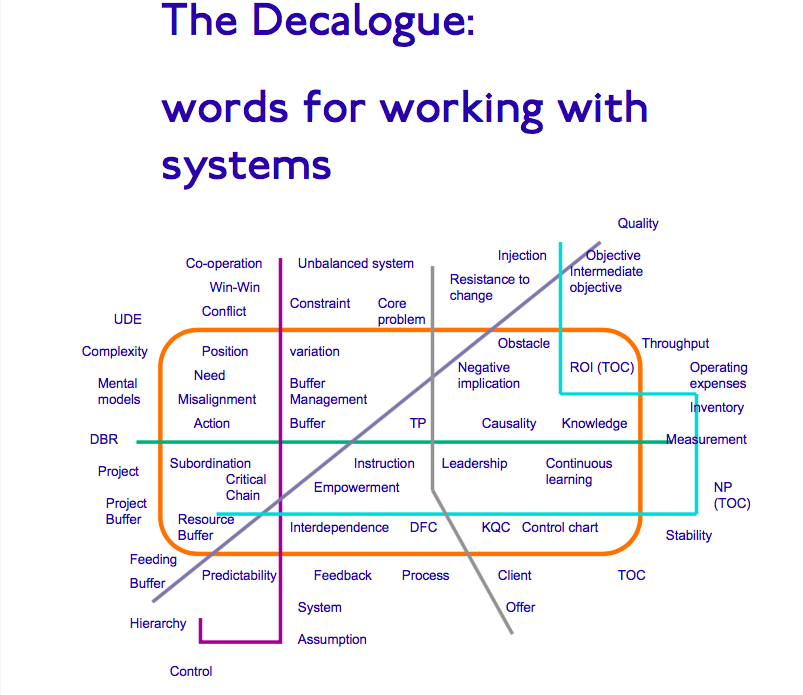
To sum up the key terms that indicate how we can work within and on systems and the field of knowledge required, we produced a word map to accompany our glossary for ‘The Decalogue’ methodology that encompasses the approaches of W. Edwards Deming and the Theory of Constraints. That was a few years ago. It’s time to add a new “line” to the map; since we produced it we have continued to evolve ‘The Decalogue’ and true to our scientific origins, we have looked to science for our basis. Here we look at some new terms to add to our word map.
Working with a systems view: Complexity, networks, emergence
Nature is not homogenous. Most of the universe is complex and composed of various subsystems — self-contained systems within a larger whole. Microscopic cells and their surroundings, for example, can be divided into many different subsystems: the ribosome, the cell wall, and the intracellular medium surrounding the cell.
The Second Law of Thermodynamics tells us that the average entropy of a closed system in contact with a heat bath — roughly speaking, its “disorder”— always increases over time. Puddles never refreeze back into the compact shape of an ice cube and eggs never unbreak themselves. But the Second Law doesn’t say anything about what happens if the closed system is instead composed of interacting subsystems.
New research by SFI Professor David Wolpert published in the New Journal of Physics considers how a set of interacting subsystems affects the second law for that system.
“Many systems can be viewed as though they were subsystems. So what? Why actually analyze them as such, rather than as just one overall monolithic system, which we already have the results for,” Wolpert asks rhetorically.
The reason, he says, is that if you consider something as many interacting subsystems, you arrive at a “stronger version of the second law,” which has a nonzero lower bound for entropy production that results from the way the subsystems are connected. In other words, systems made up of interacting subsystems have a higher floor for entropy production than a single, uniform system.
All entropy that is produced is heat that needs to be dissipated, and so is energy that needs to be consumed. So a better understanding of how subsystem networks affect entropy production could be very important for understanding the energetics of complex systems, such as cells or organisms or even machinery
Wolpert’s work builds off another of his recent papers which also investigated the thermodynamics of subsystems. In both cases, Wolpert uses graphical tools for describing interacting subsystems.
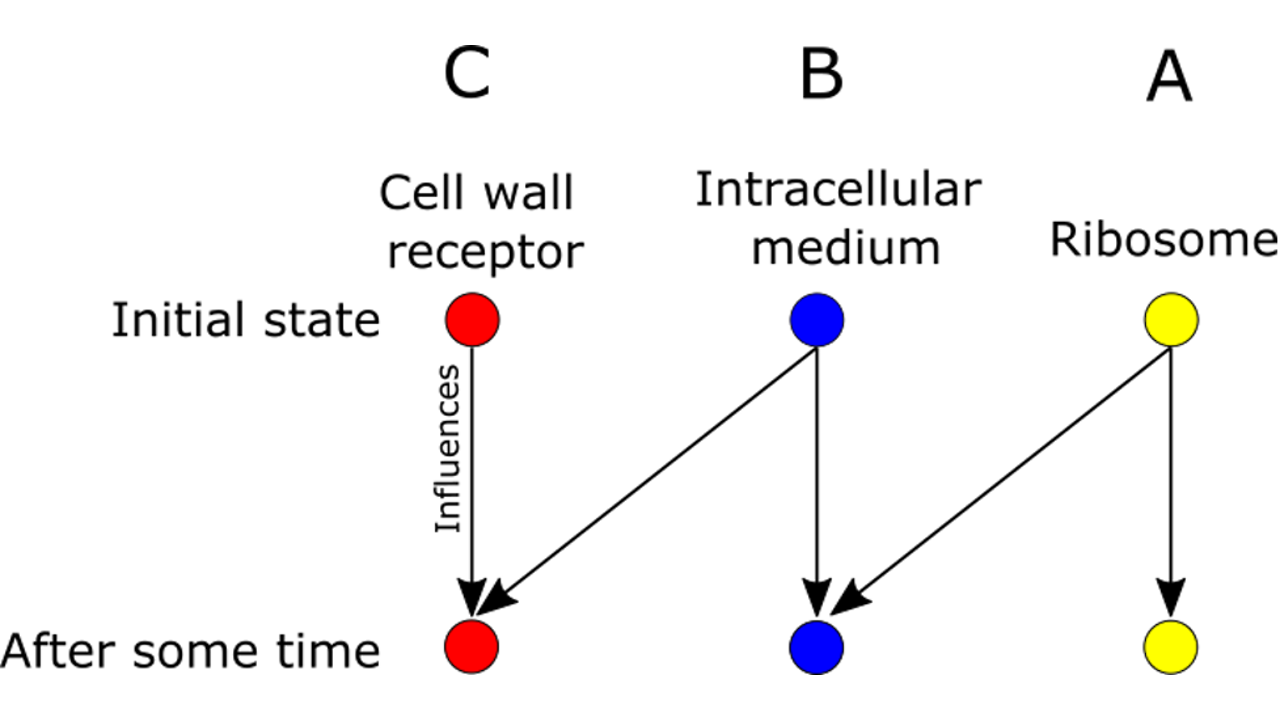
For example, the following figure shows the probabilistic connections between three subsystems — the ribosome, cell wall, and intracellular medium.
Like a little factory, the ribosome produces proteins that exit the cell and enter the intracellular medium. Receptors on the cell wall can detect proteins in the intracellular medium. The ribosome directly influences the intracellular medium but only indirectly influences the cell wall receptors. Somewhat more mathematically: A affects B and B affects C, but A doesn’t directly affect C.
Why would such a subsystem network have consequences for entropy production?
“Those restrictions — in and of themselves — result in a strengthened version of the second law where you know that the entropy has to be growing faster than would be the case without those restrictions,” Wolpert says.
A must use B as an intermediary, so it is restricted from acting directly on C. That restriction is what leads to a higher floor on entropy production.
Plenty of questions remain. The current result doesn’t consider the strength of the connections between A, B, and C — only whether they exist. Nor does it tell us what happens when new subsystems with certain dependencies are added to the network. To answer these and more, Wolpert is working with collaborators around the world to investigate subsystems and entropy production. “These results are only preliminary,” he says.
Many systems are composed of multiple, interacting subsystems, where the dynamics of each subsystem only depends on the states of a subset of the other subsystems, rather than on all of them. I analyze how such constraints on the dependencies of each subsystem’s dynamics affects the thermodynamics of the overall, composite system. Specifically, I derive a strictly nonzero lower bound on the minimal achievable entropy production rate of the overall system in terms of these constraints. The bound is based on constructing counterfactual rate matrices, in which some subsystems are held fixed while the others are allowed to evolve. This bound is related to the ‘learning rate’ of stationary bipartite systems, and more generally to the ‘information flow’ in bipartite systems. It can be viewed as a strengthened form of the second law, applicable whenever there are constraints on which subsystem within an overall system can directly affect which other subsystem.
The challenges facing public services and non-profit organizations are complex and multi-faceted, confounding the orthodoxies of bureaucratic public administration and New Public Management approaches. This article discusses the merits and potential of the emerging ‘Human Learning Systems’ (HLS) approach to the funding, commissioning and management of public services as an alternative management logic. Building on prior introductory work, the authors analyse the current state of development, content and operation of HLS and its collaborative process, involving more than 300 organizations. Drawing on the experience of public and non-profit service professionals in adopting and experimenting with this approach, the authors found that HLS can provide a helpful and innovative conceptual frame to promote constructive engagement with complexity in public management theory and practice.
IMPACT
Current approaches to public management based on principles of marketization, management and measurement are increasingly being seen to fail when faced with the complex world of public services. The Human Learning Systems (HLS) concept represents an alternative approach which embraces the complexity of the real world of organizations working to deliver services. Produced in collaboration with an emerging community of funders, managers and commissioners of services, HLS offers a framework which bridges academic complexity theory and the diverse contexts of practice. This article introduces HLS as a means to enable organizations, practitioners and service users to work together more effectively.
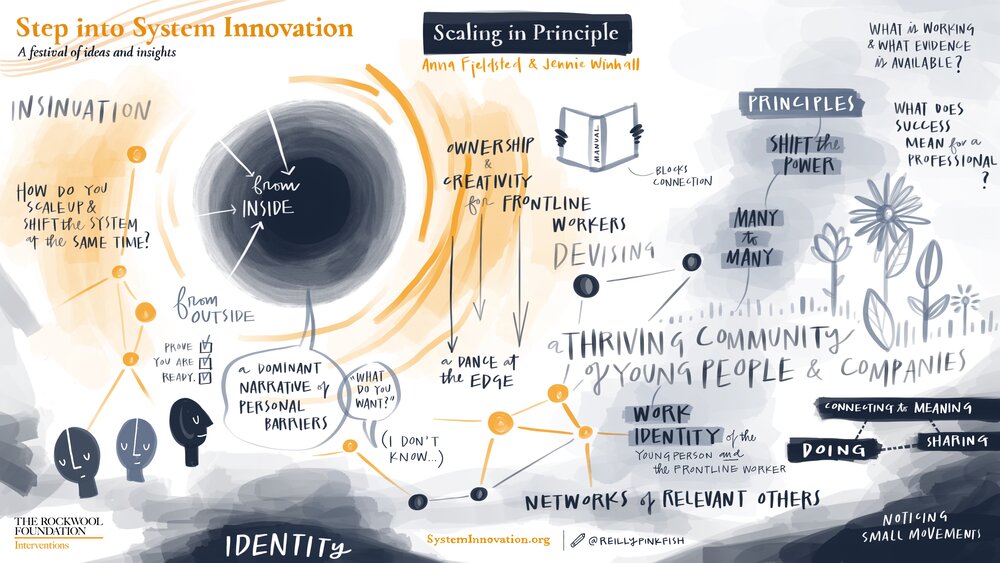
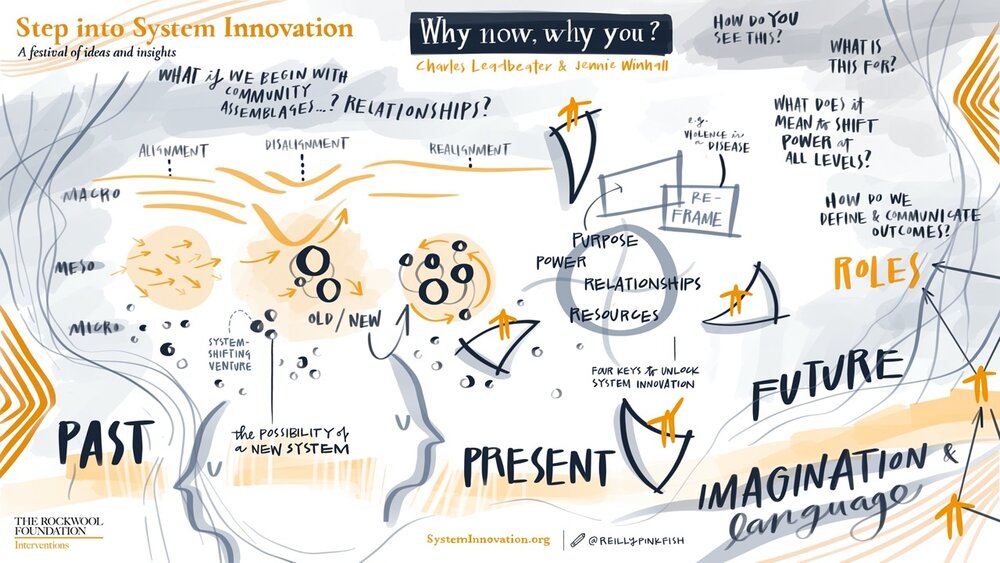
Anna Fjeldsted begins tackling challenges in a brilliant way, “well I don’t know how we could do that, but I’d really like to take the risk.” This was the premise with which Jennie Winhall opened our fascinating discussion, as she introduced her colleague Anna and began diving into the complexities of how to scale solutions, while ensuring those solutions stay true to their core purpose. Read More
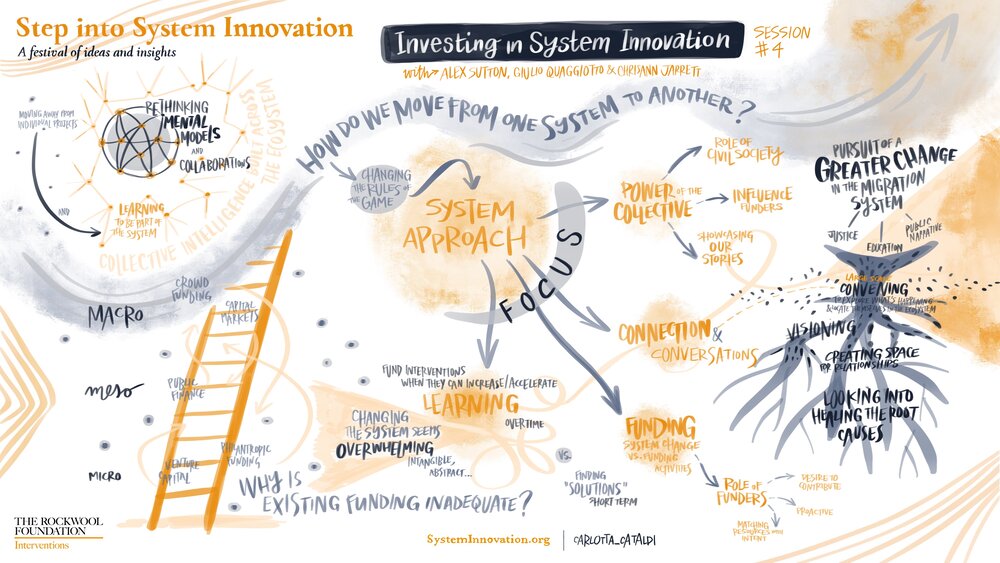
Chrisann Jarrett, Alex Sutton and Guilio Quaggiotto provided us with a thought-provoking snapshot of the funding side of the equation to Systems Innovation. As far-sighted funders themselves, both Guilio and Alex showed us why it’s essential we invest in continuous learning, experimentation and collaboration, rather than single-point solutions.Read More
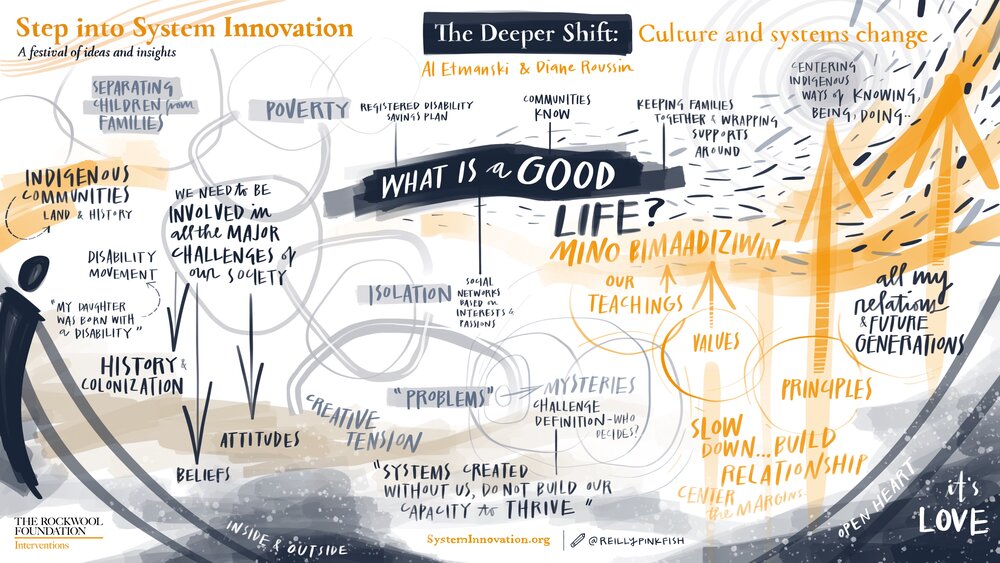
As Immy Kadeep wonderfully put it, there is a “beautiful dance” that must be learned as we interact both with the current system and operate outside of it, while also acknowledging wisdoms, histories, truths, marginalised communities and future generations. Immy, and I think all of us, can see this dance being performed with finesse by both Al Etmanski and Diane Roussin, who successfully navigate through systems while also working to radically change the values, principles and mindsets that those systems were built on. Read More
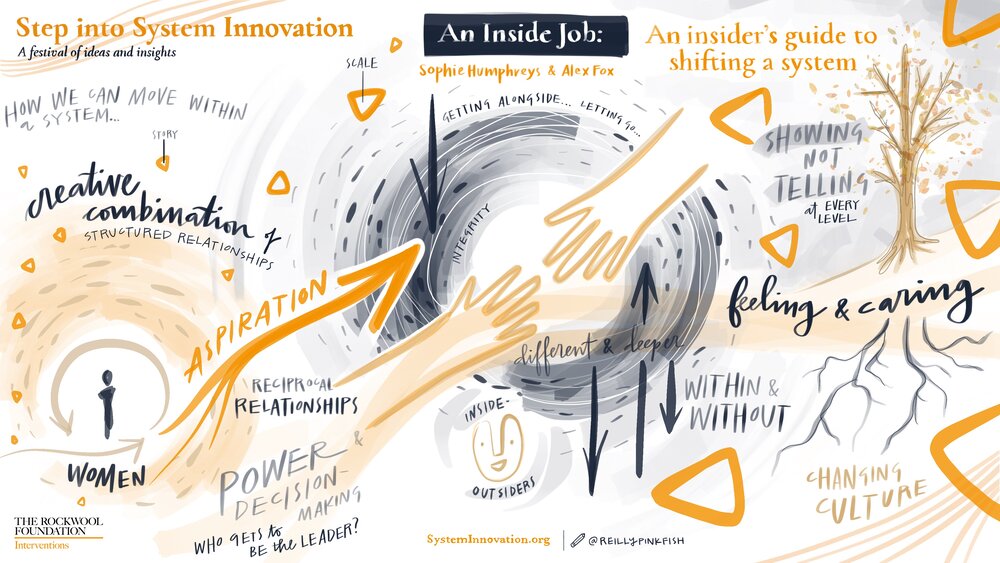
Caring is self-realisation brought about through the growth of others. That is how Milton Mayeroff defines care in his classic account On Caring. Mayeroff’s definition of care came back to me after spending more than an hour in conversation yesterday with Sophie Humphreys and Alex Fox. Our discussion highlighted a distinction central to our work at the Rockwool Foundation on systems innovation: scaling an innovation is not the same as shifting a system.Read More
Donnella Meadows, the doyenne of systems thinking, famously said that shifting purpose is the most powerful lever to transform a system. Yesterday, in the opening session of our Systems Innovation Festival, Jennie Winhall guided us through an explanation of the four keys to unlock system change: power, purpose, relationships and resources. We then asked the hundreds of participants for their view, and the majority said that the most important way into systems innovation was through relationships. These were the full results…Read More
This is a compilation of resources for people interested in exploring the Human Learning Systems approach to leading, funding and managing all forms of social intervention and public service.
The Human Learning Systems approach starts with the belief that public service exists to create the conditions which enable each person to create good outcomes in their lives. To do this, we believe that public service must embrace the complex reality of the 21st Century world.1.00
We believe that…Thinking in systems – understanding things as connected and interdependent – leads to better outcomes for all.READ MORE
We believe that…Focusing on the relationships between people creates better ways of working and better places to work.READ MORE
We believe that…Prioritising learning together over deliverology creates the safe space for innovation and lasting improvement.READ MORE
We believe that…Thinking in systems – understanding things as connected and interdependent – leads to better outcomes for all.READ MORE
We believe that…Focusing on the relationships between people creates better ways of working and better places to work.READ MORE
FIND THE PIONEERS
“Human Learning Systems is the most insightful and helpful work that I have come across. It challenges stale approaches of top down and provider centred services and encourages us to work with people – listening to them and understanding what matters to them – acting with authenticity and integrity and working together.”KEN JARROLD CBE DIRECTOR @ OTHER PEOPLES SHOES LTD
“Outstanding new report: A “must read” for those interested in the delivery of large-scale change.”HELEN BEVAN CHIEF TRANSFORMATION OFFICER @ NHS HORIZONS
“It’s unquestionably a better way to do business.”GARY WALLACE COMMISSIONER @ PLYMOUTH COUNCIL AND CCG
EVENTS & RESOURCES
We are continuously updating our event listings and resource library.
Come here for easy access to the latest and greatest from the world of Human Learning Systems.
My dad emigrated from Colombia to North America when he was 18 looking looking for a better life. For my brother and I that meant a lot of standing outside in the cold. My dad’s preferred method of improving his lot was improving lots, and my brother and I were “voluntarily” recruited to help working on the buildings we owned.
That’s how I came to spend a substantial part of my teenage years replacing fences, digging trenches, and building flooring and sheds. And if there’s one thing I’ve learned from all this building, it’s that reality has a surprising amount of detail.








 Systems Community of Inquiry
You must be logged in to post a comment.