Publisher:Princeton, NJ: Mathematica Policy ResearchApr 30, 2010AuthorsMargaret B. HargreavesProvides guidance on planning effective evaluation of system change interventions.
In recognition of the need to address systemic problems that have hindered the potential growth of Africa for decades and accelerate systems change initiatives across the continent, African Philanthropy Forum (APF) launched the APF Systems Change Program to build an African network of systems change leaders and philanthropists who can help cultivate conditions to make their transformative visions a reality.
The Systems Change Program, which began with a rigorous selection process managed by Dalberg, is a pilot with six initiatives led by system entrepreneurs who are solving problems in multiple SDG areas, including quality education, decent work, and economic growth, good health and wellbeing, clean water and sanitation and reduced inequality. It is a direct response to the need to think differently and accelerate when considering Africa’s problems and solutions.
The Program commenced in May 2020 and was publicly launched at a virtual event on August 20, where panelists and the system entrepreneurs took part in a stimulating conversation about Driving Systems Change in Africa towards achieving sustainable and inclusive development. The speakers included Randy Newcomb, Senior Advisor at The Omidyar Group; Dr. Angela Gichaga, CEO of Financing Alliance for Health; Mosun Layode, Executive Director, African Philanthropy Forum; Elena Bonometti, CEO, Tostan International; as well as Jeff Walker, Chairman New Profit/APF Board Member who served as the moderator.
“There is a need to work and change the whole system rather than focus on smaller group activities.” – Jeff Walker.
Tuesday, October 27, 2020 6:00 PM to 8:00 PM GMT+1
Details
“Well, the Force is what gives a Jedi his power. It’s an energy field created by all living things. It surrounds us and penetrates us; it binds the galaxy together.” ―Obi-Wan Kenobi The Force in organisations is real. It can shape and control you and your organisation – or you can learn to shape them. This will be an introduction to the jedi arts of management cybernetics.
Benjamin is the chief executive of the Public Service Transformation Academy, a not-for-profit social enterprise working with the UK government, managing partner/founder at RedQuadrant. He studied philosophy, politics, and economics at Oxford University before becoming co-ordinator of a youth development charity. He then worked at the London Borough of Hammersmith and Fulham for seven years, from the front line to Adviser to Mayor/Leader. He has provided service consultancy at PricewaterhouseCoopers and Sector Projects (part of Capita group), where he worked with clients from the Government of Armenia to Birmingham City council. He has undertaken voluntary accreditation missions for Youth Business International in Bangladesh and Dominica.
Benjamin is passionate about commissioning, systems thinking, customer-led transformation, lean, and better ways to run and lead organisations. He holds a lean six sigma black belt and is an accredited power+systems trainer. Benjamin is a visiting lecturer in applied systems thinking at Cass Business School, City University, and has lectured at Nottingham Business School and Oxford Said/HEC Paris.
Management Cybernetics and the Force in organisational life
Tuesday, Oct 27, 2020, 6:00 PM
Online event ,
19 Members Attending
“Well, the Force is what gives a Jedi his power. It’s an energy field created by all living things. It surrounds us and penetrates us; it binds the galaxy together.” ―Obi-Wan Kenobi The Force in organisations is real. It can shape and control you and your organisation – or you can learn to shape them. This will be an introduction to the jedi arts o…
Driving Systems Change Forward Webinar Registration
Driving Systems Change Forward
Multisite, cross-sector initiatives bring together stakeholders to tackle difficult issues – housing, health, education, and more – facing communities across the United States.
In the new report Driving Systems Change Forward, authored by the Urban Institute and published by the Federal Reserve Bank of San Francisco, you’ll learn key lessons from initiatives from across the country about what it takes to advance systems change forward by shifting power and promoting racial equity.
Join us for a virtual coffee chat on August 31 from 4pm – 5pm ET with one of the report authors—Corianne Scally—from the Urban Institute and contributing practitioner, Andrea Akita, who leads the Communities of Opportunity Initiative for King County, Washington. They’ll discuss the report findings and how initiatives can build on this learning to change the structures, relationships and attitudes that keep racism rooted in place and communities struggling.
Can’t make the exact time to join? Registering also means you’ll be notified when the recording is available, normally within 24 hours of live event.
Joining us for this discussion are:
Andrea Akita, Communities of Opportunity Director, King County Public Health
Corianne Payton Scally, Principal Research Associate, Urban Institute
Title: Driving Systems Change Forward Date: Monday, August 31 Time: 4pm – 5pm ET Cost: Free
A slate of multisite, cross-sector initiatives has emerged to address structural root causes of inequities by changing the systems that shape community conditions and individual well-being. These new, connected sets of activities were planned and implemented to achieve a goal that spans more than one site (e.g., a neighborhood, school, city, region) and involve a mix of institutions from the public, nonprofit, philanthropic, and/or private sectors. This report reflects on recent progress and shortcomings and provides strategies for initiative funders, intermediaries, sites, and evaluators who wish to evolve their efforts in ways that drive systems change forward. The findings highlight the complex intersections of systems, racial equity, and power that can work for or against systems change.
The executive summary and full report are available here.
Editors’ note: This article was excerpted, with minor edits, from Ideas Arrangements Effects: Systems Design and Social Justice (Minor Compositions, 2020),for the summer 2020 edition of the Nonprofit Quarterly. This edition of the magazine is about the need to understand the often unacknowledged and unspoken design principles behind some of the practices and structures that pervade our work. We recommend the book highly. All illustrations are by Ayako Maruyama.
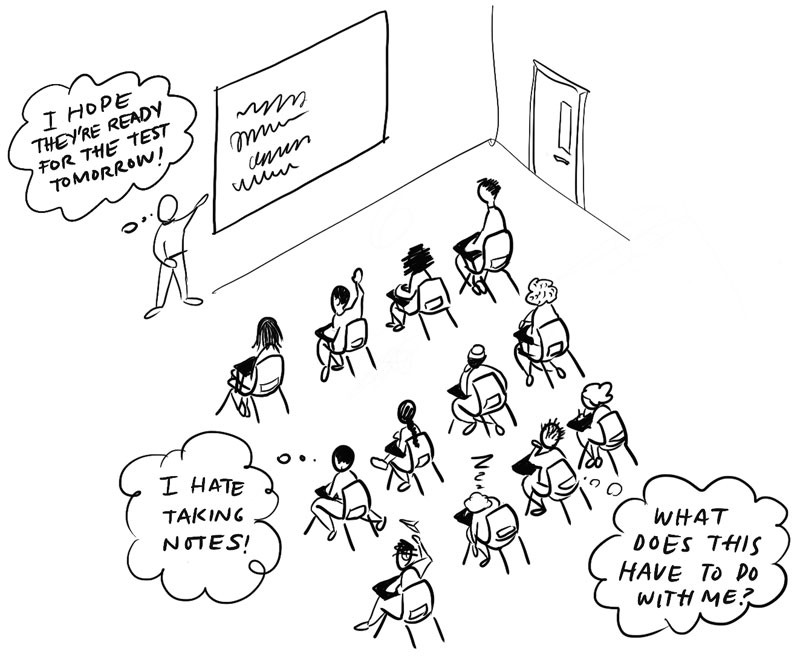
Activists, artists, philanthropists, young people, academics—all manner of folks—constantly battle injustices and negative effects in their lives and the lives of others. We take to the streets, to the Internet, to the voting booth, and more to fight for better outcomes. To the same degree, we argue vehemently about the ideas that underlie these injustices—from notions of public and private to ideas about categorizing our bodies, to all the “isms” that say some categories (and people) matter more than others.
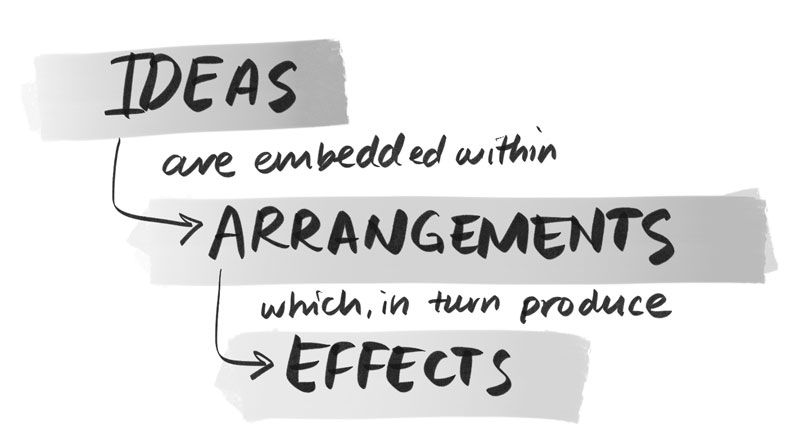
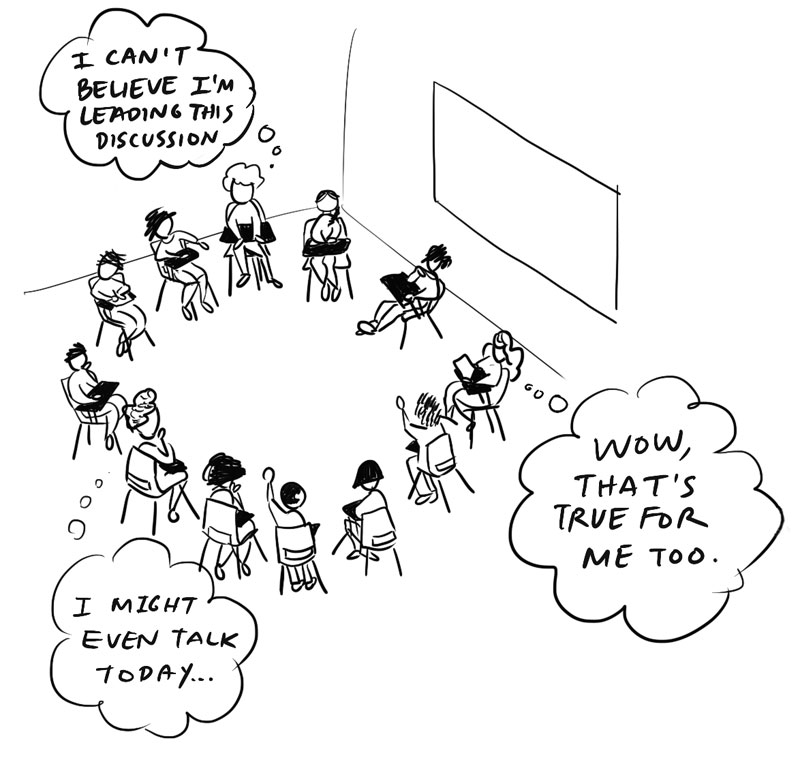
But the arena for intervention that we at DS4SI want to make a case for is a less obvious one: that of the multiple, overlapping social arrangements that shape our lives. We believe that creating new effects—ones that make a society more just and enjoyable—calls for sensing, questioning, intervening in, and reimagining our existing arrangements. Simply put, we see rearranging the social as a practical and powerful way to create social change. And we want those of us who care about social justice to see ourselves as potential designers of this world, rather than simply as participants in a world we didn’t create or consent to. Instead of constantly reacting to the latest injustice, we want activists to have the tools and time to imagine and enact a new world.
As Michelle Alexander, author of The New Jim Crow: Mass Incarceration in the Age of Colorblindness, wrote in her 2018 debut op-ed for the New York Times:
Resistance is a reactive state of mind. While it can be necessary for survival and to prevent catastrophic harm, it can also tempt us to set our sights too low and to restrict our field of vision to the next election cycle, leading us to forget our ultimate purpose and place in history….Those of us who are committed to the radical evolution of American democracy are not merely resisting an unwanted reality. To the contrary, the struggle for human freedom and dignity extends back centuries and is likely to continue for generations to come.1
With the weight of lifetime Supreme Court appointments or healthcare or climate change seeming to hang in the balance of our elections, it is easy to get stuck there. But as Alexander points out, our fixation with politics and policies as the grand arrangement from which all other forms of social justice and injustice flow serves to “set our sights too low.”2 When do we get to imagine the daily arrangements of “human freedom and dignity”?3 We know this won’t happen overnight. It takes time and investment for social arrangements to institutionalize and endure, and it will take time to change them. But it is critical that we try. And to do that, we need to be better at sensing arrangements, intervening in them, and imagining new ones.
This article provides the most current guidelines for nurse educators and nurses to use systems thinking to manage COVID-19 in health systems. A working definition of systems thinking is offered, with a review of basic knowledge and care in the context of the system awareness model (SAM). Seven key messages assist nurse educators and nurses in the management of COVID-19 patients culminating in leadership of complex health care systems using systems thinking. [J Contin Educ Nurs. 2020;51(9):402–411.]
In this in-depth interview, David Zilber, director of the fermentation lab at Noma—named the best restaurant in the world—discusses how food is culture, but fermentation is culture on a deeper level.
“Culture” and “culture” mean two different things to a biologist and an anthropologist, but in fermentation, they overlap completely.
Open events and development days, in addition to the core content, provide valuable opportunities for systems practitioners to network and mingle. Since our events are now online, this will be hard – or certainly different.
Therefore we’re running virtual networking events. Hosted by SCiO director Benjamin Taylor, with deep experience of online facilitation from five to over a hundred people, this will combine some initial small group work, Open Space-style discussions, and completely open opportunities to mingle as individuals.
Please note that you will need to attend using a desktop computer (not a tablet or phone) to get the best experience.
In today’s post, I am looking at the Conant-Ashby theorem, “The Good Regulator Theorem”, named after Roger C. Conant and W. Ross Ashby. Ashby is one of the pioneers of the Cybernetics movement. This theorem states that:
Every good regulator of a system must be a model of that system.
A really good version of this theorem comes from Daniel L. Scholten, who says – Every good key must be a model of the lock it opens. The key must match the lock in order for it to open it. As Conant and Ashby put it:
Any regulator that is maximally both successful and simple must be isomorphic with the system being regulated… Making a model is thus necessary. The theorem has the interesting corollary that the living brain, so far as it is to be successful and efficient as a regulator for survival, must proceed, in learning, by the…
We’re at a unique moment in the 200,000 years or so that Homo sapiens have walked the Earth. For the first time in that long history, humans are capable of coordinating on a global scale, using fine-grained data on individual behaviour, to design robust and adaptable social systems. The pandemic of 2019-20 has brought home this potential. Never before has there been a collective, empirically informed response of the magnitude that COVID-19 has demanded. Yes, the response has been ambivalent, uneven and chaotic – we are fumbling in low light, but it’s the low light of dawn.
At this historical juncture, we should acknowledge and exploit the fact we live in a complex system – a system with many interacting agents, whose collective behaviour is usually hard to predict. Understanding the key properties of complex systems can help us clarify and deal with many new and existing global challenges, from pandemics to poverty and ecological collapse.
In complex systems, the last thing that happened is almost never informative about what’s coming next. The world is always changing – partly due to factors outside our control and partly due to our own interventions…
In the early days of Scrum we were steeped in complex adaptive systems theory and autonomous intelligent systems. This area of research is emerging in a new form called Ambient Intelligence (AmI) due to the proliferation of intelligent devices on the internet. This proliferation and the applications we use with them caused Wired Magazine to declare “The Web is dead” in September 2010.
Work in this area can help us understand Scrum better and ensure that basic collaboration mechanisms are in place to make Scrum work. The environment must be set up so that people have an incentive to help one another in order to optimize the whole, rather than optimizing their individual niche at the expense of the larger community. Failure to do this will prevent individuals and companies achieving the full benefits of Scrum.
ACM Transactions on Autonomous Adaptive Systems has many articles worth reading to understand the issues in more depth. In particular, the article below reviews much of the literature upon which Scrum is based and proposes a better approach to achieve cooperation among networked systems.
We address the problem of cooperation in decentralized systems, specifically looking at interactions between independent pairs of peers where mutual exchange of resources (e.g., updating or sharing content) is required. In the absence of any enforcement mechanism or protocol, there is no incentive for one party to directly reciprocate during a transaction with another. Consequently, for such decentralized systems to function, protocols for self-organization need to explicitly promote cooperation in a manner where adherence to the protocol is incentivized.
In this article we introduce a new generic model to achieve this. The model is based on peers repeatedly interacting to build up and maintain a dynamic social network of others that they can trust based on similarity of cooperation. This mechanism effectively incentivizes unselfish behavior, where peers with higher levels of cooperation gain higher payoff.We examine the model’s behavior and robustness in detail. This includes the effect of peers self-adapting their cooperation level in response to maximizing their payoff, representing a Nash-equilibrium of the system. The study shows that the formation of a social network based on reflexive cooperation levels can be a highly effective and robust incentive mechanism for autonomous decentralized systems.
Categories and Subject Descriptors: I.2.11 [Artificial Intelligence]: Distributed Artificial Intelligence— Multiagent systems; C.2.1 [Computer-Communication Networks]: Network Architecture and Design—Distributed networks
General Terms: Algorithms Additional Key Words and Phrases: Cooperation, decentralized systems, self-organization ACM Reference Format: Allen, S. M., Colombo, G., and Whitaker, R. M. 2010. Cooperation through self-similar social networks. ACM Trans. Autonom. Adapt. Syst. 5, 1, Article 4 (February 2010), 29 pages.Comments are moderated and may take up to 24 hours to appear.
The Covid-19 crisis is a cataclysmic event and caught us all by surprise. It is considered a health and economic crisis, but at the same time and rarely discussed, it also reveals the weaknesses in the systemic processes in our society and organizations. The Viable System Model (VSM) by Stafford Beer allows us to structure the various weaknesses and to put them into a coherent framework. The VSM postulates that all social systems need a minimum set of systemic functions to become viable. This article explains the vital role of these systemic functions during the Covid 19 crisis. It discusses how their (in)adequate functioning decides about the prevention and mastery of the crisis. The VSM offers thus a formal framework to better understand the systemic processes needed for the prevention and mastery of crisis.
Collective computation: Complexity can arise from simple interactions among components but does it happen this way in nature—complexity at the microscale suggests not (https://t.co/RxLubGc758). The origins of this view lie in model systems like cellular automata yet von Neumann pic.twitter.com/SHDLxepzAu








 Systems Community of Inquiry
You must be logged in to post a comment.