
Tolman: Context in Systems Changes and Neuroscience (Episodic Memory)
Tolman: Context in Systems Changes and Neuroscience (Episodic Memory) – Systems Thinking – Open Learning Commons
Category Archives: Discussion
A view or perspective on the world
ASC 2020 Global Conversation – American Society for Cybernetics – September 12-13 2020, online
source
ASC 2020 Global Conversation – American Society for Cybernetics
ASC 2020 Global Conversation
September 12-13 2020, online
To Register (Free for ASC Members): Registration Page

This event is held in coordination with the British Cybernetics Society’s virtual event “Cybernetics and the 21st Century: Stories of Practice.”
The ASC invites you to participate in the “ASC 2020 Global Conversation,” September 12-13. This event will consist of a series of live online conversations running across two days and various time zones. Online conversations will be organized as moderated panel discussions, where panelists interact with each other and the audience. Panelists will provide brief pre-recorded presentations, which will be available for advance viewing by all registrants.
Call for Presentations / Panels
To participate in a panel discussion, please submit a video recording up to ten minutes in length and a brief description of it. Lengthier recordings can be accepted but should be cut into several segments of 10 minutes each. Group submissions are accepted and encouraged (to form 1 hour themed panels) subject to availability of time slots. Panelists will be grouped for a one-hour time slot consisting of a moderated conversation for 30 minutes, followed by a brief breakout session for viewers to develop questions for the panelists to respond to. The remaining time of the one hour time slot will be dedicated to discussion driven by the audience. For proposals of themed panels, please contact the organizers.
Submit pre-recorded presentations to: ASC2020.GlobalConversation@gmail.com
Inquiries (ASC): asc2020.globalconversation@gmail.com
Inquiries (Cybernetics Society): paulogcosta@gmail.com
Submission deadline for pre-recorded presentations (EXTENDED): August 31
This virtual event will be held in coordination with the British Cybernetics Society’s event “Cybernetics and the 21st Century: Stories of Practice.” Schedules for both events are coordinated such that participants will be able to take part in both events. Participants are kindly requested to register with BOTH the ASC and CYBSOC. For more details and registration at CYBSOC, see here.
Registration Details
Registration deadline: September 11. After registration, access codes for all conversations will be sent to you.
Registration: Registration is required for all participants including those who do not participate in a panel discussion.
Cost: The event is free to all current ASC Members and all current CYBSOC members.
To Register: Follow the Link to the Registration Page. There is no fee to register, but non members of the ASC will be requested to join or to make a self-determined contribution.
Joining/Renewing: To join or renew follow the link ASC2020 Membership to ASC’s 2020 Membership Page hosted by Cvent. (Memberships are good for one year.) Alternatively, follow the link on ASC’s webpage: http://asc-cybernetics.org/join
Non-Member Contributions: Non-members wishing to participate are requested to make a Self-Determined Donation to the ASC via PayPal. . Follow the yellow ‘Donate’ Button at the bottom right on our website. http://asc-cybernetics.org. (Before or after the event — your choice.)
Event Schedule
Saturday 12th September 2020
UK 11am to 1pm // New York 6am to 8am – CYBSOC
UK 1pm to 3pm // New York 8am to 10am – ASC
UK 3pm to 5pm // New York 10am to 12noon – CYBSOC
UK 5pm to 7pm // New York 12 noon to 2pm – ASC
UK 7pm to 8pm / New York 2pm to 3pm – ASC Keynote: Anthony Hodgson
Sunday 13th September 2020
UK 11am to 1pm // New York 6am to 8am – CYBSOC
UK 1pm to 3pm // New York 8am to 10am – ASC
UK 3pm to 5pm // New York 10am to 12noon – CYBSOC
UK 5pm to 7pm // New York 12 noon to 2pm – ASC
ASC2020 Global Conversation Keynote
Speaker: Anthony Hodgson
Anticipation in a World of Radical Uncertainty – Lessons From 2nd Order Cybernetics
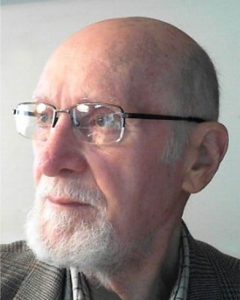
Speaker Bio:
Anthony Hodgson, Ph.D, F.R.S.A., Member IFF
Anthony Hodgson is a founding trustee of H3Uni – towards a university of the third horizon. This as an initiative born out of the recognition by a small group of foresight and strategy practitioners that most higher education does not address the huge shift in the skills of collaboration and resilient thinking that are needed to successfully navigate a turbulent world challenged by major issues not previously experienced on a global scale.
Anthony Hodgson has over forty years of experience of providing consulting and facilitation services in foresight and strategy to major corporations and in the public sector in the UK. It is in this role that Anthony Hodgson developed new methods of participative repatterning of shared thinking in groups As an experienced practitioner of systems thinking and scenario futures methods and as a founder member of the International Futures Forum think tank working especially on transformative innovation and new methods of cooperation to match the needs of the Anthropocene.
Anthony Hodgson’s doctorate is in systems science from the University of Hull. As a Research Fellow with the University of Dundee Anthony Hodgson is currently doing original work on integrating foresight methods with systems thinking and modelling through second-order cybernetics, phenomenology of time perception and futures methods. As well as published papers Anthony Hodgson has published a book on some of this work titled Systems Thinking for Turbulent Times: A Search for new perspectives (Routledge, 2020). Contact: anthony.hodgson[at]h3uni.org
ASC 2020 Global Conversation September 12-13 2020, online To Register (Free for ASC Members): Registration Page
ASC 2020 Global Conversation – American Society for Cybernetics
ASC 2020 Global Conversation – American Society for Cybernetics – Why Can’t Cybernetics Tame Pandemics? 12-1pm EDT Sunday September 3, part of the 2-day Global Conversation Conference, a joint effort of the American Society for Cybernetics and the British Cybernetics Society, and part of the ‘New Macy Meetings’
Message from Paul Pangaro via Ben Sweeting on the CYBCOM mailing list
Part of:
The New Macy Meetings: Cybernetics and Designing for Action
Evolving Draft — Last edit 2020-07-12 4:00pm EDT — Paul Pangaro ppangaro@cmu.edu Share this document via the link https://tinyurl.com/newmacy
See also an emerging Manifesto, a more concise view.
Message from Paul Pangaro:
Dear Colleague
I’m writing to invite you to the launch of #NewMacyMeetings in September 2020. This will be a modest first session, one of a series of experiments before a more formal, large-scale effort in 2021.
Our first session is called Why Can’t Cybernetics Tame Pandemics?
This first session will be held from Noon to 1pm EDT via Zoom on Sunday September 13, part of the 2-day Global Conversation Conference, a joint effort of the American Society for Cybernetics and the British Cybernetics Society.
Registration is required and a donation is completely optional.
Please go to this ASC page for more information and for the link to register. You will receive a Zoom video invitation thereafter.
I hope you will join and contribute your views and critique in an evolving project.
As some of you will know, the original Macy Meetings were held in the 1940s and 50s and they comprised seminal trans-disciplinary conversations that began the wide-spread influence of cybernetics across all the major disciplines of the second-half of the last century.
The world is different now, overtaken by pandemics of biology and technology, racism and inequality, environment and justice. #NewMacyMeetings asks the question, Can cybernetics help tame today’s pandemics?
In addition to a trans-disciplinary conversation, in order to be effective — that is, leading to effective action — our #NewMacyMeetings must also be trans-global (diverse and inclusive) as well as trans-generational (engaging all ages).
There is more detail of the overall direction of #NewMacyMeetings at this link.Please feel free to share this email or to forward the blog post here.
Please let me know if you have questions or comments.
Thank you.
-Paul
ASC 2020 Global Conversation September 12-13 2020, online To Register (Free for ASC Members): Registration Page This event is held in coordination with the British Cybernetics Society’s virtual event “Cybernetics and the 21st Century: Stories of Practice.” The ASC invites you to participate in the “ASC 2020 Global Conversation,” September 12-13. This event will consist of a series of live online conversations running across two days and various time zones. Online conversations will be organized as moderated panel discussions, where panelists interact with each other and the audience. Panelists will provide
ASC 2020 Global Conversation – American Society for Cybernetics
Systems thinking at the Tavistock Institute – past, present and future – The Tavistock Institute
source:
Systems thinking at the Tavistock Institute – past, present and future – The Tavistock Institute
Systems thinking at the Tavistock Institute – past, present and future
Presented by Dione Hills, Richard Allen and David Drabble.
Systems Thinking has been an important feature in the Tavistock Institute’s research and consultancy work from the beginning in 1947. Central to our action research work with major industries in the 1950-70’s, it formed the core of theory and practice related to ‘sociotechnical systems’ work. This tradition continued within our evaluation activities from the 1980’s onward, and features in several of our current projects. These have received added impetus from the growing interest in complexity theory and its application to evaluation practice, encouraged by our involvement in activities such as the Centre for Complexity in Evaluation across the Nexus (CECAN) and the writing of an annex to the revised Magenta book (Cross-Government Evaluation Group) published on 27 March this year.
This talk on Systems Thinking offered the opportunity to consider what we have learnt from the past, how we are currently applying this – and where systems thinking will be taking us next.
Recording of the talk
https://w.soundcloud.com/player/?url=https%3A//api.soundcloud.com/tracks/837607735&color=%23ff5500&inverse=false&auto_play=false&show_user=true
Click arrow to play
Powerpointhttps://www.slideshare.net/slideshow/embed_code/key/jocVidhoQsUaKu
Dione Hills has been involved in evaluation and consultancy activities at the Tavistock Institute for over 30 years. For the last 3 years she has taken a lead in the Institute’s partnership with CECAN, contributing to guidance documents such as the Magenta book complexity evaluation guidance, to training activities and workshops and several blogs.
Richard Allen is a Principal Researcher and Consultant at the Tavistock Institute who has more than 30 years working in the ‘not for profit’ and public sectors in a variety of project and senior management roles largely concerned with generating change and improving organisational performance. At the Tavistock Institute, he works across a range of consultancy and evaluation projects.
David Drabble is a senior researcher at the Tavistock Institute with over ten years of experience and a keen interest in organisational systems. He often works in the health field and on evaluating innovative and disruptive interventions. He has a specialised role in data presentation, analysis, and project management.
‘Systems thinking at the Tavistock Institute – past, present and future’ was presented as part of the Tavistock Institute’s Food For Thought series.
Systems thinking at the Tavistock Institute – past, present and future Presented by Dione Hills, Richard Allen and David Drabble.
Systems thinking at the Tavistock Institute – past, present and future – The Tavistock Institute
Mapping the Ripple Effect — Gloucester Community Building Collective
source:
Mapping the Ripple Effect — Gloucester Community Building Collective
Mapping the Ripple Effect
Aug 26
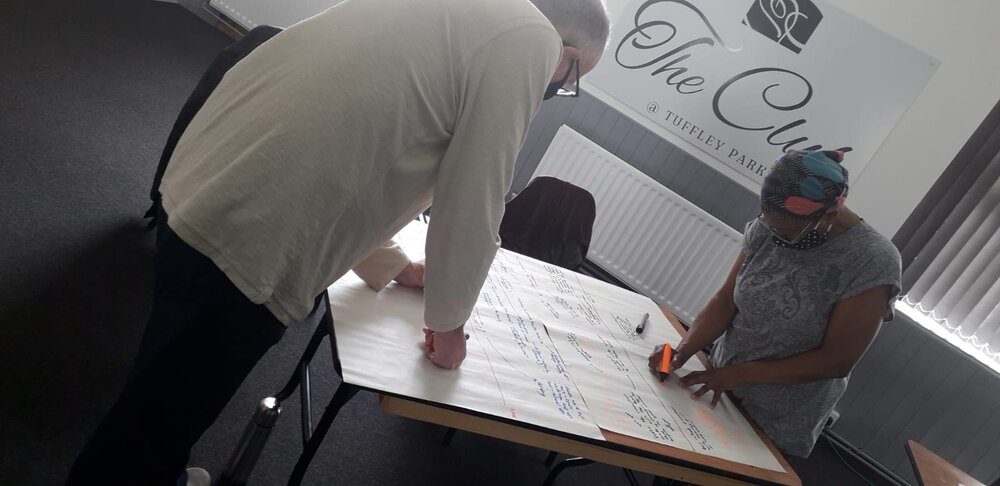
Measuring the impact of community led change is a constant challenge for those of us working in organisations that are seeking to grow community capacity rather than ‘do to’ communities.
Within more traditional project-based approaches, its often easier to predefine the outcomes at the start of the project and deliver on those. However, in taking a community building approach, our role is to enable the capacity of others, so they own the change they want to see. In doing so citizens will also often inspire other friends and neighbours to get involved, which leads to many unintended outcomes. This results in a ripple effect.
To capture this process and the outcomes that emerge from community driven development, the Gloucester Community Building Collective is working with Dr James Noble from the University of Bristol and the team at We Can Move to assess the impact of community building.
James explained why its critical that organisations engaged in community building need different ways of evaluating impact. Put simply ‘Ripple Effect Mapping’ offers a way of understanding the wider, intended and unintended, impacts of a project or programme over time. This is important as is demonstrates the catalytic role that organisations play in enabling citizens and achieving social change https://www.youtube.com/embed/tq3A-ETnZFU?wmode=opaque&enablejsapi=1
The process works by initially mapping your intended course of action, but over time also mapping what actually happened and what unintended outcomes occurred.
The mapping process often starts off with something like this…
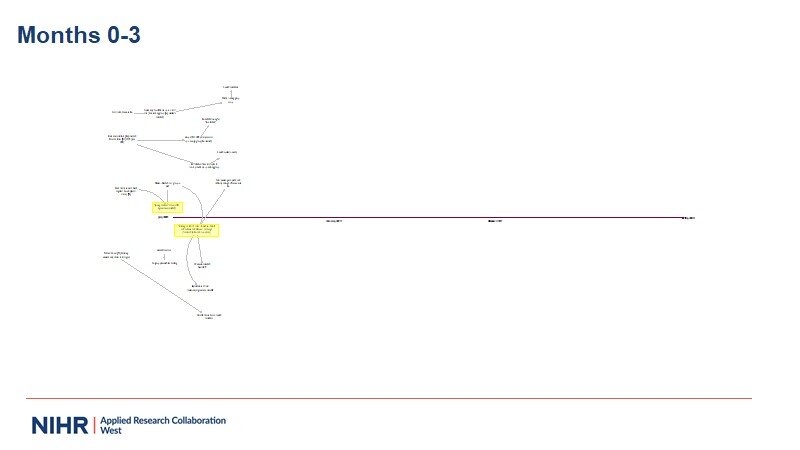
But it ends up like this
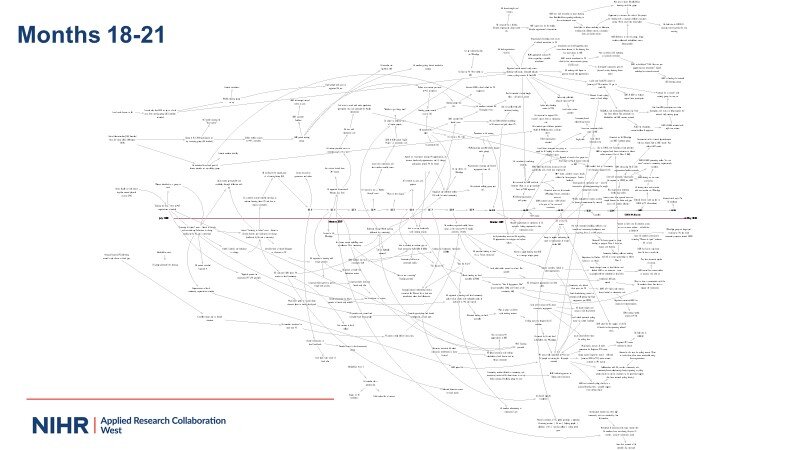
Obviously, our hand written versions are somewhat messier! But the information can be transferred using software called Vensim https://vensim.com/vensim-software/
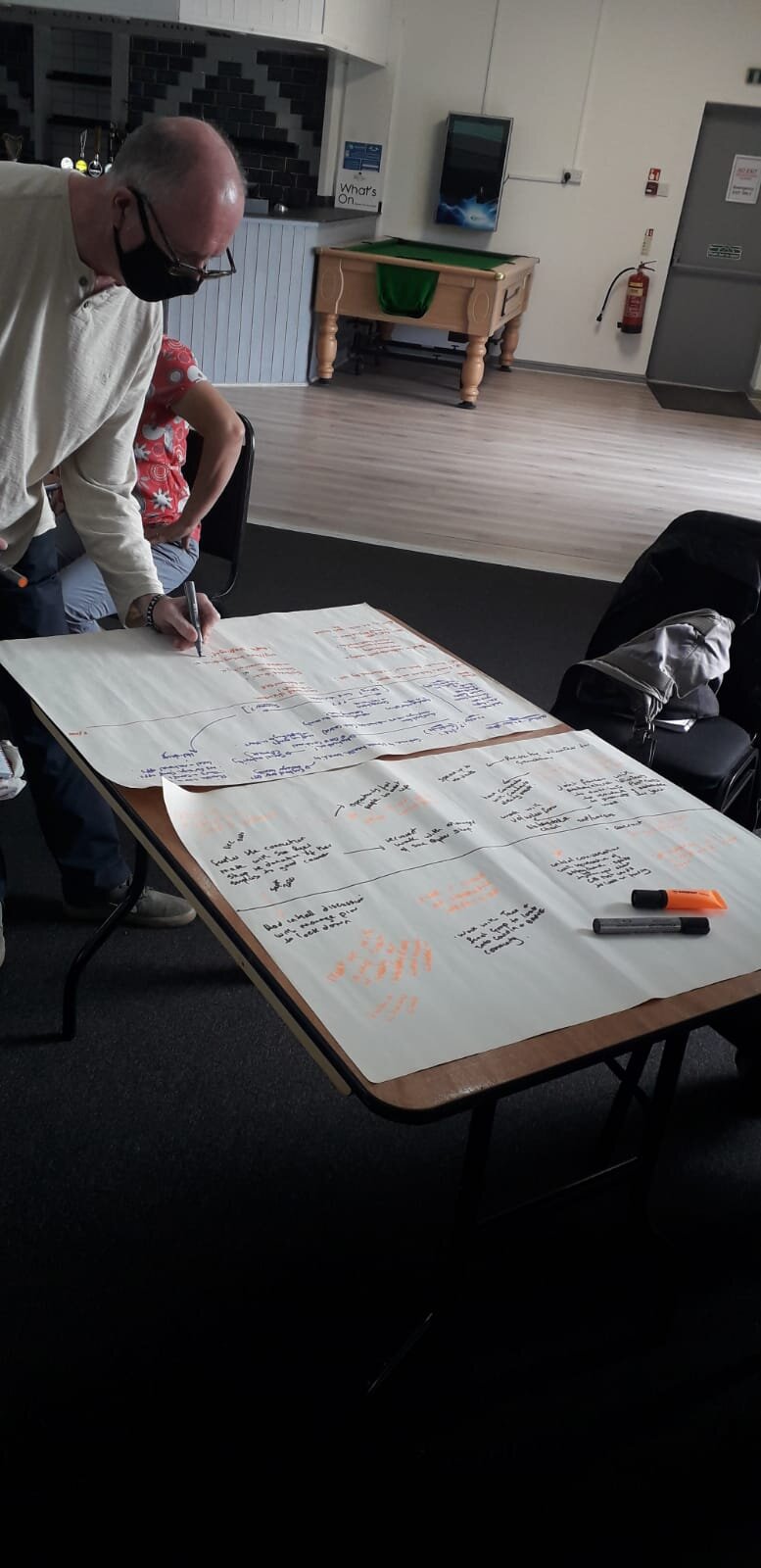
From this mapping process, you can identify the critical catalytic actions that led to the outcomes achieved, irrespective of whether you instigated them or not. It also allows you to identify key themes that could be a focus for systems change.
Gloucester Community Building Collective will be using this approach understand the impact of community building across Gloucester. We hope to share more about the process and the outcomes as we engage in this approach.
Credit: Dr James Noble, NIHR, university of Bristol
We Can Move, Active Gloucestershire
source:
Mapping the Ripple Effect — Gloucester Community Building Collective
Reacting or adapting? Purposeful adaptation and response to contextual change.

Adaptive management is increasingly on the ticket for development programming, and has been crucial in the wake of covid-19. I’ve been working with adaptive programmes for most of my career as DFID has often been pioneering and supportive of it as an approach. However, the question I hear frequently is ‘but what does good look like?’ and so I wanted to take time to reflect on that.
This particular blog post was prompted by a conversation I had with a colleague and friend Ben Kumpf (@bkumpf), Head of Innovation in DFID (then-called if reading after September 2020). We had been discussing enablers of adaptation and he asked me if I had any case studies of tools and methods that worked well… which is what sparked me to say ‘I don’t think I can do that, as I don’t believe those are what meant adaptation worked well’. After some…
View original post 2,400 more words
Richard Hughes-Jones on Twitter on Navigating Complexity… why leaders of high growth technology businesses should care
Stafford Beer, introduction to Heart of Enterprise
The concept of system is central to any discussion of organisation; few managers, perhaps, would think of that concept exactly as a tool. It is, they might consider, a term to be defined, and then to be properly used. In Chapter One, however, we begin to probe the connotation of the word ‘system’. The target definition turns out to be elusive. It seems more important to recognise that we are handling a conceptual tool, because a tool has to be understood in terms of its capability to facilitate the work undertaken, and also in terms of the limitations that its own shortcomings (in this case of reliable definition) impose on that work. In an effort to elucidate all this, the chapter engages in some mental exercises intended to loosen-up rigid attitudes to whatever is systemic about enterprises, and to promote an enquiry rather than a didactic ethos for the whole book. The examples are exclusively managerial, and deal with both economic and human affairs.
Kybernetes: Vol. 49 Iss. 8 | Emerald Insight
source:
Kybernetes: Vol. 49 Iss. 8 | Emerald Insight
Kybernetes: Volume 49 Issue 8
Strapline:
The international journal of cybernetics, systems and management sciences
Category:
Electrical and Electronic EngineeringSubscribe to Table of Content Alerts
Table Of Contents – Special Issue: Cybernetic frameworks for a shared world
Guest editorial
Jocelyn Chapman, Christiane M. Herr, Ben SweetingPDF (80 KB)
Owning one’s epistemology in religious studies research methodology
There is a lack of epistemological considerations in religious studies methodologies, which have resulted in an on-going critique in this field. In addressing this…PDF (434 KB)
Learning the Ashby Box: an experiment in second order cybernetic modeling
W. Ross Ashby’s elementary non-trivial machine, known in the cybernetic literature as the “Ashby Box,” has been described as the prototypical example of a black box…PDF (2.8 MB)
Narratives of exploration: from “Failure is not an Option” to “Try again. Fail again. Fail better.”
To trace a shift in attitudes towards control since the mid-twentieth century, as reflected in a shift in rhetoric that accompanied the extension from first- to…PDF (1 MB)
Design cybernetics in support of cross-disciplinary collaboration: educating the next generation of Chinese architects and structural engineers
This paper offers design cybernetics as a theoretical common ground to bridge diverging approaches to design as they frequently occur in collaborative design projects…PDF (921 KB)
Traces left by Herbert Brün that orient my cybernetics (Maybe)
Herbert Brün was a composer of many things including electronic and computer music. His compositions were, by design, nested in his passions for designing a new society �…PDF (156 KB)
Understanding the contributions of some Russian scientists to developing systems thinking and the theory of evolution
This study aims to explain and illustrate the character of Russian systems thinking and to show how it is different and similar to traditions in the West. This study’s…PDF (153 KB)
A proposal for the role of the arts in a new phase of second-order cybernetics
The purpose of this paper is to suggest a more central role for reflexive artistic practices in a clarified research agenda for second-order cybernetics (SOC). This is…PDF (213 KB)
The art of conversation: design cybernetics and its ethics
The purpose of this paper to discuss ethical principles that are implicit in second-order cybernetics, with the aim of arriving at a better understanding of how…
source:
Kybernetes: Vol. 49 Iss. 8 | Emerald Insight
Systems Thinking and Systems Modelling, by The Sustainability Laboratory with Loops Consulting – free courses on Kumu (Apr 2018)
Systems Thinking and Systems Modelling An Online Course for Understanding and Creating Systems Mo
Systems Thinking and Systems Modelling, by The Sustainability Laboratory with Loops Consulting
Computational Complexity as an Ultimate Constraint on Evolution
Complexity Digest http://comdig.unam.mx/2019/03/16/computational-complexity-as-an-ultimate-constraint-on-evolution/
Experiments show that evolutionary fitness landscapes can have a rich combinatorial structure due to epistasis. For some landscapes, this structure can produce a computational constraint that prevents evolution from finding local fitness optima — thus overturning the traditional assumption that local fitness peaks can always be reached quickly if no other evolutionary forces challenge natural selection. Here, I introduce a distinction between easy landscapes of traditional theory where local fitness peaks can be found in a moderate number of steps and hard landscapes where finding local optima requires an infeasible amount of time. Hard examples exist even among landscapes with no reciprocal sign epistasis; on these semi-smooth fitness landscapes, strong selection weak mutation dynamics cannot find the unique peak in polynomial time. More generally, on hard rugged fitness landscapes that include reciprocal sign epistasis, no evolutionary dynamics — even ones that do not follow adaptive paths — can find a…
source: http://comdig.unam.mx/2019/03/16/computational-complexity-as-an-ultimate-constraint-on-evolution/
To Adapt or Not to Adapt: A Quantification Technique for Measuring an Expected Degree of Self-Adaptation
Complexity Digest
To Adapt or Not to Adapt: A Quantification Technique for Measuring an Expected Degree of Self-Adaptation
Sven Tomforde and Martin Goller
Computers 2020, 9(1), 21
Self-adaptation and self-organization (SASO) have been introduced to the management of technical systems as an attempt to improve robustness and administrability. In particular, both mechanisms adapt the system’s structure and behavior in response to dynamics of the environment and internal or external disturbances. By now, adaptivity has been considered to be fully desirable. This position paper argues that too much adaptation conflicts with goals such as stability and user acceptance. Consequently, a kind of situation-dependent degree of adaptation is desired, which defines the amount and severity of tolerated adaptations in certain situations. As a first step into this direction, this position paper presents a quantification approach for measuring the current adaptation behavior based on generative, probabilistic models. The behavior of this method is analyzed in terms of three application scenarios: urban traffic control, the swidden farming model, and data communication…
View original post http://comdig.unam.mx/2020/03/25/to-adapt-or-not-to-adapt-a-quantification-technique-for-measuring-an-expected-degree-of-self-adaptation/
The Force in organisational life — the story so far | by Benjamin P. Taylor | 28 Aug, 2020
source:
https://chosenpath.wordpress.com/2020/08/28/the-force-in-organisational-life-the-story-so-far/
Three fundamental truths about uncertainty – Richard Hughes-Jones
I don’t know why my editorialising is so often triggered by ‘complexity pieces’. But I think it’s a good illustration of the problem of focusing on ‘ontological complexity’ (complexity ‘in the world’) that the two main examples here are Heisenberg’s Uncertainty Principle (wrong scale for most of reality), and Poincare’s three body problem, which was conceptually solved in 1912, and “It is now possible to get most results just by direct numerical computation using for example NDSolve.” (https://wolframscience.com/reference/notes/972d…).
Certain valuable approaches separate ontological and epistemological complexity (or let’s say, to be clearer, ‘inherent complexity in the world and the complexity of multiple perspectives and views’), but, for me, the real point is that ‘complexity’ is dependent on framing, context, perspective, knowledge, and purpose. And this applies across multiple actors.
(The second of the three points is that ‘the world is getting more uncertain’ – in the context of the above, that’s of course debatable, since we know more and can understand more – but anyway it’s just a bunch of assertions from big names).
Love Jennifer Garvey-Berger’s framing in the final bit, though.
(Also, I’m sure I’ve seen these three points in roughly this form before?)
source:
Three fundamental truths about uncertainty
Three fundamental truths about uncertainty
We like to think that our lives are ordered, predictable and subject to a great deal of control. The past is finite; we see only one outcome. We attach causality and narrative to it so that it makes sense. We roll our ability to make sense of the past over into the future, which is infinite; there are many outcomes, as yet unknown and unknowable. Randomness, chance, and luck influence us far more than we realize. Uncertainty is everywhere.
This article explores three of its fundamental truths:
1. The world is inherently uncertain
2. The world is getting more uncertain
3. Humans are hardwired to hate uncertainty
continues in source:
Three fundamental truths about uncertainty
Stories of Change webinar series #schoolofsystemchange | Forum for the Future from September
source:
Our events | Forum for the Future
Stories of Change 1: Multi-level Perspective – The Birth of Rock N Roll
Join us on 29 September 2020 for the first in a new three-part webinar series called ‘Stories of Change’. This session discusses the Multi-Level Perspective framework to understand transitions, such as the birth of Rock ‘n’ Roll in the 1950s.READ MORE
Stories of Change 2: Iceberg Model – The Rise of the Civil Rights Movement
Join us on 13 October 2020 for the second in a new three-part webinar series called ‘Stories of Change’. This session discusses the Iceberg Model to explore blindspots and challenge mental models underneath the rise of the Civil Rights Movement.READ MORE
Stories of Change 3: Regenerative Model – Water Resilience in Mexico City
Join us on 27 October 2020 for the last in a new three-part webinar series called ‘Stories of Change’. This session explains the Regenerative Model through the story of water management in Mexico City and shifting from away from extraction.READ MORE
Stories of Change NZ 1: Multi-level Perspective – The Birth of Rock N Roll
For our colleagues and partners in New Zealand. Join us on 17 September 2020 for the first in a new three-part webinar series called ‘Stories of Change’. This session discusses the Multi-Level Perspective framework to understand transitions, such as the birth of Rock ‘n’ Roll in the 1950s.READ MORE
Stories of Change NZ 2: Iceberg Model – Rise of the Civil Rights Movement
For our colleagues and partners in New Zealand. Join us on 1 October 2020 for the second in a new three-part webinar series called ‘Stories of Change’. This session discusses the Iceberg Model to explore blindspots and challenge mental models underneath the rise of the Civil Rights Movement.READ MORE
Stories of Change NZ 3: Regenerative Model -Water Resilience in Mexico City
For our colleagues and partners in New Zealand. Join us on 15 October 2020 for the last in a new three-part webinar series called ‘Stories of Change’. This session explains the Regenerative Model through the story of water management in Mexico City and shifting from away from extraction.READ MORE
source:
Our events | Forum for the Future
 Systems Community of Inquiry
You must be logged in to post a comment.