
https://www.systemdynamics.org/about
https://www.systemdynamics.org/program-overview
A view or perspective on the world
https://www.systemdynamics.org/about
https://www.systemdynamics.org/program-overview
Source: Critical Back-Casting | Integration and Implementation Insights
Community member post by Gerald Midgley

How can we design new services or strategies when the participation of marginalized stakeholders is vital to ethicality? How can we liberate people’s creativity so we can move from incremental improvements to more fundamental change?
To answer these questions, I have brought together insights from Russ Ackoff and Werner Ulrich to develop a new method that I call Critical Back-Casting.
Russ Ackoff, writing in the 1980s, is critical of organizations that focus on incremental improvements without ever asking whether they are doing the right thing in the first place. Thus, they are at risk of continually ‘improving’ the wrong thing, when they would be better off going for a more radical redesign. Ackoff makes two far-reaching prescriptions to tackle this problem. The first is participative co-creation: all parts of an organization should be involved in the redesign. This way, you can get whole-of-organization buy in for radical change, rather than the imposition of a top-down strategic plan. The second prescription is idealized design, and this represents a radical break from business-as-usual strategic planning.
Idealized design involves everybody in the organization working collectively to redesign it. However, rather than ask ‘how can we improve what we are doing?’, people are encouraged instead to imagine that their organization has ceased to exist, and they are on a task force to produce a design of something entirely new that will really meet the needs of citizens or customers. The task force only has to respect three constraints:
The idea is to liberate people from the constraints of current assumptions and to stimulate creative thinking. While one might assume that different stakeholders will have very different visions of the ideal system or service, and will come into conflict, Ackoff says that this is not the case: there is invariably an overwhelming agreement on the ideal, with only relatively minor disagreements to resolve, and the consensus on the majority of issues generates sufficient trust for people to have confidence that remaining disagreements can be constructively addressed. My own experience suggests that Ackoff is right, and once the ideal design is generated, an action agenda can be created with practical steps toward implementation.
In modern management-speak, this approach is called ‘back-casting’ (starting with where you ideally want to be and then working backwards to the present day), and it is contrasted with ‘forecasting’, where people take what we have today as given and try to anticipate what will happen next. Ackoff’s books describe numerous examples of back-casting in practice, mostly in large multi-national industries, but also for city planning and other public sector change initiatives.
However, when I first read Ackoff’s work, I had some reservations. He talks about involving everyone in the organization, but in community contexts, participation usually needs to be much wider than formally constituted organizations, and this means facing up to the problem of marginalization. If marginalized stakeholders who are supposed to benefit from a service are not centrally involved in its design, the result can be something that is based on a simplified professional model of the typical service user, rather than accounting for the lived, diverse experiences of real people.
A way to address this is to draw on 12 questions, originally designed by Werner Ulrich (1994) in the context of empowering citizens to challenge professionally imposed designs. These questions can support both marginalized stakeholders and professionals in thinking through critical issues of governance and inclusion as they produce their ideal service or system design. My version of these questions, modified for use in back-casting, can be found below. I have used the word ‘service’, but it could equally well be ‘system’, ‘partnership’ or any other term that refers to a purposeful initiative. Because Werner Ulrich says that his questions stimulate critical thinking, I call their use with idealized design (and the three constraints listed earlier), Critical Back-Casting.
Here are the questions:
(1) Who or what should benefit from the service, and how?
(2) What should be the purposes of the service; i.e. what goals should it aim for in order to deliver to the beneficiaries?
(3) What should be the service’s key measures of success?
(4) Who should be seen as the key decision makers; i.e. have the authority to change who should benefit, what the purposes should be and how success should be measured?
(5) What components (resources, people, policies, etc.) should be under the authority of the decision makers?
(6) What is essential for delivery of the benefits and purposes, but should not be under the authority of the decision makers?
(7) Who, either in addition to or instead of the decision makers, should be involved in delivering the benefits and goals?
(8) What should count as expertise; i.e. who should be considered an expert and what should be their roles?
(9) What are the key factors that will guarantee (or increase the likelihood of) success?
(10) Who or what could be affected by the activities of the service; should the affected be represented in decision making, and (if so) how?
(11) To what extent should the affected be able to retain independence; i.e., opt out or neutralise the effects on them, and/or take actions of their own choosing?
(12) Upon what core values and assumptions should the service be based?
I have used Critical Back-Casting in approximately 20 projects, with various participants (e.g., homeless children, older people, children in residential care, people with mental health problems and many service providing stakeholders). Midgley (2000) provides a couple of detailed examples. Below, I offer several general reflections based on this experience.
Facilitation:
The questions:
The process:
Implementation:
Do you have related methods or experiences to share?
References:
Ackoff, R. L., Magidson, J., and Addison, H. J. (2006). Idealized Design: Creating an Organization’s Future. Wharton School Publishing: Upper Saddle River, NJ, USA.
Midgley, G. (2000). Systemic Intervention: Philosophy, Methodology, and Practice. Kluwer/Plenum: New York, USA.
Ulrich, W. (1994). Critical Heuristics of Social Planning: A New Approach to Practical Philosophy. Wiley: Chichester, UK.
Biography: Gerald Midgley is Professor of Systems Thinking in the Centre for Systems Studies, Business School, University of Hull, UK. He also holds Adjunct Professorships at the University of Queensland, Australia; the University of Canterbury, New Zealand; Mälardalen University, Sweden; and Victoria University of Wellington, New Zealand. He publishes on systems thinking, operational research and stakeholder engagement and has been involved in a wide variety of public sector, community development, third sector, evaluation, technology foresight and resource management projects. He is a member of the Co-Creative Capacity Pursuit funded by the National Socio-Environmental Synthesis Center (SESYNC).
This blog post is one of a series developed in preparation for the second meeting in January 2017 of the Co-Creative Capacity Pursuit. This pursuit is part of the theme Building Resources for Complex, Action-Oriented Team Science funded by the National Socio-Environmental Synthesis Center (SESYNC).
Source and comments: Critical Back-Casting | Integration and Implementation Insights

The most destructive analogy in the last 100 years, says @DavidGelernter with @econtalker : “Post-Turing thinkers decided that brains were organic computers, that computation was a perfect model of what minds do, that minds can be built out of software, and that mind relates to brain as software relates to computer”. Interview states position that consciousness won’t be found in a computer.
The cited source is visible on a page on Google Books:
In his famous 1950 paper about artificial intelligence, Alan Turing mentions consciousness, in passing, as a phenomenon associated with minds, in some ways mysterious. But he treats it as irrelevant. If you define the purpose of mind as rational thought, then consciousness certainly seems irrelevant. And for Turing, rational thought was indeed the purpose of mind.
Turing’s favorite word in this connection is “intelligence”: he saw the goal of technology not as an artificial mind (with…
View original post 648 more words
The first hour or so of this is probably the best and most systems thinking summary of a bunch of the Peterson stuff I’ve come across.
Source: 12 Rules Portland: Technology, Temperament & Free Speech — The Jordan B. Peterson Podcast — Overcast


The notion of structural coupling plays a central role in Maturana and Varela’s biology of cognition framework and strongly influenced Varela’s subsequent enactive elaboration of this framework. Building upon previous work using a glider in the Game of Life (GoL) cellular automaton as a toy model of a minimal autopoietic system with which to concretely explore these theoretical frameworks, this article presents an analysis of structural coupling between a glider and its environment. Specifically, for sufficiently small GoL universes, we completely characterize the nonautonomous dynamics of both a glider and its environment in terms of interaction graphs, derive the set of possible glider lives determined by the mutual constraints between these interaction graphs, and show how such lives are embedded in the state transition graph of the entire GoL universe.
Bittorio revisited: structural coupling in the Game of Life
Randall D Beer
Adaptive Behavior
Source: journals.sagepub.com
Mark Johnson’s blog is consistently excellent and thought-provoking and I particularly like this one, especially his definition of systems thinking:
To think of ‘systems’ is a thought that accepts that the world is produced by thought.
Source: Improvisation Blog: Recursive Pedagogy, Systems thinking and Personal Learning Environments
I think that… I understand this not at all! Do you?
Source: The Future Will Be Formulated Using Category Theory

DEPOSITPHOTOS
A new approach to defining and designing systems is coming.
Introduction
The human ecosystem is made of open and closed systems. While the earth is a closed system for matter but an open system for energy, the human body is considered an open system. There is a growing belief that the current understanding of science cannot wholly explain human life, mind, and consciousness, nor can it explain the nature and origin of life, matter, the environment, the universe, and reality. Perhaps there is a need for a new ontological model of reality to look into the mysteries of the universe beyond the human ecosystem in cyberspace, aquaspace, geospace, and space (CAGS).
The universe is understood to be made of mathematics. Mathematics is primarily about rules and patterns, and science is about discovering and documenting rules and patterns that occur in nature. So, as we begin to study the universe beyond CAGS, we must focus on discovering and documenting rules and patterns and their relationships in open and closed systems that occur in nature, matter, and the universe. That brings us to an important question: how will understanding mathematical laws that govern us beyond the human ecosystem help us understand open systems better? To begin with, it will help us by giving us a reference model for understanding the interconnectedness and interdependencies of the human ecosystem.
Category theory provides a structural framework for mathematics and is on its way to becoming a language for consciousness for the entire universe. As the Stanford Encyclopedia of Philosophy states: “Roughly, [category theory] is a general mathematical theory of structures and of systems of structures… At a minimum, it is a powerful language, or conceptual framework, allowing us to see the universal components of a family of structures of a given kind, and how the structures of different kinds are interrelated. Category theory is both an interesting object of philosophical study, and a potentially powerful formal tool for philosophical investigations of concepts such as space, system, and even truth.”
Category theory is already becoming a key driver for current mathematics and academic computer science and is beginning to be applied to mathematical physics. Now, it is believed that Quantum physics, the study of the universe on an atomic scale, gives us a reference model to understand the human ecosystem in the discrete individual unit. As category theory becomes the language of mathematics for the articulation of the laws of physics, there is a hope that it will help us in defining and designing the open systems in the human ecosystem that can assist us on our journey towards understanding the origin of our universe and our place within it.
Understanding Category Theory
Based on the Mathematical Universe Hypothesis, the emerging reality is that we live in a relational reality. What does that mean? It means that the properties of the biosphere around us stem not from properties of its ultimate building blocks, but from the relations among these building blocks. While the position of category theory as a foundational language in applied mathematics and mathematical modeling is still in its infancy and a rather unexplored path, it is crucial to understand how it can help us understand the complex problems facing humanity.
The systems and structures we look at in the universe are self-organized at several different levels. Moreover, we live in a relational reality where self-organization is an obvious principle which is embedded in our description of the universe. This means that the properties of the world around us stem not from properties of its ultimate building blocks or individual units, but from the relations among these building blocks and units. That brings us to an important question: Is category theory a tool to understand the relationships? Moreover, how does category theory explain the relational reality of the contested commons of cyberspace, aquaspace, geospace, and space (CAGS)?
Category theory has already shown promise by providing an abstract framework for modeling processes to apply to science, engineering, and the contested commons of the human ecosystem. It is vital to explore how can we further apply category theory to the problems we are trying to solve today (security issues to surveillance issues, environmental issues to economics issues, automation issue to social issues and more).? How will category theory help us understand the complex issues facing the future of humanity?
Category Theory Applications
From assisting us in understanding how patterns of innovation rise to how patterns of destruction develop, category theory has the potential to be a powerful language or conceptual framework on which we can formulate our collective future. By keeping category theory as a reference model, we are more able to see the common components of a family of structures of any given kind that will finally help us understand how constructive and destructive structures and behavior are interrelated and integrated. Now, processes are universal, but we don’t look at our human ecosystem in the form of processes. Should we? Since in nature, a causal law takes the form that, similarly to actions by an individual, specific processes tie causes and effects together, we most certainly should.
Prof. (Dr.) John Carlos Baez expands on this notion in Risk Roundup: “In any system, we are dealing with on Earth, it is always very fundamentally an open system — its constantly being affected in unpredictable ways by the outside world and it is also affecting the outside world in unpredictable ways.”
If an individual being is seen as a single unit, what defines and determines our behavior and relationships? While the concept of reductionism (which essentially states that the whole is composed of simpler parts yielding discreteness and that the study of the whole can be reduced to the study of its parts) has become an integral part of the human ecosystem, can we continue to rely on the reductionist approach? It is time we understand the cause and effect of individual human behavior, and its impact on the collective human species since the nature of reality in the human ecosystem is inherently and inevitably dual. Since particle-like and wave-like behaviors are inextricably connected, they must be inherent in any design and development of open systems.
Since, category theory is expected to be a language for consciousness for the entire universe and will give us evidence to the more profound puzzle as to how to formulate the processes and patterns in the human-made ecosystem, will it help us dig deeper into why the order of the universe is dependent on interconnected and interrelated processes? Moreover, how are the systems and states undergoing open and closed processes that alter them in nature?
Justifiably category theory is rapidly becoming important today in understanding the current and future problems facing humanity. It is time decision-makers across nations begin to understand the promise of category theory and apply it to define and design systems at all levels keeping in mind the interconnected relationships between discrete individual units to build our collective future.
What Next?
Like particles in quantum mechanics, an individual unit, be it biological or non-biological, has an essential presence in spaces found in the universe (both natural and human-made). So, as we try to define and design open systems for the coming tomorrow, it is critical to understand and evaluate the essential laws of category theory to strengthen the human ecosystem in which we exist. It seems the future will need to be built using category theory.
NEVER MISS ANY OF DR. PANDYA’S POSTS
Join here for a regular update on Risk Group Insights.
Thanks to the General Intellect Unit podcast: http://generalintellectunit.net/e/032-the-inherent-instabiliyt-of-disordered-systems/
pdf: https://arxiv.org/pdf/1812.00450.pdf
Source: [1812.00450] The Inherent Instability of Disordered Systems
The Multiscale Law of Requisite Variety is a scientific law relating, at each scale, the variation in an environment to the variation in internal state that is necessary for effective response by a system. While this law has been used to describe the effectiveness of systems in self-regulation, the consequences for failure have not been formalized. Here we use this law to consider the internal dynamics of an unstructured system, and its response to a structured environment. We find that, due to its inability to respond, a completely unstructured system is inherently unstable to the formation of structure. And in general, any system without structure above a certain scale is unable to withstand structure arising above that scale. To describe complicated internal dynamics, we develop a characterization of multiscale changes in a system. This characterization is motivated by Shannon information theoretic ideas of noise, but considers structured information. We then relate our findings to political anarchism showing that society requires some organizing processes, even if there is no traditional government or hierarchies. We also formulate our findings as an inverse second law of thermodynamics; while closed systems collapse into disorder, systems open to a structured environment spontaneously generate order.
From: Yaneer Bar-Yam [view email]
[v1] Sun, 2 Dec 2018 19:21:34 UTC (26 KB)
Source: System and SE Definitions
The INCOSE Fellows’ Initiative on System and Systems Engineering Definitions was established in 2016, to review current INCOSE definitions of SYSTEM and SYSTEMS ENGINEERING, and to recommend any changes necessary to align the definitions to current practice and to the aspirations of INCOSE’s 2025 Vision.
This website presents the final output from the initiative in on-line form, as a set of linked web pages.
The formal published document version of the new definitions will be launched by INCOSE at the International Symposium in Summer 2019.
The final definitions take into account the extensive comments received during the review of the previous draft in September 2018. The review was open to all INCOSE members, and attracted over 350 individual comments and suggestions.
The three key recommendations – for definitions of systems engineering, engineered system, and a general definition of system – are presented here, with a very brief contextual explanation. Other pages provide more explanation of these definitions, and also define other specific system types and categories that are important for the systems engineering community.
Read on here, and explore the new definitions, or download the SE Definition full paper here.
Systems Engineering is a transdisciplinary and integrative approach to enable the successful realization, use, and retirement of engineered systems, using systems principles and concepts, and scientific, technological, and management methods.
We use the terms “engineering” and “engineered” in their widest sense: “the action of working artfully to bring something about”. “Engineered systems” may be composed of any or all of people, products, services, information, processes, and natural elements.
An engineered system is a system designed or adapted to interact with an anticipated operational environment to achieve one or more intended purposes while complying with applicable constraints.
Thus, an “engineered system” is a system – not necessarily a technological one – which has been or will be “systems engineered” for a purpose.
A system is an arrangement of parts or elements that together exhibit behaviour or meaning that the individual constituents do not.
Systems can be either physical or conceptual, or a combination of both.
Systems in the physical universe are composed of matter and energy, may embody information encoded in matter-energy carriers, and exhibit observable behaviour.
Conceptual systems are abstract systems of pure information, and do not directly exhibit behaviour, but exhibit “meaning”. In both cases, the system’s properties (as a whole) result, or emerge from:
Source: System and SE Definitions
Source: Systems Changers – Homepage


From climate change to poverty to healthcare, the large, complex social, environmental and economic problems we face today are too big for any one organisation to tackle alone. They require us to work together in new ways to address the root causes of problems and to create new outcomes that can change entire systems.
The failure of many of the systems that underpin modern life is increasingly difficult to avoid, so it’s not surprising that interest in ‘systems innovation’ is growing fast. At the Point People, we’ve seen pioneers emerging in this field from different sectors, leading very different kinds of organisations and speaking very different professional languages.
We had a hunch that these frontrunners could tell a compelling story about what systemic innovation looks and feels like in practice. So we put them in front of a camera and asked them a handful of questions.
This project was made possible thanks to the generous support of Green Templeton College, the University of Oxford
Although we spoke with people from very different backgrounds, common insights emerged that crossed these professional boundaries. These fall into six themes:
First
The craft of collaboration is vital to systemic change. This is easy to say, much harder to do in practice. The interviews highlight key ways in which deep collaboration can occur, as well as some of the significant barriers to achieving true partnership.
Second
Narrative is crucial. Narratives help people understand how the systems they live in are socially constructed. They help us become aware of how we prop up failing systems, and how we can build new ones.
Third
Theory and practice need to be understood as a double helix, inextricably linked. Our interviewees used different language to make this point – from appreciative enquiry to agile development – but behind this lies a shared, deeply held commitment to learning and iteration.
Forth
Systems change involves liminal spaces. Innovators need to be able to move in and out of the systems they are trying to change. Even when they are outside of the status quo, they are able to maintain a dialogue with it. If designed well, these liminal spaces can hold unstable groups of people together in the collective pursuit of change.
Fifth
Systems change looks more like a movement than like change led from either ‘top down’ or ‘bottom up’. Successful systems changers need to understand how to orchestrate multiple points of intervention, and align diverse interests with a common goal.
Sixth
Systemic leaders are unafraid of the unknown – in fact, they embrace uncertainty. They are able to identify points of intervention and act in the face of complexity. They combine a desire to understand systems with a realisation that they will always have to take action without perfect knowledge.
Just as there were important points of agreement, the interviews also highlighted important tensions and questions:
Source: Systems Changers – Homepage
Source: Complexity Explorables | Repliselmut
EXPLORABLES
This explorable is similar to the Explorables “Maggots in the Wiggle Room” and “A Patchwork Darwinge”that illustrate key features of evolution. In those two explorables individuals of different species interact directly in a competitive way. Here however, individuals do not interact directly. They merely reproduce at different rates proportional to their fitness and die at equal rates. So competition is only indirect.
[TO PLAY, GO TO THE WEBSITE]
Initially the system has a population of 100 individuals all of the same kind (same color and fitness). When the system runs each individual in the population replicates at a rate proportional to its fitness. Each individual can also die at a constant rate so eventually replication and death balance when the population is around 400.
While this is happening, mutations can occur. At a rate you can set with the mutation rate slider an individual can have a baby with a different fitness indicated by a different color. A new species is born. The new species can have a lower or a higher fitness with symmetric probability. How much the variation of fitness can be for a newborn species can be controlled with the variation magnitude slider. The third slider Selection Strength controls how sensitive the difference in reproduction rate between species depends on their fitness difference.
As the system unfolds you will see that every now and then new species emerge with a fitness higher than all the other species and oftens they “take over” the entire population until yet another new strain emerges that repeats the process.
In the plot below the controls every species in the system is represented by a dot in the same color on the fitness axis. The larger, more transparent circle represents the fraction of that species in the entire population. When species go extinct a little white dot below the axis is drawn, so one can see the series of extinction events.
The large red dot is the average fitness of the population. As time passes, the average fitness of the population increases steadily, despite the fact that mutations do not favor higher fitness.
This explorable was coded in part in the atrium of the Santa Fe Institute when I was a guest there in July 2019. I want to thank Jenna Marshall for hosting me and the Santa Fe Institute as a whole for providing such a great and inspiring environment.
We are going to take a whole system approach to xxxx
Some thoughts on this based on observations
This is the fourth of a series.
Blog 1 – brief notes
Blog 2 – responses to complex problems
blog 3 – influencing SYSTEMS
Starting out
• Have you set out a mission and vision.
• We talk complex adaptive systems. All three words matter – complex, adaptive, system. Think about it
• Have you mapped the system, all of the constituent parts, how they interact, who are the key actors and their role, whether they share the broad vision.
Approach
• There may be no single controller. Or no single person knows all of the things that are going on to achieve the broad goal
• command and control is (probably) impossible. If you must adopt command and control mindset, seek to command and shift the most important leverage points in…
View original post 372 more words
Looks interesting and apart from Trist (obvious link to Agile – too little enquired into), features Enid Mumford, who deserves more attention. InfoQ registration required to access slides.
Source: Lessons from the History of Socio-Technical Systems
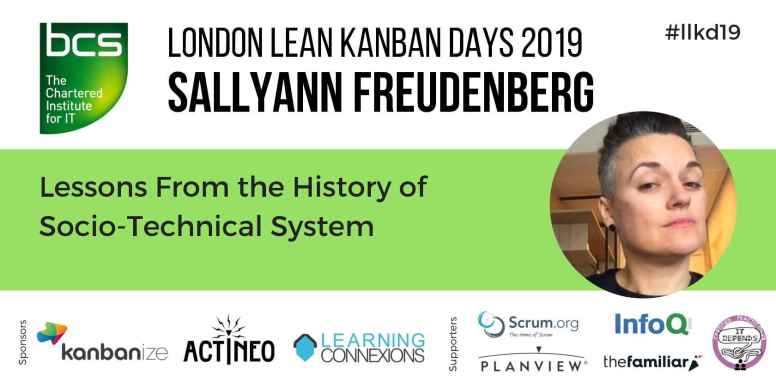
Source: Lessons from the History of Socio-Technical Systems
Oh, how we could use Geoffrey Vickers now! Or several of his ilk…
Source: Making Institutions Work, by Geoffrey Vickers – The Neglected Books Page
In an increasingly interdependent world, each of us becomes inescapably a member of many systems, each of which makes its own demands on us, as well as giving its own assurances. These demands conflict. If we acknowledge them all, we have to resolve or contain a mounting load of internal conflict. It we deny any, we disrupt some relation on which we depend. Every human association makes some demand on its members for responsibility, loyalty, and mutual trust. We are unaccustomed to respond to, perhaps incapable of responding to so many and such conflicting demands as are generated by our increasing inter-dependence on each other. The memberships we acknowledge fall increasingly short of those we need to acknowledge, if we are to sustain all the relations on which we in fact depend. The conflicts of our day reflect our failure to meet the demands of our multiple memberships.
So we have either to increase our capacity for resolving or containing conflict or to simplify the world (or allow it to simplify itself) by cutting down what we expect of it, or each other, and of ourselves to the measure of our capacities. War, famine, and pestilence will do the second except in so far as we succeed in doing the first.
 “I have an unpopular answer to an unwelcome question,” Geoffrey Vickers writes at the start of Making Institutions Work:
The question is posed by two familiar but staggering changes of the last hundred years. One is the escalation of our expectations; the other is the escalation of our institutions. The two have combined to make demands on each of us ordinary men and women … which few have begun to notice, still less to accept as valid and inescapable. The question is how, if at all, these demands can be met and at what cost. Since these costs are the price we shall have to pay to maintain the systems which now sustain us or any viable alternative, I describe the theme as the price of membership.
I don’t suppose that I can manage to get too many readers excited about a thirty-six-year-old collection of sociological essays from academic journals with such dry names as Policy Sciences, Human Relations, and The Wharton Quarterly. Yet for me, Making Institutions Work has easily been one of the most stimulating books I’ve read a long time, one whose pages I’ve dog-eared, whose lines I’ve underlined, whose passages I’ve been tempted to grab people and force them to listen to. In many ways, it seems to me to be the closest thing I’ve found to a manual for how we need to operate if we have any hope of avoiding having all our conflicts settled by war, famine, pestilence, and climatic disaster.
 Sir Geoffrey Vickers led a remarkable life. He joined the British Army in 1914 and spent as much time as perhaps any other officer serving in the trenches on the Western Front, earning the Victoria Cross and numerous other combat medals for his bravery. After the war, he returned to university, took a law degree, and worked as a solicitor. He served again during World War Two and as an administrator and board member in government and industry. In his sixties, he turned to writing, particularly on the topic of social systems analysis, and became a leading contributor to the development of systems analysis and thinking, particularly as they related to human society. Making Institutions Work collects eleven articles and lectures Vickers gave in the late 1960s and early 1970s and focuses on the specific issue of how we can learn to deal effectively in a world where we are at all times members of multiple and overlapping institutions–family, culture, nation, organization, religion, teams, clubs, neighborhoods, and others.
I work in an institution. From the day I stopped mowing lawns for money and went to work part-time in a university library, I have worked in one institution or another. And now I work in an instituion–NATO–where competing and conflicting demands of membership can be seen in every activity. The tensions between commitment to the objectives of this alliance and national loyalty are palpable in every meeting of every committee, working group, panel, board, and forum. In NATO, the fundamental mechanism of decision-making is consensus: if one nation does not agree to a decision, the decision is deferred or redefined or taken off the table.
In a consensus-driven institution, no single member ever wins all or loses all. Everything tends to favor not the most popular solution but the least objectionable one. As a result, all solutions that are supported by consensus tend to be sub-optimal. For anyone with the professionalism and pride to strive for well-crafted plans and efficient designs, the experience of working in NATO is one of constant frustration. Military officers, who comprise a good percentage of NATO’s staff at the headquarters level and below, find it particularly frustrating as they have spent their careers trying to boil things down to clear, simple, and quickly-executed orders: defining the shortest path between today and their mission’s objectives. In a consensus-driven institution, the shortest path is almost always guaranteed to lead nowhere but into a brick wall.
Vickers is the first writer I can recall to acknowledge that frustration is part of the price of competing membership demands. He identifies, in fact, “[T]he ability to tolerate greatly increased frustration without lapsing into apathy or escapism or erupting into polarised conflict,” as one of the essential survival skills for life in a world of overlapping and competing memberships. We long ago ran out of frontiers into which we could escape and, psychologically at least, pursue the myth of pure self-sufficience. But relative to the long run of human existence, this situation is still something of a novelty:
This institutions of today carry a far greater load than human institutions have ever carried before. Men are more dependent on them and make greater demands on them than ever before. Their performance is far more exposed to view and is judged by far higher standards than before. They are no longer supported in their task by being regarded as part of a natural order and for the same reason their critics are no longer muted.
Still, Vickers argues, institutions are here to stay: “[A]ny world which generations younger than mine may create or preserve on the other side of the dark decades ahead will include an institutional dimension and will make the same demands on us as players both of institutional and of personal roles.” Since these roles will inevitably create conflicts such as those I see every working day in NATO, there is an increasing need, in Vicker’s view, for what he calls (in a perhaps less than fortunate phrase) “institutionalised persons”:
By an institutionalised person I mean one who accepts the constraints and assurances of membership in all the systems of which he forms part and therefore with the responsibility for managing his share of the conflicts which they involve.
This begins to capture a distinguishing characteristic of many of the people and processes that I encounter working in NATO. Time and time again, when conflicts arise, the value that tends to win out most consistently is that of the importance of preserving the ability to work together again tomorrow. And in this way, this frustrating, multi-national, multi-lingual, bureaucratic, consensus-driven institution seems, like the U.N., the European Union, the U.S. Congress, and many of the other collaborative political institutions we frequently curse, to represent the most realistic approach to dealing with conflict in this hot, flat, and crowded world.
Ironically, the most memorable statement in the whole of Making Institutions Work is not Geoffrey Vickers’, but the epigraph, which comes from an even more obscure paper by Saul Gorn, a pioneer in computer science:
We spend the first year of our lives learning that we end at our skin; and the rest of our lives learning that we don’t.
In Vicker’s view, this task, more than anything else, is a matter of learning to pay our dues:
Those who depend so completely as each of us does on our membership of many human systems cannot afford to withhold the dues which they demand and need from us if they–and consequently we–are to survive and function. These dues are payable not merely in money–though the money dues also will have to rise–but in all the qualities which are needed to resolve or contain human conflict; in responsibility, loyalty and mutual trust; in intellectual effort and informed debate; in extended sympathy and tolerance; in brief, in a dramatic extension of the frontier which divides self from other and present from future.
And to that extent, one can find few better guides to this lifelong task than Geoffrey Vickers.
Source: Making Institutions Work, by Geoffrey Vickers – The Neglected Books Page









 Systems Community of Inquiry
You must be logged in to post a comment.