Making Places Work for
Women: Gender and
Systems Change.
A Discussion Paper by The Point
People and Giselle Cory
October 2018
Contents
Introduction
Executive Summary
Our aims and approach
Chapter 1: The case for change
Chapter 2: What’s getting in the way?
A limited understanding of ‘systems change’ and what it
looks like in practice
Data is often gender blind and service focused
Commissioning doesn’t work with the grain of
women’s lives
Mental health services aren’t sufficiently engaged in
supporting women
The voluntary sector plays a key role but it is vulnerable
The need for gender-influenced ‘systems leadership’ is
not recognised
There are significant cultural factors that are getting in
the way of change
Chapter 3: Five principles for systems change: making
the difference for women experiencing multiple
disadvantage
1: Build a shared understanding of the population of
women experiencing multiple disadvantage
2: Outcomes are attached to the system and defined by
and with women, not for them
3: Services that work together, not just alongside
one another
4: Visible leadership at all levels of the system
5: Look below the surface to address
unconscious dynamics
Chapter 4: Where next for this work?
Recommendations for Trusts and Foundations
Recommendations for commissioners and
local authorities
Recommendations for central government
Conclusion
As I’ve written about in the recent past, I focused my recently completed Masters of Design focused on a domain I’m particularly passionate about — environmental issues.
This post aims to uncover some of the research, thinking and framing of systems change and systemic action, from my Masters Thesis. I share the model I worked with to communicate my systems change initiatives.
If you’re interested in a spot of reading, you can read the entirety here:
Communicating the research, synthesis, strategy + execution for systems change is difficult but necessary. I present a model for doing that.
I share how I blended systems analysis, strategy and prototyping, to develop a portfolio of prototypes which make up a systems change initiative.
I share some insights about alternative approaches to developing, scaling and coordinating systems interventions, which may be more effective at increasing the likelihood of reaching a desired state.
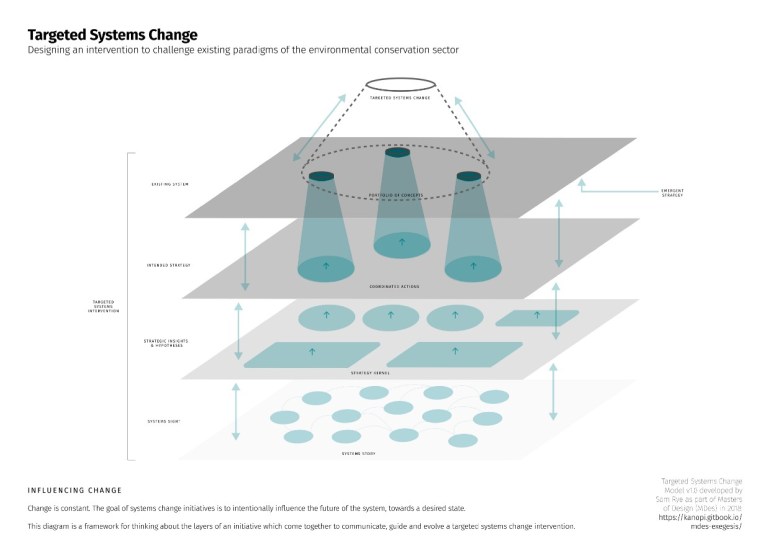
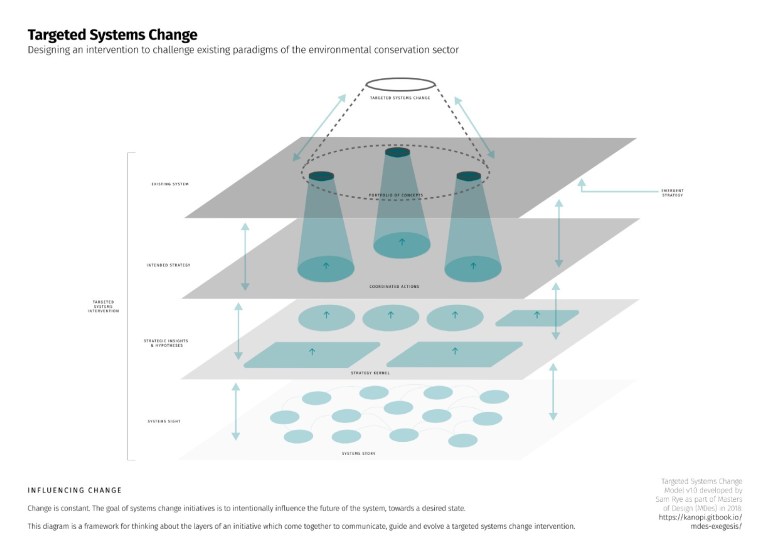
A Model for Targeted Systems Change
I developed this model as part of my Masters of Design, in order to communicate my design process, and to give shape to the sometimes slippery concept of systems change work which may be about culture, relationships and products/services.
My starting point was inspired by an illustration of Transition Theory, presented in Finance Innovation Lab’s ‘A Strategy For Systems Change’ Report [1], which shows how three interconnected strategies come together to catalyse systems change.
In this model, I present my perspectives about the foundational stacks needed when we design a targeted systems change intervention:
Systems Sight — an analysis of the existing system, communicated as a map and story.
Strategic Insights & Hypotheses — a diagnosis and direction for action.
Portfolio of Prototypes — an array of interventions which give form to the strategic action.
Together, these come together to create the targeted systems intervention, which must also be aware of the wider context it’s working in.
My conceptualisation of targeted systems change interventions was built on Odin Mühlenbein’s article “Systems Change — Big or Small?” [2], which posits that there should be ‘big vision’ objectives for systems change, and smaller initiatives which focus resources towards systemic change, often coordinated tightly or loosely:
“it is much easier to develop strategies for targeted systems change than for big visions. Targeted systems change is more specific, smaller in scope, and often more closely related to ideas and networks that social entrepreneurs are already familiar with. Obviously, it’s important to keep the bigger picture in mind. But the goal is to use a targeted systems change as the focal point for an impact strategy, combined with a clear rationale how that that change promotes the big vision.”
— Odin Mühlenbein, 2018. “Systems Change — Big or Small?”, SSIR
On Systems Leverage
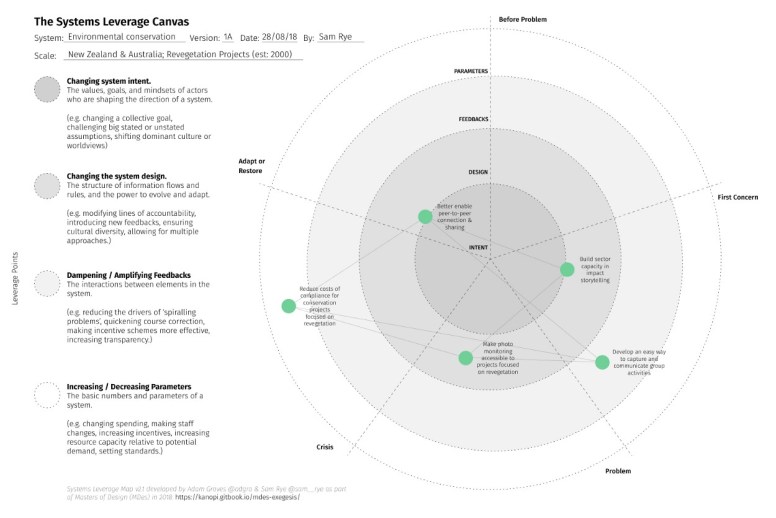
In addition to the model of systems change, I wanted to explore how to best articulate the important nuances of the strategy’s specific target. In doing so, I was reading Adam Groves’ piece about moving from service design to systems change [3], in which he introduced a systems leverage map, based on concepts from Donella Meadows and Simon Wardley’s work.
As part of my work to articulate the Strategy layer of the intervention, I created a v2 of the Systems Leverage Map in collaboration with Adam, which looked like this:
This map presents several useful aspects, which I think others might find valuable in their own practice:
A way to visualise the a strategy, service or other form of intervention, in the context of systems leverage points and lifecycle of a challenge.
A boundary artefact to engage in generative discussion and critique about the design of an intervention, with others.
A way to visualise the discrete or interconnected nature of an intervention, but also potentially the amount of resource to be invested in each (use size to denote scale), alternative scenarios (use colour to denote alternative scenarios), or really whatever else people dream up.
I am excited by this canvas, for it’s potential to advance the crafting of systems change strategies. I would love to hear from you if it resonates, and how you might use it in your own practice.
What I feel we additionally need discussion about and ways to communicate, is the breadth (what percentage of the system?) and depth (what kind of impact, and how deep and lasting is the change?) of systems change strategies. We need to be more explicit about what scale we want to act at, and what degree of change we aspire to.
Crafting a Systemic Intervention
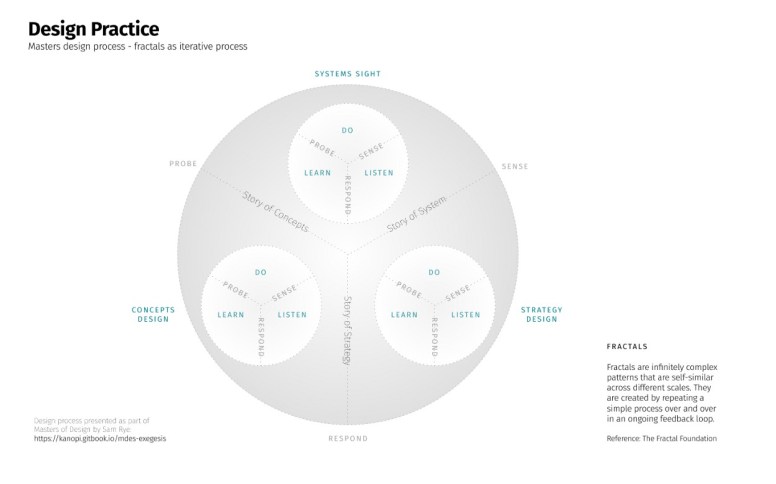
In formulating my final written part of my Masters, I explored how to share the non-linear nature of my design practice. What I ended up sharing was this simple visual:
What I found, was that as I developed systems sight, I would bridge those insights into elements of strategy or concept design, project those back into the systems analysis, and continue in this vein throughout the project. This non-linearity is a vital part of working in complexity due to the nature of emergent outcomes.
“No man ever steps in the same river twice, for it’s not the same river and he’s not the same man.”
– Heraclitus, Greek Philosopher
To this end, as I mentioned in the description of the model, I feel that the stacks of systems analysis, strategy and prototype portfolio are a minimum-viable architecture to design a systems intervention. Yet it’s the weaving together of these, and the ability to zoom in and out, and evaluate and evolve that is the art of creating an intervention that is likely to succeed. As Dan Hill notes in ‘Dark Matter and Trojan Horses’ [4]— zooming from the meta to the matter is a core competency of strategic designers. We need to give form to ideas which may evolve into something much bigger (such as a workshop resource which introduces a new culture of working together), but also be able to play in the dark matter (such as navigating power and relationships) that makes up systems.
On Scaling Impact
Finally, I’d like to offer some thoughts about systems change and impact, based on the insights from closely attuning my work with cutting edge research about complexity and its implications for how we approach complex challenges.
There’s a common theory of change which seems to have swept across the social sector, but the problem is — it rarely works as intended.
The idea is that we try something, often as a Pilot, and then if it works, we scale it up. Yet, all too often the ‘scaled up’ version doesn’t have the same effect as the pilot. Why is this? In a word: complexity.
Complexity denotes that you can do exactly the same thing, to exactly the same part of the systems, and you can get a different result. Causality is not fixed. Emergence is a dominant characteristic of living systems.
I know I’m not saying anything new about Pilots — people have been saying this for awhile…
Well, if we’re not going to ‘scale up’ a pilot that has worked, what could we do instead? How could we have the scale of impact which we need, given the size of the challenges which face us locally and globally, today?
Here’s three alternative models which I am interested in exploring further, borrowed from ecological approaches to replication:
Swarm. Much of the effort that goes into scaling efforts is about centralising the coordination, monitoring or otherwise. What we’ve learnt about swarm behaviour in nature, is that it relies on self-organised, collective behaviour. There are some examples around the world of decentralised movements and causes, but more experiments are needed in how to better use this approach for systems change.
Replicate + Adapt. The driving force of evolution is the constant cycle of replication and adaptation. Incentivising this approach for systems change activities could avoid the need for scaling up individual efforts, by significant replication of the core of an intervention, which is then localised to a specific context. For example, a funder might recognise the value in this approach, and fund a systems change initiative with explicit budget to open source the intervention (e.g. service / product blueprints and handbooks) so that others could replicate. Having taken Lifehack (our social lab on youth mental health in NZ) in this direction, I am deeply surprised this doesn’t happen more often.
Cascade. This is a nascent thought, but I regularly see this pattern in nature whereby a species of animal or tree creates conditions for many others to live. Whether it’s a beaver dam, a tree with a large canopy, or a hermit crab, this pattern is common and has potential to be explored. I could see a role for ‘keystone’ interventions which create a sort of beach head into a system where a complex challenge (like obesity for example) may exist. These keystone interventions would explicitly be part-funded to share insights, relationships and resources which allow other, niche interventions, to get started and make a difference.
As I say, these ideas are fieldnotes — ponderings which others may find useful, that I intend to pursue in the coming years, and am keen to hear from other people about. Perhaps you know people who are already working in these ways? Perhaps you have good examples of ‘impact ecosystems’ being established with one or more of these patterns? Whatever sparks, I’d love to hear more about it.
Alongside the painful and heart-wrenching events of the last few years, there have been a number of positive developments—many of which are culminations of efforts that began long ago. Movement actors are increasingly working in networked ways across issues to provide opportunities for systems-level change. Cross-movement collaborations between immigrant rights and economic development groups have resulted in promising opportunities for integrating immigrants’ experiences into regional economic plans. Racial justice has become foundational to strategies for change among reproductive rights organizations, climate justice advocates, and philanthropic institutions. These are just a few examples of the positive developments that bring us hope.
In Emergent Strategy, adrienne maree brown, social justice author, facilitator, and healer writes, “If we accept the scientific and science fictional premise that change is a constant condition of this universe, then it becomes important that we learn to be in right relationship with change.”
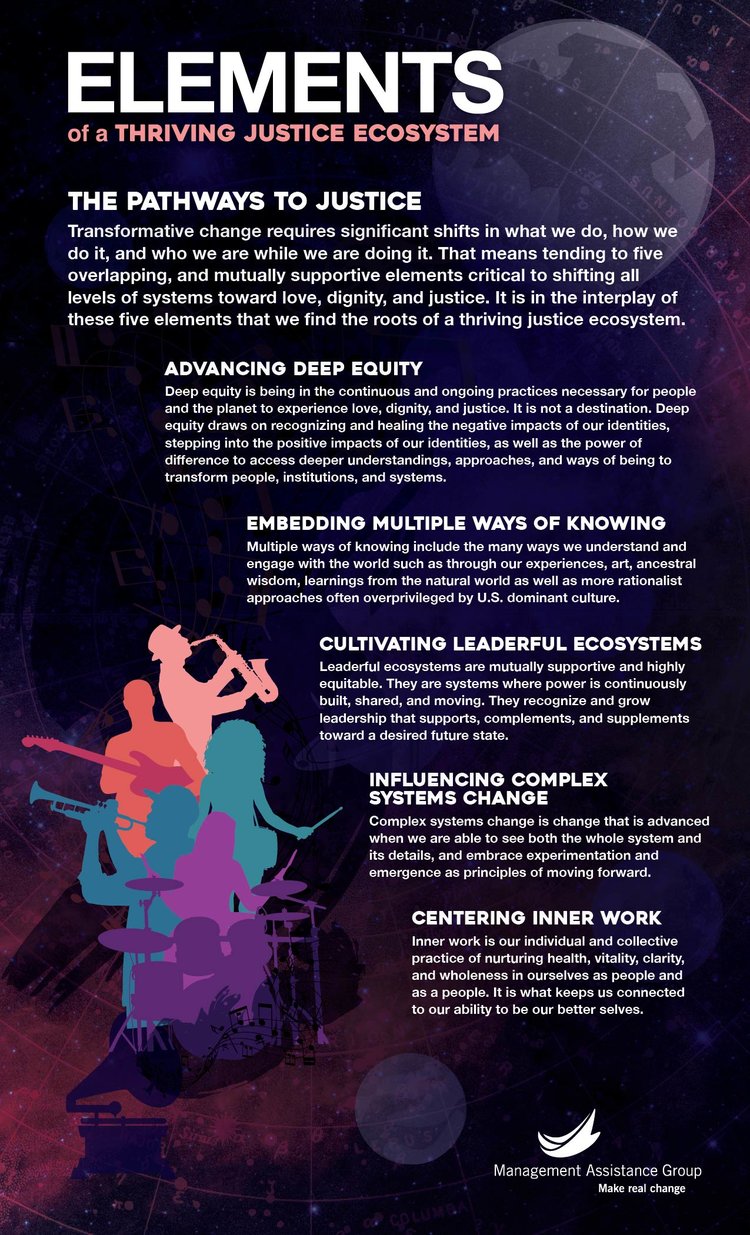
Through our work with nonprofit organizations, grantmakers, movement networks and other partners in the field, we have had the opportunity to work collaboratively with people deeply engaged in these efforts toward positive change. Through these partnerships, we are getting increasingly clear that both deep and wide-scale change is found in the interconnected practices that weave together a set of five elements.
Continuous and synchronous attention to these elements is foundational to being in “right relationship” with change—to advancing transformation toward love, dignity and justice.
The Interdependent and Interconnected Practices of the Elements
We first shared approaches and practices for embracing these elements through a series of articles published in the Nonprofit Quarterly where we looked at each element separately.
On their own, these elements are essential components of advancing transformative justice. However, the real power comes from approaches that draw on the interconnectedness and interdependence of these elements. When intentionally engaged together, they comprise a liberating context with deep equity at the core.
“The interplay of the elements is more than five fingers; it is one hand.” – Lupe Poblano
Lupe Poblano, codirector of CompassPoint—a leadership development and capacity building resource for the nonprofit sector and a longstanding partner of MAG—has done a deep dive into the five elements and has been exploring their interconnections. He points out that “the interplay of the elements is more than five fingers; it is one hand.”
This hand—a miracle of veins, nerves, bones and skin—hand in hand with others is what is needed to create a more equitable, just and sustainable world—to indeed live liberation.
Attending to the relationships between these elements, these fingers of one hand, looks different for different practitioners, but there are some important themes emerging from these efforts, ones that can help us all deepen our interconnected practices.
Deep Equity Transforms People, Practices, and Systems
We begin with an exploration of the practices that hold deep equity as the rhythm that defines and anchors liberating compositions—as the hand’s opposable thumb.
As our current political climate, the accessibility and prevalence of media, and the work of many people are making violence and injustice from the systemic to the interpersonal more visible and known, shifts are taking place within the various spheres of the justice ecosystem moving the whole ecosystem toward a practice of deep equity.
Deep equity is a cultural revolution, one that encompasses honoring differences; recognizing the impact our identities and positions have on our individual and collective experiences; focusing on relationships and whole beings with multiple identities; addressing trauma and healing; and eliminating systemic disparities.
Embracing deep equity is not a simple process, even for leaders, organizations, and networks that have engaged in focused equity work for some time and that have taken steps to make space for and nourish the leadership of people of color. Lupe Poblano acknowledges that both he and CompassPoint still wrestle with the destructive habits of white dominant culture. “Habits such as paternalism and a sense of urgency have historically socialized all of us to make decisions without including those most impacted. When we put process over people, we make bad decisions.”
The proud son of Mexican immigrants, Lupe, along with his team, is focused on the principles of liberation as an antidote to these habits, practices such as collective, intentional breathing. “Every time we pause and breathe together, we are doing deep equity work,” he says. “We need to create time to heal ourselves and build one another up. These are liberatory practices.They are essential to developing another way of being.”
Cibonay Cordova, consultant for the California Consortium for Urban Indian Health and member of the Network Weaver Learning Lab identifies early social training in white dominant culture norms. “We are told from a young age that transactional relationships are the most valuable. Those are the ones that make the most money. But when making decisions that have broad impact,” she says, “you need to hold multiple perspectives and [be able to] call on a number of people. This is really hard for some folks.” A woman and a mother of Native (Cazan Guamares/Yaqui) and Chicana descent, Cibonay focuses her efforts on supporting changes that are enduring by engaging multiple sources of “knowing.” This requires being rooted in deep equity. “And deep equity,” she says, “comes from having the humility to say we don’t know and can’t know everything.”
These practices are just a few of the ways individuals, organizations, and networks are working to embrace and embody deep equity. As awareness of the endemic racism, sexism, homophobia, xenophobia (the list goes on) in the United States increases, many organizations are also demonstrating a commitment to advancing systems change that centers equity and addresses the root causes of persistent social problems. We turn to the promising practices from these efforts next.
Advancing Complex Systems Change Requires Centering Equity
Despite increased attention towards systems change efforts that address root causes, many of these efforts have failed to acknowledge the historical and present conditions, structures, and practices that maintain inequity. This can be readily seen, for example, in philanthropic efforts to address poverty in which race is neither recognized as a corollary nor causal connection. And yet most, if not all, current poverty data—not to mention historical memory—looking at both the instances and persistence of poverty demonstrate how race and economic circumstances are inextricably tied.
In a 2018 webinar, MAG and Building Movement Project offered the following understanding of what it means to do equitable systems change:
“True systems change efforts do not merely change inequitable structures, but strive to transform the underlying power dynamics, narratives, and histories that built these structures and enable them to thrive. An equity lens is essential to systems change efforts to avoid change efforts that reinstitute the status quo or replace one systemic inequity with another.”
Much of the system-level work on social justice is funded and therefore influenced by philanthropy. Given the history of the philanthropic sector, grantmaking institutions are often quite challenged with truly centering equity in systems change efforts. However, there are promising practices emerging from several grantmaking organizations that are on the journey to center equity in their systems change efforts. And in doing so they are transforming not only their grantmaking approaches but also their understanding of both the problems and potential solutions.
For Pia Infante, a queer, first generation Filipina and co-executive director of The Whitman Institute—a philanthropic institution based in San Francisco—complex systems change requires centering those most impacted by unequal structures and systems. “When looking at environmental, political, and economic destruction,” she says, “it is clear that the brunt of its impact is on black and brown women.” But black and brown women are rarely at the center of grantmaking efforts.
In a post reflecting on the 2018 Grantmakers for Effective Organizations (GEO) Conference, Pia outlines many uncomfortable truths about philanthropy’s complicity in maintaining structural and economic racism at the same time that it strives to advance systems change efforts to addresses today’s most intractable problems.
Pia believes that it is critical to pass decision-making onto the community, but, she says, in order to do so, “grantmakers have to be brave, radical, and embodied.” Grantmakers must build relationships of trust with communities. And, in doing so, grantmakers are called on to reimagine many of their existing practices and roles.
“When you think in terms of seven generations then there is real accountability within philanthropy [required]. When we embody values of equity, trust, and accountability, our relationships and grantmaking practices look very different.” – Pia Infante
In her own work, Pia asks the philanthropic sector to take a good look at themselves in the mirror. “Wealth, whether inherited or created newly, is built on a system of inequalities where a small few [extract] profit from the work of many. Historically, the wealth of the U.S. is built on stolen lands and bodies.” If this is not acknowledged, efforts to center equity fall short.
What we need to do is acknowledge sources of wealth and their relationship to current social ills—and then transform those relationships. “When you think in terms of seven generations,” Pia says, “then there is real accountability within philanthropy [required]. When we embody values of equity, trust, and accountability, our relationships and grantmaking practices look very different.”
For example, grantmakers “living into accountability” are expanding the time horizons for investments. Thousand Currents—a foundation based in the San Francisco Bay Area that funds grassroots groups led by women, youth, and Indigenous Peoples in the Global South—has been doing just that since its founding in 1985. They provide multi-year grants of support, investing in grassroots groups that are building the cultural and political power of the communities who are most impacted by global injustices. Drawing on “grassroots brilliance” Thousand Currents funds what is most needed for the time duration that it is needed as defined by grassroots groups. As a result, Thousand Currents has been able to support organizations in building community capacity, financial resilience, and networked ecosystems to achieve meaningful impact.
“Why,” Pia asks, “is the default grant time one year? We are funding solutions to poverty, to stopping rampant deportations.” These are complex problems that developed over generations, centuries, millennia. In order to solve such problems, grantmaking efforts need to be focused on more longitudinal time commitments; this is critical to supporting more enduring solutions.
Those that are investing for the long haul are advancing systems change and doing so in a way that amounts to looking, thinking, and behaving–doing and being–differently. As Pia notes, they are building relationships rooted in trust, centering those most impacted, and shifting power.
The melody that holds the cadence of systems change and the rhythm of equity together emerges only when the being and doing are in sync—when the values of love, equity, trust, and justice are truly embodied (the being) and approaches, behaviors, and practices (the doing) reflect these values. Being in sync is not a linear or simple process; one can expect to be off key or out of rhythm sometimes, especially when we prioritize or are over-reliant on very limited sources of information (and often not the best ones for understanding the problem). Embracing multiple ways of knowing is central to these synching efforts—we explore its role next.
Multiple Ways of Knowing Catalyzes the Conditions Needed for Equitable Systems Change
Centering equity in complex systems change requires us to engage multiple perspectives and experiences in order to define both problems and solutions. To engage multiple perspectives, we need to draw on more than knowledge restricted to the intellectual and academic realms of numeric analysis, logic, theory, and rationalist approaches to truth. We need to lift up ancestral wisdom, intuitive knowing, the insight of the arts with their ability to represent complexity, and the ancient knowing of nature.
Without surfacing these multiple ways of knowing, we lose access to ourselves, our connections to each other and to the environment around us, and in so doing, we lose access to transformational approaches to creating a world in which we can all thrive.
Amee Raval—policy and research associate for the Asian Pacific Environmental Network (APEN) and a second generation South Asian American—shares that drawing on multiple ways of knowing is central to APEN’s work. An organization dedicated to bringing together low income, immigrant and refugee Asian and Pacific Islander communities to create a collective voice and develop an alternative agenda for environmental, social and economic justice, APEN centers storytelling in their organizing and advocacy efforts. “For us storytelling is really critical; it is not just a way of knowing but a way of healing,” she says.
In his book, TheTruth about Stories, Cherokee writer and photographer Thomas King writes, “The truth about stories is that’s all we are.” And thus the stories we tell matter a great deal. Many people and cultures across the globe are rooted in the wisdom of stories and we see this practice being brought forth more intentionally and frequently in justice work.
When speaking with Sacramento legislators about the need for clean energy in California, APEN community leaders shared stories about the health impacts of living in neighborhoods surrounding a nearby Chevron Refinery. One community member described her children struggling to breathe due to asthma. Another described the circumstances of her neighbors who were dying of cancer. “The whole room was silent; some legislators were crying,” says Amee. “Clean energy can seem so technical and political, so the space for stories isn’t always made.” But it was the community members stories—their lived experiences—that were most influential with legislators. And too, these stories enabled community members—many of whom are refugees that have fled war and upheaval in their home countries only to endure racism, discrimination and other hardships in the United States—to lift up their own resilience and be honored and witnessed in their enduring survival.
As we know from the work of Monica Dennis—a Black, feminist, leadership and liberation consultant, and co-director of Move to End Violence—distortion of story is a practice of white dominant culture that furthers oppression. Thus, it is through the reweaving or retelling of our individual and collective stories that we can move toward liberation.
“We live out multiple truths everyday.” – Harold Steward
Storytelling—holding many perspectives and drawing on cultural and ancestral wisdom—is also central to The Theater Offensive’s mission to present the diversity of lesbian, gay, bisexual, transgender and queer lives in ways that break through personal isolation, challenge the status quo, and build thriving communities. This engagement with multiple ways of knowing goes beyond theater programming.
Harold Steward, interim executive director of Theater Offensive and a queer black man from the South, intentionally centers a southern black practice in his leadership and work. For Harold, drawing on cultural and ancestral wisdom is critical to bringing his full self to his artistic and community organizing efforts. “I grew up in a largely black community in Dallas, Texas,” he says; “this was my training ground.”
Notes Harold, “we live out multiple truths every day.” Drawing on black culture, as well as black arts traditions such as jazz, is central to Harold’s ability to hold complexity and multiple truths. Unlike many western European traditions that tend to center one plot while subjugating others, black expressive forms such as jazz hold multiplicity—different yet non-competing musical compositions that link, weave and skirt one another. Such facility is critical to holding the many perspectives, needs and experiencesof different communities—and bringing them forward in order to develop transformative solutions.
For Evelyn Francis, interim artistic director of Theater Offensive and a self-identified femme dyke of white Appalachian origins, centering multiple ways of knowing is core to the Theater’s ‘Out in the Neighborhood Program’ or ‘OUT’hood.’ The program was born out of the invocation of a young, queer Haitian woman who participated in the Theater’s youth program. During an afternoon rehearsal at the theater, she asked, “Why do I have to take two buses and a train to feel [comfortable with] who I am? I want to be out in my neighborhood.” The question became the fulcrum for Theater Offensive’s journey from a more traditional theater company to one rooted in community development and activism.
Moving out of formal theaters and into churches and community centers in four communities of color within the greater Boston area was just one of the shifts Theater Offensive made. They also began developing and performing their own theatrical productions, ones that drew from the work, lives and dreams of community members.
This deep engagement of community culture, lived experience, ancestral knowledge and additional ways of knowing are the vehicle through which Theater Offensive is affecting cultural change, change that is co-created by the communities themselves. The transformative nature of theater also provides opportunities for all who participate to bear witness to their strengths and begin to heal the intergenerational wounds of systemic racism, patriarchy, and homophobia.
Healing these intergenerational wounds, while attempting to heal the systems and people who affect ongoing harm (who are sometimes the same people), requires that we attend to our inner work.
Collective and Individual Inner Work Supports the Transformative Healing Needed to Simultaneously Hold the Five Elements
“I believe that by changing ourselves we change the world, that traveling El Mundo Zurdo path is the path of a two-way movement—a going deep into the self and an expanding out into the world, a simultaneous recreation of the self and a reconstruction of society.” – Gloria Anzaldúa
The recognition of the significant role inner work plays in our ability to engage in transformative outer work is not new. Indigenous teachings throughout the Americas are rooted in practices of creating balance in self in order to be in right relation to others. Chicana American activist and author Gloria Anzaldúa wrote in her essay La Prieta, “I believe that by changing ourselves we change the world, that traveling El Mundo Zurdo path is the path of a two-way movement—a going deep into the self and an expanding out into the world, a simultaneous recreation of the self and a reconstruction of society.”
There is an increasing number of organizations and networks sharing their collective inner work practices, from organizers and activists to the progressive funders contributing to their work. The inner work practices of grantmakers in particular have a reverberating impact on the capacity of grantees to advance what grantees and communities see is needed.
Inner transformation is a focal point for the Hidden Leaf Foundation—a family foundation based in the San Francisco Bay Area. Tara Brown, a white woman, long-time activist, and the founding and former executive director of the foundation, describes the foundation’s efforts as “supporting transformative approaches within change movements.” An essential condition for transformation, Tara says, is spaciousness, it literally, “makes space for transformation [to occur].” Tara and other members of her family have brought their individual inner work practices to their foundation work and practice together before making important philanthropic decisions.
In their external grantmaking efforts, the family foundation’s focus has evolved from supporting non-profit leaders in deepening their own leadership and inner work practices to investing in organization-wide transformation through group engagements with deep practice in one or more modalities or traditions.
Specifically, the foundation has been committed to supporting intermediaries and capacity builders who focus on embodiment, mindfulness and inner work. Notes Tara, “internal and external capacity building is truly the only way to create the change we want to see.”
Another dimension of inner work comes from racial equity work that is focused on culturally-rooted healing and resilience practice. This is the cornerstone of Lauren Padilla-Valverde’s efforts for The California Endowment, which has been deeply investing in a 10-year, place-based community change effort in fourteen California regions known as Building Healthy Communities.
As Senior Program Manager for East Salinas (Alisal), Lauren uses what she calls a healing-informed, racial equity framework to guide her work with the community to influence a regional ecosystem of government, philanthropy, resident organizing and non-profits to work on systems change that centers a healing informed, racial justice practice. Lauren, the daughter of indigenous Guatemalan immigrants who were forced to flee their country in 1969 because of her father’s community organizing work fighting back land grabs by US national corporations, is driven by her late father’s culturally rooted philosophy on justice. For Lauren, achieving racial equity requires the centering of healing in order to create the conditions for accountability and collective action.
Her work in Monterey County arose out of a community response to four police officer involved shootings of people of color that occurred within a three-month span of time in 2014. The shootings catalyzed community outrage, but, notes Lauren, “community leaders recognized that rage alone wouldn’t address it.” Instead, “Building Healthy Communities partners and resident leaders came together to call for and create healing-informed systems change.”
Lauren and other community leaders asked members of city government “if [they] were willing to look in the mirror and understand how racism, andother forms of oppression, operate within systems to perpetuate inequity and injustices in the community.” Coming out of this request was the design and creation of a week-long racial healing and racial equity curriculum which brought together 50 community members (BHC leaders, community organizations) and 50 city government leaders and employees—such as law enforcement, planning, public works—local business owners, and nonprofit professionals.
Together, they developed a shared racial equity language and core concepts, deepened their understanding of how racism and white supremacy manifest in policies and budgeting priorities, and, most importantly, collectively grappled with racism, recognized its impact on their lives, and created a space for listening, healing and transformation. The curriculum was informed by local leaders and co-presented by Race Forward and the National Compadres Network. (To read more about this partnership and project, see the report: Building the We.)
“When we stop doing the healing, we stop moving. When you light the match of healing, it is unstoppable.” – Lauren Padilla-Valverde
“When you center healing in racially equitable systems change, the entire process brings a sense of humanity to the work,” Lauren says, one that connects multiple ways of knowing, systems change, equity and inner work. The healing reduces defensiveness and creates the conditions to develop deep understanding of how oppression and white supremacy separate entire communities to form an `Us’ vs. `Them’ narrative.” They are also cultivating a leaderful ecosystem by building community leadership capacity that can support transformative change over the long haul. Notes Lauren, the problems we are addressing “aren’t ones that we are going to fix in our lifetime.”
Lauren also brings an indigenous perspective on impact. “It took seven generations to get this way,” she says, and likely it will take “another seven generations to change it.”
Leaderful Ecosystems Build the Agency and Power Needed for Advancing Love, Dignity, and Justice
“One thing that is really important to building community and creating systems change is developing space that builds agency and power.” – Sage Crump
This alternate time horizon for change—one the recognizes the complexity of the challenges we are facing and the need for investing in deep relationship building to ensure sustained efforts that move us toward love, dignity and justice for all—foregrounds the importance of creating leaderful ecosystems to create the conditions and a people path forward.
According to Sage Crump—program specialist for Leveraging a Network of Equity (LANE) and a queer, Black woman living in the American South who is working to strengthen arts and culture in social justice movements—“one thing that is really important to building community and creating systems change is developing space that builds agency and power.”
LANE is a collaborative program that delivers the methodology and resources to strengthen the financial and organizational health of arts organizations that are geographically isolated; led by and for people of color; and/or are rooted in small to mid-sized community-based groups.
This work is needed at the individual, organizational, network, movement and ecosystem level. Building the capacity of arts organizations alone will not ensure a thriving arts sector, especially one in which arts organizations of color flourish. So LANE is addressing the two prongs of racial oppression: racial superiority and racial inferiority. “We are working to build power individually and collectively,” Sage says. “Often we have the funder in the room as a listener and a participant. This is a way to dismantle capital as a primary source of power. What does grantmaking really take? We need for funders to come from the lens of a grantee. Equity is not just the changing of people but also the processes.”
In her book The Power Manual, Cyndi Saurez notes, “Further, one can build one’s capacity for liberatory power. It requires a commitment to living mindfully, constantly increasing one’s level of awareness, so that when one finds oneself in an interaction that positions one as powerless, one is able to perceive it, keep calm, and assert mutuality. Liberatory power helps one refrain from asserting power over others, or to do so carefully.”
LANE is now broadening its focus from arts organizations and funders to social justice efforts more broadly. In doing so, they are embedding arts and culture in social justice as a fulcrum of social transformation.
It is through the arts that we can create, at an experiential level, a shared understanding of our vision for the future and simultaneously recreate ourselves and our world.
Making Music: The Syncopated, Contrary, and Melodic Rhythms of the Five Elements
“The universe is not asking us to do something, the universe is asking us to be something. And that’s a whole different thing.” – Lucille Clifton
In the Network Weaver Learning Lab, organizational and network leaders of color (and their allies) working in domestic violence prevention and services as well as other intersecting justice issues, such as reproductive and racial justice, came together to deepen their network leadership practice, build greater capacity for collaborating across movements, and cultivate leaderful ecosystems in all their networked social justice efforts.
Rooted in the five elements, the Lab became a space for exploring their interconnections. Creating leaderful ecosystems meant deepening equity, addressing power in the room, and holding tension generatively; making the space for and engaging in shared practices of inner work; drawing on multiple ways of knowing to re-member the wisdom of our communities, our ancestors, the land on which we gathered; and making visible the interconnected systems that perpetuate injustices in order to create approaches to transform these systems.
Another experience of the interplay of these five elements took place just over a year ago at MAG’s Confluence. A two-day gathering of approximately 90 of MAG’s partners and friends working on issues of justice, it was described by many as a “liberated zone.” The experience of liberation was the result of many aspects of the gathering, but the foundation of Confluence’s design—both in terms of what we dove into and our ways of moving in the waters in which we swam—was the five elements and the interplay of this five-fingered hand.
What we’ve learned through these experiences, and others, is the critical nature of “deep hanging out” (hat tip to Chris Barahona—an Urban Futures Lab Fellow—who lifted up this concept for us, originally from anthropologist Clifford Geertz). Deep hanging out entails building relationships and trust so we can wrestle with the hard stuff; focusing on the intersectionality of oppressions and liberation; building muscles for collaboration and networked approaches to leadership; developing experiments to create possibilities for new and improved outcomes; and being in right relationship with change.
Through embodying these five vital elements together, our five fingers becoming not just one hand but many hands playing together, creating music that is expansive and interdependent enough to hold improvisation—our contrary, melodic and syncopated rhythms—connecting us to one another and to the invocation of our song: a world filled with love, dignity and justice.
Below are some ideas and inspiration to help you in your research.
New Resource: Student Guide to Mapping a System
Click on image to view or download PDF
This twelve-step Guide, co-authored by Anna Johnson, Daniela Papi-Thornton and James Stauch, will help walk you (and your team, if you have one) through the process of mapping a system. This Guide will provide you with advice and additional tools for each step of the process, from picking a social or environmental challenge, to researching it and presenting your analysis and ideas (visually, orally, and in writing).
We hope this Guide and the suggested resources will not only help you navigate the Map the System process, but will also support you in your own future contributions to systems change.
The Guide was produced by the Institute for Community Prosperity at Mount Royal University, and Systems-LedLeadership.com, in partnership with the Skoll Centre for Social Entrepreneurship at the Saïd Business School, University of Oxford. Additional funding for the Guide was provided by the RECODE program of the McConnell Foundation, and by the Trico Charitable Foundation.
This is intended to be a living document that continually evolves, and we intend to release an updated version later this year. We would welcome your feedback and suggestions to help us improve it.
The Impact Gaps Canvas
The Impact Gaps canvas is a tool to help you ask the questions you might want to consider in creating your entry for Map the System. By asking questions related to the challenge landscape (questions about the problem and its impact as well as what might be holding the current status quo in place) and the solutions landscape (what is already being tried and what has or hasn’t worked) you can then identify gaps where the solutions are failing to meet the problems.
Impact Gaps Canvas with questions
Blank canvas
Click on image to view larger version or to download
The Impact Gaps Canvas was created by Daniela Papi-Thornton, former Deputy Director of the Skoll Centre, as part of her research for the Clore Social Leadership Programme.
As you already know, part of your Map the System submission is made up of creating a visual map. This is to showcase your findings in an engaging, dynamic and accessible way. There are many ways you can do this and many different tools you can use to create your visual map – and we encourage you to get as creative as possible! Here we have suggested a few online tools you can use to create your map:
As part of your research for Map the System, we encourage you to conduct first-person interviews or surveys/questionnaires with stakeholders related to the issue you have chosen. But before conducting any interviews or surveys, you need to consider if you should be complying with any specific ethical guidelines. Review the Ethical Considerations page which contains a few principles to help you with your research.
Article: Interview Pro Tips from a Journalist
This article is useful for you if you are conducting interviews for your Map the System research. It is an article from news journalist and TV host Brooke Gladstone, who has conducted hundreds of interviews, and in this she gives her number one tips for conducting successful and effective interviews.
Created by USAID, this framework is intended as a simple and practical tool to promote good systems practice. The Framework highlights five key dimensions of systems: Results, Roles, Relationships, Rules and Resources. Collectively these 5Rs can serve as a lens for assessing local systems and a guide for identifying and monitoring interventions designed to strengthen them.
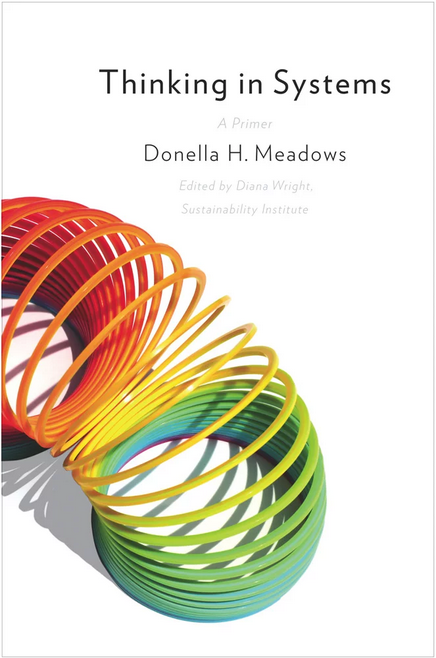
Suggested reading: Thinking in Systems: A Primer by Donella Meadows
This book by the late Donella Meadows has been highly influential in the field of systems dynamics. It is a great place to start if you want to learn more about the tools, methods and skills required for systems thinking. You can buy the book online here.
Cheryl Dahle is the Founder of Future of Fish and was a judge at the 2017 Global Final in Oxford.
Cheryl is an entrepreneur and journalist who works at the intersection of business and social change. Along with a team of designers, scientists, researchers and entrepreneurs, she creates and tests new ways to solve large-scale, systemic problems. How do you achieve systems change to world-scale challenges? In her keynote speech, Cheryl shares her real-life examples of how complex challenges can be addressed by taking a ‘systems thinking’ approach.
Video: Mapping Society for a More Meaningful World
Steve Whitla is the founder of Visual Meaning, a company that helps large organisations make sense of how they work, and how they need to change, using conceptual maps. In this video, Steve explains how system maps could revolutionise our ability to understand and change the world.
You can learn more about Steve’s work on his blog, Meaning Guide.
Video: Reclaiming Social Entrepreneurship
Daniela Papi-Thornton has a unique perspective on social entrepreneurship, developed as result of six years working for social change in Cambodia and from her role as Deputy Director of the Skoll Centre for Social Entrepreneurship at Oxford’s Saïd Business School, which she left in 2016. Daniela offers tools and perspectives that help educators, parents, and budding change makers re-position themselves and rethink how we teach and incentivize social entrepreneurs.
Article: Why Social Ventures Need Systems Thinking
A useful Harvard Business Review article making the case for the importance of systems thinking when tackling global challenges.
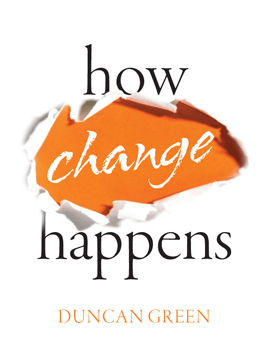
Suggested reading: How Change Happens by Duncan Green
This book from Duncan Green, Oxfam GB’s Senior Strategic Adviser, explains the importance of a systems approach to bringing about positive social change.
As you discuss the problem in your Map the System entry, you may want to examine one or more causes of the problem. This will also help you articulate which type of solution might be most effective.
Perhaps you’ve also been there: at the beginning of something new; bold and fearless in the face of opposition and hopeful at the possibility of sparking real change.
This is very much where we were in 2014, when the stars aligned and the Government of Alberta officially launched the Alberta CoLab — one of the first Public and Social Innovation Labs (hereafter Labs) in Canada. Two years later, co-founder and good friend Dr. Alex Ryan penned the Alberta CoLab Story in which he openly reflects on the creation of a government-wide service for systemic design and foresight. He also reflects on the highs and the lows faced by the team working to integrate a counter-intuitive and counter-cultural approach to policy development into a bureaucratic world of risk-based approvals, results-based budgets, and efficiency gains. It’s an insightful piece outlining what made the CoLab unique and its early impact.
Today, the Alberta CoLab continues to function as permanent government design team, but “by design” it does so with a dramatically different focus and mandate. This is a three part retrospective that looks back on the past five years of the CoLab and examines why, at the height of our success, we went back to the drawing board to reimagine it all over again.
The always-brilliant systems studio newsletter. I’ll post some of the key contents separately (and already have posted some) – but I always think this is worth sharing alone.
This Jan The Systems Sanctuary launched new Cohorts for systems leaders at least two years into their work (In the Thick of It) with a special Cohort for our friends in Aus/NZ. Both are now oversubscribed with amazing people.
We have 3-4 spaces for this program. One East Coast and one West Coast. If you’ve been thinking of applying and haven’t yet, please just do it!
Even if you don’t consider yourself a systems leader yet, even if you can’t afford it. We have some bursary’s available, we welcome women of all career stages and the form will take you 5 mins to fill in!
BRILLIANT PEOPLE WITH CAPACITY TO DO SYSTEMS CHANGE WORK
Nikil Dugal who’s been an Associate on systems change at the Skoll Centre at Oxford
Mansi Kakkar who’s a superstar facilitator and teaches systems change internationally
Have a story we should include in this newsletter?
We love to support our #systemschange colleagues by getting the word out about your work.
Get in touch rachel@thesystemstudio.com
The Systems Studio exists to build the field of systems change practice, so it can support humans and nature to flourish.
Our clients are trying to change professions, institutions and industries in service of people and planet.We do this by creating experiences where people can truly connect and strategize about the things they really care about. Working with us always feels focused and fun.
We do three things:
Create community for systems leaders.
Craft and facilitate gatherings that change everything.
Teach strategy and leadership for systems change.
If this email was forwarded to you, please click here to subscribe.
All of the links and recommendations contained in this newsletter are selected by the Systems Studio team based on our opinion of what would be most useful and inspiring to our subscribers. We do not accept any payment or other compensation in return for inclusion.
“A truly expansive and valuable book that challenges the assumptions and constraints of current leadership thinking… Its focus on integrating theory and practice is particularly helpful in linking its key ideas to current public sector management concerns.”—Gareth Morgan, Author of Images of Organization
“While other authors have offered general principles of systemic leadership or given readers single approaches, Hobbs is much more ambitious: she brings together diverse, well-tested theoretical, methodological and practical approaches to provide today’s leaders with a multifaceted resource that can aid them in thinking systemically. In this respect, her book is a significant advance on previous offerings, and I wholeheartedly recommend it to leaders, aspiring leaders and leadership academics around the world.”—Gerald Midgley, University of Hull, UK
“This is an impressive and innovative work that draws together the disparate strands of complexity theory, systems thinking and operational research to build an adaptive social learning approach for local governance, helping to shift it from a service-led to systemic-deliberative model. This is essential reading for local government actors, students of local policy and for the public policy generalist.”—Robert Geyer, Lancaster University, UK
Addressing matters of complexity systemically rather than mechanistically is now an ethical and practical paradigm-changing challenge for public policy. This optimistic book explores how action could be led in a joined-up way, signposting resources to thinking differently. Attention is paid to leading the design of adaptive social learning around what matters, re-connecting with public purpose to enable tailoring towards contemporary needs and constraints. Relevant to postgraduates, academics, local government managers, curious practitioners and the wider public, private and third sectors where there is interest in interpreting leadership via the cognitive capabilities of Systems Science.
Table of contents (9 chapters)
Introduction: Local Government Reform and a Journey to the Empty Quarter
In this 60 minute recorded webinar, the Academy hosts Otto Scharmer in discussion about his work on Theory U, focusing on core principles and applications. Academy Founders, Peter Senge and Darcy Winslow, along with Academy Fellow and Strategic Design Manager, Katie Stubley, talk about turning theory into practice and take questions from participants as to how we can implement this work in our daily lives.
Otto Scharmer is a Senior Lecturer in the MIT Sloan School of Management and founder of the Presencing Institute. He chairs the MIT IDEAS program for cross-sector innovation, which helps leaders in business, government, and civil society to innovate at the level of the whole system. Scharmer introduced the concept of “presencing” – learning from the emerging future – in his bestselling books Theory U and Presence (the latter co-authored with Peter Senge, Joseph Jaworski, and Betty Sue Flowers). His new book, The Essentials of Theory U (2018), is a powerful pocket guide for practitioners that distills all of the research and materials found in his seminal texts Theory U and Leading from the Emerging Future. This book enables leaders and organizations in all industries and sectors to shift awareness, connect with the highest future possibilities, and strengthen the capacity to co-shape the future.
Gaining traction on today’s ever-more complex challenges requires collective leadership. That means practicing new ways of operating at the levels of Self, Team, Organization, and System. This online Fieldbook provides tools and resources for system leaders to use in supporting people and groups as they develop the skills to accelerate progress on intractable problems together.
To make real and lasting change, we need to:
Recognize that we are part of the systems we seek to change: Self
Interact productively with—and learn from—others: Team
Collaborate across internal stakeholder groups: Organization
Work across boundaries to co-create the future: System
Hover over the different segments of the circle, to the left, to identify the modules that will help you build your capacity to become a system leader.
“Change must start from within—with deep self-awareness. We start by identifying and discussing what each individual already has—their roots—and we work with them as they learn from a mentor and practice by doing.”
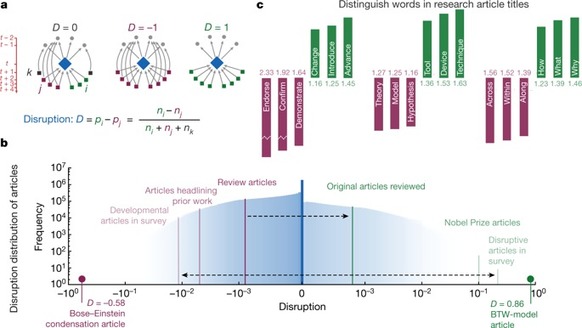
One of the most universal trends in science and technology today is the growth of large teams in all areas, as solitary researchers and small teams diminish in prevalence1,2,3. Increases in team size have been attributed to the specialization of scientific activities3, improvements in communication technology4,5, or the complexity of modern problems that require interdisciplinary solutions6,7,8. This shift in team size raises the question of whether and how the character of the science and technology produced by large teams differs from that of small teams. Here we analyse more than 65 million papers, patents and software products that span the period 1954–2014, and demonstrate that across this period smaller teams have tended to disrupt science and technology with new ideas and opportunities, whereas larger teams have tended to develop existing ones. Work from larger teams builds on more-recent and popular developments, and attention to their work comes immediately. By contrast…
Introduction. Systems Literacy is a coordinated ongoing action to create a greater awareness and understanding about “Systems” in our lives, in the world, nature, society, science and art, schools and universities and engineering and beyond and with that awareness and understanding an ability to make informed decisions and communicate using systems approaches . This Systems Literacy initiative builds on previous “literacy” work facilitated and/or contributed to by the College of Exploration and by many other Literacy projects combined with the many “systems” education programs around the world. These range across many disciplines and many related topics, including cybernetics, complexity, complex adaptive systems, systems thinking, network literacy and network thinking, pattern literacy, developments in neurosciences and many others. Please send in suggestions
Other Literacy actions. The College of Exploration efforts in the above efforts and the associated guides are possible models for systems literacy. A collection of worldwide literacy efforts that we can consider is collected here http://www.coexploration.org/literacy
Vision. The vision is to create a systems literate world. The aim is to create a broader awareness and understanding of the science (and art) of systems. To achieve that we are building a collaborative learning system for systems literacy that coherently and systemically includes as many individuals, groups, societies, associations and other organizations from around the world who are concerned with systems research, education, theory, methods and applications to map, understand and describe big ideas, principles and concepts of systems.
Project at the College of Exploration. A Systems Literacy project at the College of Exploration began in 2008 when we presented a poster on Geosciences Literacy at the American Geophysical Union annual conference in December 2008. The natural development of this idea was to suggest a Systems Literacy initiative as described on this College of Exploration Systems Literacy page created in 2008. These two projects remained as ideas for lack of funding.
Renewed effort began in 2015. Then in 2015 we attended the International Society for the Systems Sciences (ISSS) annual conference in Berlin, Germany. There we spoke informally about our work on ocean and earth science literacy in the USA over the previous fifteen years. We suggested that perhaps ISSS might consider a similar effort for systems. This idea gained attention quickly, so much so that we were encouraged to pursue Systems Literacy in ISSS and also with the International Council of Systems Engineers (INCOSE) , the International Federation for Systems Research (IFSR) and other Systems organizations, federations, society and groups.
Exploratory Workshops since 2015. Many workshops on Systems Literacy have been conducted at IFSR, ISSS and INCOSE meetings. One member of INCOSE, Bill Schindel, has stated that system phenomena are the starting point for traditional disciplines in the natural sciences and engineering. See his presentation “Got Phenomena” at the Sirocco Summit in 2016 and his related paper presented at the 26th Annual INCOSE International Symposium.
Other References to Systems Literacy. Subsequent to initiating this cooperative effort with ISSS, INCOSE and IFSR and the worldwide systems community at large in 2015 we have found the term “systems literacy” has been used in different ways. All these uses of the term “systems literacy” were unknown to us in 2015 when we made the impromptu suggestion at the ISSS Conference in Berlin to create a systems literacy project.
Another view is presented by Hugh Dubberly proposing a Systems Literacy Manifesto, All these uses of the term “systems literacy” were unknown to us in 2015 when we made the impromptu suggestion at the ISSS Conference in Berlin to create a systems literacy project.
In 2017 Howard Silverman wrote a chapter for book The Community Resilience Reader – Essential Resources for an Era of Upheaval. The chapter is called “Systems Literacy: A Toolkit for Purposeful Change”. You can read the book here https://reader.resilience.org/
Language
As can be seen from the term “systems literacy” is not without it challenges, even for the English language. We acknowledge that these two words already have different meanings, The term literacy is also not easily translated into many languages.
Complex networks: theory, methods, and applications (5th edition) Villa del Grumello, Como, Italy, May 13-17, 2019
Many real systems can be modeled as networks, where the elements of the system are nodes and interactions between elements are edges. An even larger set of systems can be modeled using dynamical processes on networks, which are in turn affected by the dynamics. Networks thus represent the backbone of many complex systems, and their theoretical and computational analysis makes it possible to gain insights into numerous applications. Networks permeate almost every conceivable discipline —including sociology, transportation, economics and finance, biology, and myriad others — and the study of “network science” has thus become a crucial component of modern scientific education.
The school “Complex Networks: Theory, Methods, and Applications” offers a succinct education in network science. It is open to all aspiring scholars in any area of science or engineering who wish to study networks of any kind…
…continuing my discussion of ‘complexity’ methods – this looks like a truly fascinating attempt to infer something essential or internal to a system from description of observable characteristics, using hard maths.
There’s something about a focus on the material here, and perhaps an equivalent to informed brute-force decryption attacks?
Many time-evolving systems in nature, society and technology leave traces of the interactions within them. These interactions form temporal networks that reflect the states of the systems. In this work, we pursue a coarse-grained description of these systems by proposing a method to assign discrete states to the systems and inferring the sequence of such states from the data. Such states could, for example, correspond to a mental state (as inferred from neuroimaging data) or the operational state of an organization (as inferred by interpersonal communication). Our method combines a graph distance measure and hierarchical clustering. Using several empirical data sets of social temporal networks, we show that our method is capable of inferring the system’s states such as distinct activities in a school and a weekday state as opposed to a weekend state. We expect the methods to be equally useful in other settings such as temporally varying protein…
“How we can improve our perception of the complexity we live within, so we may improve our interaction with the world?”
An international lecturer, researcher and writer, Nora wrote, directed and produced the award-winning documentary, An Ecology of Mind, a portrait of her celebrated father — systems theorist, holistic thinker, anthropologist and pioneer of cybernetics, Gregory Bateson. Building on her father’s legacy, Nora brings the fields of biology, cognition, art, anthropology, psychology, and information technology together into a study of the patterns in the ecologies of living systems. She is President of the Swedish-based International Bateson Institute.
Her book Small Arcs of Larger Circles (Triarchy Press, UK, 2016) is a revolutionary personal approach to the study of systems and complexity. Nora is uniquely qualified to facilitate cross disciplinary discussions. As an “interdisciplinary interloper” she travels between conversations in different fields and with different audiences bringing multiple perspectives into view to reveal larger patterns.
In her public lecture on Monday 18th February, Nora will address four themes which will then become the framework for the two-day workshop she will lead on Tuesday 19th and Wednesday 20th February:
Systems thinking and everyday life
Identity in complexity
How systems learn
Warm Data
Systems Thinking and Everyday Life
Nora’s teaching, and her challenge to us, is about developing our capacity for taking a systemic approach of mutual learning to everyday life, from family, to groups, organisations and society.
‘Symmathesy’* is a new term created by Nora that derives from the Greek prefix sym (together) and mathesi, (to learn). Symmathesy is not about finding five-step solutions, it is about deepening, expanding and exploring the sensitivity with which we interpret and interact with our complex world more creatively and positively, and less destructively. Be sure, this is not a tweaking of thinking and approach, but a profound shift.
Combining theory, art, story-telling, poetry and emerging practice, Nora will guide us to take a different look at how to approach the seemingly intractable problems that we face personally and as a society. She will take us on a journey exploring the art and science of complexity, transcontextuality* and how systems learn. Along the way, we will explore notions of identity, agency, leadership, pain and double binds—and how such notions become paradoxical and ambiguous when seen through a systemic lens. Once we embrace the creative tension in this perspective, we can see new possibilities for altering and easing how we live, individually and collectively.
*(The meaning of anything depends on its context. We live in many contexts, spread over time, space and relationships, that are continually shifting. Identity, for example, is what Nora calls ‘transcontextual’, in that it is shaped and changed not by one context but by many.)
Identity in Complexity
In meeting the needs of a changing world, our two most valuable assets are sensitivity and complexity. As individuals and within larger communities our notions of identity inform us as to who we are in relation to the systems we live within. But this era is a time of upheaval; the ecosystems and social systems around the globe are in rapid transition. While change is a constant in living systems, the rate of change now is unprecedented. Who are we in this changing world? As families, as professionals, as cultures, how is our perception of ourselves changing . . . and what if it doesn’t?
Identity—in fact all meaning—depends on context. We live in many contexts, spread over time, space and relationships, that are continually shifting. If we are open, we continue to
learn from our deceased ancestors and from our children and generations to come. In this sense, identity is what Nora calls ‘transcontextual’, in that it is shaped and changed not by one context but by many. Identity often seems to depend on belonging to a particular gender, nationality, political party, religion etc. with its attendant problems at the edges where one belonging rubs up against another.
Identity is a personal matter, but it also matters in terms of society, ecosystems, and the future. Double binds of identity, and other traps of obsolete fragmentation in our thinking can be seen with greater insight through the lens of complexity and systems.
As our ability to perceive the complexity of our own identity is increased, so is our ability to perceive the complexity of our world. With this perception we have much better information from which to make the important decisions, as well as much more sensitivity. For example, through a lens of complexity, how is the experience of pain expanded? Pain is often reduced to a singular causation and experience, and then numbed away. But right now we need to be able to feel the sadness and anxiety of our world in a larger colour spectrum . . . we cannot afford to anesthetize our interaction with the world around us.
How Systems Learn
There is much focus on complexity these days, but our predominant metaphors are still linear and mechanistic. It is hardwired into us all at a deeply personal level and tends to rule the day. Even when we think we are approaching things systemically we are likely to revert to our habitual linear mode of thinking. If we are genuinely thinking systemically or ecologically, what is the meaning of notions such as ‘agency’ and ‘leadership’, which become paradoxical in a systemic world?
All of biological evolution, and development of culture and society, would seem to be a testament to the characteristics of contextual multilayered shiftings through time. Nothing stays the same, clearly. So could it be that change is a kind of learning? If a living entity transforms, even slightly, the contextual interrelationships it is within change and these changes can cascade through the bigger systems in which it is embedded. The same kind of tree in the same forest does not necessarily grow to be the same shape. Some may have higher winds to contend with, or grow in a thicker density of flora around them. The trees in these contrasting contexts live into their contexts by receiving the many forms of relational information they are within, and responding to them. They grow into
different shapes and metabolize at different levels . . . learning, calibrating, and through stochastic process, responding to their contextual interrelationships. And aren’t we all a little bit like those trees? Becoming who we are in the contexts of our lives . . .
Warm Data
Nora will also speak about ‘warm data,’ which (in contrast to ‘cool’ or hard data) she defines as “transcontextual information about the interrelationships that integrate a complex system.”
On December 7, 2018, Nora posted:
“The world is ready for warm data. After years of what has felt like starting fires in the rain, finally there is a recognition that the way problem solving has been considered, has not been adequate to meet the complexity of the issues we face. I am just back from an amazing Warm Data session in Mexico, preparing to bring together public service groups in Puebla and Mexico City in 2019. Next up is a deep dive on Warm Data in London this week. The session is completely full. Meanwhile the United Nations General Assembly has taken an interest in Warm Data as well. Here is a new blog post of the piece going into the United Nations Office for Disaster Risk Reduction (UNISDR) 2019 Global Assessment Report on Risk.” Warm Data to Better Meet the Complex Risks of This Era
Thinking in complexity requires the ability to perceive across multiple perspectives and contexts. This is not a muscle that has been trained into us in school or in the work world. It is a skill acutely needed in this era to meet our personal, professional and collective need to respond to crisis, and to improve our lives.
Nora has devised a process that she calls a “Warm Data Lab” for use with groups who are interested in strengthening and further practicing their collective ability to perceive, discuss and research complex issues. By shifting perspectives, the Warm Data Lab process increases ability to respond to difficult or “wicked” issues. Because so many of the challenges that we face now are complex, we need approaches to meeting that complexity. Although there is a desire to reframe these complex issues in simple terms that might lend themselves to easy solutions, this usually leads to the dangers of unintended consequences of reductionism . . . and thus further problems. It is a living kaleidoscope of conversation in which information and formulation of cross-contextual knowing is generated. The conversational process is designed to seamlessly engage
multiple theoretical principals in a practical format. The process relies on using two concepts: Transcontextual Interaction and Symmathesy.
Transcontextual Interaction is the recognition that complex systems do not exist in single contexts but rather are formed between multiple contexts that overlap in living communication.
The ways in which systemic interdependency forms is through contextual interaction and mutual learning. Symmathesy is the concept of mutual learning that encourages us to concentrate on how these contextual interactions inform one another and generate learning.


















 A System Leader’s Fieldbook




 Systems Community of Inquiry
You must be logged in to post a comment.