What can Social Systems Theory bring to the VSM? | strategic structures – Ivo Velitchkov


Source: What can Social Systems Theory bring to the VSM? | strategic structures


What can Social Systems Theory bring to the VSM?

In 2015, when the Metaphorum was in Hull, I tried to kick off a discussion about potential contributions from cognitive science, and particularly from the Enactive school. I shared some insights and hinted at other possibilities. This year the Metaphorum conference was in Germany for the first time. It was organised by Mark Lambertz and hosted by Sipgate in Düsseldorf. I saw in the fact that the Metaphorum was in Germany a good opportunity to suggest another combination, this time with the Social Systems Theory of Niklas Luhmann.

These are the slides from my talk and here you can also watch them with all animations.

The unmarked state – Laws of form 50th Anniversary Conference August 8-10, 2019, Liverpool UK

Source: LOF50

The Conference

2019 marks 50 years since George Spencer-Brown’s book, Laws of Form was first published; 50 years since Heinz von Foerster’s influential review in The Last Whole Earth Catalogue first appeared, describing it as a Twentieth Century transistorized power-driven equivalent of Occam’s razor; 50 years since Stafford Beer reviewed it in Nature, stating he suspected he was reviewing ‘a work of genius’, a view shared by Lancelot Law Whyte, who described it as such in his book, The Universe of Experience: A Worldview Beyond Science and Religion, adding, ‘I recommend to all interested in the frontiers of the intellect the introduction and notes to Laws of Form.’ In The British Journal for the Philosophy of Science, he stated, ‘I still consider, on re-examining this book after a two-year interval, that it is a work of genius … One is aware of contact with a mind of high originality’.

In that space of 50 years, the book, which to many seemed to mix mathematics and mysticism, has influenced major developments in mathematics, humanities, logic, philosophy, systems theory, and sciences.

The Unmarked State Laws of Form 50th anniversary conference celebrates the work of author and polymath, George Spencer-Brown, 1923-2016 and reviews the past, present, and future of his attempt to rethink creation from first principles, his influence on Kauffman, Luhmann, von Foerster, Varela, and others, and questions what might develop out of Spencer-Brown’s work in the next fifty years.

The Unmarked State Laws of Form 50th anniversary conference is a celebratory cross-disciplinary gathering which will be of interest to mathematicians, philosophers, sociologists, cyberneticists, designers, and all those interested in how to create a world from nothing.

Dates & Location

August 8-10, 2019.

Old Library, Liverpool University, 19 Abercromby Square L69 7ZN, UK.

Liverpool is reached by train to Lime Street, by air to Manchester or Liverpool Airports.

University car parks are nearby. There are many hotels in the vicinity, with options to suit every budget.

Call for Papers

The Unmarked State Laws of Form 50th anniversary conference is a celebratory cross-disciplinary gathering which will be of interest to mathematicians, philosophers, sociologists, cyberneticists, designers, and all those interested in how to create a world from nothing.

The cross-disciplinary conference will review the influence that Laws of Form has had since its publication and its unexplored potential and explore the work of author and polymath, George Spencer Brown, 1923-2017. We aim to explore the past, present, and future of his attempt to rethink creation from first principles, his influence on Kauffman, Luhmann, von Foerster, Varela, and others; and question what might develop out of Spencer-Brown’s work in the next fifty years.

As with other academic conferences, the primary goal of LoF50 is for people to meet and interact.

Presentations of research connected to the work of George Spencer-Brown are invited in two forms:

  1. Regular papers

Every regular paper will have a 30-minute slot in the programme, during which they are expected to give a 20 minute presentation and answer questions in person.

  1. Short presentations and workshops

These can be of a more fluid nature and give personal or artistic responses to the Laws of Form. Short presentations should be at about 20 minutes in length.

Workshop organisers please say how long they might require.

Cross-disciplinary and inter-disciplinary approaches are encouraged.

Please send a 200-word abstract of your proposal to the committee by noon on the 11th of March 2019. To submit a proposal, please use the submission page on EasyChair.

We intend to publish regular papers, where appropriate, in a special volume of the Series on Knots and Everything.

An account of the conference as a collection of abstracts and presentations will be circulated as an edited pdf.

Expressions of Interest

Please use the contact form on this website to request further information or express interest in contributing.

Christopher Alexander, Horst Rittel, C. West Churchman – Coevolving Innovations from David Ing


Source: Christopher Alexander, Horst Rittel, C. West Churchman – Coevolving Innovations


At U.C. Berkeley in the 1960s, Christopher AlexanderHorst Rittel and C. West Churchman could have had lunch together.  While disciplinary thinking might lead novices to focus only on each of pattern languagewicked problems and the systems approach, there are ties (as well as domain-specific distinctions) between the schools.

Circa 1968-1970: Christopher Alexander, Horst Rittel, West Churchman

Circa 1968-1970: Christopher Alexander, Horst Rittel, West Churchman

West Churchman joined Berkeley in 1957, and initiated master’s and doctoral programs in operations research at the School of Business Administration.   From 1964 to 1970, Churchman was associate director and research philosopher at UC Berkeley’s Space Sciences Laboratory, directing its social sciences program.  After his retirement in 1981, Churchman taught in the Peace and Conflict Studies program for 13 years.

Horst Rittel came to the Berkeley College of Environmental Design in 1963, the same year that dean William Wurster recruited Christopher Alexander.  In 1973, Rittel split his time between Berkeley and the architecture faculty at the University of Stuttgart, where he founded the Institut für Grundlagen der Planung.

Christopher Alexander became a cofounder of the Center for Environmental Structure at Berkeley in 1967, gradually moving outside of the university by 2000.

The tie between Churchman and Rittel are well-documented, in a 1967 article in Management Science.

Professor Horst Rittel of the University of California Architecture Department has suggested in a recent seminar that the term “wicked problem” refer to that class of social system problems which are ill-formulated, where the information is confusing, where there are many clients and decision makers with conflicting values, and where the ramifications in the whole system are thoroughly confusing. The adjective “wicked” is supposed the describe the mischievous and even evil quality of these problems, where proposed “solutions” often turn out to be worse than the symptoms. [p. B-141]

This idea of “wicked problems” would eventually be published by Rittel and Webber in 1973.

The ties between Christopher Alexander and West Churchman are more elusive, however.  In 1967, Alexander published “Systems Generating Systems” as part of an exhibit display.  In addition to the original article, Molly Steenson’s 2014 dissertationprovided historical context.  In a Facebook discussion threadHelene Finidori asked about where she might “find a synthetic critical view of Christopher Alexander’s work and it’s evolution, and potentially its contradictions too”.   I responded …

David Ing (April 16, 2017, 6:46pm) If you’re looking for the “synthetic, critical view of Christopher Alexander’s work and its evolution”, you’ve now already read them. Both Steenson and I read the original documents (back to the formation of the Center for Environmental Structure), and have used the content. There may be a few details in my dissertation, but if you really want to get to that level of detail, you’ll have to do the ground work, too. The “critical” part is the challenge, as it requires that the criticism take an opposing position. My position is based on the pursuit of service systems thinking, which may or may not be your position.

On “not so much about patterns themselves ….” Alexander doesn’t describe “pattern” as much as “pattern language”. This goes back to Notes on the Synthesis of Form, and then evolves from there. To catch the nuances, you’ll have to keep in mind that Alexander himself was learning the ideas, and what he wanted to say, so the words and meaning changed over time. Thus “quality without a name” because “unfolding structure” which became “unfolding wholeness”. (This last label comes from reading the later unpublished works at http://www.patternlanguage.com/ , when Alexander writes about a meeting with David Bohm.

When I was talking with Jim Coplien (AsianPLoP 2015), we discussed systems thinking. He has the right intuitions, but not necessary all of the “correct” language, because he hasn’t done graduate level studies of systems thinking. I would say the same is the case for Alexander, and members of the CES at Berkeley. Some of the graduate students went over to West Churchman’s seminar, but it wasn’t their primary field of study, so they weren’t totally immersed.

I try to be very specific about what I’m doing. I try to not use the word “pattern” by itself, because different people have different understandings of that. Even “pattern language” has risks, because at PLoP, I learned that the Gang of Four “Design Patterns” book actually slightly predates the Hillside Group formation (e.g. Ralph Johnson is sympathetic to Richard Gabriel, but came from different purposes at that time). In particular, “generative pattern language” is something that the Hillside Group purists are pursuing, while the technology-oriented developers are more concerned with abstractions of programming languages.

Helene responded with a question “about the relationship between the pattern and the system”, and Helmut Leitner thought this was “an interesting detail”.  I wrote:

David Ing (April 16, 2017, 7:19pm) Helene, to be clear, my research is on “pattern language”, and not on “pattern”. My work on “the systems sciences” — that’s plural, not singular — and more colloquially on “systems thinking” (largely because Russ Ackoff and contemporaries adopted that term to reflect both art and science) — and not on “systems”.

I’m sympathetic to Helmut seeking clarity in the use of terms. The reason that it took me 3 years (from PLoP 2014 through PUARL 2016, and in my 2017 dissertation) to get to this level of clarity is because I needed to make adjustments at the philosophical level that depart from Christopher Alexander’s concern on built environments. I’m not a building architect, and I work in social systems and information systems. Thus, I’ve shifted to ecological anthropology and the work of Tim Ingold, where the meaning of affordances originated by J.J. Gibson (and mangled by Don Norman, for later self-correction) was made clear. This led to my final act of information-gathering for my dissertation, with a diversion to the IFIP WG8.2 meeting in Dublin in December 2017 to listen and speak directly with Tim Ingold.

The pattern as “solution to a problem in context” doesn’t work for me, because, as Russ Ackoff says, we work in systems of problems (i.e. problematiques, messes), which require systems of solutions. This is somewhat similar to Alexander’s resolution of “forces”, which is mystical to most people. The systems thinking foundations might have been better elicidated if the Alexander camp had gone across campus at Berkeley in the 1970s to discuss with Horst Rittel on wicked problems, and West Churchman on the systems approach. Those graduate students are now in their retirements, so if we want to make those bridges, we’ll have to make haste to draw on their memories, and/or build them ourselves.

In seeking out history, I had previously read the blog of Thorbjoern Mann (and Abbé Boulah).   On Nov. 14, 2014, Thor had written “A personal note on Pattern Language applications in other fields“, on Alexander and Rittel, including:

Both Alexander and Rittel were teaching at Berkeley when I was there as a graduate and then postgraduate student, in the late 1960’s and early 1970’s. Both belonged to the ‘design methods’ movement, a group of people who tried to remedy what was widely seen as a lack of research and adaptation of the new ‘space age’ insights in architecture and urban design and planning. They tried to bring ideas and tools from operations research, the emerging computer applications and systems studies to bear on architecture and planning. However, Alexander dramatically disassociated himself from that group, after a first disappointing attempt at devising a computer program to produce architectural designs. [4] He then focused on his ambitious pattern language project. This was seen as a move philosophically opposing the methods and systems efforts — efforts whose early applications in the sociopolitical arena had seen some spectacular failures.

That specific blog post led to a back-and-forth exchange in the comments sectionbetween Thor and myself.

On Sept. 12, 2016, Thor expanded that exchange into a blog post on the three professors at Berkeley, in “Alexander, Churchman, Rittel: A Fog Island Tavern Conversation“, including:

– Yes, I remember: Alexander’s Pattern Language for Environmental Design; Rittel’s Wicked Problems and Argumentative Model of Planning and information systems. They were both teaching at the College of Environmental Design. But Churchman was in the Business School, working on his Systems Approach books and research, wasn’t he? So somebody wants to reconcile those different perspectives? For what purpose? Isn’t that a bit of old history? Haven’t all those disciplines evolved into new conundrums by now?

Thus, to my delight, the Facebook thread led to an additional first-person account from Thor, as a former Teaching Assistant (TA) for Rittel:

Thor Mann (April 17, 2017, 11:19pm) David, just a response to your comment on the relationship between Alexander, Churchman, and Rittel in the ’60s and ’70s (from one of those guys that are now in retirement):

Both Alexander and Rittel were part of what at the time was called the ‘design methods’ movement in architecture, worked and taught in the same building, and did talk and were seen walking off to have lunch together. Churchman was teaching in the Business School a few minutes down on the way to the center of campus.

The problem was (as I perceived it, having come to Berkeley from a ‘systems building’ as well as methods interest, working with Rittel) that a part of that movement was trying to learn from the OR/systems approach that had been working and writing for some time already — Churchman’s and Ackoff’s books were on the design methods reading list. Alexander seemed to veer off his early general systems-based investigations by his fascination with the linguistic ideas of Chomsky, and some early attempts to use the computer to generate architectural designs that did work as well as he expected (at the time, as Rittel’s TA, working in a common space with all the other TA’s, I listened to the frustration of Alexander’s TA’s about that project). So he turned to the Pattern Language project, and in a dramatic statement in the ‘Design Methods Journal’ proclaimed a philosophical break with the design methods and ‘systems’ movement. (This resonated well with many Berkeley students at the time for whom the ‘System’ was THE big bad enemy…)

Rittel was working on different tasks somewhat remote from actual building design: information systems for design and planning. For these, he found it necessary to first work out a clearer understanding of the design process, how designers think, and design and planning problems. His answers were: the ‘argumentative model’ of design and planning, the concept of ‘issue based information systems’ for design, and the concept of ‘wicked problems’ that clarified why the ‘first (OR-based) generation’ of systems approach for design and planning were inadequate to deal with these ‘messes’, as Ackoff had come to call them, and that led Churchman to his version of the systems approach that I think was not widely adopted by the stalwart systems folks elsewhere. (Systems consultants working for corporate clients had to promise more concrete results on time and budget to get contracts, than were warranted e.g. by wicked problem properties… )

There was enough work for everybody to be done on all emerging facets of these ideas — the ‘wicked problems’ insights that provided an important basis for the call for wide participation in design (architectural programming) and planning; the development of programs and applications for the fast-developing computer technology are just examples. Rittel’s argumentative model, focusing on the ‘unprecedented’ (wicked) aspects of design projects, was not widely adopted by architectural practice and teaching — architecture was and is, after all, so constrained by traditional expectations, ‘good design’ canons and building regulations as well as the limitations of available building materials and technology, that any truly unprecedented problems were easily sidestepped by resorting to precedent, client preferences, and great designers’ creativity imperative to produce ‘new’ and ‘different’ solutions to ‘challenge users’ preconceptions’.

Besides my part in developing the argumentative model with my efforts to develop more transparent approaches to evaluate design and planning arguments, and to include these in a better ‘planning discourse support’ platform and process, my questions about the Pattern Language led me to articulate a ‘way of talking about architecture that focused on users and viewers’ ‘occasions’ or experiences in the built environment as the elements of both programming and design work, and on the ‘images’ evoked by built environment in users’ minds. I saw this as contributions to both architectural programming, design, and — by exploring it in combination with the issue of building economics to develop an approach to the question of value of built environment — an effort that comes close to offering insights and measurements into the part of quality of life influenced by the built environment.

These are just personal examples of how the ideas of Alexander, Churchman and Rittel have influenced my further work; I am sure that other people from that time have similar stories to tell. In my opinion, the current efforts devoted to exegesis of what these thinkers and the terms they proposed ‘really’ meant, — and to make that a ‘science’ — should focus more on formulating a clear agenda of the work that still needs to be done, about half a century later. Those are tasks of design, strategy, articulating visions, more than science (this should not be seen as emphasizing design as fundamentally ‘different’ from science; science-based and generated knowledge is one of the essential pillars of design — one of the key premises of deign and planning arguments.)

In my writings, e.g ‘Abbe Boulah’ blog (one post specifically about the relationship between CA, WC and HR) and a number of papers posted on Academia.edu, as well as some threads in the LI and FB systems community, I have made some efforts of sketching out some priority issues for that task. The task deserves a more coherent and sustained framework and process than the format of these platforms currently facilitates. It is also somewhat different from many of the contributions in these networks that focus, quite understandably, on learning more about consulting practices and approaches aim at bringing in consulting contracts.

This first-person account of a former graduate student at Berkeley in the 1970s complements the general history of science that has been written by each of the figures individually.  Practically half a century later, there may be an opportunity not only to deepen our appreciation of each of these researchers as independent thinkers, but benefit through common struggles that they might have shared informally, towards new generative theories.

References

Churchman, C. West. 1967. “Wicked Problems.” Management Science 14 (4): B-141-B-146. doi:10.1287/mnsc.14.4.B141.

Rittel, Horst WJ, and Melvin M. Webber. 1973. “Dilemmas in a General Theory of Planning.” Policy Sciences 4 (2): 155–169. doi:10.1007/BF01405730.

Composite image derived from:

   October 14th, 2017

 Posted In: pattern languagesystems

 Tags: 


Systems Thinking Ontario – 2018-11-21 – Wicked Problems, Systems Approach, Pattern Language

Source: Systems Thinking Ontario – 2018-11-21

November 21 is the 62nd monthly meeting for Systems Thinking Ontario. The registration is on Eventbrite.

Wicked Problems, Systems Approach, Pattern Language

At U.C. Berkeley in the 1960s, Horst Rittel (originator of “Wicked Problems“), C. West Churchman (luminary in the Systems Approach) and Christopher Alexander (leading Pattern Language) led graduate programs. Doctoral students flowed across departments to their seminars and workshops.

Many of those alumni are the core of the PUARL (Portland Urban Architecture Research Laboratory) and Purplsoc (Pursuit of Pattern Languages for Social Change) communities.

David Ing led workshops at the Purplsoc conference in October 2017, and PUARL conference in October 2018, with the aim of regenerating some of the ties that were lost in the 1970s.

Come participate in an informal, unrehearsed conversation about commonalities and distinctions across these three bodies of work. In the interest of open communications, the conversation will not be recorded, and the Chatham House rule will apply.

David Ing is a systems change researcher, and one of the cofounders of Systems Thinking Ontario. He is a past-president (2011-2012) of the International Society for the Systems Sciences.

Venue:

Suggested pre-reading:

David will refer to the following artifacts:

Agenda

Time Activity Role(s)
6:30 Self-introductions  (15 seconds each)
  • Introduce yourself and briefly tell us about interests, experiences or affiliations related to systems thinking.
  • How did learn about this Systems Thinking Ontario session?
All
Convenor:  David Ing
6:45 Stepping through the readings  (as entry points)
  • What’s going on in these workshops?
Reviewer: All attendees
8:10 Process reflection
  • What went well in this meeting?
  • What should be discuss in the next meeting?
Suggestions welcomed
8:15 Adjourn
  • Optionally, join other attendees to continue discussion over dinner and/or drinks at a nearby restaurant
  • We prefer a venue that is quiet, reasonably priced and spacious enough for our continued conversations.
  • Typically, when we meet at 100 McCaul, we walk up to Baldwin Street; when we meet at 205 Richmond, we walk up to Queen Street West.
No host

THE SYSTEMS VIEW OF LIFE – Fritjof Capra

THE SYSTEMS VIEW OF LIFE
Chapter 8 of the Turning Point: Science, Society and the Rising Culture 1982-
Fritjof Capra


Click to access eb5a1c768763598cc9cb5b2d8a7c22c1cb0e.pdf

Margaret J. Wheatley: The Unplanned Organization

Source: Margaret J. Wheatley: The Unplanned Organization


THE UNPLANNED ORGANIZATION:
LEARNING FROM NATURE’S EMERGENT CREATIVITY

From Noetic Sciences Review #37
Spring 1996

by Margaret Wheatley ©2007

In my work with large organizations, one of the questions we often ask is, “How would we work differently if we really understood that we are truly self-organizing?” The first thing we recognize is that, just like individuals, the organizations we create have a natural tendency to change, to develop. This is completely counter to the current mantra of organizational life: “People resist change. People fear change. People hate change.” Instead, in a self-organizing world, we see change as a power, a presence, a capacity, that is available. It’s part of the way the world works — a spontaneous movement toward new forms of order, new patterns of creativity.

We live in a world that is self-organizing. Life is capable of creating patterns and structures and organization all the time, without conscious rational direction, planning, or control, all of the things that many of us have grown up loving. This realization is having a profound impact on our beliefs about the nature of processin interpersonal relations, in business organizations, as well as in nature itself. In this article, I will focus on some of the recent shifts in our understanding of the way things change.

Three images have changed my life — one, a picture of a chemical reaction, another, a termite tower in Australia, and a third, an aspen grove in my new home state of Utah. Each image in its own way represents a profound shift in my understanding about the nature of change in organizations. I will explain their significance later, but first I want to discuss eight tenets of what I call “unplanned organization”, inspired by these images.


Nature’s Paradigm: The Core Ideas of Systems Theory | Creative by Nature

“People normally cut reality into compartments, and so are unable to see the interdependence of all phenomena. To see one in all and all in one is to break through the great barrier which narrows o…

Source: Nature’s Paradigm: The Core Ideas of Systems Theory | Creative by Nature

Systemic Design Association formed from the Systemic Design Research Network

Source: Systemic Design


This is the page of the Systemic Design Association

This is a short update of things that have happened recently. More elaborate info will follow so stay tuned!

The RSD7 in Torino was a success. Thanks to all the organizers for the great effort.
The proceedings will follow in a few months.

The Systemic Design Research Network (SDRN) was formalized in a founding meeting the 23rd October in Turin. It is a non-for-profit association. Its new name is
The Systemic Design Association (SDA)

The board is
Chair: Silvia Barbero (Polito)
Vice chair Birger Sevaldson (AHO)
Secretary: Jenny Darzentas (Aegean)
Treasurer : Benedicte Wildhagen (DOGA)
Board member: Peter Jones. (OCADU)

SDA will be registered as a non-for-profit organization in Norway at the brreg.no registry.

You can now become a member of SDA. Just follow the link in the main menu.

Next RSD will be in Chicago October 17 to 19th 2019!
Stay tuned for more information and note in your calendar!


Here is a wonderful report from the RSD7 D-conference on the Mon Viso institute

http://monviso-institute.org/rsd7-de-conference/

How Design and Cybernetics Reflect Each Other – Ranulph Glanville

via Ben Sweeting. Glanville’s last keynote.

A keynote speech delivered by Ranulph Glanville at the Relating Systems Thinking & Design 3 Symposium (RSD3) at the Oslo School of Architecture and Design on 15-October-2014 with friendly approval by Prof. Birger Sevaldson (conference chair). Video by Thomas Fischer.

The difference between Networked Leadership, Systems Leadership and Digital Leadership ?


Source: The difference between Networked Leadership, Systems Leadership and Digital Leadership ?


The difference between Networked Leadership, Systems Leadership and Digital Leadership ?

Photo by David Menidrey on Unsplash

I have moved between various communities of practice over the last decade and in the last 3 or 4 years I’ve heard people talk about networked leadership, or systems leadership or digital leadership.* I was thinking about what each of these mean (to me) and what I’ve seen as the benefits and challenges of each, and where they are of course talking about the same thing anyway.

I think of them simply as:

Networked Leadership

Understanding that we are in a networked world, and that change can really only happen through networks. Anne-Marie Slaughter’s book, The Chessboard and the Web is good on this. I also wrote a blog about a networked mindset last year.

Systems Leadership

Understanding that change is continually happening anyway and having the ability to see and understand the interconnections between things and the root causes of issues, whilst stewarding all those different parts of the puzzle forwards. (The now quite old article in Stanford Social Innovation Review is a good overview of this). We also created this site back in 2014 talking to a group of ‘systems leaders’ about their practice (excuse the awful videos!) and created this publication with Oxford University in 2015 about the different elements of systems change practice. It’s also worth reading Collaborate’s new compendium of Systems Leadership in Local Government.

Digital Leadership

I think there are two aspects of this actually.

One is that you are adept at working in an agile way — making use of the way software is built (openly, iteratively and through data driven design), to inform the culture of how you work — this is what people mean by the culture of digital.

The second is that you have an understanding of technology — a basic level of knowledge about how the internet works and an understanding of how technology effects all the different aspects of your organisation, as well as its impact on the wider context (community and society) in which your organisation operates.

These two things often get conflated which is unhelpful.

The good and the bad

What I’m interested in is how the good aspects of each of these can combine. People in the systems change space are great at understanding what’s really going on, at building trusted relationships, at surfacing what’s difficult (especially power), and at holding complexity. What can happen though is that moving into action can be quite stifled. It can feel at times like there is inertia, or opaqueness, or so much “deep democracy” to ensure that every voice is included, that you end up forgetting what you were all trying to achieve in the first place.

In the digital community, people are great at making things happen, at being pragmatic, at working in the open and at pace. The other side of this though, is that it doesn’t always feel authentic in terms of acknowledging the complexity, and the messiness of human life. It can work well for transactional government services but doesn’t neatly translate to other contexts. The urge to get things done can also knock important things out of the way, and this means they don’t always take root.

And just being networked isn’t enough without intent, without actively curating your networks to be more and more diverse — you end up existing in a huge echo chamber, talking to the same people and getting your theories of change validated by people just like you.

New Additions

*I actually started this blog 9 months ago (think what that says about my blog backlog!) and since then, there’s a few more to include — Collective Leadership, Responsible Leadership (something Anita Roddick was talking about in the 90’s but in a different context), and Ecosystem Leadership.

Responsible Leadership is something Doteveryone are doing. Janet Hughes wrote this blog when she and I kicked off the programme in 2017, and now Alex Mecklenburg is doing a great job of adapting it to be fit for purpose with senior leaders at City Hall. I’m hoping all City Leaders will adopt this approach. Like Theo Blackwell said at TiCTEC Local on Tuesday — it is the responsibility of city leaders to consider what they commission and advocate for, especially in relation to technology.

Collective Leadership is something that the government is doing. I was involved in the scoping (through interviews and sharing my experience) of this work that Sandra Armstrong and her team are leading. This kind of leadership embodies the principle of ‘greater than the sum of our parts.’ This is also the kind of leadership that makes sense for Mariana Mazzucato’s work and IIPP, when thinking about what kind of person/people are needed to lead Mission-oriented Innovation.

Ecosystem leadership (creating shared intelligence across a system) draws on a few practices. The movement building work of NEON and Ayni Instituteis worth looking at. The now relatively old but still useful writing on taking a collective impact approach is too. It also links to “Generous Leadership” a term my new employer, the Big Lottery Fund, talks about — having a collective awareness and generosity towards the wider set of people and organisations with whom your work is connected.

My personal practice

The book that has most influenced me in terms of leadership is Dancing At The Edge by Graham Leicester and Maureen O’haraThe Point People are currently doing work with the International Futures Forum to build on the contents of the book, and share it more widely. Some of our early interpretation and translation of this work is below. This is a list of some things we think are important to know about when leading in an increasingly complex world, and in a world that is fostering more polarity, and more inequality:

  • Strategy — not about imposing goals on the external world but about reading the landscape and seeing the potential for what will happen next
  • Seeing the whole and root causes
  • Sensing opportunity and resonance at an individual, group and system level
  • Giving time to sensing and seeing patterns
  • Doing reflexive practice — which is like wisdom in action
  • Constantly moving between your internal world and the external context
  • Seeing movement and flows, not fixed stocks
  • Active listening — listening is generally hugely undervalued
  • Problem setting and framing, not assuming you can problem solve
  • Be driven by the problem and or curiosity rather than by yours and others skillset
  • Don’t reduce the problem to fit the existing competencies you and others have, but expand ourselves instead (transformational competence)
  • Build wise groups and create conditions for collective efficacy
  • Develop competency in the old and the new — this involves warning of the threats of not-changing, heralding the new and encouraging commitment and passion.

This is a lofty list — when we publish that work it will talk much more about what these things look like in practice and what they enable.

A few people I’d like to acknowledge that I see really embodying this kind of leadership are Kit Collingwood and Imandeep Kaur. There are many more people of course but I’ve personally experienced their leadership on projects.

I’m also hugely grateful for the Action Learning Set of ‘Digital Leaders’ I’ve been part of for 18 months that Janet Hughes and I set up. And the informal learning group I’m a part of, of phenomenal women leaders in the social sector,with whom I meet every month and have learnt so much from — Catherine HoweAnna Birney, Rowan ConwayAlice EvansAnna Randle and the elusive Helen Goulden!

Systems Changers – Homepage

Source: Systems Changers – Homepage


From climate change to poverty to healthcare, the large, complex social, environmental and economic problems we face today are too big for any one organisation to tackle alone. They require us to work together in new ways to address the root causes of problems and to create new outcomes that can change entire systems.

The failure of many of the systems that underpin modern life is increasingly difficult to avoid, so it’s not surprising that interest in ‘systems innovation’ is growing fast. At the Point People, we’ve seen pioneers emerging in this field from different sectors, leading very different kinds of organisations and speaking very different professional languages.

We had a hunch that these frontrunners could tell a compelling story about what systemic innovation looks and feels like in practice. So we put them in front of a camera and asked them a handful of questions.

The Systems
Compass

This project was made possible thanks to the generous support of Green Templeton College, the University of Oxford

Systems Changers

Although we spoke with people from very different backgrounds, common insights emerged that crossed these professional boundaries. These fall into six themes:

First
The craft of collaboration is vital to systemic change. This is easy to say, much harder to do in practice. The interviews highlight key ways in which deep collaboration can occur, as well as some of the significant barriers to achieving true partnership.

Second
Narrative is crucial. Narratives help people understand how the systems they live in are socially constructed. They help us become aware of how we prop up failing systems, and how we can build new ones.

Third
Theory and practice need to be understood as a double helix, inextricably linked. Our interviewees used different language to make this point – from appreciative enquiry to agile development – but behind this lies a shared, deeply held commitment to learning and iteration.

Forth
Systems change involves liminal spaces. Innovators need to be able to move in and out of the systems they are trying to change. Even when they are outside of the status quo, they are able to maintain a dialogue with it. If designed well, these liminal spaces can hold unstable groups of people together in the collective pursuit of change.

Fifth
Systems change looks more like a movement than like change led from either ‘top down’ or ‘bottom up’. Successful systems changers need to understand how to orchestrate multiple points of intervention, and align diverse interests with a common goal.

Sixth
Systemic leaders are unafraid of the unknown – in fact, they embrace uncertainty. They are able to identify points of intervention and act in the face of complexity. They combine a desire to understand systems with a realisation that they will always have to take action without perfect knowledge.

Just as there were important points of agreement, the interviews also highlighted important tensions and questions:

  • Is it is possible to design for systems change at all?
  • Is systems change revolutionary or an evolution? .
  • Is systems change an elitist discourse that excludes more than it enables?
  • Do organisations and institutions play a key role in achieving systems change; or are they obstacles, part of the old system that gets in the way?

Lankelly Chase | Place based working – what have we learned so far?

[Great reflection and interesting learning – I recommend clicking on the links, especially the ‘learning partner’ one towards the end, and browsing the Lankelly Chase website if interesting in this topic]

Source: Lankelly Chase | Place based working – what have we learned so far?


Place based working – what have we learned so far?

Eighteen months ago we set out to work alongside a few partners in places to explore how we can support people and institutions nurture the conditions for change to flourish locally.  This followed 18 months of seeking advice and input from as many people as possible about the role a funder could most usefully play, and not play, in this respect. From the initial 18 months emerged 9 system behaviours that people felt were present when change was flourishing at an individual, organisational and place level. Behaviour such as people seeing themselves as part of an interconnected whole.

We had a learning partner, a group of Associates with a range of skills/expertise and a few partners in local places.  We didn’t have a definitive plan or process.  We knew the why. We knew the system behaviours.  We had an initial sense of the how – working with associates to start conversations – we didn’t have a sense of the where next.  We wanted to start with a range of options as we didn’t want to lock ourselves into one approach too quickly.  We wanted to experiment and try out different things – and for it to be responsive to what people locally said.

Our entry into places varied. The work in YorkBarrow and Manchester emerged out of projects we were funding there already.  We were happy with this, because we knew we needed to start somewhere.

By the time we started conversations with Barking & Dagenham and Gateshead, we had become much more confident about our role, our approach to change and our comfort with not knowing where next. The conversations here started with local authorities and focused more on the systems behaviours.

When we brought together the associates, we brought together people who had a range of skills/expertise that people in places had asked for. Skills and expertise that complemented each other. Some we were working with already and others were new.  We envisaged a ‘core team’ of associates, talking to partners locally, holding up mirror to what is going on in places and supporting them to start seeing their local systems.  The brief for them was wide.  We imagined that they would call on each other and us as they grappled with the local issues.  We imagined that we would fade out once we had the associates in place.  We imagined that the people in places would make their decisions on the change needed. So what have we learned?

We poorly occupied our role

By asking the Associate to hold the relationships and create a process for bringing people together, we were asking them to hold difficult conversations, remain neutral in the face of conflict locally, challenge power dynamics and hold a process of working with emergence in places faced with austerity and pressure.

Two things happened – local partners wanted to keep in touch with us, to talk about the work and hear our views and at the same time we were trying not to tread on the Associates’ toes.

We have realised that we need to collectively hold the process and work alongside associates and local partners as co-inquirers.

A clear process to hold the uncertainty

We started with a wide approach, to experiment with different approaches.  We genuinely didn’t know the best approach and wanted to be open to an alternative view.

We’ve learnt that if you don’t know what to do and want to embrace uncertainty and remain open to what emerges, then clarity is needed elsewhere – for example about processes – structured support and reflection are also essential.

At the same time people are uncomfortable with people not knowing – we were continually asked us ‘What is Lankelly’s view?  What does Lankelly Chase want/expect?’

Spaces to bring people together make sense of their system(s) were the most promising

For us the Elephants work offered some of the most fruitful learning towards our approach as it created collaborative spaces for people to explore ways of building the health of systems, starting with dialogue to see how they can have a different kind of relationship.  It confronted the issues of power, history and voice.  It was an opportunity for two groups who rarely come together to collectively make sense of their systems, observing together and experimenting with ideas together.

Invest in collaborative leadership and relationships, not just projects

External funding can be seen as an opportunity to offload responsibility for complex and resource-intensive functions. It can mean that local partners see a particular project as the responsibility of one agency (say the police) and conclude that something is getting done, therefore they don’t have to do anything.

We want to support collaborative leadership, where the health of the systems is everyone’s responsibility.

Creating more powerful learning experiences

We have had to go on a journey with our learning partner.  Our original conversation was to create learning circles and support local actors to reflect on the decisions they are making. For a number of reasons this hasn’t yet been possible. We didn’t commission an evaluation, because we don’t know what success looks like yet, and we were worried that an evaluation looking at predetermined outcomes would drive behaviour to meet those rather than being open.  Instead they refocused to create spaces for all of us to reflect on our work through in time feedback (feedback in the moment) and through time (feedback to do better next time).  While this has been of value, it has also meant that people in places have not had guided the learning process. Therefore, we want to go back to our original aim of creating learning spaces to explore what’s emerging and what needs to happen next.

It’s been an amazing 18 months, full of rich learning, deepening partnerships, sparks of change. It’s taught us a lot about the role of a national funder working in place, supporting change to flourish at a systems level. Our biggest learning – money is incredibly important and as important are the other things that we don’t always give enough recognition to – support, processes, our relationships, learning and being responsive to feedback.

Learning Partner

Here’s a link to the most recent reflections from our Learning Partner on ‘Is our approach helpful?’

Request for collaborators – system viability and organisational crisis research (Yeu Wen)

This is from Yeu Wen, who can be contacted at https://about.me/simplexity

Inspired by the work done in
System viability of organizations and the aetiology of organizational crisis : A Quantitative Assessment of Stafford Beer’s Viable System Model
– https://dspace.library.uu.nl/handle/1874/356772,

I propose a variation of the original research question posed in the thesis above as the following…
To what degree do the necessary and sufficient conditions for organizational viability, as defined by Beer’s Viable System Model, predict Organizational Crises, using a new science of causality based on Chaitin, Solomonoff and Kolmogorov Algorithmic Probability?

See www.algorithmicdynamics.net for details of the concept of algorithmic probability

These are early stages for the research so conversations are sought!

Yeu Wen
https://about.me/simplexity

Multifunctional organisation models. Framework for new venture discovery and creation – Social Studies of Science

Source: Release | Multifunctional organisation models. Framework for new venture discovery and creation – Social Studies of Science


Release | Multifunctional organisation models. Framework for new venture discovery and creation

Dr. Steffen Roth

Roth S., Valentinov V., Kaivo-oja J., and Dana L.-P. (2018), Multifunctional organisation models. A systems-theoretical framework for new venture discovery and creationJournal of Organizational Change Management, online first [SSCI 1.262, Scopus, CNRS**, CABS**].

Article available for download here

Purpose: Are entrepreneurial opportunities discovered or created? The debate around this question has crucial implications for successful organizational change management in the business world. The present conceptual paper transcends this debate by embedding the concept of the entrepreneurial opportunities within a Luhmannian systems – theoretical framework which accentuates the unique role of organization and change in the age of functional differentiation. The purpose of this paper is to show how the strategic navigation of the borders between function systems such as politics, science, education, religion, art, or, of course, economy leads to the discovery or creation new opportunities for both business and social entrepreneurship.
Design/methodology/approach: The paper combines…

View original post 186 more words

The *how* of systems change – The Point People – Medium

Source: The *how* of systems change – The Point People – Medium

By Cassie Robinson.

The *how* of systems change

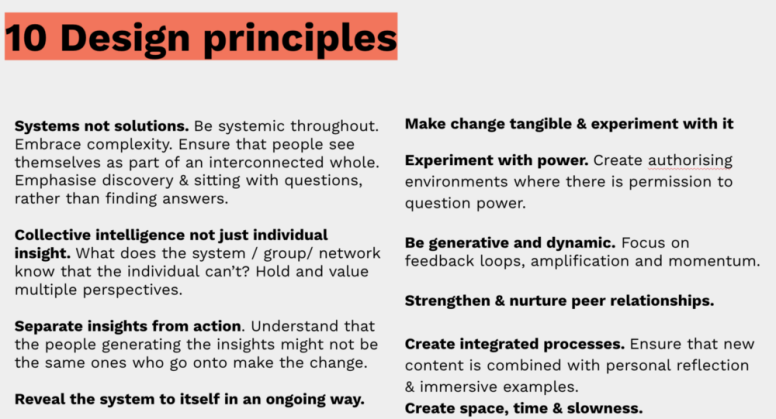
A few weeks ago, the Point People ran a one day workshop for Lankelly Chaseand their Place Based Associates, talking through some of the thinking, methods and tools we use for designing systemically for change.

This is part of the Point People’s ongoing relationship with Lankelly Chase to help build the field of ‘systems change’ and especially the need that we all feel to “democratise” it. My colleague Ella Saltmarshe is writing a longer blog post about that, coming soon!

The idea of the day was that through us sharing *how* we do things, those that joined the session could go away and use some of tools in their own work — all of whom are involved in place-based systems change. Some of the participants included CollaborateMEAM and Save The Children’s Local Systems Change team.

We tried to deliver the session in a way that made practical sense — when might the different tools and approaches be useful? How do you use them? And with whom?

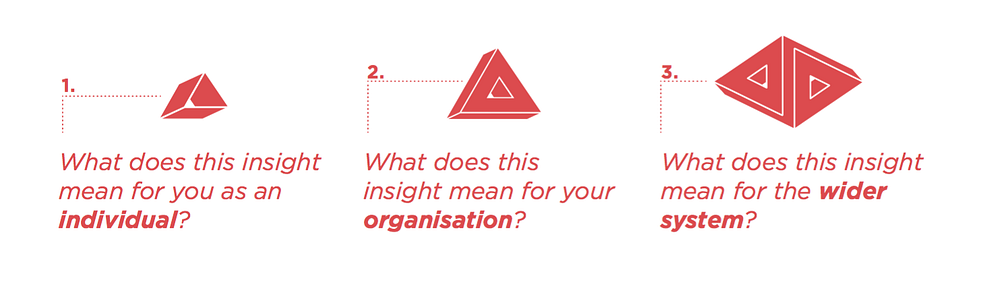
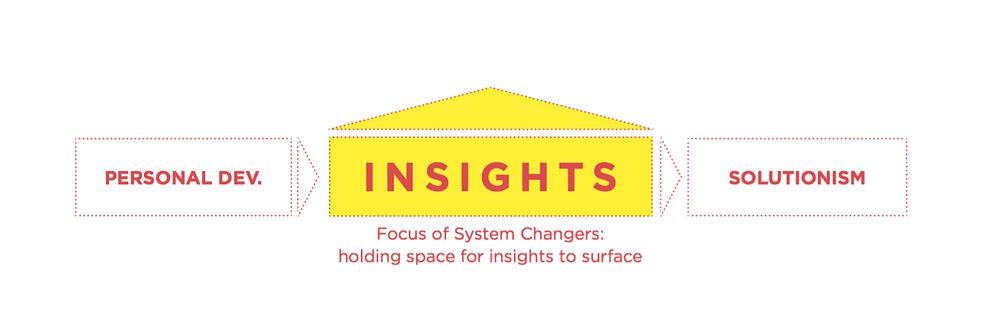
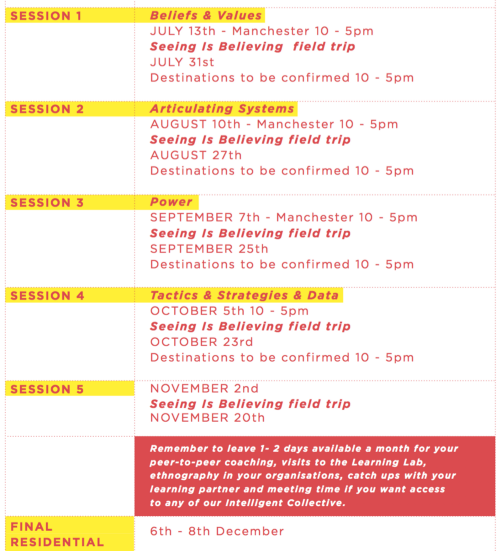
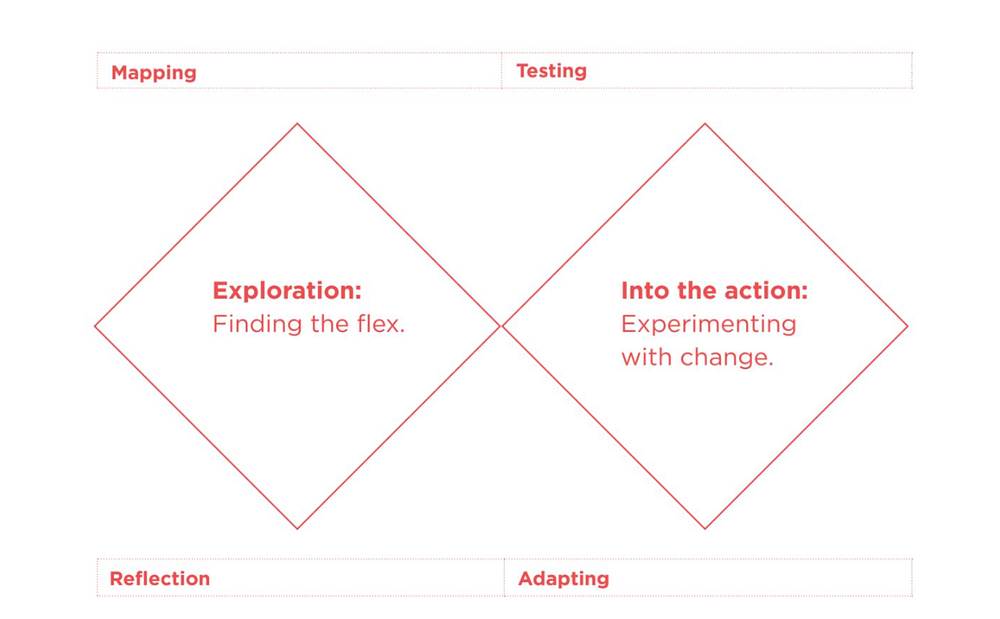
The slides we created for the session are hereThey show the different elements of the Systems Changers programme (Seeing the System, Finding Flex, Experimenting with Change), some of the tools and methods we use, and when we use them. We hope people find them useful.

After the session I reflected (and then tweeted) on how organisations doing “systems change” work need to get much better at describing, in detail, what they actually do. It was also one of the things that made our work for Agenda(#awomansplace) really challenging— when we were doing interviews with ‘systems change practitioners’ they seemed to find it incredibly hard to get down to detail.

I think there’s a lot of..

“Build coalitions and relationships across the system”

“Work with power”

“Build empathy and trust”

“Agree on shared outcomes”

“Demonstrate generous leadership” etc etc…

….but if people want these approaches to spread then what’s needed is a much more granular telling and showing of the *how* — hence my tweet.

Thank you to Ella Saltmarshe and Jennie McShannon, my co-designers and co-facilitators on the day.