
See below for a rich list of articles. I note from a quick google that MDPI is a not entirely uncontroversial publisher (https://en.wikipedia.org/wiki/MDPI seems balanced) – broadly it seems that they are not on ‘predatory journals’ lists but their academic quality has sometimes been called into question. However, some interesting titles here and you can judge for yourself.
Category Archives: Discussion
A view or perspective on the world




It’s a wicked problem, stupid! (revisited) | CSL4D
A bit over 5 years ago I first learned about wicked problems. So I looked at the oft-cited seminal article by Rittel & Webber of 1973 and tried to make sense of it (see old post). There was a lot of information in the article, which made it a bit confusing. The most often quoted part of the article is the list of ten characteristics of wicked problems. These ten points seem to be clear to most people, but to me it remained a bit cryptical. Time for a second effort. I will make use of a second paper by Rittel entitled ‘On the planning crisis’ of 1972 (presented 1971). The reader must bear with me, because both papers are very long (on average over 8240 words each), rich and profound. I am pretty sure the essence of Rittel’s work has been properly condensed now. Here we go.
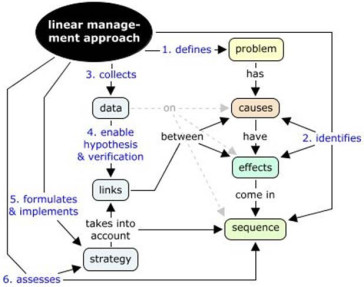
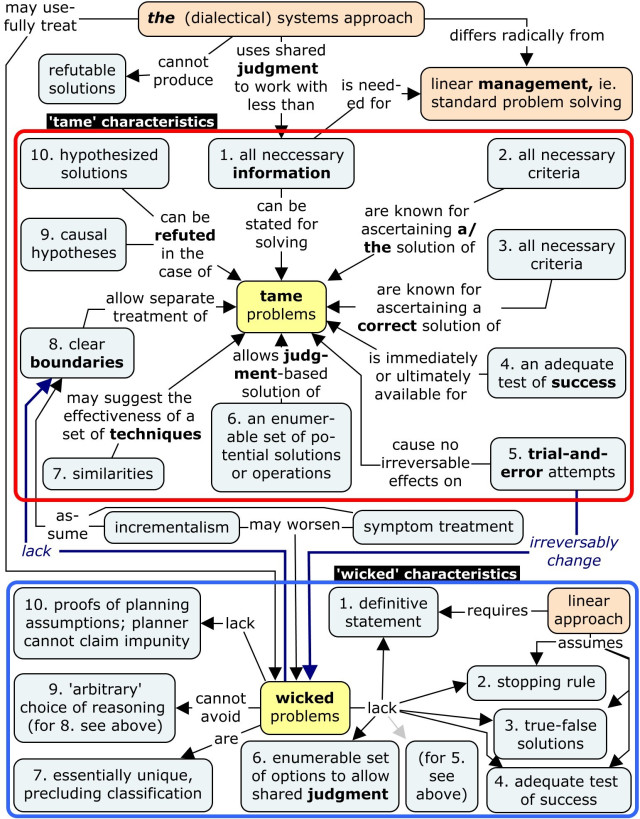
[Continues in source]: It’s a wicked problem, stupid! (revisited) | CSL4D
Ritual anti-structure as an alternate pathway to social complexity
“There is growing dissatisfaction with the traditional approach to the evolution of complex societies, which treated it principally as a sequence of transformations toward political centralization driven by the construction of increasingly vertical hierarchies by a powerful elite.”
[Aha! As I suspected, yet more proof that lazy tropes are lazy tropes… if anyone gives you a linear progressive narrative of history, they’re selling something. Don’t buy it! Don’t buy it!]
Connecting the Purpose(s) – Intelligente-Organisationen
Connecting the Purpose(s)

The VSM as a Way of Looking at the World and How to Align Visions in Order to Create a Unifying Meta-Purpose
The discussions about the so called „Organizational Purpose“ have reached in recent years a new level – at least in my perception. Of course there always was (and will be) a never ending debate about what the „true“ purpose of an organization might be. I am pretty sure, that it is crucial to distinguish between the imagined/visionary purpose and the results an organization „really“ achieves. The imagined/visionary purpose is here purely a mental projection or a bet on how the future might look like. There is the definition of Stafford Beer who said that the purpose of an organization is what it does – in short POSIWID. This distinction is important, because people often mix up the Purpose of an Organization and its Vision. In this respect I am a great fan of looking at the Imagined Purpose (aka Vision) and Achieved Purpose (aka Production) separately.
For the Reflective Practitioner, who does not only want to understand how the „thing“ works, as an Expert would do, two questions arise: what should one do with the above mentioned distinction in the real world, in a real company with existing constraints? How to deal with the difference of the imagined outcomes and truly achieved goals?
For me and my cognitive biased brain the VSM offers an elegant, plausible and aesthetic way to understand this pseudo-paradox and connect the different functional and systemic (Sub-) Purposes of a System (in the context of the VSM).
Micro Excursion I
Elegance, Plausibility and Aesthetics are not necessarily parameters in a scientific way of thinking. They could promote the distribution of Bullshit and must be treated with greatest skepticism. Nevertheless I use them as indicators, if a solution is simple enough, but not too simple (in order to re-phrase Albert Einstein).
How can the VSM help to connect the different Functional (skill and task related) and the Systemic (VSM-like) Purposes of an Organization?
This question might sound quite academic, but out there in the wild life of business I do see an urging relevance for the topic mentioned in the headline. It needs in economic/social systems an integrated way to connect the Functional Purpose of the different units with the VSM-System-specific responsibilities. It’s about enabling a „Holistic Whole“. The following example might be useful to illustrate the application of the VSM for this matter.
Continues in source: Connecting the Purpose(s) – Intelligente-Organisationen
Improvisation Blog: Redundancy and the Communication of Meaning in Music: Bach’s 3-part Invention (Sinfonia) no. 9 in F minor
Saturday, 21 July 2018
Redundancy and the Communication of Meaning in Music: Bach’s 3-part Invention (Sinfonia) no. 9 in F minor
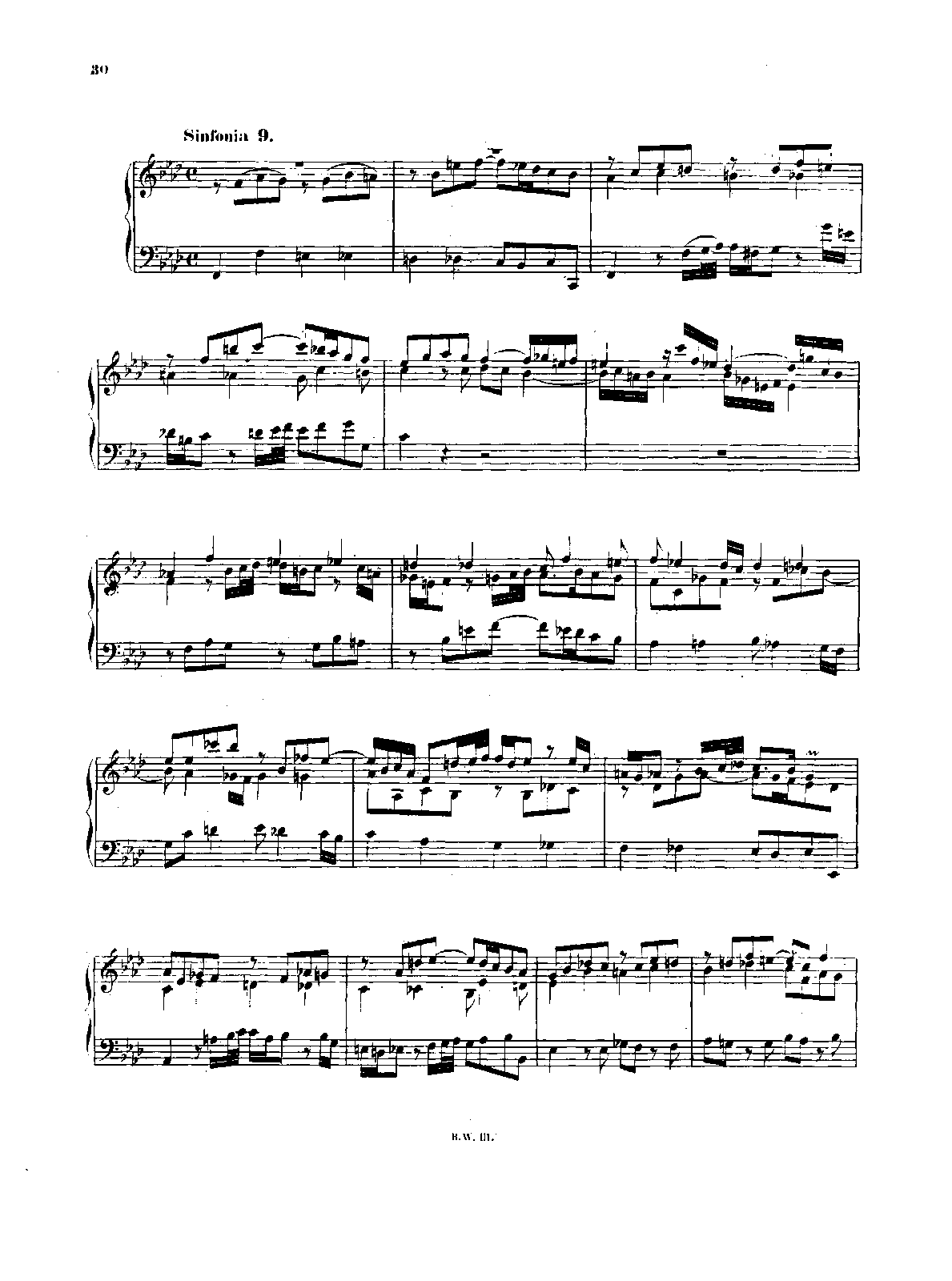
Hindemith chose Bach’s F minor 3 part invention for analysis to demonstrate his theory of composition in “The craft of musical composition”. It is a fascinating piece – one of Bach’s most chromatic and expressive pieces of keyboard writing, and rather like other extraordinary musical moments (like Wagner’s musical orgasm in Tristan), it raises the question “What is going on?”. I like Hindemith’s theory very much (although not as much as I like his music!), but his analysis sent me on my own analytical journey through the lens of information theory.

What happens in music, I believe, is the unfolding of a structure where multiple constraints are interwoven and overlaid. Information theory can provide some insight into this (as is discussed in a very recent paper from Loet Leydesdorff, myself and Inga Ivanova in the Journal of the Association for Information Science and Technology: https://onlinelibrary.wiley.com/doi/full/10.1002/asi.24052), and particularly the meaningfulness of the communication.
When considering music from the perspective of information theory, there are three fundamental problems to be overcome:
- Music has no object of reference. So how is meaning communicated without reference?
- Music emerges over time, producing novelty and unfolding a diachronic structure which appears to be linked to its synchronic structure. For this reason, music is not ergodic, unlike the use of letters in a language: its entropy over one period of time is not the same as its entropy over a different period of time.
- Music’s unfolding novelty is not arbitrary: novelty in music appears to be a symmetry-breaking process similar to that found in epigenesis where both synchronic and diachronic symmetries gradually define structure
The first page of Bach’s music looks like this:
Here’s a performance:
The piece is fugal, and obviously in three parts, there is a very bare texture, and this bareness seems to contribute to the expressiveness of the music. However, there is a harmonic structure which is articulated throughout the piece, and a reduction of the harmonic written as chords per beat, looks something like this:

This kind of harmonic reduction is very common in music analysis as a method for getting at the “deep structure” of music (particularly in Schenker). It is typical of Bach’s music that the harmonic reduction is very much like a chorale (hymn). In trying to understand how Bach’s music works, we can start by asking about the relation between the harmonic reduction and the finished piece.
At first glance, from an information theory perspective, the block chords of the reduction seem to remove a considerable amount of entropy which exists in the movement of parts in the original. It does this by compressing the variety into single “beats”, which taken as an entirety have an entropy of 1. However, the variety compression makes more apparent the shifting harmonies. Written in chord symbols, this is an extended I (tonic) – V (dominant) – I (tonic) movement, interspersed with diminished chords (which are harmonically ambiguous) and a oscillation between major and minor chords. But if one was to calculate the entropy of the harmony, it wouldn’t be that great.
Continues in source: Improvisation Blog: Redundancy and the Communication of Meaning in Music: Bach’s 3-part Invention (Sinfonia) no. 9 in F minor
An artificial life approach to the origins of the genetic code
a very interesting approach to using embodiment as an explanatory principle for origins of life.
“A growing number of artificial life researchers propose that making progress on the problem of the origins of life requires taking seriously life’s embodiment: even very simple life-like systems that are spatially individuated can interact with their environment in an adaptive manner. This behavior-based approach has also opened up new perspectives on a related unsolved problem, namely the origin of the genetic code, which can now be seen as emerging out of iterated interactions in a community of individuals. Thus, artificial life demonstrates that the dominant scientific strategy of searching for the conditions of Darwinian evolution should be broadened to consider other possibilities of optimization.”
Release | Stakeholder Theory: A Luhmannian Perspective

Valentinov V., Roth S., and Will M. G. (2018), Stakeholder theory: A Luhmannian perspective, Administration and Society, online first [SSCI 1.761, Scopus, CNRS***, ABS**, VHB**].
Abstract: We explore the cross-fertilization potential between stakeholder theory and Niklas Luhmann’s social systems theory. Social systems, such as corporations or nonprofits, are defined by complexity reduction and operational closure, which may render them insensitive to their environment and undermine their sustainability. This vision resonates with stakeholder theory’s arguments on the importance of the corporate responsiveness to stakeholder interests. The suggested common ground between the theories yields novel insights into key concepts of stakeholder theory such as the contrast between the jointness of stakeholder interests and trade-off thinking, the normativity of the stakeholder idea, and the meaning of corporate social responsibility.
Keywords: stakeholder theory, social systems theory, Niklas Luhmann, normativity, organizational multifunctionality.
Full article available for download here.
Understanding Society blog: Downward causation
Tuesday, July 17, 2018
Downward causation
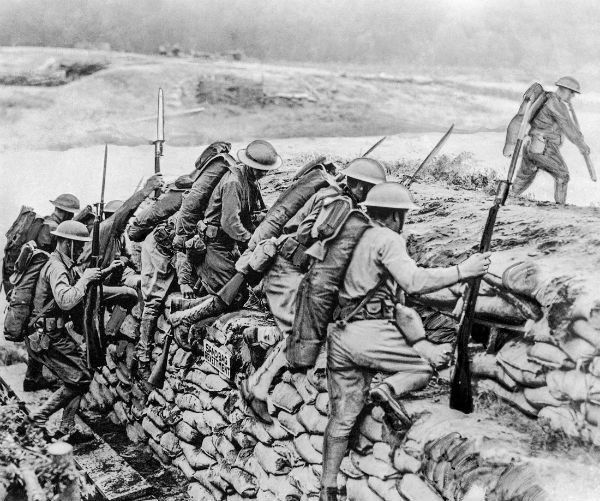
I’ve argued for the idea that social phenomena are generated by the actions, thoughts, and mental frameworks of myriad actors (link). This expresses the idea of ontological individualism. But I also believe that social arrangements — structures, ideologies, institutions — have genuine effects on the actions of individual actors and populations of actors and on intermediate-level social structures. There is real downward and lateral causation in the social world. Are these two views compatible?
I believe they are compatible.
The negative view holds that what appears to be downward causation is really just the workings of the lower-level components through their aggregation dynamics — the lower struts of Coleman’s boat (link). So when we say “the ideology of nationalism causes the rise of ultraconservative political leaders”, this is just a shorthand for “many voters share the values of nationalism and elect candidates who propose radical solutions to issues like immigration.” This seems to be the view of analytical-sociology purists.
But consider the alternative view — that higher level entities sometimes come to possess stable causal powers that influence the behavior and even the constitution of the entities of which they are composed. This seems like an implausible idea in the natural sciences — it is hard to imagine a world in which electrons have different physical properties as an effect of the lattice arrangement of atoms in a metal. But human actors are different from electrons and atoms, in that their behavior and constitution are in fact plastic to an important degree. In one social environment actors are disposed to be highly attentive to costs and benefits; in another social environment they are more amenable to conformance to locally expressed norms. And we can say quite a bit about the mechanisms of social psychology through which the cognitive and normative frameworks of actors are influenced by features of their social environments. This has an important implication: features of the higher-level social reality can change the dispositions and workings of the lower-level actors. And these changes may in turn lead to the emergence of new higher-level factors (new institutions, new normative systems, new social practices of solidarity, …). So enduring social arrangements can cause changes in the dynamic properties of the actors who live within them.
Could we even say, more radically and counter-intuitively, that a normative structure like extremist populism “generates” behavior at the individual level? So rather than holding that individual actions generate higher-level structures, might we hold that higher-level normative structures generate patterns of behavior? For example, we might say that the normative strictures of patriarchy generate patterns of domination and deference among men and women at the individual level; or the normative strictures of Jim-Crow race relations generate individual-level patterns of subordination and domination among white and black individuals. There is a sense in which this statement about the direction of generation is obviously true; broadly shared knowledge frameworks or normative commitments “generate” typical forms of behavior in stylized circumstances of choice.
Does this way of thinking about the process of “generation” suggest that we need to rethink the directionality implied by the micro-macro distinction? Might we say that normative systems and social structures are as fundamental as patterns of individual behavior?
Consider the social reality depicted in the photograph above. Here we see coordinated action of a number of soldiers climbing out of a trench in World War I to cross the killing field of no mans land. The dozen or so soldiers depicted here are part of a vast army at war (3.8 million by 1918), deployed over a front extending hundreds of miles. The majority of the soldiers depicted here are about to receive grievous or mortal wounds. And yet they go over the trench. What can we say about the cause of this collective action at a specific moment in time? First, an order was conveyed through a communications system extending from commander to sergeant to enlisted man: “attack at 7:00 am”. Second, the industrial wealth of Great Britain permitted the state the ability to equip and field a vast infantry army. Third, a system of international competition broke down into violent confrontation and war, leading numerous participant nations to organize and fund armies at war to defeat their enemies. Fourth, the morale of the troops was maintained at a sufficiently high level to avoid mass desertion and refusal to fight. Fifth, an infantry training regime existed which gave ordinary farmhands, workers, accountants, and lords the habits and skills of infantry soldiers. All of these factors are part of the causal background of this simple episode in World War I; and most of these factors exist at a meso- or macro-level of social organization. Clearly this particular group of social actors was influenced by higher-level social factors. But equally clearly, the mechanisms through which these higher-level social factors work are straightforward to identify through reference to systems of individual actors.
Think for a minute about materials science. The hardness of titanium causes the nail to scratch the glass. It is true that material properties like hardness depend upon their microstructures. Nonetheless we are perfectly comfortable in attributing real causal powers to titanium at the level of a macro-material. And this attribution is not merely a way of summarizing a long story about the micro-structure of metallic titanium.
I’ve generally tried to think about these kinds of causal stories in terms of the idea of microfoundations. The hardness of titanium derives from its microfoundations at the level of atomic and subatomic causation. And the causal powers of patriarchy derive from the fact that the normative principles of partriarchy are embedded in the minds and behavior of many individuals, who become exemplars, enforcers, and encouragers of compliant behavior. The processes through which individuals acquire normative principles and the processes through which they behaviorally reflect these principles constitute the microfoundations of the meso- and macro-power of patriarchy.
So the question of whether there is downward causation seems almost too easy. Of course there is downward causation in the social world. Individuals are influenced in their choices and behavior by structural and normative factors beyond their control. And more fundamentally, individuals are changed in their fundamental dispositions to behavior through their immersion in social arrangements.
Systems Studio newsletter July 2018
[As usual, the excellent monthly newsletter from The Systems Studio]
|
|


|
|
|
|

|

C. West Churchman with Kristo Ivanov | 1987 | archive.org
Video is viewable through an online viewer, and downloadable in multiple formats (h264 MP4, MPEG2 VOB, OGG Video) on the Internet Archive at https://archive.org/details/Index_20180206_1053 . This recording was producted by the department of Informatics of Umeå University in the spring of year 1987, with C. West Churchman interviewed by Kristo Ivanov.

The opening title reads:
Professor C. WEST CHURCHMAN
Universicy [sic] of California, Berkeley
Interviewed by professor
Kristo Ivanov
on April 30, 1987,
at the University of Umeå ,
Sweden – department of
Administrative Data processing.
The second and third slide read …
This interview was made during a visit of professor Churchman as guest lecturer at the University of Umeå , following his being rewarded a honorary doctor’s degree in economic science in the autumn 1985.
A summary of professor Churchman’s life and work is given at the end of the recording.
The background song “Der Lindenbaum” – music by Franz Schubert and text by Wilhelm Müller – is sung by professor Churchman himself!
Via:
- “Interview with C. West Churchman (video)” | Benjamin P. Taylor | July 1, 2018 at https://stream.syscoi.com/2018/07/01/interview-with-c-west-churchman-video/
- “Interview with C. West Churchman (video)” | Sjon van ‘t Hof | July 1, 2018 | C2L4D (Concepts & Systems Learning for Systemic Agency) at https://csl4d.wordpress.com/2018/07/01/interview-with-c-west-churchman-video/
System change consulting skills programme | Health Education England
System change consulting skills programme
Healthcare leaders are increasingly required to facilitate transformational change in and across their system and organisations, often without power or authority.
Invitation to apply
Senior healthcare professionals working on a transformational change project or leading/supporting a strategic, complex system change are invited to apply. Alternatively, you may be a senior OD/HR or transformation professional working in and/or supporting others with transformational change projects? For example:
- a clinician leading transformation programmes associated with The Sustainability Transformation Planning (STP) / Integrated Care Systems (ICS) / Accountable Care Organisation (ACS) new models of care, primary care home
- a senior leader working to strategically transform their organisation.
- a system change leader working across organisations
- a senior OD/HR and transformation professional working in strategic OD
This programme will provide you with an intensive development experience designed to extend your confidence and skills to step into a system change leadership role utilising a system change consulting approach.
About the programme
The programme is highly experiential, using live, real time system transformation challenges experienced by participants. Learning is highly practical and can be readily applied between modules and in on-going work supported by a vibrant network of peer consultants.
Being an enabler and leader of transformational change across a system draws on a blend of relationally based consultancy skills, mindset, processes and techniques. How we connect with and relate to others impacts our ability to influence. Impactful and effective systems change agency isn’t simply about advocating a point of view, but rather how you choose to use your informal authority and presence to benefit the wider system.
The programme will help you to:
- Be a confident, competent and courageous system change leader who can collaborate well, and influence system change and transformation ‘in place’ across your local healthcare system
- Share the benefits of taking a more consultative and relationship-based approach to system-wide transformation, and follow a consultancy-led process
- Have greater levels of self-awareness and a deeper understanding of how you impact others, how to use yourself more effectively to enable transformation and change, and identify your future development needs
- Develop your perspective and mindset as to what creates successful transformation across the system and draw on a range of tools and approaches to assist you.
- Identify how you could use your skills as a change leader and facilitator to work at a system level and support system-wide transformation outside your current organisation in the future.
There is an expectation that following the programme you will be more involved in working across your local healthcare system to support wider system transformation projects or work-streams.
Application process
Participation on the programme is dependent on a successful application , submitted by 25 July 2018. Participants should have ready opportunity for involvement in systems change/transformation projects
For further information contact leadershipenquiries.yh@hee.nhs.uk in the first instance.
Source: System change consulting skills programme | Health Education England
New article on entraining chaotic dynamics
woah… mind ‘splode.
literally… metaphorically.
“Use of Self as an Instrument of Change” Study – thanks to CoCreative Consulting newsletter, plus other links
Thanks to the excellent newsletter from the excellent CoCreative Consulting (The Work is Growing! News, resources, and tools for system change – have a look for much more on collaboration, systems change, and network building), I found this piece:
“Use of Self as an Instrument of Change” Study
Dr. Mee-Yan Cheung-Judge of Quality & Equality and Professor David W. Jamieson of the University of St. Thomas have released an intriguing new survey about how we as change leaders use ourselves intentionally as instruments of change. Although the research team is focused on the field of OD, we got permission to invite people who are leading and facilitating change in larger systems. With over 137 assessment items (the intent of the survey is to narrow their future inquiry), we found the survey to be a useful and compelling tool for self-reflection.To participate, you must have 5 or more years of OD practice experience, internally or externally, or 5 years of actively facilitating complex systems change. Find more information here
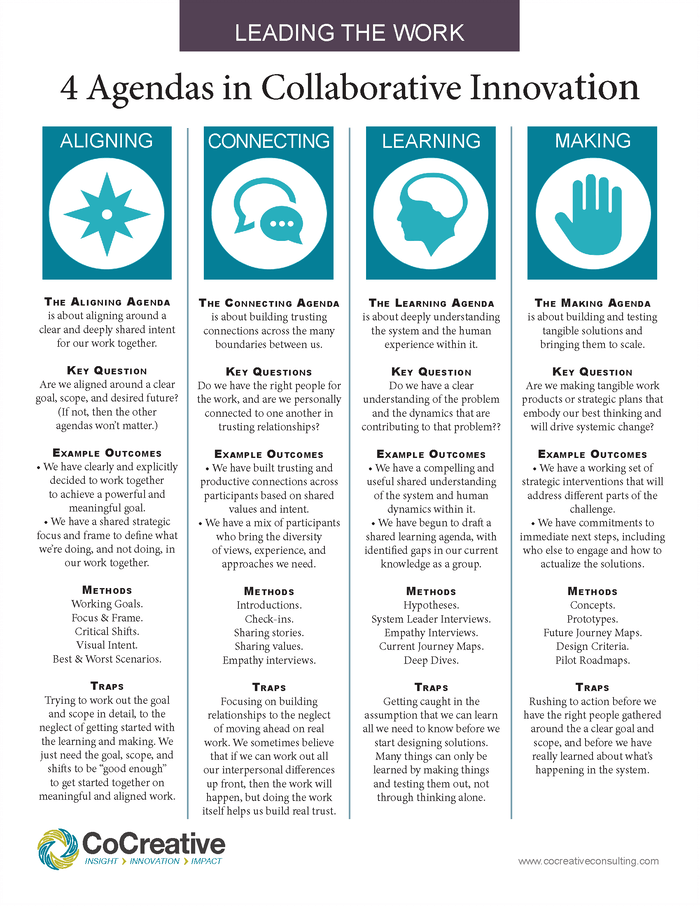
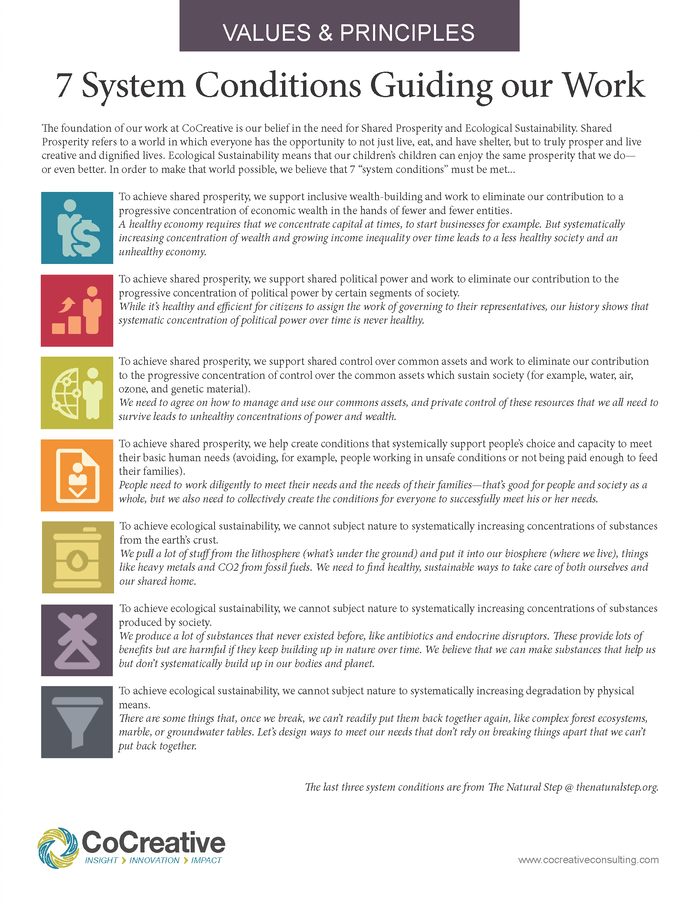
Also, (links with further info in newsletter link at top), two great visual pieces – agendas in collaborative innovation, and systems conditions guiding their (CoCollaborative) work:
Living Systems | James Grier Miller | 1978
The 1100+ page Living Systems book published in 1978 by the founder of Behavioral Science in 1956, James Grier Miller, became available as a softcopy on the Internet Archive in May 2017.
What is a living system and what does it do? Many scientists coming from diverse scientific backgrounds, when engaged in the search for general principles to integrate our understanding of the phenomena of life, have placed major emphasis on the notion of living systems composed of interrelated units. The various “systems theories” differ greatly in their concepts and definitions of basic terms. Their common goal is to organize the findings in some or all of the sciences of life and behavior into a single conceptual structure.
1. One general theory of living systems
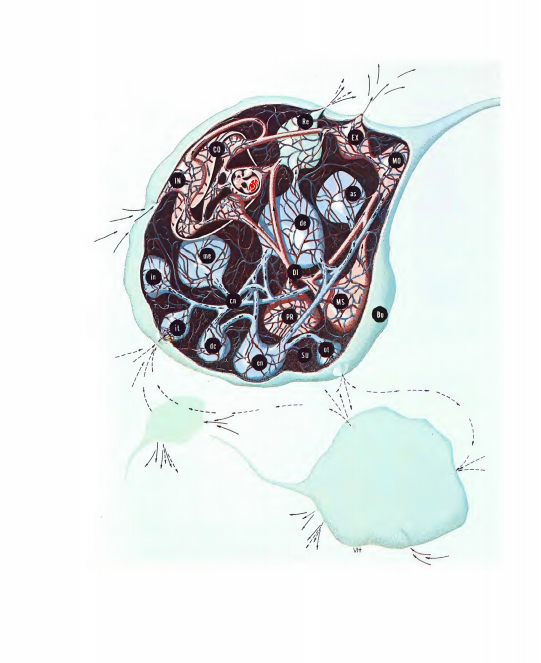
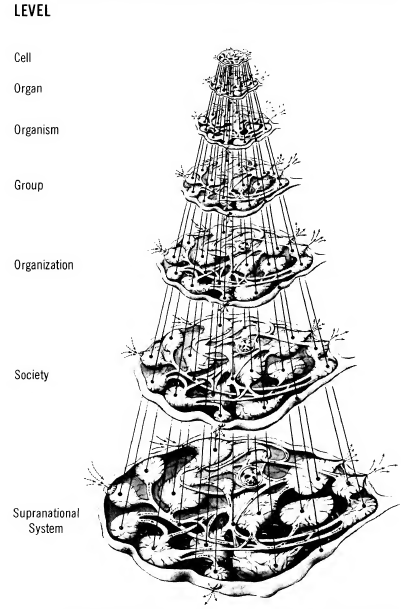
The general living systems theory which this book presents is a conceptual system concerned primarily with concrete systems (see page 17) which exist in space-time. Complex structures which carry out living processes I believe can be identified at seven hierarchical levels (see page 25) — cell, organ, organism, group, organization, society, and supranational system. My central thesis is that systems at all these levels are open systems composed of subsystems which process inputs, throughputs, and outputs of various forms of matter, energy, and information. I identify 19 critical subsystems (see page 32 and Table 1-1) whose processes are essential for life, some of which process matter or energy, some of which process information, and some of which process all three. Together they make up a living system, as shown in Fig. 1-1. In this table the line under the word “Reproducer” separates this subsystem from the others because that subsys- tem differs from all the others by being critical to the species or type of system even though it is not essen- tial to the individual. Living systems often continue to exist even though they are not able to reproduce. Subsystems in different columns which appear oppo- site each other have processes with important similar- ities — for instance, the processes carried out by the ingestor for matter and energy are comparable to those carried out by the input transducer for information. In general the sequence of transmissions in living systems is from inputs at the top of Table 1-1 to outputs at the bottom, but there are exceptions. [p. 1]
Fig. 1-1 A generalized living system interacting and intercommunicating with two others in its environment.
Subsystems which process both matter-energy and information: Reproducer (Re); Boundary (Bo).
Subsystems which process matter-energy: Ingestor (IN); Distributor (DI); Converter (CO); Producer (PR); Matter-energy storage (MS); Extruder (EX); Motor (MO); Supporter (SU).
Subsystems which process information: Input transducer (IT); Internal transducer (IN); Channel and net (CN); Decoder (DC); Associator (AS); Memory (ME); Decider (DE); Encoder (EN); Output transducer (OT). [p. 2]
Systems at each of the seven levels, I maintain, have the same 19 critical subsystems. The structure and processes of a given subsystem are more complex at a more advanced level than at the less advanced ones. This is explained by what I call the evolutionary principle of “shred-out,” a sort of division of labor (see Fig. 1-2). Cells have the 19 critical subsystems. When mutations occurred in the original cells, the mutant could continue to exist only if it could carry out all the essential processes of life of the 19 subsystems; otherwise it would be eliminated by natural selection. The general direction of evolution is toward greater complexity. As more complex cells evolved, they had more complex subsystems, but still the same 19 basic pro- cesses. Similarly as cells evolved into more complex systems at advanced levels — organs, organisms, and so on — their subsystems shredded out into increasingly complicated units carrying out more complicated and often more effective processes. If at any single point in the entire evolutionary sequence any one of the 19 subsystem processes had ceased, the system would not have endured. That explains why the same 19 subsystems are found at each level from cell to supra- system. And it explains why it is possible to discover, observe, and measure cross-level formal identities (see page 17). [pp. 1,4]
Fig. 1-2 Shred-out. The generalized living system (see Fig. 1-1) is here shown at each level. The diagram indicates that the 19 subsystems at the level of the cell shred out to form the next more advanced level of system, the organ. This still has the same 19 subsystems, each being more complex. A similar shredding-out occurs to form each of the five more advanced levels — organism, group, organization, society, and supranational system. [p. 4]For each subsystem I identify about a dozen variables representing different aspects of its processes. It would be easy to identify more if one wanted an exhaustive list. Each of these variables can be measured at each of the levels, and the sorts of variation discovered can be compared across the levels. The interactions between two or more variables in a single subsystem or in multiple ones can also be observed, measured, and compared across the levels. This is how cross-level formal identities, basic to a general theory of living systems, can be examined (see page 27).
This book is an effort to integrate all the social, biological, and physical sciences that apply to structure or process at any of the seven levels. Physiology, biochemistry, genetics, pharmacology, medicine, economics, political science, anthropology, sociology, and psychology are all almost entirely relevant. Physical science and engineering also contribute. Logic, mathematics, and statistics yield methods, models, and simulations, including some involving the relatively new approaches of cybernetics and information theory. [p. 4]
References
Miller, James Grier. 1978. Living Systems. McGraw-Hill. https://archive.org/details/LivingSystems.
Behavioral Science, A New Journal | 1956 | James Grier Miller
The founding of Behavioral Science in 1956, with James Grier MIller as the founding editor, was sponsored through research into mental health. This interdisciplinary approach was a precursor to the organization now labelled as the International Society for the Systems Sciences.
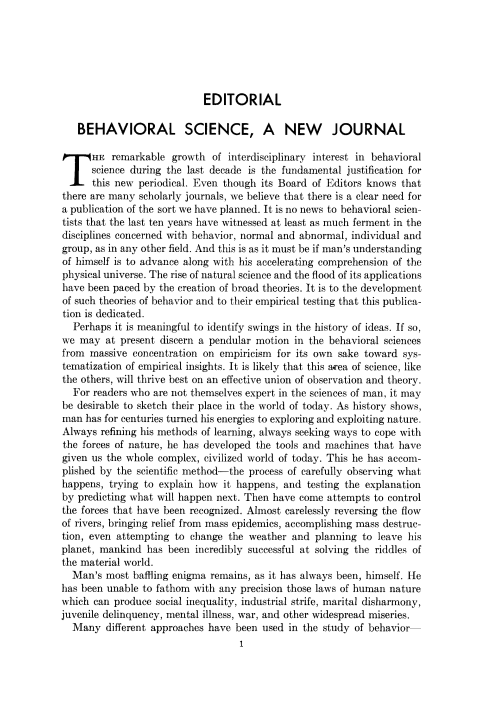
The remarkable growth of interdisciplinary interest in behavioral science duirng the last decade is the fundamental justification for this new periodical. [….]
Man’s most baffling enigma remains, as it has always been, himself. He has been unable to fathom with any precision those laws of human nature which can produce social inequality, industrial strife, marital disharmony, juvenile delinquency, mental illness, war, and other widespread miseries. [p. 1]
Many different approaches have been used in the study of behavior — mathematical biology, biochemistry, physiology, genetics, medicine, psychiatry, psychology, sociology, economics, politics, anthropology, history philosophy, and others. Though the term “interdisciplinary” is widely current, and for a long time efforts a t collaboration have been made, true unification of these fields still remains an unattained goal. And within each are various schools. Their approaches and skills are specific, but the problems are general. Can the scientific method solve the larger, more pervasive questions about man as well as the smaller, more particular ones? Is the tool with which man has won his victories over the physical world applicable to uncovering the laws which govern man’s conduct, the deepest causes of our strife and our harmony? If the fragments of multiple sciences were brought together in a unitary behavioral science and all the separate skills focused on the study of human behavior, perhaps the time required to find answers to these questions could be reduced. It is possible that inadequacies in the present studies of man could thus be avoided. The uniformities among disciplines could be recognized; better communication among them established ; generality of findings magnified; additional benefits derived from comparing theories in diverse fields, explaining both similarities and differences; and the validity and applicability of empirical work increased by planning individual studies as components of an explicit mosaic of research strategy. [pp. 1-2]
About 1949 a group of faculty members at the University of Chicago, some of whom have now moved to the University of Michigan, began to consider whether a sufficient body of facts exists to justify developing empirically testable general theories of behavior. This group used the term “behavioral science” to cover the diverse areas of their interests, primarily because its neutral character made it acceptable to both social and biological scientists.
Most of the participants were at first skeptical that our comprehension of these different areas had advanced sufficiently to justify such activity. The first meetings engendered a general hopelessness as the diversity of languages and the multitude of approaches to the study of man became increasingly apparent. But then we began to see among us certain commonalties of thinking, despite their many linguistic disguises, and this agree- ment gave us hope that our efforts were not unrealistic.
Members of this group have met intensively for several years as the Committee on Behavioral Science at the Universit,y of Chicago. Some are continuing this activity at Chicago; others went to staff the new Mental Health Research Institute, established in August, 1955, at the University of Michigan; and there they were joined by still others. The Regents of the University and the Legislature of the State of Michigan established this Institute on a permanent basis. [p. 2]
The aim is to conduct basic research; the expectation, that from such research will flow contributions, particularly in the field of mental health and disease, that will help to solve the many problems of human relations. Our understanding of mental illness is primitive compared with our knowledge of other forms of disease, partly because of the complexity of the problems and partly because research efforts have not been commensurate with their magnitude. Public interest in these issues is growing rapidly, as evidenced by the new or greatly increased appropriations for investigation by state legislatures and the Congress, and by additional support from foundations. [pp. 2-3]
In this area of behavioral science there are numerous schools with conflicting beliefs. No one as yet has seen how the insights of psychodynamics, the projective techniques of psychology, the facts of neuropathology, the discoveries of endocrinology, biochernistry, and neurophysiology , and the concepts of social science can be merged into a single framework for explaining the biological and psychiatric and social phenomena of mental illness. There is need now for renewed and exhaustive examination of these separate matters, and for creative attempts to integrate them, to test them empirically, and to apply them.
Such studies should be carried out at various levels. Our present thinking-which may alter with time-is that a general theory will deal with structural and behavioral properties of systems. The diversity of systems is great. The molecule, the cell, the organ, the individual, the group, the society are all examples of systems. Besides differing in the level of organization, systems differ in many other crucial respects. They may he living, nonliving, or mixed; material or conceptual; and so forth.
The strategy of the Michigan Institute’s work will emphasize identification of general principles, which extend across various levels of systems. We shall attempt to clarify and make precise both the general principles and the particular differences; and to test — in laboratories and in clinics, by group studies and by social surveys, with whatever methods prove appropriate — the validity and usefulness of such analysis. Research techniques will probably be derived from several areas, including the physiological, psychological, economic, political, social and cultural.
Although the Institute expects to pay particular attention to the similarities and dissimilarities among different behaving systems, this is only one of many legitimate approaches to behavior theory. Behavioral Science, as a journal with wider scope than any single Institute, will welcome articles which are constructively critical of this orientation or which advance other alternative strategies, as well as articles which present relevant empirical studies. [p. 3]
This is the official publication of the Mental Health Research Institute at the University of Michigan. As such it wil contain edited records of roundtable discussions on theory and reports of other activities involving the Institute. It is hoped that Ann Arbor can in the summer offer its facilities as a meeting center for scientists, many from other institutions, who are concerned with behavior theory or mental health or with related experimental and clinical work. Reports of such conferences and workshops will also be included in this journal. [pp. 3-4]
Other centers are carrying out closely related work. The Committee on Behavioral Science at Chicago, for example, maintains its original interests, and other universities are supporting or planning comparable programs. A particularly significant focus of activity is the Center for Advanced Study in the Behavioral Sciences established by the Ford Foundation and located at Stanford, California. This journal will welcome contributions from scholars a t these centers or elsewhere. It should serve as one channel of communication for members of the ever-increasing group engaged in advancing the sciences of man.
We are aware of no present journal with a primary policy of making its pages available to representatives of any field-the humanities, the social sciences, the biological and medical sciences, and the physical sciences — to discuss theory concerning behavior, and empirical studies clearly oriented to such theory. It has been rare for physicists, psychiatrists, political scientists, and historians to publish in, or even read, the same journal. We shall strive to achieve this end.
[….]
Franz Alexander
Alex Bavelas
David Easton
Ralph W. Gerard
Clyde Kluckhohn
Donald G. Marquis
Jacob Marschak
Anatol Rapoport
Ralph W. Tyler
Raymond W. Waggoner
Some this history is more fully explicated in the 2010 book The Science of Synthesis: Exploring the Social Implications of General Systems Theory, by Debora Hammond.
References
Alexander, Franz, Alex Bavelas, Ralph W. Gerard, Donald G. Marquis, Jacob Marschak, James G. Miller, Anatol Rapoport, Ralph W. Tyler, and Raymond Waggoner. 1956. “Editorial: Behavioral Science, A New Journal.” Behavioral Science 1 (1): 1–5. https://doi.org/10.1002/bs.3830010102.
Hammond, Debora. 2003. The Science of Synthesis: Exploring the Social Implications of General Systems Theory. University Press of Colorado. http://books.google.com/books?id=skSMuZycpTwC , or at a library near you.
 Systems Community of Inquiry
You must be logged in to post a comment.