This workshop will be held at 15:30-17:30 CET (Central European Time)
Why a workshop on Systems Change?
Citizens’ assemblies (CAs) are chief among a range of participatory democratic tools considered to have potential for addressing the numerous technically and morally complex problems at the root of the polycrisis. As the crisis most advanced in public consciousness, climate citizens’ assemblies have gained particular traction in the past few years. However, many processes in this deliberative wave have struggled to address system-level aspects of the climate crisis, its connections to other crises, and the trade-offs inherent in a transformed, low-carbon future.
Guidance on how to design and evaluate deliberative processes on the climate crisis has become available in a short space of time, thanks to networks such as KNOCA. But few resources are currently available on how to design deliberative processes, climate or otherwise, to open discussion for the broader systemic transformations that are increasingly recognised as necessary.
Purpose of the workshop
In this workshop we will discuss how citizens’ assemblies can address underlying systemic issues at the heart of a genuinely transformative response to the environmental and social crises facing the planet today. The discussion will build on a presentation of a draft of new guidance on this very issue that will be published by the Centre for Climate Change and Social Transformation authored by Claire Mellier (Iswe Foundation) and Stuart Capstick (CAST).
Who is the workshop for?
This workshop is for policymakers, practitioners, researchers and other civil society actors who are interested in exploring whether citizens’ assemblies can be designed to grapple with systemic aspects of the polycrisis.
If you register before Wednesday May 17th you will recieve a draft of the new guideline.https://xwirx.mjt.lu/wgt/xwirx/u2l/form?c=2c7eecce
About the new guideline
In their presentation, Claire and Stuart will introduce a guideline that is intended to help policymakers, practitioners, researchers and other civil society actors consider how citizens’ assemblies can address underlying systemic issues at the heart of a genuinely transformative response to the environmental and social crises facing the planet today.
It focuses on power literacy as the key element that allows practitioners to understand how citizens’ assemblies can grapple with systemic aspects of present crises. It will illuminate the relationship between citizens’ assemblies, power, and systemic transformations through tangible examples, focusing on three previous climate assemblies that the authors had direct involvement in: the United Kingdom’s Climate Assembly (CAUK), France’s Convention Citoyenne pour le Climat (CCC), and the first transnational citizens’ assembly on the climate and ecological crisis, the Global Assembly (GA).
About the speakers
Claire Mellier, Facilitator and Researcher – Co-initiator and organiser of the Global Citizens’ Assembly – Iswe Foundation
What does it take to change a system? With 25 years of learning and experience we still don’t believe there’s a magic formula for systemic change. If there was, we’d all be doing it!So, we’re launching an enquiry:http://ow.ly/Aq9m50Oc55z#SystemsChange 1/3
The digital revolution changed everything. Everything, except management.
Managers of the digital age need operating models that are collaborative, ethical, and effective. Models that reveal opportunities for managers to deploy Agile and Lean methods, as well as complex situations where leadership means carefully creating the conditions for success. In other words, models that support managers’ transition from providing all the answers, to leaders who help clarify objectives and discover how to achieve them.
In this short book, I introduce The Chalice as an upgrade on the pyramid metaphor. The chalice represents an operating model that both puts customers on top and engages with the beliefs and diversity of the staff who create value for an entire ecosystem. Unique features of the chalice include:
Connecting prioritization and customer value delivery processes using feedback mechanisms as controls.
Structuring prioritization as a process, whose performance must be measured and improved.
Achieving predictable and agile delivery to customers by selecting only appropriate agile, or plan-driven, controls.
Revealing the tension sources that create conflicting priorities and confusion if not addressed directly.
Creating a pluralistic ecosystem that relies on collaboration and diversity to develop shared understanding and profit from innovation.
I provide just enough information in this book to share the big picture. I trust that more adventurous amongst you will try some of the ideas it generates in your imagination. Subsequent books will explore the sections of the chalice in more detail, building on this foundation.
Would you like to learn more about how to deal with complexity in policy analysis and evaluation?
We’re running the second iteration of the Handling Complexity training course in partnership with CECAN Centre for Evaluating Complexity Across the Nexus. The course is made up of 3-modules and is based on the Supplementary Guide to the Government’s Magenta book on evaluation:
Module 1 – Complexity and its Challenges for Policy and Evaluation Module 2 – Selecting an Appropriate Evaluation Approach Module 3 – Commissioning and Managing a Complex Evaluation
What does it mean to go back to the ground and learn the fading skills necessary to work the forest with our hands? To read the land assisted by tools we sight with our own eyes? To create new visions of old roles, such as a land steward or cottager?
I explore those thoughts and more with my guest today, Hazel, who some of you may know as Tom Ward.
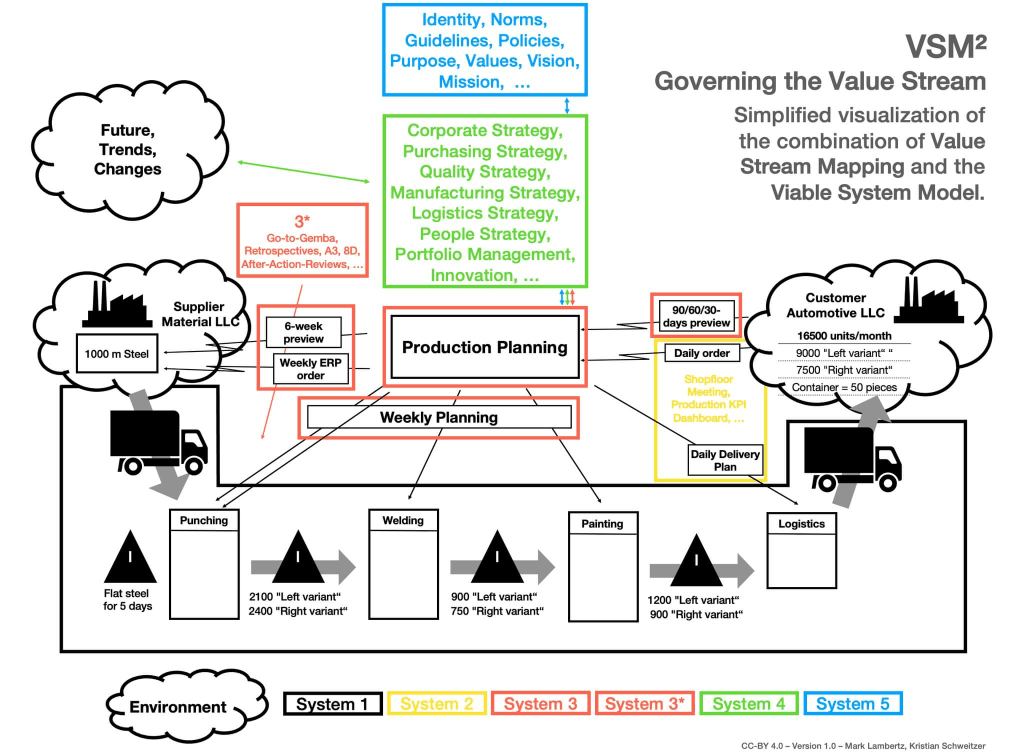
Exciting news! I am thrilled to announce the first version of the combination of Value Stream Mapping and the Viable System Model, known as VSM². This concept originated from a conversation that took place in 2017 between Kristian Schweitzer and me. With VSM², you can understand how to govern a value stream more clearly and precisely.
We believe that VSM² allows a holistic view of a value-creating system by integrating the input-output-logic of the Value Stream Mapping with the steering logic of the Viable System Model.
Kudos to Martin Pfiffner for the methodology to apply the Viable System Model and respective aspects like the coloring system for the model.
We look forward to sharing more updates on VSM² in the near future!
Call for Papers to a Research Day on Innovation Venue: Excelia Business School, La Rochelle, France Date: 23 May 2024. This research day is associated with a special issue of Creativity and Innovation Management [SSCI 3.644, CABS-AJG 2**, FNEGE Rank 3, 2**]. Organisation committee for the Research Day on Innovation Poonam Oberoi, Steffen Roth, and […]
In reviewing the original introduction for Systems Thinking: Selected Readings in the 1969 Penguin paperback, there’s a few threads that I only recognize, many years later.
In the selection of papers for this volume, two problems have arisen, namely what constitutes ‘systems thinking’, and what systems thinking is relevant to the thinking required for organizational management? The first problem is obviously critical. Unless there were a meaningful answer, there would be no sense in producing a volume of readings in systems thinking in any subject. A great many writers have manifestly believed that there is a way of considering phenomena which is sufficiently different from the well-established modes of scientific analysis to deserve the particular title of systems thinking. Reasons for believing that the distinction is of…




 Systems Community of Inquiry
You must be logged in to post a comment.