Carlos E. Perez on Twitter: “Why is top-down causation so problematic for many? Is it a consequence of their lifelong bias towards substance metaphysics?” / Twitter

Why is top-down causation so problematic for many? Is it a consequence of their lifelong bias towards substance metaphysics?

(2) Carlos E. Perez on Twitter: “Why is top-down causation so problematic for many? Is it a consequence of their lifelong bias towards substance metaphysics?” / Twitter

See also

https://stream.syscoi.com/2022/05/28/roche-human-biochemical-pathways/

The golden age of complexity science books

pholme's avatarPetter Holme

Here is a list of complexity science books in a popular science style from when the hype was the biggest—from 1988 and a decade further*—and some very brief comments. Several of them are available at archive.org, as linked below. I’m pretty sure I forgot several. If so, I’ll add them later.

* I’m no longer the film buff I used to be, but this reminds me of the golden age of Hong Kong police action films which most fans agree, with surprisingly little discussion, was from 1984 to 1993. (And, yes, John Woo’sHard Boiledis the crown jewel of the genre.)

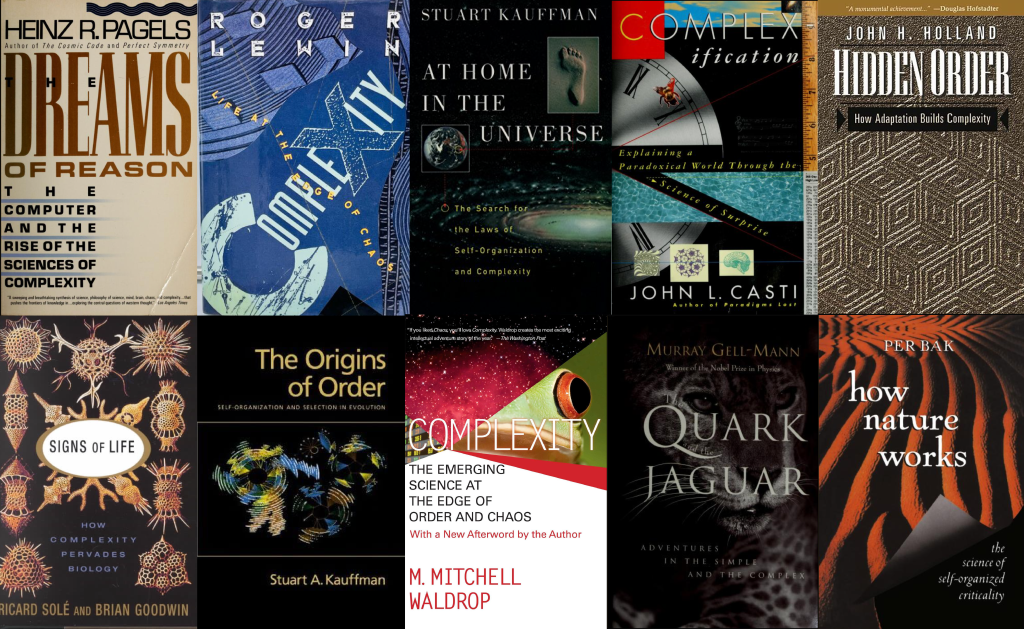
Covers of some of the books in this post.

HR Pagels, 1988.The Dreams of Reason: The Computer and the Rise of the Sciences of Complexity. Simon and Schuster, New York.

We’ll kick off with maybe the most remarkable of all these books (and the most interesting…

View original post 1,138 more words

Information theory: A foundation for complexity science

cxdig's avatarComplexity Digest

Amos Golan and John Harte

PNAS 119 (33) e2119089119

Modeling and inference are central to most areas of science and especially to evolving and complex systems. Critically, the information we have is often uncertain and insufficient, resulting in an underdetermined inference problem; multiple inferences, models, and theories are consistent with available information. Information theory (in particular, the maximum information entropy formalism) provides a way to deal with such complexity. It has been applied to numerous problems, within and across many disciplines, over the last few decades. In this perspective, we review the historical development of this procedure, provide an overview of the many applications of maximum entropy and its extensions to complex systems, and discuss in more detail some recent advances in constructing comprehensive theory based on this inference procedure. We also discuss efforts at the frontier of information-theoretic inference: application to complex dynamic systems with time-varying constraints, such as…

View original post 13 more words

Video: “An Overview of Systems Lineages and Implications for Research and Practice“, Deborah Hammond, ISSS meeting in Boulder, Colorado 2016

Linked from David Ing’s piece just shared,

2016 recording of a lecture by Debora Hammond on “An Overview of Systems Lineages and Implications for Research and Practice“, given a the ISSS meeting in Boulder, Colorado

Systems Thinking in Practice – Debora Hammond PhD on Vimeo

Genealogy of Systems Thinking | Debora Hammond | 2002

daviding's avatarIn brief. David Ing.

In the history of science of systems thinking, Debora Hammond related the backgrounds and connections of the founder of the Society for General Systems Research, that is now the International Society for the Systems Sciences.

Boulding (1956) plays a large role in framing two orientations towards “general systems theory”.

Kenneth Boulding used to distinguish between what he called ‘special’ general systems theory and ‘general’ general systems theory, the first oriented primarily around mathematical modeling and the second incorporating a more philosophical consideration of the ethical dimensions of systems. From my own perspective there are three primary orientations within the systems community. Each of the original founders reflects one or more of these orientations, with slightly different emphasis.

(1) Theoretical/Rational—Formal Models, Quantitative Analysis
(2) Applied/Empirical/Utilitarian—Interdisciplinary Problem Solving
(3) Normative—Humanistic, Anti-mechanistic [p. 426]

These three orientations reflect the motivations of why individuals might be interested in diving into a science…

View original post 1,105 more words

The Visual Cliff: Eleanor Gibson & the Origins of Affordance

David Ing surface this, saying:

The cybernetics tradition has been described as outmoded by the “perceptual ecology” of J.J. Gibson with affordances, says Erica Robles Anderson (NYU) and Scott Ferguson (U. South Florida).

Cybernetics has long been narrated as the paradigm that shaped human-computer interactions. Perceptual ecology reveals another path, equally foundational but ontologically distinct. Perceptual ecology is not concerned with signals, feedback loops, or uncertainty. It theorizes a sensory-rich, ever-changing world inhabited by animate perceivers. The terrain is a substance. The ground is a surface primordially differentiated from the sky at the horizon. The atmosphere is an immersive, boundless medium. Animate perceivers do not receive bits of information through discrete channels. Instead, they register the constant flux of light on surface as an “ambient optical array.” Persistent sensory information is called “invariance” and it corresponds to the “solid angles” in a shifting world.

“The Visual Cliff: Eleanor Gibson and the Origins of Affordance” | Erica Robles Anderson & Scott Ferguson | April 2022 at https://moneyontheleft.org/2022/04/19/the-visual-cliff-eleanor-gibson-the-origins-of-affordance/

Money on the Left's avatarMoney on the Left

By Erica Robles Anderson & Scott Ferguson

Originally presented at Hidden Histories: Gender in Design, Design History Society Seminar, April 14, 2022.

Part I: TED Talks and Teapots

In a 2003 TED Talk titled “Three Ways Design Makes You Happy,” Donald Norman announced that “The new me is beauty.” Norman – a professor, design firm principal, and the first Vice President of User Experience at Apple – ranks among the most influential figures in the field of user experience design. Yet above all, he is associated with the concept of “affordance,” an invented term now widely employed to refer to the forms and features of any useful thing.

Norman brokered the term from psychology to design in his 1988 book The Psychology of Everyday Things. Citing J.J. Gibson’s 1979 book The Ecological Theory of Perception as his source, he offered this definition: “The affordances of the environment are…

View original post 2,340 more words

Hypotheses Concerning Living Systems | James Grier Miller – Coevolving Innovations (David Ing)

Hypotheses Concerning Living Systems | James Grier Miller August 3, 2022 daviding

Hypotheses Concerning Living Systems | James Grier Miller – Coevolving Innovations

Two-sided form, differentiation and second-order observation in Escher’s artworks and Calvino’s stories | Appignanesi (2018)

Two-sided form, differentiation and second-order observation in Escher’s artworks and Calvino’s stories Article informationLaura Appignanesi

(99+) Kybernetes Two-sided form, differentiation and second-order observation in Escher’s artworks and Calvino’s stories Article information | Laura Appignanesi – Academia.edu

A General Theory of Living Systems | James Grier Miller – Coevolving Innovations

A General Theory of Living Systems | James Grier Miller August 2, 2022 daviding

A General Theory of Living Systems | James Grier Miller – Coevolving Innovations

Cybernetic Leadership – Exploring skills for leading change in a disrupted, tech-enabled world (white paper)| ANU School of Cybernetics

Cybernetic LeadershipExploring skills for leading change in a disrupted, tech-enabled world

Cybernetic Leadership | ANU School of Cybernetics

Controlling Complexity: From Nonlinear Systems To Complex Networks And Beyond. Ischia, Italy. September 9 – 10, 2022

cxdig's avatarComplexity Digest

The International Workshop Controlling Complexity aims at bringing together researchers from the fields of nonlinear systems and control, optimization, and complex networks to celebrate the 70th birthday of Franco Garofalo who started the research group on nonlinear systems and complex networks at the University of Naples Federico II with a group of students and colleagues who are now established researchers in Italy and abroad. The workshop will gather scholars from the Control Community to share their views and perspectives on the emerging challenges in the analysis, design and control of complex systems. We welcome the participation of young researchers and PhD students.

Read the full article at: www.sicc-it.org

View original post

The Art of Systems Change: Eight Guiding Principles for a Green and Fair Future | Publications | WWF

The Art of Systems Change: Eight Guiding Principles for a Green and Fair FutureDATE:November 01, 2019The Fuller Systems Transformation Collaborative

The Art of Systems Change: Eight Guiding Principles for a Green and Fair Future | Publications | WWF

Systems Thinking: A Foxy Approach – Venkatesh Rao (2013)

Systems Thinking: A Foxy Approach

Systems Thinking: A Foxy Approach

BBC – Radio 4 – The Reith Lectures Transcripts 1948-1959 – 1950 – John Zachary Young: Doubt and Certainty in Science

https://www.bbc.co.uk/radio4/features/the-reith-lectures/transcripts/1948/#y1950


Reith 1950 – John Zachary Young: Doubt and Certainty in Science

On LinkedIn (https://www.linkedin.com/feed/update/urn:li:activity:6958549227190857729/), Dennis Sandow says:

In the 1950’s Humberto Maturana became a student of JZ Young.

In this first Reith lecture JZ discusses the scientific process of muddling through as opposed to the philosophic process found in logic.

https://lnkd.in/gejihrEG

From Cybernetics to Second-Order Cybernetics: A Comparative Analysis of Their Central Ideas | Froese (2010)

From Cybernetics to Second-Order Cybernetics: A Comparative Analysis of Their Central Ideas

(99+) From Cybernetics to Second-Order Cybernetics: A Comparative Analysis of Their Central Ideas | Tom Froese – Academia.edu