
Vacancy Details IRC2362539
Senior Systems Thinking Manager
As Senior Systems Thinking Manager, you’ll be one of the leading Systems Thinking practitioners within the organisation, helping shape how the railway approaches complex operational, strategic and organisational challenges.
– Full Time Hours
– Salary: £85,395 – £104,160
– Location: London Puddle Dock, Blackfriars
– Closing Date: 30/08/2026
Recent Updates Page 7
Exploring the role of the Knowledge Weaver | Q Community
Cybernetics in the Annex: Commemorating Stafford Beer’s Centenary + Summer Conferences Recap | Guild
A good – even a big – deal: Barry Oshry’s Encounters with the Other just became free!
Encounters with the Other
Encounters with the Other – Triarchy Press
How we continue to misunderstand, dehumanize, scorn, humiliate, oppress − and even kill − others.
And how we can stop.
Barry Oshry

Information = Comprehension × Extension • Comment 7
Let’s stay with Peirce’s example of inductive inference a little longer and try to clear up the more troublesome confusions tending to arise.
Figure 2 shows the implication ordering of logical terms in the form of a lattice diagram.
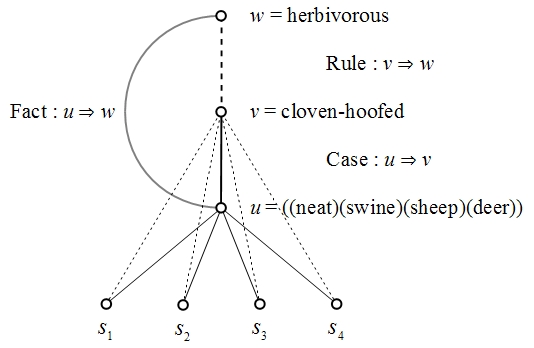

Figure 4 shows an inductive step of inquiry, as taken on the cue of an indicial sign.
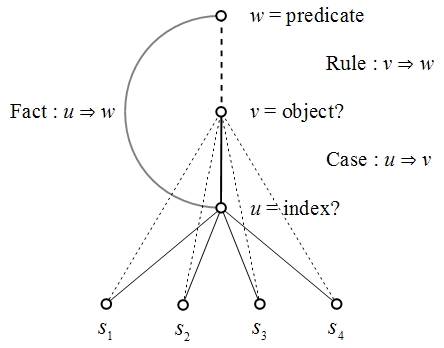

One final point needs to be stressed. It is important to recognize the disjunctive term itself — the syntactic formula “neat, swine, sheep, deer” or any logically equivalent formula — is not an index but a symbol.‡ It has the character of an artificial symbol which is constructed to fill a place in a formal system of symbols, for example, a propositional calculus. In that setting it would normally be interpreted as a logical disjunction of four elementary propositions, denoting anything in the universe of discourse which has any of the four corresponding properties.
The artificial symbol “neat, swine, sheep, deer” denotes objects which serve as indices of the genus herbivore by virtue of their belonging to one of the four named species of herbivore. But there is in addition a natural symbol which serves to unify the manifold of given species, namely, the concept of a cloven‑hoofed animal.
As a symbol or general representation, the concept of a cloven‑hoofed animal connotes an attribute and connotes it in such a way as to determine what it denotes. Thus we observe a natural expansion in the connotation of the symbol, amounting to what Peirce calls the “superfluous comprehension”, the information added by an “ampliative” or synthetic inference.
In sum we have sufficient information to motivate an inductive inference, from the Fact 


Remark
- Here, once again, I have departed from using symbol in the precise technical sense Peirce introduced at the beginning of this discussion, reverting to the more ordinary sense all of us, Peirce included, tend to use on other occasions. Perhaps the best way to smooth the wrinkle in usage is to mark a distinction among symbols, singling out the natural, normal, canonical, or simple symbols within the more general run of artificial, compound, or complex types. Taking that tack has the beneficial side‑effect of aligning the work of abduction and induction, at least, in a pre‑established universe of discourse, with the mainstream of work in computation which takes us from dubious terms to clear signs for the objects of our interest.
References
- Peirce, C.S. (1866), “The Logic of Science, or, Induction and Hypothesis”, Lowell Lectures of 1866, pp. 357–504 in Writings of Charles S. Peirce : A Chronological Edition, Volume 1, 1857–1866, Peirce Edition Project, Indiana University Press, Bloomington, IN, 1982.
- Peirce, C.S. (1867), “Upon Logical Comprehension and Extension”, Proceedings of the American Academy of Arts and Sciences, Vol. 7, pp. 416–432. Archive. Online.
Resources
cc: Academia.edu • Cybernetics • Laws of Form • Mathstodon
cc: Research Gate • Structural Modeling • Systems Science • Syscoi
SysPrac26 21-22 September, UK – 12 HOURS LEFT FOR EARLY BIRD TICKETS!
SysPrac26 21-22 Sept 2026 | SCiO – Systems and Complexity in Organisation https://www.systemspractice.org/SYSPRAC26
I’ll be at this, and doing a workshop, just to warn you 😉
On Conversational Confluences at the American Society for Cybernetics Conference | Ep. 166
Hiroki Sayama (@HirokiSayama) on X
Second Law of Technodynamics – by Ivo Velitchkov
Tavistock Institute of Human Relations | Two Traditions, One Living…
Lunchtime Talk with Dr Lennox Joseph, consultant, author & NTL Institute for Applied Behavioural Science practitioner
Date: Wednesday 16 September 2026, 1pm — 2.30pm
Location: Online
Link: Tickets
The Necessary Tangle update tracking – please contribute!
All you need to do to contribute https://transduction.systems/#view=contribute and offer contributions, things to cover (especially collections that are web-accessible), corrections, usability issues etc etc
v0.17 now live
- ‘surprise me’ button on home page (surprisingly, in a different font, for now)
- better tracking https://transduction.systems/submissions/ of contributions https://transduction.systems/#view=contribute
and a start of thoughts and mapping on inclusion/exclusion https://transduction.systems/canon-and-lineage/
RIP Merrelyn Emery, 1940-2026
Another really significant figure sadly gone, and Merrelyn was still working and contributing very recently. I’ll leave the first brief obituary to the Socio-Technica Systems Round Table, as per their mailing list announcement:
 |
| It is with great sadness that we share the news of Merrelyn Emery‘s passing last week, after a long illness. Anyone who worked with Merrelyn will recognise the feeling right now: that mix of loss and enormous, uncomplicated gratitude. She gave so much, to so many of us, for so long. Over five decades, Merrelyn — with Fred Emery and then in her own right — developed Open Systems Theory and refined the Search Conference and the Participative Design Workshop into methods that put people back in charge of their own work and their own communities. She was rigorous, direct, generous with her time, and utterly unwilling to accept that people needed to be managed rather than trusted. Her legacy stays with us. It’s in the practitioners she trained, the communities she helped find their own way, and the organisations still being designed around her ideas today. Her body of work, decades of papers on the genotypical organization design principles, democratising organisations, education, media and perception, and theory turned into practice, remains freely available at Social Science That Actually Works. We’d encourage anyone who hasn’t explored it to do so. Thank you to everyone who supported and worked alongside her over the years.  The work continues — and that is exactly how she would want it. In gratitude and loss, all of us at the Socio-Technical Systems Roundtable (STS RT) |
This week in systemic design
The Porter Ratio and the Systems Survival Theorem
The Porter Ratio (Quinn Porter, AHQ papers) is R = λ_self / λ_env.
λ_self is the rate of internal structure restoration and propagation.
λ_env is the rate of environmental disruption.
When R ≥ R★ (the ostiary/coherence threshold), prior states remain active, forming a self-sustaining interior with temporal depth and recursive coherence. Below it, structure dissipates and the system stays externally driven.
Primary sources:
https://philarchive.org/rec/PORATT-2
https://philarchive.org/rec/PORTCT-15
Some obvious similarities to Hoverstadt’s: “to survive, the system must be capable of a rate of change that is greater than or equal to the rate of change in the environment on which it depends”: ΔS ≥ ΔE. (Grammar of Systems, 2022)
(he also says the strategies to achieve this include moving faster, retarding the environmental change rate, or directing environmental change)
See
https://researchgate.net/profile/Patrick-Hoverstadt/publication/332082232_Organisational_agility_and_its_measurement/links/5c9e5a9da6fdccd460438dae/Organisational-agility-and-its-measurement.pdf?utm_source=chatgpt.com&__cf_chl_rt_tk=PIder.UzjUOsdZLeNwyBUII3oE1kRQb3Sc7_6SoFK7E-1786986626-1.0.1.1-E2LwoKpdqyPkvzAMkczO8p92KOHOQ5zW0hRzdRDJOJM (2018)
https://mesg.ch/en/organisational-agility/ (2021)
https://systemspractice.org/system/files/2022-03/2022.2%20hoverstadt.pdf (2022)
The 2018 measurement paper and 2021 MESG piece turn ΔS ≥ ΔE into a practical diagnostic: quantify environmental change rate, then assess scanning, orientation, decision speed and pivot capacity. Those levers directly raise the effective internal rate, matching the three strategies and the quantitative Porter threshold.


You must be logged in to post a comment.