I enjoy this podcast and – underprisingly perhaps – it’s quite systems | cybernetics | complexity – ish.
In this interview with Ron Gantt I was just thinking ‘hmm this is Requitie Variety for safety – that’s insightful/obvious’ and sure enough, Ron Gantt actually uses the phrase ‘the requisite variety necessary to manage a construction site’.
https://preaccidentpodcast.podbean.com/e/rethinking-safety-ai-pre-jobs-and-the-power-of-listening/
So I asked my chat j’ai pété to do a dive into RV as a concept in Safety. It said:
His argument has a recognisable lineage, but he gives it a particularly useful inter-organisational and political twist.
### The closest precedent: high reliability organising
The nearest match I have found is Karl Weick, Kathleen Sutcliffe and David Obstfeld’s 1999 paper, [‘Organizing for High Reliability: Processes of Collective Mindfulness’](https://www.theisrm.org/documents/Weick%20%281999%29%20Organizing%20for%20High%20Reliability%20-%20Processes%20of%20Collective%20Mindfulness.pdf).
They say that high-reliability organisations:
‘cultivate requisite variety and assume that it takes a complex system to sense a complex environment’.
Their mechanisms include diverse perspectives, overlapping checks, job rotation, adversarial review and what Schulman called ‘conceptual slack’: disagreement and alternative interpretations that prevent the organisation from collapsing complexity too soon.
Even closer to Gantt, they describe safety as depending on ‘negotiated complexity’: informal and continually renewed relationships between organisations. Those relationships are not peripheral niceties. They form part of the machinery through which safe operation is produced.
That is almost exactly Gantt’s construction-site problem. The expertise needed to regulate the work is dispersed among client, principal contractor, subcontractors, supervisors, trades and workers. No single organisation contains enough of the relevant variety.
### The direct safety literature
There is also a paper whose title answers your question almost comically directly:
Vanessa Becker Bertoni, Tarcisio Abreu Saurin and Flávio Sanson Fogliatto, [‘Law of requisite variety in practice: Assessing the match between risk and actors’ contribution to resilient performance’](https://doi.org/10.1016/j.ssci.2022.105895), published in *Safety Science* in 2022.
It applies Ashby’s law to the relationship between the variety of risks and the contribution of different actors to resilient performance, using social-network analysis in a healthcare setting. The practical proposition is that safety depends not just on possessing expertise somewhere in the organisation, but on whether the network makes the necessary people and capabilities available to one another.
A related paper by Hirose and colleagues, [‘Functional Analysis of Law of Requisite Variety’](https://doi.org/10.1016/j.ifacol.2022.10.231), links Ashby explicitly with resilience engineering and FRAM. Their modelling suggests that strategies with a greater repertoire of possible actions cope better with variability in working conditions.
So there is an identifiable, if still rather small, literature explicitly joining requisite variety and safety.
### Safety-II and resilience engineering
A much larger body of safety work makes essentially the same argument without always naming Ashby.
The early resilience-engineering formulation defines resilience as the capacity to adjust functioning before, during or after disturbances so that required operations continue under expected and unexpected conditions. The [EUROCONTROL resilience-engineering white paper](https://www.eurocontrol.int/archive_download/all/node/11591) says, in effect, that the less completely work can be specified in advance, the more performance variability is needed.
That is requisite variety translated into safety language:
- Work generates more states and disturbances than procedures can enumerate.
- People therefore have to notice differences, interpret them and adjust.
- A safe system needs a sufficiently differentiated repertoire of responses.
- Attempts to remove all variation from human performance can remove the very capacity that keeps the system safe.
Todd Conklin’s formulation that safety is ‘the presence of capacity’, rather than merely the absence of accidents, belongs in this family. Dekker and Tooma develop that idea more systematically in [‘A capacity index to replace flawed incident-based metrics for worker safety’](https://sidneydekker.com/wp-content/uploads/2024/12/ilr.12210.pdf). Among the capacities they identify are operational knowledge, resources, diversity of voices, local decision authority and the ability to respond to emerging risk.
### What Gantt is adding
Gantt’s point is not simply ‘we need more perspectives’. It is that the variety already present on a construction site is prevented from becoming usable regulatory variety.
| Construction-site feature | Cybernetic reading |
| ———————————————————— | —————————————————————– |
| Changing conditions, interacting trades and emerging hazards | Disturbance variety |
| Local knowledge and different contractors’ capabilities | Potential response variety |
| Contracts, liability anxiety and organisational silos | Attenuated communication and action channels |
| Hierarchy and power differences | Suppression of signals and reduction of actors’ effective options |
| ‘The right people at the right time’ | Appropriate selection plus sufficiently rapid response |
| Trust and joint problem-solving | Coupling distributed variety into a functioning regulator |
This makes power a cybernetic variable. A worker or contractor may perceive a dangerous condition and know how to respond, but anticipated blame, contractual exposure or lack of authority can remove that response from the system’s effective repertoire.
In other words, nominal variety is not enough. It has to be:
- perceptible;
- communicable;
- authorised;
- resourced;
- co-ordinated;
- available quickly enough to matter.
Gantt’s suggestion that the more powerful client should accept some liability risk and actively earn trust is therefore not merely a cultural recommendation. It is an attempt to alter the control structure so that distributed knowledge can participate in regulation.
### One important qualification
Requisite variety is a necessary condition for regulation, not a complete theory of safety.
More variety is not automatically better. Unstructured diversity may produce noise, conflict or paralysis. Systems also achieve safety by attenuating disturbance variety: guarding machinery, separating traffic, simplifying interfaces, providing physical buffers and standardising genuinely repeatable work.
The useful question is therefore not simply ‘How do we increase variety?’ It is:
Which disturbances should we prevent or attenuate, and what remaining variety must the system be able to detect, interpret and respond to?
So my short answer is: yes, several traditions have done this. The strongest explicit precursor to Gantt is Weick, Sutcliffe and Obstfeld’s combination of requisite variety, collective mindfulness and ‘negotiated complexity’. What seems particularly sharp in Gantt’s version is the application to the client–contractor boundary: liability, hierarchy and mistrust can leave a construction system full of expertise while making that expertise cybernetically unavailable.

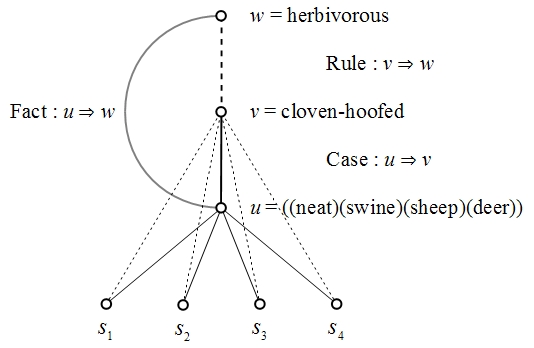

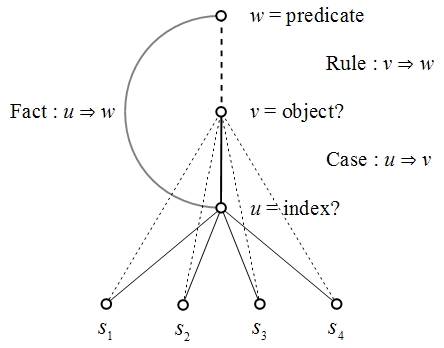


 and the Rule
  to the Case
  The lack of any cases which are
  and not
  is expressed by the implication
  Taking that in conjunction with the Rule
  But that reduces the Case
  to the Fact
  Again, in Figure 4, is
  really an index of object
  There is nothing for it but returning to Peirce’s text and trying once more to follow his reasoning.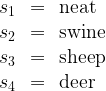

 in lattice terminology, the least upper bound of the disjoined terms,
  and what we might regard as the natural disjunction or natural lub of those terms, namely,
  cloven‑hoofed.
 namely, the rule that cloven‑hoofed animals are herbivorous.

 is said to be
  where
where  in lattice terms, the greatest lower bound of the conjoined terms,
  and what we might regard as the natural conjunction or natural glb of those terms, namely,


You must be logged in to post a comment.