
I’m leading a (very small) piece of work for a children’s charity focused on local systems change.
While I know quite a lot of material about this subject, I’d be enormously grateful if people could respond to this post with anything they consider relevant – and particularly any summaries?
This is social systems relating to children’s early years literacy, child protection, wellbeing in general. I know it is quite a wide field…
cheers!
Benjamin
Monthly Archives: March 2018
From the specific to the general – As Easy As Riding A Bike(why one case isn’t a good argument for the whole)
From the specific to the general
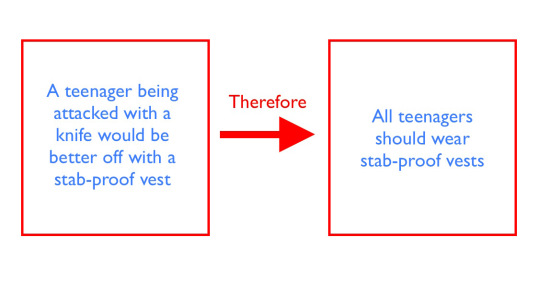

Imagine a grim, appalling, but unfortunately all-too-common scenario. A primary school is under attack from a deranged gunman. Shots have been fired, and the gunman stalks the school corridors, looking for children to kill. In one of the classrooms, a nine-year-old child is cowering under his desk with his teacher, both hearing the approaching footsteps of the gunman.
As the gunman opens the door to their classroom, we freeze time, and imagine two possible alternative scenarios. In the first, both teacher and pupil are unarmed and defenceless. In the second, the teacher has a firearm, which he has in a holster.
Given these specific circumstances, I’m sure most of us might consider it would be better – at that specific moment – for the teacher to be armed with a gun, than to be unarmed and defenceless. With a gun, he might, at least, be able to surprise the gunman, leaping up from his hiding place and firing several rounds at him, incapacitating him. That would certainly be better than the alternative of being effectively powerless as the gunman enters the classroom.
So, given these specific circumstances, we could reasonably think that is a good idea for a primary school teacher to be armed with a gun.
But would any of us then draw the conclusion that it is a good idea to arm primary school teachers in general? Just because our particular teacher might benefit from having a gun in the specific circumstances of a gunman approaching him down a school corridor, do we then think it makes sense to for all primary school teachers to be equipped with an easy-to-access handgun, throughout the school day?
continues in headline link…
What was Boyd Thinking? – Slightly East of NewAn intellectual history of the OODA loop etc
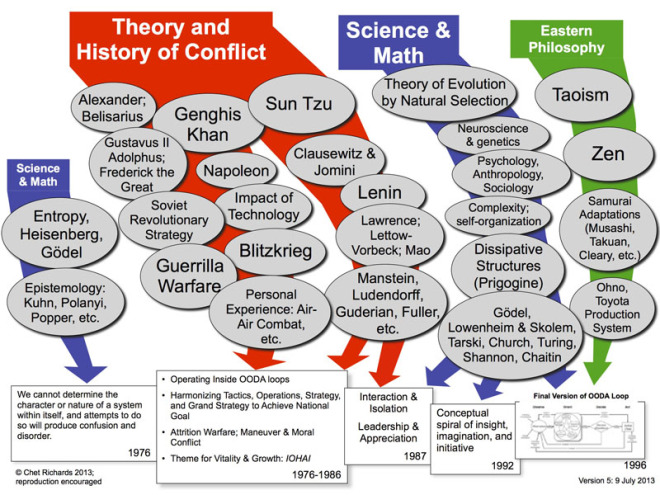 An interesting intellectual history of the OODA loop, from the prime contemporary source on the subject.
What was Boyd Thinking? And when did he think it? In his own words: For the interested, a careful examination will reveal that the increasingly abstract discussion surfaces a process of reaching across many perspectives; …
The Simple Algorithm That Ants Use to Build Bridges | Quanta Magazine
 Even with no one in charge, army ants work collectively to build bridges out of their bodies. New research reveals the simple rules that lead to such complex group behavior.
Source: The Simple Algorithm That Ants Use to Build Bridges | Quanta Magazine
The Ultimate Guide To The OODA Loop: Uncertainty into Opportunity
The Ultimate Guide to the OODA Loop

TL;DR
The OODA loop was a tool developed by military strategist John Boyd to explain how individuals and organizations can win in uncertain and chaotic environments.
It is an Acronym that explains the four steps of decisions making: Observe, Orient, Decide Act.
This article will give you the understanding you need to turn ambiguity into advantage and risk into results in your career, business and life.
Source: The Ultimate Guide To The OODA Loop: Uncertainty into Opportunity
Flocks of sheep ‘hefted’ to the landDefra, UK – Science Search
An interesting concept, which I saw on twitter…
Source: Defra, UK – Science Search
In A World of Systems – YouTube
Published on 4 Mar 2016
The Blended Systems Thinking Approach – enhancing understanding to enable regenerative transformation | systemspractitioner – Pauline Roberts
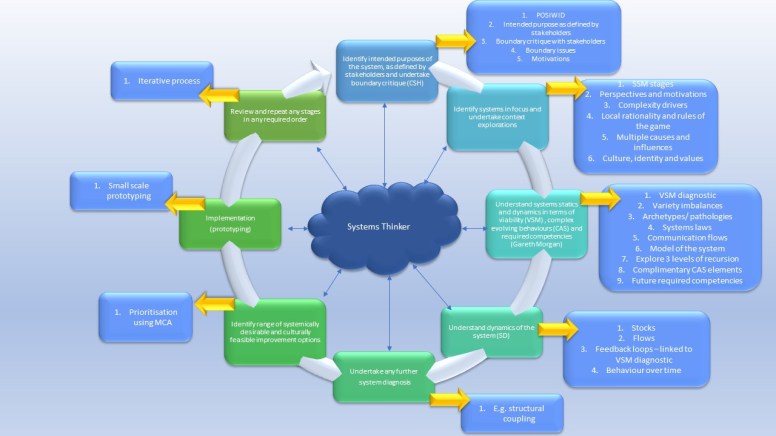
Imagine if there was an approach that could take away the fear that managers feel because they have no idea what improvements to make, where to start or how to get to where they want and need to be…
Revealing In-Block Nestedness: detection and benchmarking Albert Sol´e-Ribalta, Claudio J. Tessone, Manuel S. Mariani, Javier Borge-Holthoefer
[I’m posting this because it *sounds* fascinating, and applicable to pattern language, complex adaptive systems stuff, and the VSM. And also in the hope someone who understands the mathematics will explain it to me :-)]
Revealing In-Block Nestedness: detection and benchmarking
Albert Sol´e-Ribalta, Claudio J. Tessone, Manuel S. Mariani, Javier Borge-Holthoefer
As new instances of nested organization –beyond ecological networks– are discovered, scholars are debating around the co-existence of two apparently incompatible macroscale architectures: nestedness and modularity. The discussion is far from being solved, mainly for two reasons. First, nestedness and modularity appear to emerge from two contradictory dynamics, cooperation and competition. Second, existing methods to assess the presence of nestedness and modularity are flawed when it comes to the evaluation of concurrently nested and modular structures. In this work,
we tackle the latter problem, presenting the concept of in-block nestedness, a structural property determining to what extent a network is composed of blocks whose internal connectivity exhibits nestedness. We then put forward a set of optimization methods that allow us to identify such organization
successfully, both in synthetic and in a large number of real networks. These findings challenge our understanding of the topology of ecological and social systems, calling for new models to explain how such patterns emerge
Source: [1801.05620] Revealing In-Block Nestedness: detection and benchmarking
Seven characteristics of complex systems – Sonja Blignaut blogs Paul Cilliers

Seven characteristics of complex systems – Sonja Blignaut blogs Paul Cilliers
I have been re-reading the work of Prof Paul Cilliers, who truly was a pioneer in complexity thinking. I came across this summary of the general characteristcs of complex systems in a piece he wrote in 2000. It is concise and accessible qualitative description of complexity and I thought it would be useful to share here on my blog.
-
Complex systems consist of a large number of elements that in themselves can be simple.
-
The elements interact dynamically by exchanging energy or information. These interactions are rich. Even if specific elements only interact with a few others, the effects of these interactions are propagated throughout the system. The interactions are nonlinear.
-
There are many direct and indirect feedback loops.
-
Complex systems are open systems—they exchange energy or information with their environment—and operate at conditions far from equilibrium.
-
Complex systems have memory, not located at a specific place, but distributed throughout the system. Any complex system thus has a history, and the history is of cardinal importance to the behavior of the system.
-
The behavior of the system is determined by the nature of the interactions, not by what is contained within the components. Since the interactions are rich, dynamic, fed back, and, above all, nonlinear, the behavior of the system as a whole cannot be predicted from an inspection of its components. The notion of “emergence” is used to describe this aspect. The presence of emergent properties does not provide an argument against causality, only against deterministic forms of prediction.
-
Complex systems are adaptive. They can (re)organize their internal structure without the intervention of an external agent.
From: What can we learn from complexity, Prof Paul Cilliers, Emergence, March 2000
Top Inspiration, Events and News on Systems Change
since I posted most of the links from the Systems Studio newsletter last month… here’s this months’ newsletter. A lot of rich reading here 🙂
|

|
|
|
Inheritance Is Moving Beyond Genetics and Epigenetics
 Via Complexity Explorer
Heredity Beyond the Gene
What you pass on to your kids isn’t always in your genetic code.
The idea that genes encode all the heritable features of living things has been a fundamental tenet of genetics and evolutionary biology for many years, but this assumption has always coexisted uncomfortably with the messy findings of empirical research. The complications have multiplied exponentially in recent years under the weight of new discoveries.
Classical genetics draws a fundamental distinction between the “genotype” (that is, the set of genes that an individual carries and can pass on to its descendants) and the “phenotype” (that is, the transient body that bears the stamp of the environments and experiences that it has encountered but whose features cannot be transmitted to offspring). Only those traits that are genetically determined are assumed to be heritable—that is, capable of being transmitted to offspring—because inheritance occurs exclusively through the transmission of genes. Yet, in violation of the genotype/phenotype dichotomy, lines of genetically identical animals and plants have been shown to harbor heritable variation and respond to natural selection.

Conversely, genes currently fail to account for resemblance among relatives in some complex traits and diseases—a problem dubbed the “missing heritability.”1 But, while an individual’s own genotype doesn’t seem to account for some of its features, parental genes have been found to affect traits in offspring that don’t inherit those genes. Moreover, studies on plants, insects, rodents, and other organisms show that an individual’s environment and experiences during its lifetime—diet, temperature, parasites, social interactions—can influence the features of its descendants, and research on our own species suggests that we are no different in this respect. Some of these findings clearly fit the definition of “inheritance of acquired traits”—a phenomenon that, according to a famous analogy from before the Google era, is as implausible as a telegram sent from Beijing in Chinese arriving in London already translated into English. But today such phenomena are regularly reported in scientific journals. And just as the Internet and instant translation have revolutionized communication, discoveries in molecular biology are upending notions about what can and cannot be transmitted across generations.
Biologists are now faced with the monumental challenge of making sense of a rapidly growing menagerie of discoveries that violate deeply ingrained ideas. One can get a sense of the growing dissonance between theory and evidence by perusing a recent review of such studies and then reading the introductory chapter from any undergraduate biology textbook. Something is clearly missing from the conventional concept of heredity, which asserts that inheritance is mediated exclusively by genes and denies the possibility that some effects of environment and experience can be transmitted to descendants.
continues in headline link
Information theory, predictability and the emergence of complex life – Luís F. Seoane, Ricard V. Solé
Abstract
Despite the obvious advantage of simple life forms capable of fast replication, different levels of cognitive complexity have been achieved by living systems in terms of their potential to cope with environmental uncertainty. Against the inevitable cost associated with detecting environmental cues and responding to them in adaptive ways, we conjecture that the potential for predicting the environment can overcome the expenses associated with maintaining costly, complex structures. We present a minimal formal model grounded in information theory and selection, in which successive generations of agents are mapped into transmitters and receivers of a coded message. Our agents are guessing machines and their capacity to deal with environments of different complexity defines the conditions to sustain more complex agents.

SCiO spring open meeting – 23 April 2018, Manchester
Monday 23rd April 2018
Booking required – https://www.eventbrite.co.uk/e/scio-open-meeting-spring-2018-manchester-all-welcome-tickets-43781605962
Manchester Business School, Room G13D, Sackville Street, Manchester, M1 3WE
The next SCiO open meeting is on Monday 23rd April 2018, at the Manchester Business School.
Note that this is again in a different building and room as MBS are undergoing major construction work – this time we are in Sackville Street. Please use the postcode and see the map on the Eventbrite site to find it.
Please book via Eventbrite: https://www.eventbrite.co.uk/e/scio-open-meeting-spring-2018-manchester-all-welcome-tickets-43781605962 to avoid disappointment. Booking is £20. All are welcome.
· 09:30 – 10:00 will be an introduction to the viable system model
· The full day will start at 10:00
An open meeting where a series of presentations of general interest regarding systems practice will be given – this will include ‘craft’ and active sessions, as well as introductions to theory.
Session 1: Peter Miles; Demosophia – Collective Intelligence through Structured Dialogue
John Warfield and Aleco Christakis developed the field of Interactive Management in the US in the 1980s, and Christakis subsequently evolved it into the methodology Structured Dialogic Design. In its various forms (and under different names) it has been widely applied across the globe in enabling groups to tackle wicked problems and complex challenges, but is not well known in the UK. This presentation will outline the methodology, it’s provenance, and the current state of practice.
Session 2: Alexandra Stubbings; Adaptive Organisation Design – organising with stakeholders in mind
As companies increasingly need to collaborate to deliver large projects, and as the world of work gets evermore complex with short-term contracts and the ‘gig economy’, it is getting harder to structure organisations that are fit for purpose and adaptive to changing needs. In this session Alexandra will share with us her experience and some of the ideas and tools she has developed to work systemically in organisation design and think about questions like: How do you create effective multi-party teams and partnerships that fully take stakeholders’ priorities into account? How do you engage well across organisational boundaries? How do you ensure accountability in these multi-party teams?
Session 3: Ian Glossop; STREAMS – Systems Thinking, Real Enterprise Architecture and Management Science
This presentation will outline the STREAMS ideas and Philosophy. STREAMS is a set of ideas about how to build and manage an Enterprise based on a common, rigorous STREAMS Philosophy. It leads to methodologies, methods and techniques for building, managing, evolving and innovating Enterprises that can be applied in practice but, like an Engineering approach, its methods are grounded in rigorous research and understanding.
Common to the three main strands, or tributaries, of STREAMS is the Use of Models: conceptual models of a variety of descriptions and characteristics ranging from highly complex mathematical models informed by volumes of quantitative data grounded in empirical observation and measurement to simple qualitative models expressing some simple truth. The purpose of the models is to guide Decision Making.
STREAMS is a set of ideas that are both transdisciplinary and integrative of theory and practice. It is “Trans-disciplinary” in the sense that it eclectically draws on ideas, theories, principles and methods from a range of academic disciplines – deliberately paying no heed to the traditional divisions in universities – or similar academic institutions. It is “Integrative” in the sense that is seeks to blend these ideas into a coherent, well-founded theoretical framework – but also incorporate empirically grounded and proven ideas and practices from Practice, not just academic theory. STREAMS is not intended to be an academic exercise in the social science but theoretically-sound ideas and methods for practitioners in engineering enterprises.
Session 4:Parag Gogate: Using Lego® Serious Play® for problem framing and solving
This will be an interactive workshop session where Parag will introduce the science behind the Lego® Serious Play® methodology and guide the group working on a real world problem.
The Lego® Serious Play® methodology is an innovative, experimental process designed to enhance innovation and business performance. It is based on research which shows that this kind of hands-on, minds-on learning produces a deeper, more meaningful understanding of the world and its possibilities, the Lego® Serious Play® methodology deepens the reflection process and supports an effective dialogue – for everyone in the organisation. It taps into the human ability to imagine, to describe and make sense of the issues at hand, to initiate change and improvement, and even to create something radically new.
The OR Society: OR60 Annual Conference
OR60 ‘Anniversary’ Conference
Organisational research society
11 – 13 SEPTEMBER 2018
Lancaster University, Bailrigg, Lancaster. LA1 4YW UK

Planning for OR60, our next OR Society Annual Conference, taking place at Lancaster University, is underway.
Lancaster University was established by Royal Charter in 1964, one of seven new universities created in the 1960s. Operational Research was one of the founding departments, the first in the country. The first professor was Pat Rivett, President of the OR Society at the time of his appointment. So, it is particularly significant that the conference returns to Lancaster to celebrate the Diamond anniversary.
The campus buildings are arranged around a central walkway known as the Spine, which is connected to a central plaza, named Alexandra Square in honour of its first chancellor, Princess Alexandra. The accommodation and conference venues are all within 100 yards of each other.
The University is set in 560 acres of stunning woodland which includes, we are told, 290 species of plants! Less than three miles away lies the historic city of Lancaster, with a medieval castle, Georgian architecture and much more to marvel at. Williamson Park, one of the city’s best kept secrets, contains a stunning ornate butterfly house. For those who fancy travelling a little further, England’s largest National Park, the Lake District is less than one hour away by car.
Location – http://www.lancaster.ac.uk/contact-and-getting-here/maps-and-travel/
I post this specifically because there’s a systems thinking stream:
OR60 Stream – Systems Thinking
Stream Organisers
| Gerald Midgley (more information) Email: G.R.Midgley@hull.ac.uk |
 |
| Giles Hindle (more information) Email: giles.hindle@hull.ac.uk |
 |
| Angela Espinosa (more information) Email: A.Espinosa@hull.ac.uk |
 |
Stream Definition
Many OR and Systems practitioners share a common interest in systemic intervention to address highly complex organizational, social and environmental problems. This stream provides a fantastic opportunity to bring people from both the OR and Systems communities together to learn from one another, so both can be enriched. We welcome the widest possible diversity of practitioners and academics, whichever tradition of systems thinking or systemic OR you come from. We encourage the submission of abstracts discussing applications of systems thinking; methodological innovations; theoretical contributions; thoughts on the diversity, impacts and ethics of systemic OR practice; and reflections on the past, present and future of the relationship between Systems Thinking and OR. In addition to the usual paper presentations, the stream will start with a workshop where everyone can participate in learning from one another and collectively defining Systems Thinking for OR practice. The stream will also end with a second workshop to discuss future directions, and we will facilitate small, collaborative groups in defining new research agendas that matter for both Systems/OR as a field of practice, and for systemic improvement in our wider society.
Bios
Gerald Midgley
Gerald Midgley is Professor of Systems Thinking in the Business School, University of Hull, UK. He also holds Adjunct Professorships at the University of Queensland, Australia; Mälardalen University, Sweden; the University of Canterbury, New Zealand; and Victoria University of Wellington, New Zealand. He has held research leadership roles in both academia and government OR, having spent ten years as Director of the Centre for Systems Studies at Hull, and seven years as a Senior Science Leader in the Institute for Environmental Science and Research (ESR), New Zealand. Gerald has written over 300 papers for academics and practitioners on systems thinking, problem structuring methods, community operational research and conflict management, and has been involved in a wide variety of public sector, community development, technology foresight and resource management projects. He was the 2013/14 President of the International Society for the Systems Sciences, and has written or edited 11 books. These include Systemic Intervention: Philosophy, Methodology, and Practice (Kluwer, 2000); Operational Research and Environmental Management: A New Agenda (Operational Research Society, 2001); Systems Thinking, Volumes I-IV (Sage, 2003); Community Operational Research: OR and Systems Thinking for Community Development (Kluwer, 2004); and Forensic DNA Evidence on Trial: Science and Uncertainty in the Courtroom (Emergent, 2011). In 2017, he contracted with Routledge for a book series on systems thinking for practitioners.
Giles Hindle
Dr Giles Hindle is a Senior Lecturer at Hull University Business School and an Associate Fellow at Warwick Business School. Prior posts include Assistant Professor at Warwick Business School, Senior Consultant for Tribal Consulting PLC and Business Consultant for Lancaster University’s Institute for Entrepreneurship and Enterprise Development. Giles has conducted consultancy and research projects for a wide range of organisations including Research Councils UK, the Food Standards Authority, National Public Health Service of Wales, NHS Scottish Executive, County Councils Network, Secta Health Group, Countryside Agency, Department for Transport, DHSSPS in Northern Ireland, Business Link, Network Rail, Tornado Wire Ltd, and many others. He is a member of the OR Society’s Analytics Network. His current research is focussed on strategic thinking, business analytics, business modelling, spatial modelling and service innovation.
Angela Espinosa
Angela was born in Bogota, Colombia and graduated as a computer and systems engineer in 1981, and got a PhD on Organisational Cybernetics from Aston Business School, UK in 1995. She worked as an Information Systems Manager, in private and public enterprises, and as the Director of the Secretariat of Information and Systems of the Colombian President’s Office (1990 – 1992). From 1993 to 2002, she taught systems and cybernetics in the Engineering Faculty in Los Andes University; and provided consultancy for both private and public organisations. Since 2002 she has been researching and teaching at the Centre of Systems Studies from Hull University Business School, where she is now a Reader in Cybernetics. Since 2009 she has been an invited fellow at Los Andes Business School, El Rosario Business School and La Sabana Business School in Colombia, as well as an invited fellow in Australia, Cuba, Oman, and Mexico. She has focused her post doctoral research on the application of organizational cybernetics to support organisational and societal self -transformations towards improved viability and sustainability on businesses, communities and networks. She has published extensively the results of this research, mostly in research monographs, and in systems, cybernetics, complexity and operational research journals.
OR60 Stream – Systems Thinking
Stream Organisers
| Gerald Midgley (more information) Email: G.R.Midgley@hull.ac.uk |
|
| Giles Hindle (more information) Email: giles.hindle@hull.ac.uk |
|
| Angela Espinosa (more information) Email: A.Espinosa@hull.ac.uk |
|
Stream Definition
Many OR and Systems practitioners share a common interest in systemic intervention to address highly complex organizational, social and environmental problems. This stream provides a fantastic opportunity to bring people from both the OR and Systems communities together to learn from one another, so both can be enriched. We welcome the widest possible diversity of practitioners and academics, whichever tradition of systems thinking or systemic OR you come from. We encourage the submission of abstracts discussing applications of systems thinking; methodological innovations; theoretical contributions; thoughts on the diversity, impacts and ethics of systemic OR practice; and reflections on the past, present and future of the relationship between Systems Thinking and OR. In addition to the usual paper presentations, the stream will start with a workshop where everyone can participate in learning from one another and collectively defining Systems Thinking for OR practice. The stream will also end with a second workshop to discuss future directions, and we will facilitate small, collaborative groups in defining new research agendas that matter for both Systems/OR as a field of practice, and for systemic improvement in our wider society.
Bios
Gerald Midgley
Gerald Midgley is Professor of Systems Thinking in the Business School, University of Hull, UK. He also holds Adjunct Professorships at the University of Queensland, Australia; Mälardalen University, Sweden; the University of Canterbury, New Zealand; and Victoria University of Wellington, New Zealand. He has held research leadership roles in both academia and government OR, having spent ten years as Director of the Centre for Systems Studies at Hull, and seven years as a Senior Science Leader in the Institute for Environmental Science and Research (ESR), New Zealand. Gerald has written over 300 papers for academics and practitioners on systems thinking, problem structuring methods, community operational research and conflict management, and has been involved in a wide variety of public sector, community development, technology foresight and resource management projects. He was the 2013/14 President of the International Society for the Systems Sciences, and has written or edited 11 books. These include Systemic Intervention: Philosophy, Methodology, and Practice (Kluwer, 2000); Operational Research and Environmental Management: A New Agenda (Operational Research Society, 2001); Systems Thinking, Volumes I-IV (Sage, 2003); Community Operational Research: OR and Systems Thinking for Community Development (Kluwer, 2004); and Forensic DNA Evidence on Trial: Science and Uncertainty in the Courtroom (Emergent, 2011). In 2017, he contracted with Routledge for a book series on systems thinking for practitioners.
Giles Hindle
Dr Giles Hindle is a Senior Lecturer at Hull University Business School and an Associate Fellow at Warwick Business School. Prior posts include Assistant Professor at Warwick Business School, Senior Consultant for Tribal Consulting PLC and Business Consultant for Lancaster University’s Institute for Entrepreneurship and Enterprise Development. Giles has conducted consultancy and research projects for a wide range of organisations including Research Councils UK, the Food Standards Authority, National Public Health Service of Wales, NHS Scottish Executive, County Councils Network, Secta Health Group, Countryside Agency, Department for Transport, DHSSPS in Northern Ireland, Business Link, Network Rail, Tornado Wire Ltd, and many others. He is a member of the OR Society’s Analytics Network. His current research is focussed on strategic thinking, business analytics, business modelling, spatial modelling and service innovation.
Angela Espinosa
Angela was born in Bogota, Colombia and graduated as a computer and systems engineer in 1981, and got a PhD on Organisational Cybernetics from Aston Business School, UK in 1995. She worked as an Information Systems Manager, in private and public enterprises, and as the Director of the Secretariat of Information and Systems of the Colombian President’s Office (1990 – 1992). From 1993 to 2002, she taught systems and cybernetics in the Engineering Faculty in Los Andes University; and provided consultancy for both private and public organisations. Since 2002 she has been researching and teaching at the Centre of Systems Studies from Hull University Business School, where she is now a Reader in Cybernetics. Since 2009 she has been an invited fellow at Los Andes Business School, El Rosario Business School and La Sabana Business School in Colombia, as well as an invited fellow in Australia, Cuba, Oman, and Mexico. She has focused her post doctoral research on the application of organizational cybernetics to support organisational and societal self -transformations towards improved viability and sustainability on businesses, communities and networks. She has published extensively the results of this research, mostly in research monographs, and in systems, cybernetics, complexity and operational research journals.
 Systems Community of Inquiry
You must be logged in to post a comment.