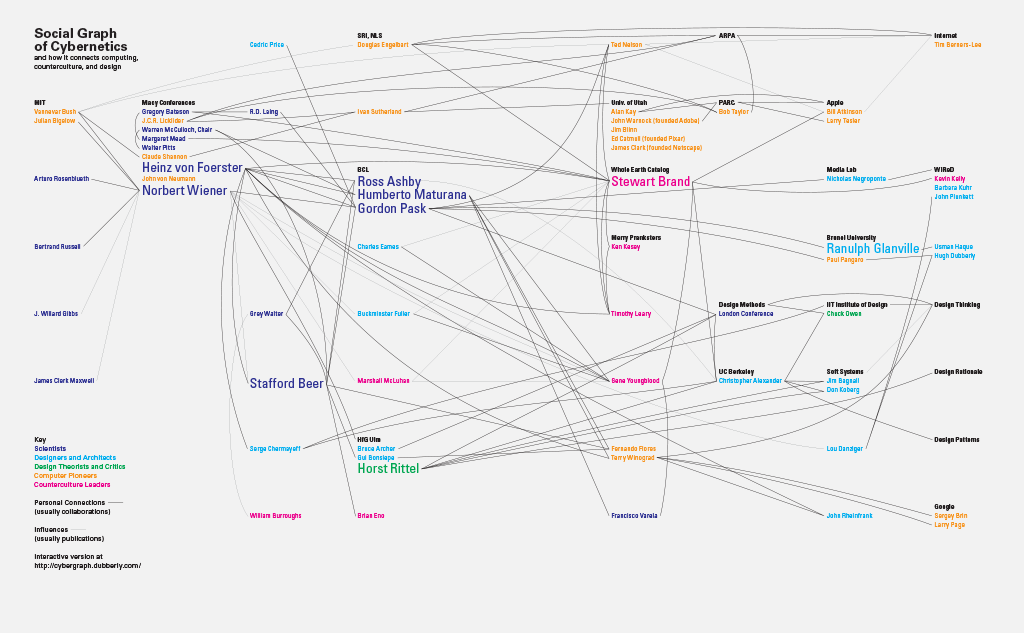
How cybernetics connects computing, counterculture, and design – Dubberly and Pangaro

Cyber_Social_Graph

Written by Hugh Dubberly and Paul Pangaro. Originally published by the Walker Art Center in the catalog for the exhibit Hippie Modernism: The Struggle for Utopia.

“Man is always aiming to achieve some goal and he is always looking for new goals.”
— Gordon Pask[1]

Beginning in the decade before World War II and accelerating through the war and after, scientists designed increasingly sophisticated mechanical and electrical systems that acted as if they had a purpose. This work intersected other work on cognition in animals as well as early work on computing. What emerged was a new way of looking at systems—not just mechanical and electrical systems, but also biological and social systems: a unifying theory of systems and their relation to their environment. This turn toward “whole systems” and “systems thinking” became known as cybernetics. Cybernetics frames the world in terms of systems and their goals.

This approach led to unexpected outcomes.

Continues in source: How cybernetics connects computing, counterculture, and design

What is an intelligent machine? W. Ross Ashby

full pdf:

Click to access 50580275.pdf


Contact The DL Team Contact Us | Switch to single page view (no tabs)

From the “intelligent” processes we must first split off those that are peculiar to the living brain, but only because they are not commonly met with elsewhere. These processes are of interest but are neither intelligent nor stupid, neither good nor bad.

The “intelligent” processes <u>par excellence</u> are the goal-seeking–those that show high power of appropriate selection. Man and computer show their powers alike, by appropriate selection. But both are bounded by the fact that appropriate selection (to a degree better than chance) can be achieved only as a consequence of information received and processed.

Machines can be made as intelligent as we please, but both they and Man are bounded by the fact that their intelligence cannot exceed their powers of receiving and processing information.

Source: What is an intelligent machine?

Patterns – the Newsletter of the American Society for Cybernetics – Fall 2007 (pdf) Includes ‘Battle of the Bulge – the obesity epidemic as a pathogenic system’ by Kathleen S Long

Click to access PATTERNS%202007%20Fall.pdf

Patterns – the Newsletter of the American Society for Cybernetics – Fall 2007 (pdf)


Includes:

Battle of the Bulge – the obesity epidemic as a pathogenic system by Kathleen S Long

Towards a Future We Desire?

The Cybernetics of Sanity

Paskian Art Research

Margaret Mead


The Intelligent Organization, PART I Stafford BEER // posted by Javier Livas – YouTube

Published on 16 Jan 2011

SUBSCRIBE 1.6K
This is the conference by Stafford Beer at Monterrey Tec where he explains the difference between the Reductionist Paradigm and the Cybernetic Paradigm. The presents the VSM and the importance of Asbhy’s Law of Requisite variety. 4 extra minutes have been added to end PART I

Norbert Weiner – The Human Use of Human Beings (full text pdf)

Click to access Wiener_Norbert_The_Human_Use_of_Human_Beings.pdf

Letting nature take its course: Wolves in Yellowstone National Park

[Probably not the final word on this, but this is a synthesis of 40 years of research on large mammals in Yellowstone National Park – and the impact of the reintroduction of the wolves. Can’t find original paper free online]

Press release with quotes etc: https://www.sciencedaily.com/releases/2018/10/181016150722.htm

Letting nature take its course: Wolves in Yellowstone National Park

Date:
October 16, 2018
Source:
University of Alberta
Summary:
Since the reintroduction of wolves to Yellowstone National Park in 1995, the park’s ecosystem has become a deeply complex and heterogeneous system, aided by a strategy of minimal human intervention. The new study is a synthesis of 40 years of research on large mammals in Yellowstone National Park.
Share:
FULL STORY

Since the reintroduction of wolves to Yellowstone National Park in 1995, the park’s ecosystem has become a deeply complex and heterogeneous system, aided by a strategy of minimal human intervention. The new study is a synthesis of 40 years of research on large mammals in Yellowstone National Park, conducted by University of Alberta ecologist Mark Boyce.

“Yellowstone has benefited from the reintroduction of wolves in ways that we did not anticipate, especially the complexity of biological interactions in the park,” explained Boyce, professor in the Department of Biological Sciences and Alberta Conservation Association Chair in Fisheries and Wildlife. “How the vegetation in one valley responded to wolf recovery can be very different than in the next valley.”

Some of these complex interactions include the increasing influence of bears on the survival of elk calves, the relationships between wolves and hunters, as well as the recovery of willow, cottonwood, and aspen trees in different areas of the park. In addition, bison have replaced elk as the dominant herbivore on Yellowstone’s Northern Range, and bison numbers continue to increase.

“We would have never seen these responses if the park hadn’t followed an ecological-process management paradigm — allowing natural ecological processes to take place with minimal human intervention,” said Boyce.

However, Boyce explained, using the Yellowstone model in human-dominated systems would have a very different effect, and the top-down influence of wolves and other large carnivores cannot be expected to rescue ecosystems outside national parks or other protected areas.

“Human-dominated systems are very different and wolf recovery will not produce the same results because agriculture, livestock and hunting overwhelm the effects caused by large carnivores. We already have viable populations of wolves, bears, and cougars across much of Alberta but their influence varies depending on the extent of human alterations to the system.”

Story Source:

Materials provided by University of AlbertaNote: Content may be edited for style and length.


Journal Reference:

  1. Mark S Boyce. Wolves for Yellowstone: dynamics in time and spaceJournal of Mammalogy, 2018; 99 (5): 1021 DOI: 10.1093/jmammal/gyy115


And article ref page: https://academic.oup.com/jmammal/article-abstract/99/5/1021/5107035?redirectedFrom=fulltext

Wolves for Yellowstone: dynamics in time and space

Journal of Mammalogy, Volume 99, Issue 5, 10 October 2018, Pages 1021–1031,https://doi.org/10.1093/jmammal/gyy115
Published:
26 September 2018
Article history

Abstract

The reintroduction of gray wolves (Canis lupus) to Yellowstone National Park is the most celebrated ecological experiment in history. As predicted by population models, the rapid recovery of a wolf population caused both temporal and spatial variability in wolf–ungulate interactions that likewise generated temporal and spatial variation in the expression of trophic cascades. This has amplified spatial variation in vegetation in Yellowstone, particularly with willow (Salix spp.) and cottonwood (Populus spp.) in riparian areas, with associated changes in food webs. Increasing influences of grizzly bears (Ursus arctos), cougars (Puma concolor), and bison (Bison bison) are making what initially was predominantly an elk–wolf interaction into an increasingly complex system. Outside Yellowstone, however, humans have a dominant influence in western North America that overwhelms trophic cascades resulting in what appear to be bottom-up influences on community structure and function. Complex and unexpected ecosystem responses to wolf recovery in Yellowstone reinforce the value of national parks and other protected areas as ecological baseline reserves.

#383

The Disruptive Innovation Festival 2018 | Transition Consciousness

[I’ve never completely grokked the DIF from the Circular Economy Foundation but it is very interesting!]

THE DISRUPTIVE INNOVATION FESTIVAL 2018

Maria and I introduce our book Customer Experiences with Soul: A New Era in Design by explaing how for us, the most disruptive word we can use in innovation is soul. For this reason we were really delighted to receive an invitation to speak about our work at this year’s Disruptive Innovation Festival,the world’s largest online festival of ideas.
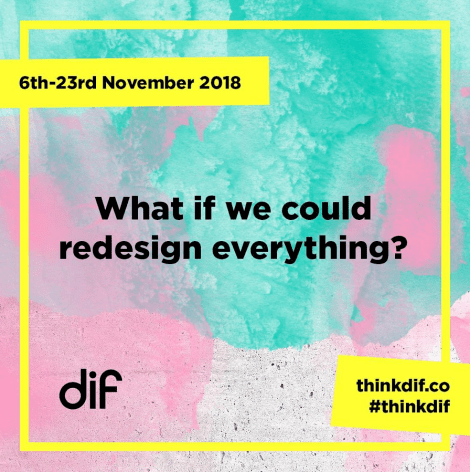
The online event is curated by the Ellen MacArthur Foundation, a non-profit organisation whose mission is to accelerate the transition to a circular economy. It will be streamed live from the 6th to the 23rd of November, with a hugely interesting schedule of films, podcasts and live sessions.

The DIF enables participators from a global network to share, discover and learn from some of the world’s brightest start-ups, innovators and entrepreneurs.

The foundational philosophy of the event is that we should start to shift the focus from treating the symptoms to tackling the root causes by going back to the beginning and designing differently.

The three principles for a circular economy are:

  1. Design out waste & pollution;
  2. Keep materials and products in highest value use;
  3. Regenerate natural systems.⠀

The three focal themes of this year’s festival are cities in transition, materials and design, and people and the economy. The festival will also be looking at the future of food, reimagining learning, reinventing business and thinking in systems. So some of the questions the festival will be seeking to answer include the following:

  • How might we design an economy that still functions for business, lifts people up to a standard of social living and has environmental benefits?⠀
  • As the economy continues to evolve, how can we ensure that people get access to the goods and services, materials and components they need to help them live and prosper?
  • What type of economy do we want to live in?⠀
  • With the 21st century economy already shifting away from a ‘bottom line’ approach to measuring success, and with computational power, digitisation and the mobile internet opening up endless new opportunities, how are businesses evolving to keep up with and take advantage of this shift?⠀
  • With their high concentration of resources, capital, data, and talent over a small geographic territory, could cities be uniquely positioned to drive positive change and a new transition?
  • What will it take to make tomorrow’s cities everything that we promise they’ll be today?⠀
  • How can we design more personalised methods of teaching and learning that tap into what it means to be human, rather than based on a production factory line?⠀
  • What are the implications of systems thinking in this new way for business, design and the wider economy?
  • How can we create systems of food production which avoid soil quality degradation, fossil fuel dependence and high losses?

For those people who may not be so familiar with the concept of the circular economy, there will also be a series of introductory talks designed to cover the most fundamental aspects of this approach to economics and design.
As part of both the People and the Economy and Reinventing Businessthemes, Maria and I will be discussing Customer Experiences with Soul on November 16th. We will look at what happens when you combine the best global design practices with Brazilian heart, Western philosophical insight and timeless Eastern spiritual wisdom.

We will be introducing our holistic framework for designers, corporate entrepreneurs, creative leaders and those starting a new business or initiative to explore the principles underlying the dynamics of soulful customer experiences. This was created in order to provide the guidance needed for developing, structuring and implementing customer experiences with soul, helping people to build and grow authentic businesses and organisations which honour what it is to be human in our world.
The festival was created to spark conversations with a global audience by inviting people to share disruptive ideas and stories relating to design, innovation, people and planet.

If you would like to join in, you can sign up for a MyDIF Account which allows you to comment and interact with other viewers during live sessions and on catch up afterwards. Additionally you can use the hashtag #thinkdif on social media to put your questions to the speakers and get involved in the debate.

And if you would like to watch our talk, you can find out more here: thinkdif.co/sessions/customer-experiences-with-soul-a-new-era-in-design

Source: The Disruptive Innovation Festival 2018 | Transition Consciousness

The Viable System Model & Related Pathologies by Jean-Daniel Cusin on Prezi

a nice overview

Jean-Daniel Cusin on 28 March 2015

Transcript of The Viable System Model & Related Pathologies

The Viable System Model – Typical Pathologies
System ONE
Viable: Meaning, capable of independent existence.

What are the systemic invariances that explain viability?

The VSM distinguishes five sub-systems, each of which has a systemic role in interaction with the others to sustain the viability of the whole.

The purpose of these five sub-systems is to maintain the system in a state of homeostatic equilibrium, that is, under control, to ensure the system’s survival, both in the short and long term, by processes of learning, adaptation and evolution.

continues and with full prezi in source: The Viable System Model & Related Pathologies by Jean-Daniel Cusin on Prezi

Complexity in health policy. Brief notes – Greg Fell

A great overview and introduction to #complexity (and therefore #systemsthinking… and #cybernetics) in #public health

part one linked below – https://gregfellpublichealth.wordpress.com/2018/08/24/complexity-in-public-health-part-1/

part two – https://gregfellpublichealth.wordpress.com/2018/08/26/complexity-in-public-health-part-2-actions-to-take-responses-to-complex-problem/
Complexity in health policy, part 2. Actions to take & responses to complex problems

part three – https://gregfellpublichealth.wordpress.com/2018/10/18/interventions-to-influence-system-change/
Interventions to influence SYSTEM change. Complexity part 3

gregfell500's avatarSheffield DPH

Complexity in public health

I went to an excellent meeting in the Spring at the Health Foundation led by Prof Rutter on complexity. It’s the new “thing” don’t you know. It made my brain hurt. A lot.

Much to reflect on. This blog covers the points I took from the meeting, and subsequent reflections

Part 1 – what’s the issue. some background, some definitions and the problem that is the starting premise

1. What do we mean by complexity

A complex system cannot be explained merely by breaking it down into its component parts because those parts are interdependent: elements interact with each other, share information and combine to produce systemic behaviour.

They exhibit ‘non-linear’ dynamics produced by feedback loops in which some forms of energy or action are dampened (negative feedback) while others are amplified (positive feedback).

It is impossible to precisely predict what changes might happen as a…

View original post 1,098 more words

#complexity, #cybernetics, #public, #systemsthinking

The supply and demand of social systems: towards a systems theory of the firm | Kybernetes

via Ivo Velitchkov on twitter (@kvistgaard) – no freely available version that I can find, yet.

The supply and demand of social systems: towards a systems theory of the firm

Author(s):
Vladislav Valentinov , (Leibniz Institute of Agricultural Development in Transition Economies,Halle, Germany)
Spencer Thompson , (Center of Development Studies, University of Cambridge, Cambridge, UK)

…Show less authors

Abstract:

The economic theory of the firm apparently concurs with Niklas Luhmann’s theory of social systems with regard to the primary function of the firm to be complexity reduction, i.e. the alleviation of the cognitive burden on agents whose cognitive capacities are limited. At the same time, however, the theory of the firm ignores the attendant issues of societal sustainability emphasised by Luhmann. The paper aims to fill this gap.

Taking a theoretical approach, the paper builds on the conceptual construct of “the complexity-sustainability trade-off”, which combines two contrasting aspects of the relationship between a system and its environment, namely, the precariousness highlighted by Luhmann and the embeddedness highlighted by open systems theory. These themes are respectively reflected in the principles of complexity reduction and environmental dependence which constitute the trade-off.

Drawing inspiration from the classic Marshallian presentation of supply and demand in modern economics, the paper argues that the principles of complexity reduction and critical dependence translate into the demand for and supply of social systems. In the proposed systems-theoretic interpretation of the theory of the firm, demand and supply refer to the imperatives of achieving coordination and securing cooperation within the firm, respectively. Thus, in the theory of the firm, the complexity-sustainability trade-off manifests itself as a trade-off between coordination and cooperation.

The implicit focus of the theory of the firm on complexity reduction disregards the nature, importance and fragility of cooperation in real-world firms. In so doing, it impedes the authors’ understanding of unconventional types of business organisation, such as cooperatives. These defects can be corrected by reorienting the theory of the firm according to the proposed systems-theoretic approach, which holds that firms should not be governed or studied in isolation from their environment, as they too often are – and, accordingly, that apparently anomalous forms of organisation should be taken seriously, as they too often are not.

Keywords:
DemandFirmSystemSupplyNiklas LuhmannAlfred Marshall
Type:
Conceptual Paper
Publisher:
Emerald Publishing Limited
Acknowledgments:

The authors are grateful to anonymous reviewers for their helpful comments.

Copyright:© Emerald Publishing Limited 2018
Published by Emerald Publishing Limited
Licensed re-use rights only

Citation:
Vladislav ValentinovSpencer Thompson, (2018) “The supply and demand of social systems: towards a systems theory of the firm”, Kybernetes, https://doi.org/10.1108/K-04-2018-0178
Downloads:The fulltext of this document has been downloaded 40 times since 2018


Source: The supply and demand of social systems: towards a systems theory of the firm | Kybernetes | Ahead of Print

An introduction to systems thinking

csl4d's avatarCSL4D

At the First Global Conference on Research and Implementation, held in Canberra, Australia, in September 2013, Gerald Midgley gave an introductory talk on systems thinking. Midgley is a British organizational theorist, professor of systems thinking, director of the Centre for Systems Studies at the University of Hull, and past president (2013-14) of the International Society for the Systems Sciences. Other presidents of the ISSS that I have already written about, sometimes fleetingly, include Ashby (1962-64), Stafford Beer (1971), Mead (1972), Checkland (1986), Ackoff (1987), Churchman (1989), Mitroff (1992, pointed out to me by David Ing, himself president in 2011-12), Linstone (1993), Nelson (2000), and Jackson (2001). So now it’s the turn of Midgley, whom I know indirectly through my work with Bob William as a co-author of Wicked Solutions. Midgley’s talk is superbly concise (just 23 minutes if we leave out the introduction and the questions), so I decided…

View original post 1,422 more words

Cross-border impacts of cannabis legalization in Canada

With cannabis legalized in Canada today (Oct. 17), can we compare socio-political aspects to the U.S. Prohibition laws 1920-1933?  Daniel Francis, a historian in BC, was reviewed.

For Canada, America’s federal Prohibition law, in effect from 1920 to 1933, was a miraculous economic benefit. Canadians were free to manufacture and export liquor. The American customers who took possession of it in their own waters or on their own soil assumed all the risk. Big-money people weren’t the only Canadians cashing in, for the little guy prospered as well. A case of whisky bought in Quebec for $15 could be sold in New York State for $120. “There wasn’t any job in Canada that paid that much for so little work,” Francis writes.

“Prohibition in U.S. led to exciting times in Canada (review of Closing Time by Daniel Francis)”  | Marcel Martel | January 2, 2015 | Vancouver Sun at http://www.vancouversun.com/Prohibition+exciting+times+Canada/10697267/story.html

Closing Time: Prohibition, Rum-runners and Border Wars | Daniel Francis | 2014 at https://danielfrancis.ca/books/closing-time

Closing Time, Daniel Francis


#canada, #cannabis, #legalization

Connectivity and complex systems: learning from a multi-disciplinary perspective | Turnbull, Hutt, Ioannides et. al | 2018

Understanding complex systems from different disciplines, writes @Ecohydrology et al., requires appreciating the standpoints of …

  • (i) defining the fundamental unit for the study of connectivity;
  • (ii) separating structural connectivity from functional connectivity;
  • (iii) understanding emergent behaviour; and
  • (iv) measuring connectivity.

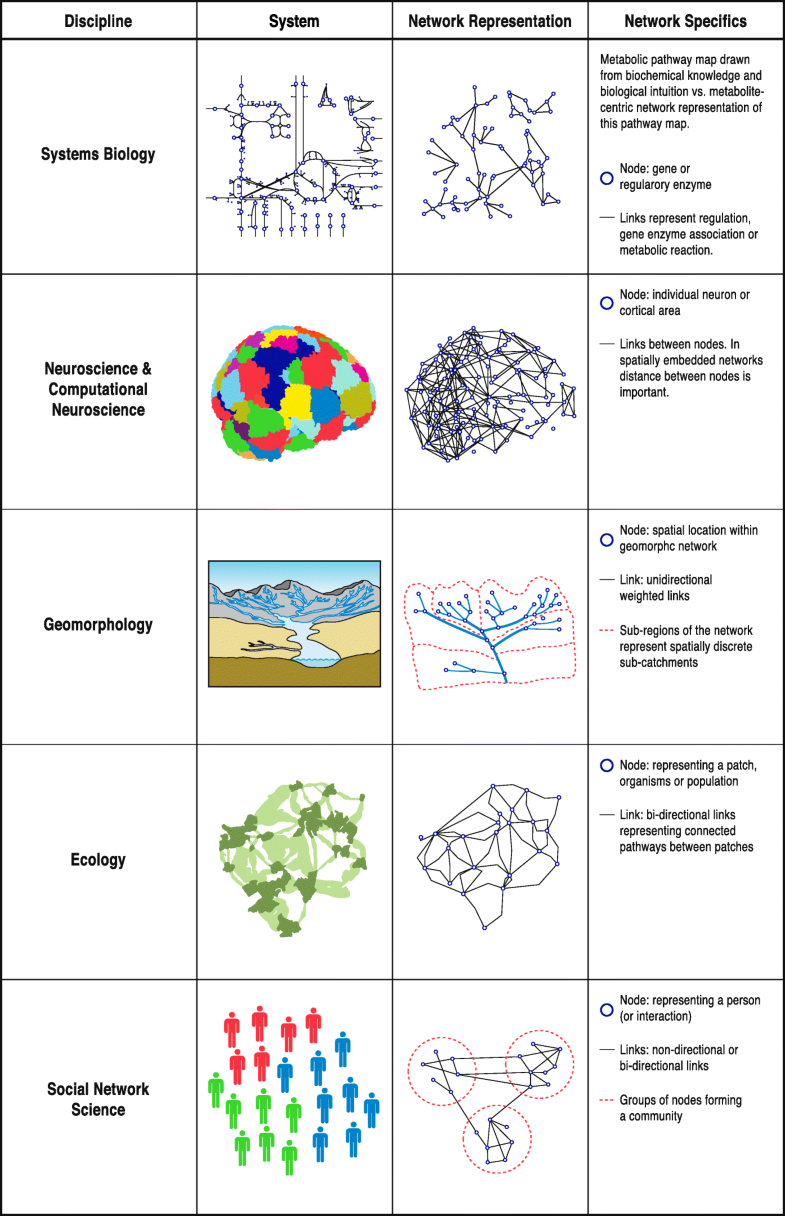
Here’s a table (detailed text removed from the original article) that compares disciplinary approaches.

Table 1:
Summary of connectivity challenges across different disciplines. Extent to which connectivity challenges are an issue:

    • * do not present a challenge;
    • ** presents a challenge but progress has been made;
    • *** presents a major challenge.

.

Fundamental Unit (FU)

Separating Structural Connectivity (SC) and Functional Connectivity (FC)

Understanding Emergent Behaviour

Measuring Connectivity

Systems Biology

**

**

**

**

Neuroscience

*

**

**

**

Computational Neuroscience

*

**

*

*

Geomorphology

***

***

***

**

Ecology

**

**

**

**

Social Network Science

*

***

***

***

Recognizing Structural Connectivity (SC) as different from (but not exclusive from) Functional Connectivity (FC) is a big start.

Fig. 1 Network-based representation of structural and functional connectivity

Fig. 1 Network-based representation of structural and functional connectivity. Illustration of ways in which structural and functional connectivity within a multitude of systems can be conceptualised using a network-based approach across Systems Biology, Neuroscience/Computational Neuroscience, Geomorphology, Ecology, and Social Network Science

References

  • Connectivity and complex systems: learning from a multi-disciplinary perspective | Laura Turnbull, Marc-Thorsten Hütt, Andreas A. Ioannides, Stuart Kininmonth, Ronald Poeppl, Klement Tockner, Louise J. Bracken, Saskia Keesstra, Lichan Liu, Rens Masselink and Anthony J. Parsons | Applied Network Science | 2018, 3:11 https://doi.org/10.1007/s41109-018-0067-2

#complex-systems, #connectivity, #multi-disciplinary

Supporting the design of competitive organizations by a domain specific application framework for the Viable System Model (pdf)

Click to access JMPM01109.pdf

Tarek Sadi
Technical University of Munich,
Chair of Product Development
tarek.sadi@tum.de

Julian Wilberg
wilberg@pe.mw.tum.de

Iris D. Tommelein
University of California, Berkeley,
Department of Civil and
Environmental Engineering
tommelein@berkeley.edu

Udo Lindemann
lindemann@pe.mw.tum.de


An Introduction to Holonomics: Seeing and Living in Authentic Wholeness – Simon Robinson

The introduction of a new idea is often framed with the observation that we cannot solve our existing problems with the same level of consciousness that created them. The subsequent call to action is frequently accompanied by an appeal to change our paradigms, and at other times a call to change our mental models. It is very easy to say these things, yet much more difficult to understand and more difficult still, to put into practice.

Holonomics is not a new idea per se; it is a new way of seeing, one which is able to comprehend the wholeness of economic systems. This way of seeing is not a ‘dogmatic annunciation’ but a ‘creative conception’ of economics which understands the deeply interwoven relationship with our planet’s ecosystem.

Photo: Simon Robinson

Hence our coining of a new definition for the word ‘holonomics’, which can be thought of as the combination of the words ‘whole’ and ‘economics’. If we look at the Greek origins of these words we find three components; ὅλος (holos — all, whole, entire, total), οἶκος (oikos — house) and νόμος (nomos — custom or law). Economics can be thought of as the understanding of the laws and customs of our home (oikos + nomos). We cannot have a limited view of our home, for home is a living planet of finite resources. Our understanding of economics has to encompass an understanding of the wholeness of nature and business systems in all their complexity, and this can only come from holonomic thinking.

Photo: Simon Robinson

Continues in source: An Introduction to Holonomics: Seeing and Living in Authentic Wholeness

s
search
c
compose new post
r
reply
e
edit
t
go to top
j
go to the next post or comment
k
go to the previous post or comment
o
toggle comment visibility
esc
cancel edit post or comment