
Source: Home


|
Decoding and Reprogramming LifeWe aim to significantly expand our understanding of the causal mechanisms underlying natural and artificial systems and to develop new tools to offer new mechanistic insights into the nature and sequence of molecular events inherent to cellular reprogramming..
Algorithmic Information Dynamics is an exciting new field put forward by our lab based upon some of the most mathematically mature and powerful theories at the intersection of computability, algorithmic information, dynamic systems and algebraic graph theory to tackle some of the challenges of causation from a model-driven mechanistic perspective, in particular, in application to behavioural, evolutionary and molecular reprogramming. Current and future research directions include: algorithmic feature selection, algorithmic model generation; connections between spectral graph theory and algorithmic complexity; the study of non fine-tuned models of causal networks; and applications of our algorithmic calculus to disentangling interconnected multilayered networks. |
|
One year before passing away, Marvin Minsky, widely considered the founding father of Artificial Intelligence, described what turns one of our main conducting lines of research. Together with Sydney Brenner’s direction — the 2002 Nobel prize in Physiology or Medicine laureate awarded by the Karolinska Institute — it completes the picture of what our lab strives: |
|
|
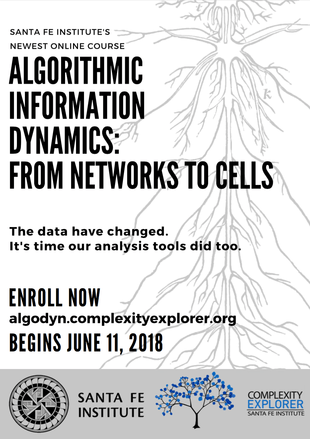
A Computational Approach to Causality and Molecular Biology: From Complex Networks to Reprogramming Cells
Almost 300 people have already enrolled in only the first 3 days. Enrol here.
|
|
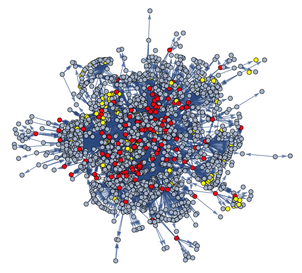
ABOUTThe Algorithmic Dynamics Lab is a spin-off group of the Unit of Computational Medicine and the result of a long-term collaboration between experts in algorithmic information theory, dynamical systems, network science, machine learning and computational biology sharing interests in fundamental science and in applications to programmability of natural and artificial systems and cognitive, genetic and evolutionary biology.
To this end, we have created research teams each tacking different fundamental questions, one is devoted to introducing cause and effect in the practice of data analytics and the introduction of model-based reasoning complementing and enabling current statistical machine learning approaches (including deep learning) to better deal with questions of causation. Related to this, a major challenge is how to combine the power of symbolic computation in its fundamentally discrete form with the power of essentially continuous fields such as differentiable programming and dynamical systems. Our aim is to introduce and exploit the most powerful mathematical theories bringing to bear mature concepts (such as multi-scale dynamics, spectral theory, and algorithmic inference) in solving some of the most pressing problems in the areas of systems modelling. |

SISTER LABSOn the one hand, our sister Living Systems Lab led by Prof. Jesper Tegnér at KAUST is setting up a 3 million USD state-of-the-art lab with the latest equipment for single cell sequencing and in vivo manipulation technology to steer and reprogram single cells using the reprogramming methods that we have developed at CompMed and AlgoDyn. The cell lines and organisms to be used are stem cells, immune cells and cancer cells.
|
PEOPLE
|

|

|

 Systems Community of Inquiry