Advancing my systems change typology: considering scaling out, up and deep | Marcus Jenal

Source: Advancing my systems change typology: considering scaling out, up and deep | Marcus Jenal


Advancing my systems change typology: considering scaling out, up and deep

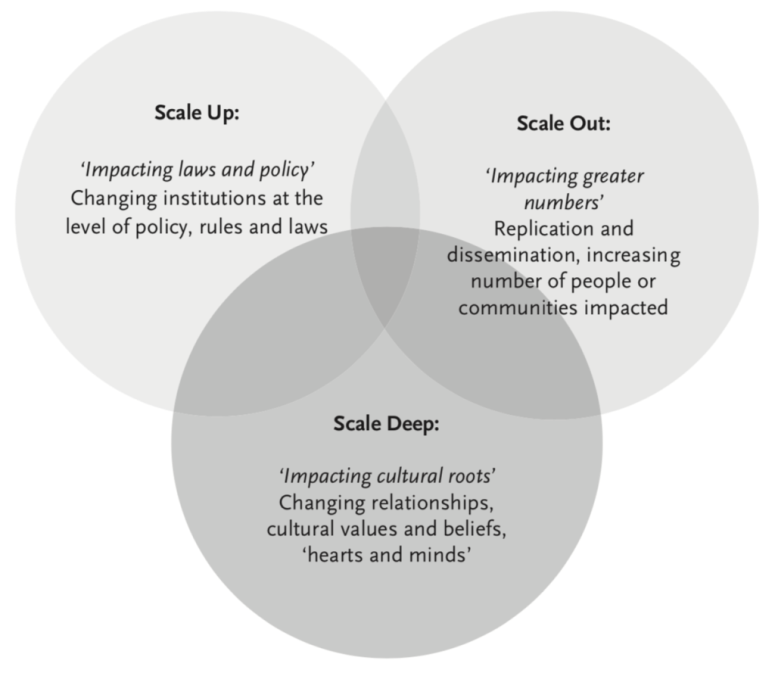
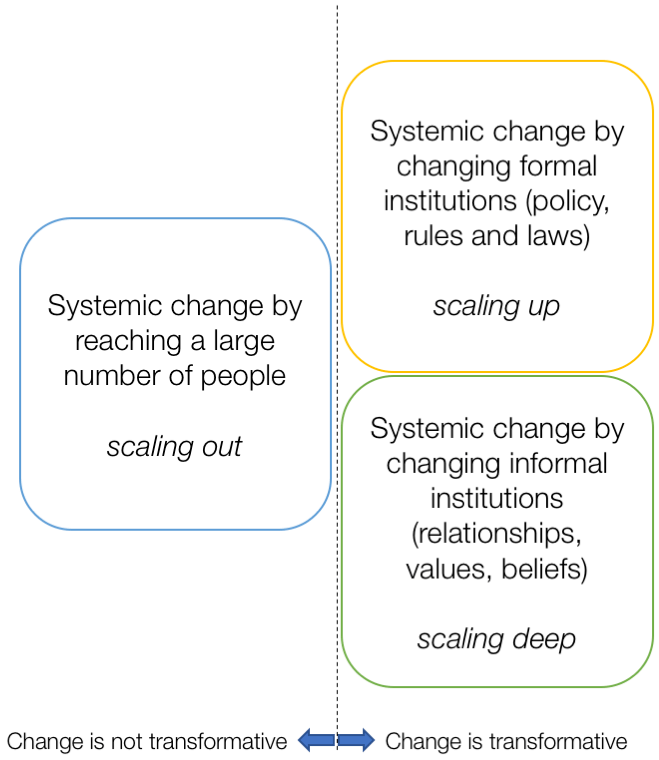
Recently I started a series on the development of a typology of systems change (the two previous articles are here and here). In this post, I want to introduce the concepts of ‘scaling out’, ‘scaling up’ and ‘scaling deep’ developed by scholars of social innovation. I want to link these concepts to my earlier thinking around the systems change typology and update it based on the new insights from this literature. At the end I will also voice a little critique on innovation-focused approaches to systems change.

‘Scaling out’ refers to the most common way of attempting to getting to scale with an innovation: reaching greater numbers by replication and dissemination. ‘Scaling up’ refers to the attempt to change institutions at the level of policy, rules and laws. Finally, ‘scaling deep’ refers to changing relationships, cultural values and beliefs.

The differentiation between scaling out, scaling up and scaling deep was introduced by Michele-Lee Moore, Darcy Riddell and Dana Vocisano in a 2015 article in The Journal of Corporate Citizenship [1]. Moore and colleagues both draw from the literature – particularly the scholarly fields of strategic niche management (SNM) and social innovation – and from an empirical study they conducted with a number of grantees from the J.W. McConnell Family Foundation in Canada. SNM is a sub-field of the literature around socio-technical transition research I also refer to in my first article of the series.

In the outset of their article, Moore and colleagues ask [1:69]:

How can brilliant, but isolated experiments aimed at solving the world’s most pressing and complex social and ecological problems become more widely adopted and achieve transformative impact?

They then make the important point that … [1:69]

… [l]eaders of large systems change and social innovation initiatives often struggle to increase their impact on systems, and funders of such change in the non-profit sector are increasingly concerned with the scale and positive impact of their investments.

Hence, the starting point of the research is very similar to the one described by the Adapt-Adopt-Expand-Respond (AAER) framework (which I introduced in my first post in the series): a (social) innovation that is successfully addressing a particular problem or situation in one or a few specific contexts or niches.

Continues in source: Advancing my systems change typology: considering scaling out, up and deep | Marcus Jenal

 

Paul Cairney: Politics & Public Policy

Nice blog which introduces, summarises, and discusses some key system-related topics, e.g.:

(title is in url)

https://paulcairney.wordpress.com/2019/02/03/policy-concepts-in-1000-words-its-time-for-some-game-theory/

https://paulcairney.wordpress.com/2019/02/03/policy-concepts-in-1000-words-the-institutional-analysis-and-development-framework-iad-and-governing-the-commons/

https://paulcairney.wordpress.com/2019/02/03/policy-in-500-words-the-social-ecological-systems-framework/

https://paulcairney.wordpress.com/2019/02/03/policy-in-500-words-ecology-of-games/

Margaret Archer – Wikipedia

Thanks to Howard Silverman for flagging Professor Archer as a notable systems thinker!

Source: Margaret Archer – Wikipedia


Margaret Archer

From Wikipedia, the free encyclopedia

Margaret Scotford Archer (born 20 January 1943) spent most of her academic career at the University of Warwick, UK, where she was for many years Professor of Sociology. She was also a professor at l’Ecole Polytechnique Fédérale de Lausanne, Switzerland. She is best known for coining the term elisionism in her 1995 book Realist Social Theory: The Morphogenetic Approach. In April 2014, Professor Archer was named by Pope Francis to succeed former Harvard law professor and U.S. Ambassador to the Holy See Mary Ann Glendon as President of the Pontifical Academy of Social Sciences.[1]

She studied at the University of London, graduating B.Sc. in 1964 and Ph.D. in 1967 with a thesis on The Educational Aspirations of English Working Class Parents. She was a lecturer at the University of Reading from 1966 to 1973.

She is one of the most influential theorists in the critical realist tradition. At the 12th World Congress of Sociology, she was elected as the first woman President of the International Sociological Association, is a founder member of both the Pontifical Academy of Social Sciences and the Academy of Learned Societies in the Social Sciences. She is a Trustee of the Centre for Critical Realism.

She has supervised some Ph.D students, some of whom have gone on to contribute towards the substantive development of critical realism in the social sciences, including Robert Archer, author of Education Policy and Realist Social Theory[2], Sean Creaven, author of Marxism and Realism[3], and Justin Cruickshank, author of Realism and Sociology[4].

Analytical dualism[edit source]

Margaret Archer argues that much social theory suffers from the generic defect of conflation where, due to a reluctance or inability to theorize emergent relationships between social phenomena, causal autonomy is denied to one side of the relation. This can take the form of autonomy being denied to agency with causal efficacy only granted to structure (downwards conflation). Alternatively it can take the form of autonomy being denied to structure with causal efficacy only granted to agency (upwards conflation). Finally it may take the form of central conflation where structure and agency are seen as being co-constitutive i.e. structure is reproduced through agency which is simultaneously constrained and enabled by structure. The most prominent example of central conflation is the structuration theory of Anthony Giddens. While not objecting to this approach on philosophical grounds, Archer does object to it on analytical grounds: by conflating structure and agency into unspecified movements of co-constitution, central conflationary approaches preclude the possibility of sociological exploration of the relative influence of each aspect.

In contradistinction Archer offers the approach of analytical dualism.[5] While recognizing the interdependence of structure and agency (i.e. without people there would be no structures) she argues that they operate on different timescales. At any particular moment, antecedently existing structures constrain and enable agents, whose interactions produce intended and unintended consequences, which leads to structural elaboration and the reproduction or transformation of the initial structure. The resulting structure then provides a similar context of action for future agents. Likewise the initial antecedently existing structure was itself the outcome of structural elaboration resulting from the action of prior agents. So while structure and agency are interdependent, Archer argues that it is possible to unpick them analytically. By isolating structural and/or cultural factors which provide a context of action for agents, it is possible to investigate how those factors shape the subsequent interactions of agents and how those interactions in turn reproduce or transform the initial context. Archer calls this a morphogenetic sequence. Social processes are constituted through an endless array of such sequences but, as a consequence of their temporal ordering, it is possible to disengage any such sequence in order to investigate its internal causal dynamics. Through doing so, argues Archer, it’s possible to give empirical accounts of how structural and agential phenomena interlink over time rather than merely stating their theoretical interdependence.

Cellular automaton – Wikipedia

Source: Cellular automaton – Wikipedia

Vester’s Sensitivity Model


Sensitivity Model
Sensitivity Model Prof. Vester®The computerized planning- and management tool for complex systems.
In an more and more complex world the common methods of solving problems are no longer sufficient and therefore no longer appropriate. Prof. Frederic Vester, recognized expert in the field of cybernetics, has developed this instrumentarium to meet the demand.

Over 30 years the Sensitivity Model Prof.Vester®, since 2006 now further developed as “Malik Sensitivity Model®Prof.Vester”, has been successfully applied in the fields of:

  • management and technical consulting
  • business strategies
  • mediation
  • risk management
  • traffic planning
  • town- and regional planning
  • scientific research and education
  • ….

The Basis- and Professional Software SYSTEMTOOLS 9.2 for Windows XP, Vista, Windows 7, Windows 8 exists as trilingual software (German, English, Spanish). Further information on demand via email

Methodology, background and practical projects are described in Frederic Vesters book: The Art of Interconnected Thinking – Ideas and Tools for dealing with complexity. A New Report to the Club of Rome.
(MCB-Publishing House, Munich 2007, 2nd edition 2013). The book can be ordered online via Amazon.

Tel. +49 089-535010
info@frederic-vester.de
pdf
http://www.frederic-vester.de/uploads/InformationEnglishSM.pdf

The Centre for the Evaluation of Complexity Across the Nexus (CECAN)

Source: Welcome to CECAN | CECAN


The Centre for the Evaluation of Complexity Across the Nexus (CECAN), a £3m research centre hosted by the University of Surrey, is transforming the practice of policy evaluation in Nexus areas, to make it fit for a complex world.

CECAN is pioneering, testing and promoting innovative policy evaluation approaches and methods across Nexus domains such as food, energy, water and the environment, through a series of ‘real-life’ case study projects with co-funders (ESRCNERCDEFRABEISFSA and EA).

CECAN has been delivering a programme of evaluation methods workshops, training courses in evaluation tools and specialist seminars delivered by international experts, to encourage knowledge sharing and capacity building amongst those working in UK policy making.


Resources – https://www.cecan.ac.uk/resources?fbclid=IwAR053DvRhdfKIXMww1I_H6i4Eo4R8qAeGTo7qvcV0AfuPavFZP9gJNgdniE


CECAN is producing a variety of resources available for download from this page. They are all available under a Creative Commons CC BY 4.0 licence.


CECAN’s Updated Manifesto, April 2018 Version 2.0

CECAN Syllabus

CECAN Managing Conflicts of Interest

CECAN Toolkits

CECAN EPPNs

CECAN has launched a Policy and Practice Note Series, with e-versions available to download.

CECAN Project Reports

CECAN Annual Conference 2018 – Policy Evaluation for a Complex World

Presentations:

Posters:

CECAN E-Newsletter Archive

Other Resources


Barabási Lab

About Us

The Center for Complex Network Research (CCNR), directed by Professor Albert-László Barabási, has a simple objective: think networks. The center’s research focuses on how networks emerge, what they look like, and how they evolve; and how networks impact on understanding of complex systems.

To understand networks, CCNR’s research has developed to rather unexpected areas. Certain studies include the topology of the www – showing that webpages are on average 19 clicks form each other; complex cellular network inside the cell-looking at both metabolic and genetic networks; the Internet’s Achilles’ Heel. The center’s researchers have even ventured to study how actors are connected in Hollywood.

Source: Barabási Lab

General Morphological Analysis

General Morphological Analysis

A general method for non-quantified modeling

© Swedish Morphological Society, 2002 (Revised 2013)
Licensed under a Creative Commons Attribution.

Article presenting Fritz Zwicky’s General Morphological Analysis as a method for non-quantified modeling, scenario development and strategy analysis.

Source: General Morphological Analysis


Wikipedia: https://en.wikipedia.org/wiki/Morphological_analysis_(problem-solving)


Morphological Analysis by Fritz Zwicky

https://www.toolshero.com/creativity/morphological-analysis-fritz-zwicky/


A HANDBOOK of INTERACTIVE MANAGEMENT by John N. Warfield and A. Roxana Cárdenas

Click to access HIM_01.pdf

“RECURSIVE FRAME ANALYSIS: A Qualitative Research Method for Mapping Change-Oriented Discourse” by Hillary Keeney, Bradford Keeney et al.

Another free whole book

Source: “RECURSIVE FRAME ANALYSIS: A Qualitative Research Method for Mapping Ch” by Hillary Keeney, Bradford Keeney et al.

 DownloadDownload Full Text (5.2 MB)

Description

Recursive Frame Analysis (RFA) is a qualitative research method for mapping and analyzing change-oriented conversation. Cybernetician and therapist Bradford Keeney invented RFA over twenty years ago as a means of discerning and indicating the bare bones organization of real-time therapeutic performance. This book revisits some of Keeney’s original ideas while providing a more exhaustive theoretical foundation for RFA, a thorough exploration of its practical application as a research tool, and several detailed analyses of therapy sessions.

Rooted to Gregory Bateson’s notion of contextual frame and the way that a distinction can recursively operate on itself as formulated by G. Spencer-Brown’s Laws of Form, RFA offers both researchers and practitioners of all kinds a formal way of tracking the dramatological construction and movement of a conversation through its beginning, middle, and end episodes. By limiting the analysis to the actual performance of the conversation being studied – including spoken discourse and description of non-verbal action – RFA lays bare the primary distinctions, re-indications, and contextual frames embodied by the communication being studied, as well as those of the researcher. Commentary later generated by the researcher must be demarcated as a separate order of discourse, providing opportunity for multiple layers of analysis by researchers while keeping the primary data intact.

Though this book primarily exemplifies the application of Recursive Frame Analysis to the study of therapeutic sessions, RFA as a research tool is not limited to this domain but can be applied to the analysis of any change-oriented conversation, interaction, or even textual discourse to track the primary distinctions, recursively generated re-indications, and emergent contextual frames being constructed. It is intended that this book serve as a resource for the future application of RFA across multiple fields.

Publication Date

2015

Publisher

The Qualitative Report

City

Fort Lauderdale

Keywords

Recursive Frame Analysis, RFA

Disciplines

Community-Based Learning | Community-Based Research | Quantitative, Qualitative, Comparative, and Historical Methodologies | Social and Behavioral Sciences | Sociology

Comments

Hillary Keeney and Bradford Keeney would like to express their gratitude and appreciation to our colleagues in Mexico for their support of this work. In particular Pedro Vargas Avalos and Clara Haydee Solis Ponce, who with their colleagues have sponsored our teaching at the Department of Clinical Psychology, National University of Mexico (UNAM), Zaragoza, and Juan Carlos García and Sylvia Arce, who have sponsored our teaching at Etfasis: Institute of Systemic Family Therapy. It was during our seminars there that many of the ideas in this book were developed.

Ronald Chenail would like to thank President George L. Hanbury II and Nova Southeastern University for supporting The Qualitative Report; Hillary and Brad Keeney for their continuing guidance and encouragement; Lydia Acosta, Michele Gibney, and Cheryl Ann Peltier-Davis for launching NSU Works and helping with our first book development and release; Melissa Rosen for her copyediting and graphics skills; Adam Rosenthal for his leadership in making TQR Books a reality; and Jan Chenail, my late wife, for making me a better writer, husband, father, and friend.

Copyright 2014: Hillary Keeney, Bradford Keeney, Ronald Chenail and Nova Southeastern University

Strategic Assumption Surfacing and Testing (SAST)

csl4d's avatarCSL4D

Mitroff’s ‘operationalization’ of Churchman’s systems approach, part 1

In table 12-3 (p. 301 of Mason’s and Mitroff’s ‘Challenging strategic planning assumptions’) major approaches to business problem solving are compared, including the systems approach and SAST (strategic assumption surfacing and testing), but also analytic modelling (typical of operations research), the case method (widely used, but lacking in objectivity), structured approaches (e.g. PIMS and its many derivatives, often failing to look at key non-quantifiables). The problem with the systems approach is that it is difficult to operationalize (although it could be argued that Wicked Solutions solved that problem). The problem of SAST may be the unwillingness of participants to lay bare their assumptions. This is a general problem in all approaches where we want to leave no stone unturned (as assumptions, e.g. about people’s motivations, lurk beneath them). In this post I will argue that SAST can be combined with…

View original post 1,478 more words

Introduction to the Modeling and Analysis of Complex Systems – Open SUNY Textbooks

full, free textbook!


Source: Introduction to the Modeling and Analysis of Complex Systems – Open SUNY Textbooks


Introduction to the Modeling and Analysis of Complex Systems


Download PDF PDF DOWNLOAD  19 MB

Author(s): 

Keep up to date on Introduction to Modeling and Analysis of Complex Systemsat http://bingweb.binghamton.edu/~sayama/textbook/!

Introduction to the Modeling and Analysis of Complex Systems introduces students to mathematical/computational modeling and analysis developed in the emerging interdisciplinary field of Complex Systems Science. Complex systems are systems made of a large number of microscopic components interacting with each other in nontrivial ways. Many real-world systems can be understood as complex systems, where critically important information resides in the relationships between the parts and not necessarily within the parts themselves. This textbook offers an accessible yet technically-oriented introduction to the modeling and analysis of complex systems. The topics covered include: fundamentals of modeling, basics of dynamical systems, discrete-time models, continuous-time models, bifurcations, chaos, cellular automata, continuous field models, static networks, dynamic networks, and agent-based models. Most of these topics are discussed in two chapters, one focusing on computational modeling and the other on mathematical analysis. This unique approach provides a comprehensive view of related concepts and techniques, and allows readers and instructors to flexibly choose relevant materials based on their objectives and needs. Python sample codes are provided for each modeling example.

This textbook is available for purchase in both grayscale and color via Amazon.com and CreateSpace.com.

REVIEWS:

Hiroki Sayama’s book “Introduction to the Modeling and Simulation of Complex Systems” is … a unique and welcome addition to any instructor’s collection. What makes it valuable is that it not only presents a state-of-the-art review of the domain but also serves as a gentle guide to learning the sophisticated art of modeling complex systems. –Muaz A. Niazi, Complex Adaptive Systems Modeling 2016 4:3


… Sayamaʼs book is a very good instrument for students who want to read an introductory text on modeling and analysis of complex systems, and for instructors who need such a text in simple language for their complex systems courses and projects. The book offers a good introduction to the complex systems terminology and plenty of readily available examples with technical implementation details. … Overall, Introduction to the Modeling and Analysis of Complex Systems offers a novel pedagogical approach to the teaching of complex systems, based on examples and library code that engage students in a tutorial-style learning adventure. It is a solid tool that may become one of the primary instruments for teaching complex systems science and help the discipline to become more established in the academic world, triggering the necessary transition from a top-down tradition to a bottom-up complex systems approach.
-Stefano Nichele, Artificial Life 22(3): 424-427, 2016. www.mitpressjournals.org/doi/abs/10.1162/ARTL_r_00209


Facebooktwittergoogle_plusredditlinkedintumblrmail

I Preliminaries

1 Introduction

1.1 Complex Systems in a Nutshell

1.2 Topical Clusters

2 Fundamentals of Modeling

2.1 Models in Science and Engineering

2.2 How to Create a Model

2.3 Modeling Complex Systems

2.4 What Are Good Models?

2.5 A Historical Perspective

II Systems with a Small Number of Variables

3 Basics of Dynamical Systems

3.1 What Are Dynamical Systems?

3.2 Phase Space

3.3 What Can We Learn?

4 Discrete-Time Models I: Modeling

4.1 Discrete-Time Models with Difference Equations

4.2 Classifications of Model Equations

4.3 Simulating Discrete-Time Models with One Variable

4.4 Simulating Discrete-Time Models with Multiple Variables

4.5 Building Your Own Model Equation

4.6 Building Your Own Model Equations with Multiple Variables

5 Discrete-Time Models II: Analysis

5.1 Finding Equilibrium Points

5.2 Phase Space Visualization of Continuous-State Discrete-Time Models

5.3 Cobweb Plots for One-Dimensional Iterative Maps

5.4 Graph-Based Phase Space Visualization of Discrete-State Discrete-Time Models

5.5 Variable Rescaling

5.6 Asymptotic Behavior of Discrete-Time Linear Dynamical Systems

5.7 Linear Stability Analysis of Discrete-Time Nonlinear Dynamical Systems .

6 Continuous-Time Models I: Modeling

6.1 Continuous-Time Models with Differential Equations

6.2 Classifications of Model Equations

6.3 Connecting Continuous-Time Models with Discrete-Time Models

6.4 Simulating Continuous-Time Models

6.5 Building Your Own Model Equation

7 Continuous-Time Models II: Analysis

7.1 Finding Equilibrium Points

7.2 Phase Space Visualization

7.3 Variable Rescaling

7.4 Asymptotic Behavior of Continuous-Time Linear Dynamical Systems

7.5 Linear Stability Analysis of Nonlinear Dynamical Systems

8 Bifurcations

8.1 What Are Bifurcations?

8.2 Bifurcations in 1-D Continuous-Time Models

8.3 Hopf Bifurcations in 2-D Continuous-Time Models

8.4 Bifurcations in Discrete-Time Models

9 Chaos

9.1 Chaos in Discrete-Time Models

9.2 Characteristics of Chaos

9.3 Lyapunov Exponent

9.4 Chaos in Continuous-Time Models

II Systems with a Large Number of Variables

10 Interactive Simulation of Complex Systems

10.1 Simulation of Systems with a Large Number of Variables

10.2 Interactive Simulation with PyCX

10.3 Interactive Parameter Control in PyCX

10.4 Simulation without PyCX

11 Cellular Automata I: Modeling

11.1 Definition of Cellular Automata

11.2 Examples of Simple Binary Cellular Automata Rules

11.3 Simulating Cellular Automata

11.4 Extensions of Cellular Automata

11.5 Examples of Biological Cellular Automata Models

12 Cellular Automata II: Analysis

12.1 Sizes of Rule Space and Phase Space

12.2 Phase Space Visualization

12.3 Mean-Field Approximation

12.4 Renormalization Group Analysis to Predict Percolation Thresholds

13 Continuous Field Models I: Modeling

13.1 Continuous Field Models with Partial Differential Equations

13.2 Fundamentals of Vector Calculus

13.3 Visualizing Two-Dimensional Scalar and Vector Fields

13.4 Modeling Spatial Movement

13.5 Simulation of Continuous Field Models

13.6 Reaction-Diffusion Systems

14 Continuous Field Models II: Analysis

14.1 Finding Equilibrium States

14.2 Variable Rescaling

14.3 Linear Stability Analysis of Continuous Field Models

14.4 Linear Stability Analysis of Reaction-Diffusion Systems

15 Basics of Networks

15.1 Network Models

15.2 Terminologies of Graph Theory

15.3 Constructing Network Models with NetworkX

15.4 Visualizing Networks with NetworkX

15.5 Importing/Exporting Network Data

15.6 Generating Random Graphs

16 Dynamical Networks I: Modeling

16.1 Dynamical Network Models

16.2 Simulating Dynamics on Networks

16.3 Simulating Dynamics of Networks

16.4 Simulating Adaptive Networks

17 Dynamical Networks II: Analysis of Network Topologies

17.1 Network Size, Density, and Percolation

17.2 Shortest Path Length

17.3 Centralities and Coreness

17.4 Clustering

17.5 Degree Distribution

17.6 Assortativity

17.7 Community Structure and Modularity

18 Dynamical Networks III: Analysis of Network Dynamics

18.1 Dynamics of Continuous-State Networks

18.2 Diffusion on Networks

18.3 Synchronizability

18.4 Mean-Field Approximation of Discrete-State Networks

18.5 Mean-Field Approximation on Random Networks

18.6 Mean-Field Approximation on Scale-Free Networks

19 Agent-Based Models

19.1 What Are Agent-Based Models?

19.2 Building an Agent-Based Model

19.3 Agent-Environment Interaction

19.4 Ecological and Evolutionary Models

Bibliography

Index

Hiroki Sayama

Hiroki Sayama, D.Sc., is an Associate Professor in the Department of Systems Science and Industrial Engineering, and the Director of the Center for Collective Dynamics of Complex Systems (CoCo), at Binghamton University, State University of New York. He received his BSc, MSc and DSc in Information Science, all from the University of Tokyo, Japan. He did his postdoctoral work at the New England Complex Systems Institute in Cambridge, Massachusetts, from 1999 to 2002. His research interests include complex dynamical networks, human and social dynamics, collective behaviors, artificial life/chemistry, and interactive systems, among others. He is an expert of mathematical/computational modeling and analysis of various complex systems. He has published more than 100 peer-reviewed journal articles and conference proceedings papers and has edited eight books and conference proceedings about complex systems related topics. His publications have acquired more than 2000 citations as of July 2015. He currently serves as an elected Board Member of the International Society for Artificial Life (ISAL) and as an editorial board member for Complex Adaptive Systems Modeling (SpringerOpen), International Journal of Parallel, Emergent and Distributed Systems (Taylor & Francis), and Applied Network Science (SpringerOpen).

are there any developed methods specific to #complexitytheory other than Agent Based Modelling?

I asked this question on social media and in the systems thinking facebook groups (#lazyweb – all those I could address with a single click through buffer.com).

I think my emergent point is that any real distinction is purely tactical/motivated/arbitrary – at the very least that the overlaps between ‘cybernetics’, ‘systems thinking’, and ‘complexity science’ are so massive – and have such shared routes – that, in order to carve any of them out as individual territories, you have to artificially apportion stuff that rightfully belongs to one or both to the other… if you see what I mean! Remember that I am trying to think specifically about *methods*.

Each has some elements which are of course distinct – agent-based modelling seems like the best candidate in ‘complexity’ – and certainly specific *applications* of mathematical techniques – and maybe some stuff around network modelling?

Here are the threads:

https://www.facebook.com/groups/774241602654986/2083395748406225/?comment_id=2083432968402503&notif_id=1549119341857033&notif_t=group_comment&ref=notif

https://www.facebook.com/groups/2391509563/10156785597314564/?comment_id=10156785650364564&notif_id=1549119885345223&notif_t=group_comment&ref=notif

https://www.facebook.com/groups/1698754760335916/2275321949345858/?comment_id=2275328329345220&notif_id=1549119105597714&notif_t=group_comment&ref=notif

There will now follow a lot of posts of interesting approaches unearthed!

seeking amazing speakers in London and Manchester for Systems and Complexity in Organisation

I’m a non-exec Director of www.scio.org.uk – systems and complexity in organisation – and we run four open days a year, with four systems-related speakers at each one.

We would love to have more speakers (and attendees) related to systems change, regenerative agriculture, sustainability, philanthropy, international development etc. We’d also love to have more contributors from sectors we hear less from – health, education at all levels, social care, arts, charities

Can you recommend any speakers – would you be interested to speak? Reply here or drop me a line at ben.taylor@scio.org.uk

Cheers!
Benjamin

Definitions of systems and systems thinking

csl4d's avatarCSL4D

There are no simple definitions of systems and systems thinking (Monat & Gannon 2015) that are sufficiently rich to clarify what they are essentially about. So instead, I will offer a circumscriptive definition in three parts and add a small concept map to go with it.

Systems thinking       …. is the selection and application of more or less general systems methods or systemic problem solving tools to examine, debate, model, and modify systems structures, which underlie systems behavior. Systems thinking serves to identify and improve or understand the system behavior of a broad range of open systems.

Open systems      … consist of sets of at least two parts, elements, components or subsystems that are characterized by at least one interrelationship. The distinction between an open system and its environment is conceptualized by the system boundary. Open systems interact with their environment by receiving…

View original post 295 more words

s
search
c
compose new post
r
reply
e
edit
t
go to top
j
go to the next post or comment
k
go to the previous post or comment
o
toggle comment visibility
esc
cancel edit post or comment