
Source: Epidemiology is ecosystem science | SpringerLink
Epidemiology is ecosystem science

S.I.: Philosophy of Epidemiology
Abstract
This paper primarily argues that Epidemiology is Ecosystem Science. It will not only explore this notion in detail but will also relate it to the argument that Classical Chinese Medicine was/is Ecosystem Science. Ecosystem Science (as instantiated by Epidemiology) and Ecosystem Science (as instantiated by Classical Chinese Medicine) share these characteristics: (a) they do not subscribe to the monogenic conception of disease; (b) they involve multi variables; (c) the model of causality presupposed is multi-factorial as well as non-linear.
Keywords
Ecosystem science Epidemiology Classical chinese medicine Multifactorial causation Non-linear causality
1 Introduction
- 1.
Biomedicine exhibits two paradigms of explaining disease. The monogenic conception of disease, which is the dominant paradigm, embodies the standards and criteria of scientificity for Biomedicine. In contrast, Epidemiology is considered to be the Cinderella as its paradigm of explanation and scientificity is different and hence, held, at arm’s length, if not with outright suspicion.1
- 2.
The two paradigms differ ontologically and methodologically. The monogenic conception of disease upholds the thesis: one causal agent, one disease entity. It rests on thing-ontology. Its implied model of causality is Humean, monofactorial and linear (the causal arrow is unidirectional, from cause to effect only). On the other hand, Epidemiology understands disease not so much as a disease entity but more as a pattern of interrelated events which may lead to a pattern of ill-health in the population. It rests on process-ontology. Its model of causality is non-Humean, multi-factorial and non-linear (the relationships are synergistic, reciprocal, with feedback loops).2
- 3.
While the monogenic conception of disease is rooted in the Gold Standard of the Randomised Controlled Trial (RCT) and of late its related Gold Standard of Evidence-based Medicine (EBM), Epidemiology proceeds more in the manner of Ecology as a field science. Ecology explicitly studies ecosystems: the biotic and abiotic components which make up a particular ecosystem, the relationships between these with the ecosystem as a Whole, not to mention with other ecosystems. This kind of science is necessarily non-Reductionist as the Whole in terms of its causal inter- as well as intra-relationships are reciprocal in character; this complicated network of causal relations means that properties emerge from the Whole which cannot be predicted by simply adding up the contribution of each of the component parts of the Whole. Epidemiology is, hence, Ecosystem Science.3 It will also be shown that Ecosystem Science/Thinking itself may be considered as a variant of Systems Thinking.
- 4.
If one cares to do some comparative history of science, the model of Ecosystem Science/Thinking and Systems Theory/Thinking can be said to be found in Classical Chinese Medicine (CCM for short, whose origin may be traced back to more than two and a half thousand or more years): CCM is a science which is Wholist4 in orientation, resting on process-ontology (rather than thing-ontology) and whose causal model is multi-factorial, non-linear and reciprocal, and with feedback loops.5
- 5.
In a very brief extension of the theme at 4, this contribution looks at how CCM perceived/perceives epidemics and whether it had/has any grasp of what today we call Epidemiology. The conclusion is positive, although to mark the differences in spite of the similarities between CCM and modern Epidemiological thinking, the CCM discipline will occur in italicised form, namely, Epidemiology.
Headings
2 The monogenic conception of disease, its paradigm of scientificity and its associated drawbacks
3 Epidemiology and its paradigm of scientificity
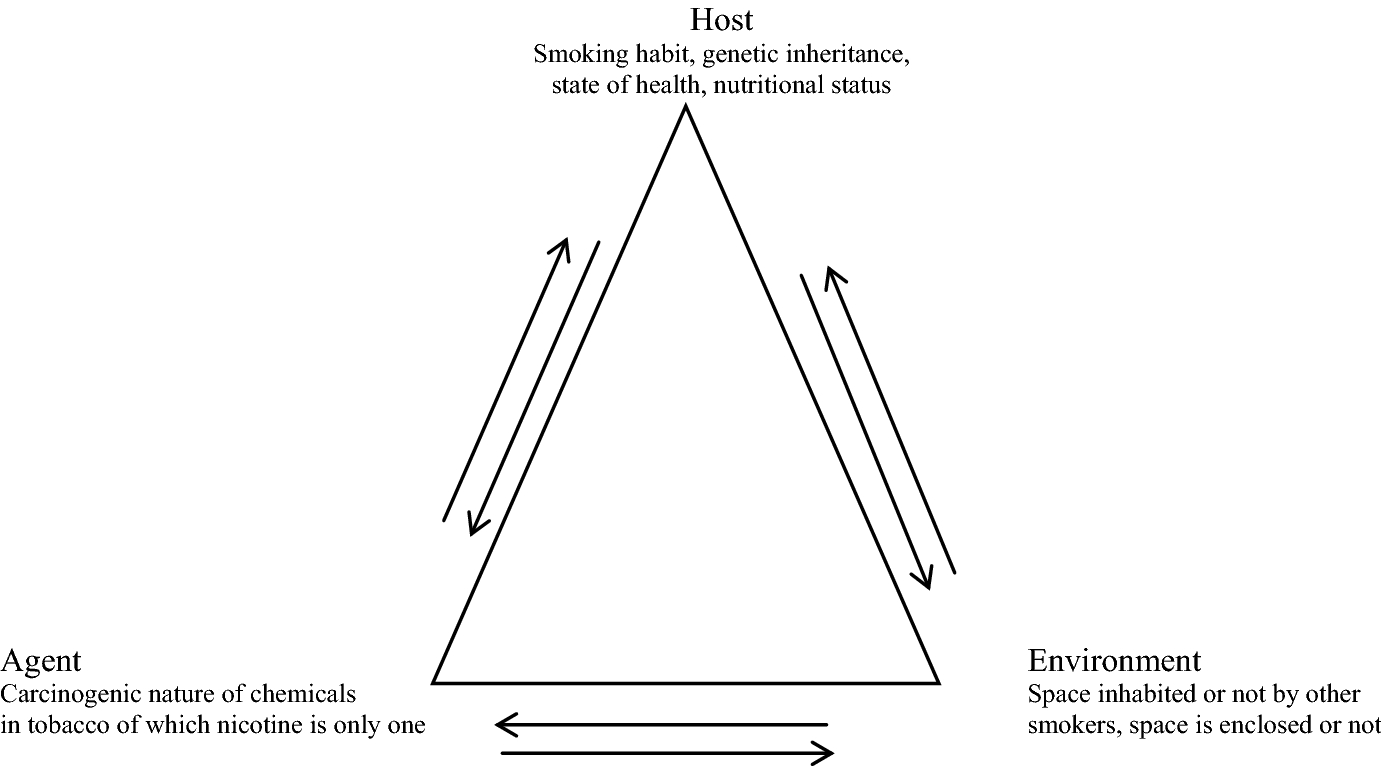
Epidemiological (enhanced) triangle of relevant variables and causation
|
Monogenic, linear |
Epidemiological, non-linear |
|
|---|---|---|
|
a |
b |
|
|
I |
Humean/Billiard-ball |
Non-Humean |
|
II |
Monofactorial |
Multi-factorial |
|
III |
One cause, one effect |
Inter-acting causal variables leading to even a synergistic effect18 |
|
IV |
Causal direction moves in a single uni-directional straight line |
Causal direction is reciprocal, from A to B, B to A19 |
|
V |
Static, ahistorical |
Dynamic, historical |
|
VI |
Atomistic materialism: the whole is no more than the sum of its parts |
Wholism: the whole differs from/is greater than the sum of its parts; emergent properties |
|
VII |
Reductionist |
Non-reductionist |
|
VIII |
Solid medicine/thing-ontology |
Patterns of events in populations/process-ontology |
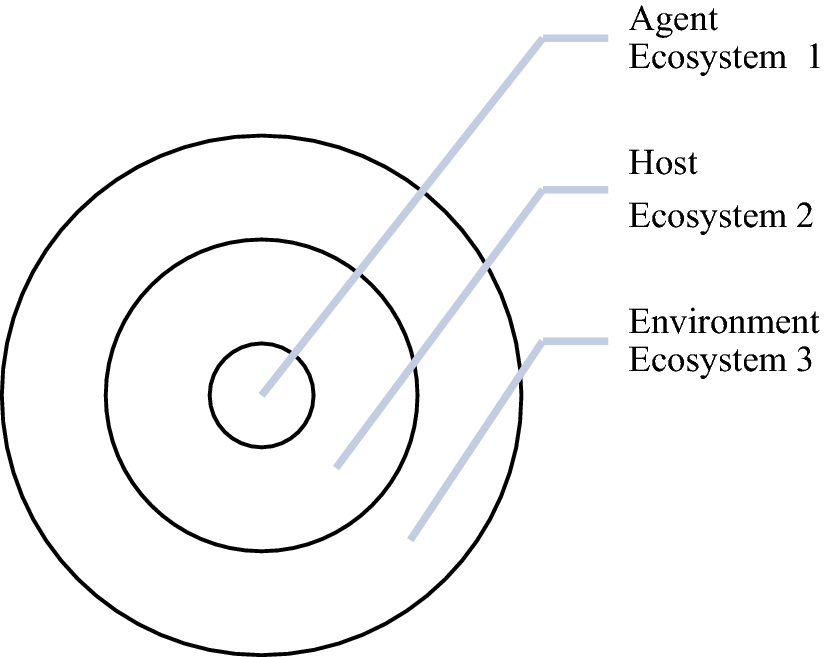
Epidemiological causation as ecosystem nesting of concentric circles
4 Ecology: ecosystems and ecosystem science
5 Classical Chinese medicine is ecosystem science
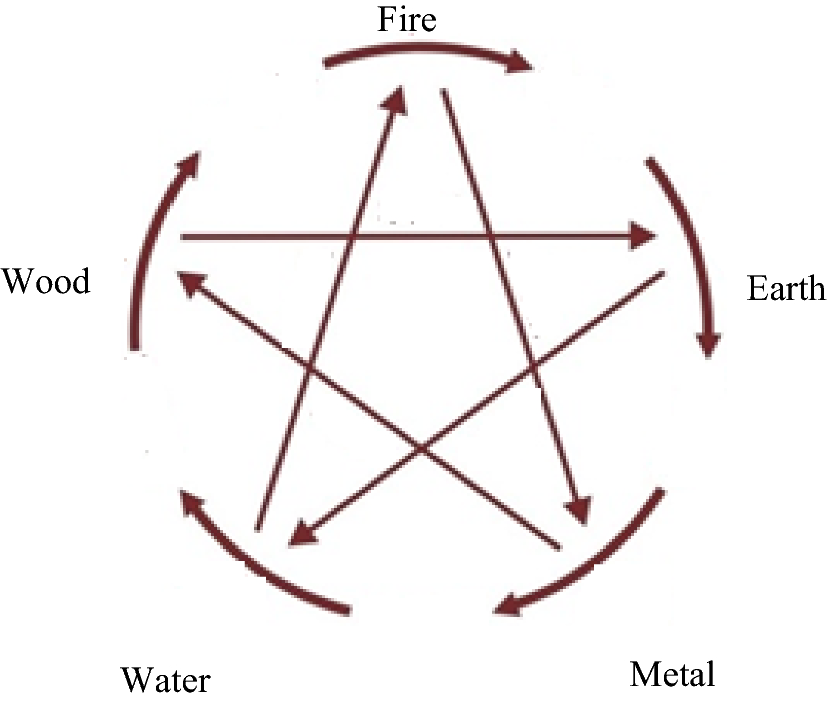
The thick broken lines of the circle and their arrows stand for the mutually engendering cycle while the thinner unbroken lines and their arrows inside the circle stand for the mutually constraining cycle
 Systems Community of Inquiry