Nora Bateson and Gil Friend: Inner Ecology—Thinking Through the Mess – YouTube

Nora Bateson and Gil Friend: Inner Ecology—Thinking Through the Mess

Published on 22 Apr 2019

SUBSCRIBED 77
Nora Bateson and Gil Friend kick off Gil’s “Conversations at the Edge of Now” series at the Commonwealth Club of California with a wide-ranging exploration that starts with a simple, provocative question: “How can we think our way out of these messes, when the way we think is part of the mess?” ———————————————————————————– The world is coming undone, all sort of chaos looms. It’s pitch dark. There’s no moon. You can’t find your map. The ground shifts beneath your feet. You grope tentatively to detect sure footing, or the edge of a precipice, and long for a hand to hold. Welcome to the Anthropocene—perhaps the most uncertain era in the human evolutionary experience. Underlying the climate crisis and other pressing dilemmas of our times is the problem of how we think, and how we encounter the world, others and ourselves. How we meet this era is critical. Are we going to soothe ourselves and pretend that business as usual is an option? No. There is no more time for trendy buzz-words or empty promises. To meet the challenges of this era is to accept that, no matter how well intended, previous approaches to sustainable and just socio-economic solutions were not sufficient to meet the systemic nature of the problems. A paradigm shift is more than an incremental adjustment of existing institutions, more than a detailed strategy for silo-ed solutions to silo-ed crises that have been bought about by silo-ed thinking. Climate, immigration, trade, innovation, wealth gap, AI, biodiversity, racism, acidification, mental health, urbanization, power, supply chains, exploitation of human beings and nature…all are connected, through similar blocks, similar blindness, and something that illuminates it all. Underlying our dilemmas is the problem of how we think—“the difference between how nature works and the way people think,” as Gregory Bateson put it—and how we encounter the world, others and ourselves. It is time to authorize another kind of description of the meta-crises we live in, another kind of response, and another kind of conversation, with each other and with ourselves—since we create worlds in these conversations, and open or close the possibilities we live into. This is a radical move, out of the standard accepted models of goals and deliverables into what it really takes to meet the trans-contextual complexity of now. Join Nora and Gil as we explore warm data, the patterns that connect, the dilemma of purpose, and the ways our words shape the worlds we inhabit, and the possibilities we generate, in each other and in ourselves. Nora Bateson is an award-winning filmmaker, writer and educator, and President of the International Bateson Institute, based in Sweden. Her work asks the question “How we can improve our perception of the complexity we live within, so we may improve our interaction with the world?” Nora wrote, directed and produced the award-winning documentary, An Ecology of Mind, a portrait of her father, Gregory Bateson. Her work brings the fields of biology, cognition, art, anthropology, psychology, and information technology together into a study of the patterns in the ecology of living systems. Her book, Small Arcs of Larger Circles, released by Triarchy Press, UK, 2016 is a revolutionary personal approach to the study of systems and complexity. Gil Friend is a strategist, author and businessman, named “one of the top ten sustainability voices in the US” by The Guardian. As CEO of Natural Logic, he has challenged and guided some of the world’s leading companies to build value and competitive advantage by applying nature’s 3.8 billion years of open source R&D to today’s biggest problems. He served as the first Chief Sustainability Officer for the City of Palo Alto, and is founder of Critical Path Capital. Gil is author of The Truth About Green Business (FT Press, 2009) and numerous articles for GreenBiz, Sustainable Brands, and the LA Times Syndicate. He began his sustainability journey at Buckminster Fuller’s “World Game” nearly 50 years ago.

Machine Learning Widens the Gap Between Knowledge and Understanding – David Weinberger (via David Gurteen)


Via David Gurteen (whose newsletter and other communications are highly recommdned) at http://www.gurteen.com/gurteen/gurteen.nsf/id/machine-learning-and-complexity, where he writes:

Title The true complexity of the world outstrips our ability to fully explain it
Weblog Gurteen Knowledge Log
Knowledge Letter Appears in the Gurteen Knowledge Letter issue: 226
Posted Date Sunday 28 April 2019 18:51 GDT
Posted By David Gurteen
Categories Complexity
People David Weinberger
I have long been an admirer and follower of the work and thinking of David Weinberger ever since he was one of the authors of The ClueTrain Manifesto in 1999.

He still never fails to have an impact on me in his writing. Recently he wrote a Medium article entitled Machine Learning Widens the Gap Between Knowledge and Understanding.

It’s a ten minute read but here is the jist.

We humans have long been under the impression that if we can just understand the immutable laws of how things happen, we’ll be able to perfectly predict, plan for, and manage the future.

We have, therefore, made it our business to know how things happen by discovering the laws and models that govern our world.

Given how imperfect our knowledge has always been, this assumption has rested upon a deeper one.

Our unstated contract with the universe has been that if we work hard enough and think clearly enough, the universe will yield its secrets, for the universe is knowable, and thus, at least, somewhat pliable to our will.

But now that our new tools, especially machine learning and the internet, are bringing home to us the immensity of the data and information around us, we’re beginning to accept that the true complexity of the world far outstrips the laws and models we devise to explain it.

Our newly capacious machines can get closer to understanding it than we can, and they, as machines, don’t really understand anything at all.

David goes on to give some good examples, the bottom line, however, us that AI can discover relationships between things in the world that we humans will never be able to, given the size and complexity of the data, even though the AI software has no understanding of the world. In David’s words:

“We need to give up our insistence on always understanding our world and how things happen in it.”

A new world is dawning,

If you are interested in Knowledge Management, the Knowledge Café or the role of conversation in organizational life then you my be interested in this online book I am writing on Conversational Leadership


MAIN ARTICLE:

Source: Machine Learning Widens the Gap Between Knowledge and Understanding


OneZero

Machine Learning Widens the Gap Between Knowledge and Understanding

And gives us the tools for our next evolutionary step

Credit: peepo/Getty Images

The program“Deep Patient” doesn’t know that being knocked on the head can make us humans dizzy or that diabetics shouldn’t eat 5-pound Toblerone bars in one sitting. It doesn’t even know that the arm bone is connected to the wrist bone. All it knows is what researchers fed it in 2015: the medical records of 700,000 patients as discombobulated data, with no skeleton of understanding to hang it all on.

Yet, after analyzing the relationships among these blind bits, Deep Patient was not only able to diagnose the likelihood of individual patients developing particular diseases, it was in some instances more accurate than human physicians, including about some diseases that until now have utterly defied predictability.

Continues in source: Machine Learning Widens the Gap Between Knowledge and Understanding


Exploring The Ashby Space:

Harish's avatarHarish's Notebook - My notes... Lean, Cybernetics, Quality & Data Science.

Ashby4

Today’s post is a follow-up to an earlier post, Solving a Lean Problem versus a Six Sigma Problem:

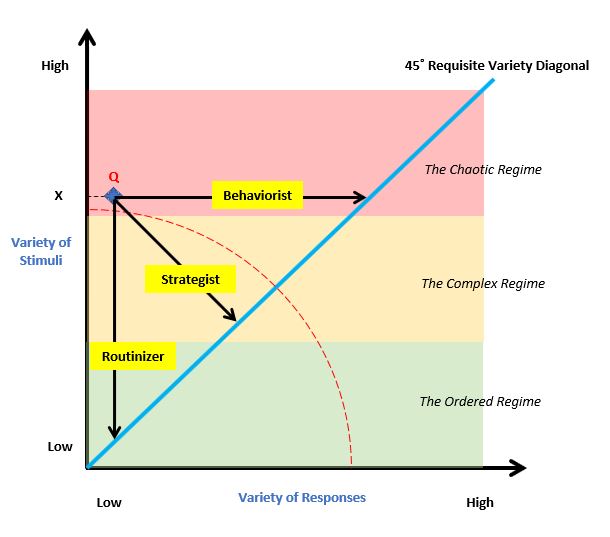
In today’s post, I am looking at “The Ashby Space.” The post is based on the works of Ross Ashby, Max Boisot, Bill McKelvey and Karl Weick. Ross Ashby was a prominent cybernetician who is famous for his “Law of Requisite Variety.” The Law of Requisite Variety can be stated as “Only variety can destroy/absorb variety.” Ashby defined variety as the number of distinguishable states of a system. Stafford Beer used variety as a measure of complexity. More variety a system has the more complex it is. An important concept to grasp with this idea is that the number of distinguishable states (and thus variety) depends upon the ability of the observer. In this regard, variety of a system may be viewed as dependent on the observer.

Max Boisot and…

View original post 1,515 more words

Systems Innovation – new forum on their site now open for discussions

Systems Innovation‏ @Sys_innovationFollowing Following @Sys_innovationMoreNew forum on the site now open for discussion, take a look: http://bit.ly/2XtxeKk 3:30 pm – 21 Apr 2019

Focus: Entropy & Homeostasis

caminao's avatarCaminao's Ways

Preamble

As defined by thermodynamics entropy is a measure of the energy within a system that cannot be usefully harnessed; cybernetics has took over, making entropy a pillar of information theory.

Figuring Digital Matter (Marcelo Cidade)

Notwithstanding the focus put on viable systems and organizations (as epitomized by the pioneering work of Stafford Beer), cybernetics’ actual imprint on corporate governance has been frustrated by the correspondence assumed between information and energy. But the immersion of enterprises into digital environments brings entropy back in front, along with a paradigmatic shift out of thermodynamics.

domain: Physics vs Economics

The second law of thermodynamics states that entropy within a system is constant, and so is information as defined by cybernetics. But economics laws, if there is such a thing, are to differ: as far as business is concerned information is not to be found in commons but comes from the processing of raw…

View original post 1,081 more words

SOLSTICE 2019 – Summer Solstice Conference on Discrete Models of Complex Systems 2019

cxdig's avatarComplexity Digest

15-17 July 2019

Max Planck Institute for the Physics of Complex Systems, Dresden, Germany

Source: solstice2019.loria.fr

View original post

The necessity of extended autopoiesis

cxdig's avatarComplexity Digest

The theory of autopoiesis holds that an organism can be defined as a network of processes. However, an organism also has a physical body. The relationship between these two things—network and body—has been raised in this issue of Adaptive Behaviour, with reference to an extended interpretation of autopoiesis. This perspective holds that the network and the body are distinct things, and that the network should be thought of as extending beyond the boundaries of the body. The relationship between body and network is subtle, and I revisit it here from the extended perspective. I conclude that from an organism = network perspective, the body is a biological solution to the problem of maintaining both the distinctness of an organism, separate from but engaged with its environment and other organisms, and its distinctiveness as a particular individual.


The necessity of extended autopoiesis
Nathaniel Virgo
Adaptive Behavior

https://doi.org/10.1177/1059712319841557

Source: journals.sagepub.com

View original post

“Bounded Applicability” & “Conditionality” – Lou Hayes Jr

Source: “Bounded Applicability” & “Conditionality”

“Bounded Applicability” & “Conditionality”

I first heard of the term Bounded Applicability last week, in Liminal Cynefin & ‘control by Dave Snowden:

…with some exceptions few things are wrong, most are right within boundaries. To put it another way they are context specific not context free.

Also, from the Cognitive Edge glossary:

Bounded Applicability — the concept that different and contradictory things work in different bounded spaces

My mind immediately turned to parenting and teaching kids about dangers, hazards, and safety. I had been pondering the difficulty in talking to young children about when certain behaviors are acceptable and when they’re not.

Don’t walk in the street. Then have a block party where everyone is literally sitting on chairs in the roadway.

Don’t talk to strangers. Then strike up a conversation with some random guy in line at the deli counter.

Don’t touch the BBQ grill. Then pick up the grates with your bare hands to wash them.

Don’t drink alcohol. Then uncork a bottle of wine at dinner.

Hypocritical? Not exactly.

I’ve referred to this as conditionality. Conditions matter. But as parents, we generally aren’t convinced that our kids can appreciate the nuances and subtleties. And rightfully so.

I recall a conversation with my son after a teacher complained he pointed a “finger gun” on the pre-school playground. (pew pew!) It was the start of teaching conditionality. Finger guns, NERF guns, and all other toy guns are allowed at home. But NO toy guns at school. Not even finger guns. (He’s kept his finger holstered ever since.)

It makes sense to err on the side of safety and control. Safer to not touch anyone. Safer to not pet the dog. Safer to not climb the ladder. Especially since young kids might not comprehend the variables that go into the variety of “conditions” that can exist. So we come up with rules; sometimes ridiculous rules.

In a much broader sense than parenting, I fear society does a lackluster job at teaching conditionality or bounded applicability. We come in with rulebooks, checklists, binders, plans, flowcharts, and different flavors of Nevers and Shalls. We strip our people of discretion and judgement by giving them rules and constraints that work in most, but not all situations. We treat them like toddlers.

And when they find themselves in one (1) of those outlier events where the rules or checklist doesn’t work…they have very little to fall back upon.  They lack the why, the understanding, and the bigger picture.

My wife and I don’t believe in “stranger danger.” As such, we’ve never told our kids to not talk to strangers. Our message is different. Actually, we demonstrate and teach our kids HOW to talk to strangers. We had to change the narrative. We had to go deeper than a simple rule.

What if we invested the time and effort into teaching concepts, principles, values, complexity, and decision-making? What if we role-played conditions and circumstances? What if we put our people into simulations that replicated those situations that fell outside “normal” conditions? What if we brought our people into the mix when designing policies and procedures…to solicit input from those actually doing the job, who’ve experienced outlier events?

All kids eventually figure out the stove is not always hot. How quickly do they learn? And can they learn it without getting burned?

These approaches come with risks, tradeoffs, and compromises. There are no easy solutions.

***

Lou Hayes, Jr. is a criminal investigations & intelligence unit supervisor in a suburban Chicago police department. With a passion for training, he studies human performance & decision-making, creativity, emotional intelligence, and adaptability. Follow Lou on Twitter at @LouHayesJr or on LinkedIn. He also maintains a LinkedIn page for The Illinois Model.

The supply and demand of social systems: towards a systems theory of the firm | Kybernetes | Vol 48, No 3, 2018 – Valentinov and Thompson


Source: The supply and demand of social systems: towards a systems theory of the firm | Kybernetes | Vol 48, No 3

pdf available from:

https://www.researchgate.net/publication/328233363_The_supply_and_demand_of_social_systems_towards_a_systems_theory_of_the_firm

and

https://cambridge.academia.edu/SpencerThompson

The supply and demand of social systems: towards a systems theory of the firm

Author(s):
Vladislav Valentinov , (Leibniz Institute of Agricultural Development in Transition Economies,Halle, Germany)
Spencer Thompson , (Center of Development Studies, University of Cambridge, Cambridge, UK)
Abstract:

The economic theory of the firm apparently concurs with Niklas Luhmann’s theory of social systems with regard to the primary function of the firm to be complexity reduction, i.e. the alleviation of the cognitive burden on agents whose cognitive capacities are limited. At the same time, however, the theory of the firm ignores the attendant issues of societal sustainability emphasised by Luhmann. The paper aims to fill this gap.

Taking a theoretical approach, the paper builds on the conceptual construct of “the complexity-sustainability trade-off”, which combines two contrasting aspects of the relationship between a system and its environment, namely, the precariousness highlighted by Luhmann and the embeddedness highlighted by open systems theory. These themes are respectively reflected in the principles of complexity reduction and environmental dependence which constitute the trade-off.

Drawing inspiration from the classic Marshallian presentation of supply and demand in modern economics, the paper argues that the principles of complexity reduction and critical dependence translate into the demand for and supply of social systems. In the proposed systems-theoretic interpretation of the theory of the firm, demand and supply refer to the imperatives of achieving coordination and securing cooperation within the firm, respectively. Thus, in the theory of the firm, the complexity-sustainability trade-off manifests itself as a trade-off between coordination and cooperation.

The implicit focus of the theory of the firm on complexity reduction disregards the nature, importance and fragility of cooperation in real-world firms. In so doing, it impedes the authors’ understanding of unconventional types of business organisation, such as cooperatives. These defects can be corrected by reorienting the theory of the firm according to the proposed systems-theoretic approach, which holds that firms should not be governed or studied in isolation from their environment, as they too often are – and, accordingly, that apparently anomalous forms of organisation should be taken seriously, as they too often are not.

Waters Center for Systems Thinking Journey – Waters Center for Systems Thinking


Source: Waters Center for Systems Thinking Journey – Waters Center for Systems Thinking


Waters Center for Systems Thinking Journey

We are pleased to announce we are now the Waters Center for Systems Thinking! Hover over the images below for details on our journey over the past 30 years.

See source: Waters Center for Systems Thinking Journey – Waters Center for Systems Thinking

Systems Thinking Ontario – 2019-05-13 – Systems Changes: Attention, Errors, Traps


Source: Systems Thinking Ontario – 2019-05-13


2019-05-13

May 13 (the second Monday of the month) is the 67th meeting for Systems Thinking Ontario. The registration is on Eventbrite.

Systems Changes: Attention, Errors, Traps

David Ing will continue exploring Systems Changes, with three perspectives.

  • Attention (i.e. attentionality c.f. intentionality, and cognitivism);
  • Errors (with the ignorance map); and
  • Traps (e.g. poverty traps, rigidity traps, and five elements theory).

These directions are to be shared in an open conversation, checking for resonance with the audience.

Venue:

Suggested pre-reading:

The diligent (and only the really diligent) may be interested in pursuing some philosophical foundations for these perspectives.

Agenda

All
Convenor:  TBD

</td>
</tr>
<tr>
<td>6:45</td>
<td>
<b>Exposition of the ideas</b>
 (as an entry point)
<br />
<ul>
<li>What is the current thinking on this research?</li>
</ul>
</td>
<td>
Discussion leader: David Ing
<br />
</td>
</tr>
<tr>
<td>8:10</td>
<td>
<b>Process reflection</b>
<br />
<ul>
<li>What went well in this meeting?</li>
<li>What should be discuss in the next meeting?</li>
</ul>
</td>
<td>Suggestions welcomed</td>
</tr>
<tr>
<td>8:15</td>
<td>
<b>Adjourn</b>
<br />
<ul>
<li>Optionally, join other attendees to continue discussion over dinner and/or drinks at a nearby restaurant</li>
<li>We prefer a venue that is quiet, reasonably priced and spacious enough for our continued conversations.</li>
<li>Typically, when we meet at 100 McCaul, we walk up to Baldwin Street; when we meet at 205 Richmond, we walk up to Queen Street West.</li>
</ul>
</td>
<td>No host</td>
</tr>
</tbody>
</table>”>

How Efficiency Shapes Human Language

cxdig's avatarComplexity Digest

We review recent research on the burgeoning topic of how language structure is shaped by principles of efficiency for communication and learning.
Work in this area has infused long-standing ideas in linguistics and psychology with new precision and methodological rigor by bringing together information theory, newly available datasets, controlled experimentation, and computational modeling.
We review a number of studies that focus on phenomena ranging from the lexicon through syntactic processes, and which deploy formal tools from information theory and probability theory to understand how and why language works the way that it does.
These studies show how a pervasive pressure for efficient usage guides the form of natural language and suggest a rich future for language research in connecting linguistics to cognitive psychology and mathematical theories of communication.


How Efficiency Shapes Human Language

Edward Gibson, et al.

Trends in Cognitive Science

Source: www.cell.com

View original post

Power, Decision Making & Strategy in Extinction Rebellion – YouTube – Dr. Gail Bradbrook

#ExtinctionRebellion

Power, Decision Making & Strategy in Extinction Rebellion

Published on 20 Apr 2019

Dr. Gail Bradbrook – April 20th 2019 The 10 Working Principles of Extinction Rebellion https://Rebellion.Earth/who-we-are/#p… 1. We have a shared vision of change 2. We set our mission on what is necessary 3. We need a re-generative culture 4. We hopefully challenge ourselves, and this toxic system 5. We value reflection and learning 6. We welcome everyone, and every part of everyone into Extinction Rebellion 7. We actively mitigate for power 8. We avoid blaming and shaming 9. We are a non-violent movement 10. We are based on autonomy and de-centralization World Map of XR Chapters: https://tinyurl.com/XRchapters DONATE? https://fundrazr.com/Global_XR Join Us: https://Rebellion.Earth/contact/ Twitter: https://twitter.com/ExtinctionR #ExtinctionRebellion Facebook: https://www.facebook.com/ExtinctionRe… Website: https://Rebellion.Earth Instagram: https://www.instagram.com/ExtinctionR… Climate Factsheet for Rebels: https://Rebellion.Earth/the-climate-f… Rebellion Overview Document: https://goo.gl/91cFn4 International Signup: https://XRebellion.org/ Southampton: https://www.facebook.com/XRSouthampton/ Bristol: https://twitter.com/XRBristol Sheffield: https://www.facebook.com/Extinction-R… Lancashire: https://www.facebook.com/XRlancs Frome: https://www.facebook.com/ExtinctionRe… Glasgow: https://www.facebook.com/XRGlasgow Scotland: https://www.facebook.com/XRScotland Sweden: https://twitter.com/XR_Sweden France: https://www.facebook.com/xrParis/ Germany: https://twitter.com/ExtinctionR_DE Netherlands: https://twitter.com/NLRebellion Denmark: https://twitter.com/ExtinctionRDK Denmakr: https://www.facebook.com/groups/20207… India: https://xr-india.weebly.com/ Australia: https://AusRebellion.Earth/ North Qld: https://www.facebook.com/ExtinctionRe… SE Qld: https://www.facebook.com/ExtinctionRe… NorthernRivers: https://www.facebook.com/XRbundjalung NSW: http://www.facebook.com/xrNSW VIC: https://www.facebook.com/groups/xrVIC… SA: https://www.facebook.com/xrAdelaide WA: https://www.facebook.com/AusRebellionWA New Zealand: https://www.facebook.com/ExtinctionRe… Nelson NZ: https://www.facebook.com/groups/XRnelson USA: https://www.facebook.com/ExtinctionRe… SF Bay Area: https://www.facebook.com/ExtinctionRe… Sacramento: https://www.facebook.com/Extinction-R… Los Angeles: https://www.facebook.com/ExtinctionRe… New York: https://www.facebook.com/Extinction-R… Wash DC: https://www.facebook.com/ExtinctionRe… Boston: https://www.facebook.com/ExtRebMA/ Chicago: https://www.facebook.com/XRchicago/ Tampa: https://www.facebook.com/xrtampabay/ Central Kentucky: https://www.facebook.com/XRebelKY/ Savannah: https://www.facebook.com/ExtinctionRe… Austin: https://www.facebook.com/XRAustin/ Yellow Springs: https://www.facebook.com/groups/34179… Grand Rapids: https://www.facebook.com/ExtinctionRe… Minneapolis: https://www.facebook.com/groups/50371… Colorado: https://www.facebook.com/groups/28394… Denver: https://www.facebook.com/ExtinctionRe… Wyoming: https://www.facebook.com/ExtinctionRe… Montana: https://www.facebook.com/extinctionre… NewMexico: https://www.facebook.com/groups/58244… Seattle: https://www.facebook.com/XRSeattle/?r… Eugene: https://www.facebook.com/XREugene/ Bellingham: https://www.facebook.com/XRBellingham/ Hawaii: https://www.facebook.com/groups/extin… Canada: https://www.facebook.com/ExtinctionRe… Alberta, Canada: https://www.facebook.com/groups/35689… Cowichan Bay, BC, Canada: https://www.facebook.com/groups/74587… British Columbia, Canada: https://www.facebook.com/ExtinctionRe… Nova Scotia, Canada https://www.facebook.com/ExtinctionRe… Howe Sound, British Columbia, Canada: https://www.facebook.com/Extinction-R… Vancouver, BC, Canada: https://www.facebook.com/xrvanbc/ Ontario, Canada: https://www.facebook.com/extinctionre… World Map of XR Chapters: https://tinyurl.com/XRchapters

Claude Shannon: How a Real Genius Solves Problems – Medium – Zat Rana


Source: Claude Shannon: How a Real Genius Solves Problems – Personal Growth – Medium

Claude Shannon: How a Genius Solves Problems


It took Claude Shannon about a decade to fully formulate his seminal theory of information.

He first flirted with the idea of establishing a common foundation for the many information technologies of his day (like the telephone, the radio, and the television) in graduate school.

It wasn’t until 1948, however, that he published A Mathematical Theory of Communication.

This wasn’t his only big contribution, though. As a student at MIT, at the humble age of 21, he published a thesis that many consider possibly the most important master’s thesis of the century.

To the average person, this may not mean much. He’s not exactly a household name. But if it wasn’t for Shannon’s work, what we think of as the modern computer may not exist. His influence is enormous not just in computer science, but also in physics and engineering.

The word genius is thrown around casually, but there are very few people who actually deserve the moniker like Claude Shannon. He thought differently, and he thought playfully.

One of the subtle causes behind what manifested as such genius, however, was the way he attacked problems. He didn’t just formulate a question and then look for answers, but he was methodological in developing a process to help him see beyond what was in sight.

His problems were different from many of the problems we are likely to deal with, but the template and its reasoning can be generalized to some degree, and when it is, it may just help us think sharper, too.

All problems have a shape and a form. To solve them, we have to first understand them.

Build a Core Before Filling the Details

The importance of getting to an answer isn’t lost on any of us, but many of us do neglect how important it is to ask a question in such a way that an answer is actually available to us.

We are quick to jump around from one detail to another, hoping that they eventually connect, rather than focusing our energy on developing an intuition for what it is we are working with.

This is where Shannon did the opposite. In fact, as his biographers note in A Mind at Play, he did this to the point that some contemporary mathematicians thought that he wasn’t as rigorous as he could be in the steps he was taking to build a coherent picture. They, naturally, wanted the details.

Shannon’s reasoning, however, was that it isn’t until you eliminate the inessential from the problem you are working on that you can see the core that will guide you to an answer.

In fact, often, when you get to such a core, you may not even recognize the problem anymore, which illustrates how important it is to get the bigger picture right before you go chasing after the details. Otherwise, you start by pointing yourself in the wrong direction.

Details are important and useful. Many details are actually disproportionately important and useful relative to their representation. But there are equally as many details that are useless.

If you don’t find the core of a problem, you start off with all of the wrong details, which is then going to encourage you to add many more of the wrong kinds of details until you’re stuck.

Starting by pruning away at what is unimportant is how you discipline yourself to see behind the fog created by the inessential. That’s when you’ll find the foundation you are looking for.

Finding the true form of the problem is almost as important as the answer that comes after.

Harness Restructuring and Contrast

In a speech given at Bell Labs in 1952 to his contemporaries, Shannon dived into how he primes his mind to think creatively when addressing things that are keeping him occupied.

Beyond simplifying and looking for the core, he suggests something else — something that may not seem to make a difference on the surface but is crucial for thinking differently.

Frequently, when we have spent a lot of time thinking about a problem, we create a tunnel vision that rigidly directs us along a singular path. Logical thinking starts at one point, makes reasoned connections, and if done well, it always leads to the same place every time.

Creative thinking is a little different. It, too, makes connections, but these connections are less logical and more serendipitous, allowing for what we think of as new thinking patterns.

One of Shannon’s go-to tricks was to restructure and contrast the problem in as many different ways as possible. This could mean exaggerating it, minimizing it, changing the words of how it is stated, reframing the angle from where it is looked at, and inverting it.

The point of this exercise is simply to get a more holistic look at what is actually going on.

It’s easy for our brain to get stuck in mental loops, and the best way to break these mental loops is to change the reference point. We are not changing our intuitive understanding of the problem or the core we have identified, just how it is expressed.

We could, for example, ask: What is the best way to solve this? But we could also ask: What is the worst way to solve this? Each contains knowledge, and we should dissect both.

Just as a problem has forms, it also has many shapes. Different shapes hold different truths.

Multiply the Essence of Every Input

While it’s important to focus on the quality of ideas, it’s perhaps just as important to think about the quantity. Not just concerning total numbers but also how you get to those numbers.

To solve a problem, you have to have a good idea. In turn, to have a good idea, it’s often the case that you have to first go through many bad ones. Even so, however, throwing anything and everything at the wall isn’t the way to do that. There is more to it than that.

During the Second World War, Shannon met Alan Turing, another computer science pioneer. While Turing was in the US, they had tea almost every day. Over the years, they continued to keep in touch, and both men respected the other’s thinking and enjoyed his company.

When discussing what he thinks constitutes genius, Shannon used an analogy shared with him by Turing, from which he extrapolated a subtle observation. In his own words:

“There are some people if you shoot one idea into the brain, you will get a half an idea out. There are other people who are beyond this point at which they produce two ideas for each idea sent in.”

He humbly denied that he was in the latter category, instead putting people like Newton in there. But if we look beyond that, we can see what is at play. It’s not just about quantity.

Every input has a particular essence at its core that communicates a truth that lies behind the surface. This truth is the foundation for many different solutions to many different problems.

What Shannon is getting at, I suspect, is that generating good ideas is about getting good at multiplying the essence of every input. Bad ideas may be produced if you get the essence wrong, but the better you identify it, the more effectively you’ll be able to uncover insights.

Doubling the output of your ideas is the first step, but capturing the essence is the difference.

All You Need to Know

Much of life — whether it’s in your work, or in your relationships, or as it relates to your well-being — comes down to identifying and attacking a problem so that you can move past it.

Claude Shannon may have been a singular genius with a unique mind, but the process he used isn’t out of reach for any of us. His strength was in this process and its application.

Good problem-solving is a product of both critical and creative thinking. The best way to combine them is to have some process in place that allows each to shine through.

Thinking patterns shape our minds. The goal is to have the right thinking patterns doing so.

Comments and discussion in source: Claude Shannon: How a Real Genius Solves Problems – Personal Growth – Medium

Action Learning – Introduction by Reg Revans – YouTube

Action Learning – Introduction by Reg Revans

Published on 22 Nov 2012

Professor Reg Revans explains the philosophy, origins and applications of Action Learning in archive footage from 1984. Over the years, the theory and practice of Action Learning has developed – this film provides a clear statement of where it all began. (DVD running time: 18 mins 50 secs. PAL and NTSC formats available). Excerpt from a film by Joanna Kozubska, available as a DVD from IFAL (International Foundation for Action Learning). Visit www.ifal.org.uk “Resources’ to download an order form.
s
search
c
compose new post
r
reply
e
edit
t
go to top
j
go to the next post or comment
k
go to the previous post or comment
o
toggle comment visibility
esc
cancel edit post or comment