
Excellent newsletter from the excellent CoCreative – subscribe at the bottom of their homepage: http://www.cocreativeconsulting.com/
Source: Systems Change is Taking Hold! News, Tools, & Updates from CoCreative’s Work

Systems Change is Taking Hold!
News, Tools, & Updates from CoCreative’s Work
With daily reminders of the complex social and ecological challenges we face, we are encouraged by the bold work of thousands of “systems heroes” around the world. In the year ahead, we’ll be working on new tools, resources, and (shh…) a new learning and support platform to support this growing field.
In this issue of our (admittedly irregular) newsletter, you’ll find tools, learning, and partnerships that are sources of inspiration and hope to us. Inside…
-
2019 CoCreative Course Schedule
-
Collaborative Learning & Innovation Community (CLIC)
-
Building the Field of Systems Change
-
Tools we’re sharing
-
Resources from the field
CoCreative’s 2019 Course Schedule
Whether you’re contemplating, just getting started or fully engrossed in taking on a complex challenge with others, CoCreative has a course that can support your efforts. We’ve taken the best of over two dozen approaches to collaboration, strategy, and change and designed a training program that can meet your needs.
Here’s what one of the participants; Deborah Chang, recently offered…
CoCreative’s training stands out in three crucial ways. One, they situate their training within the context of your long-term work Sometimes I leave .a training and think, “That was wonderful, but what do I do with it?” With CoCreative, I always walk out with a concrete way to apply their training. Two, CoCreative’s frameworks stand the test of time. I find myself going back to CoCreative’s materials over and over again, even a year later. In fact, my CoCreative training manual is within reach of my desk so that at any moment, I can refer to it when planning my next event. Three, the trainers have unparalleled experience across industries, geographies, and cultures.
No matter what you’re working on, CoCreative’s trainers will be able to support you in adapting their frameworks to your specific context.
Our full course calendar for the year is still in development but here are two open registration courses that you can sign up for now…


Along with our core Collaborative Innovation Essentials course, we offer other courses on Collaborative Leadership Essentials, Leveraging Conflict for Innovation, Design & Systems Thinking for Transformational Change, and Advanced Collaborative Leadership. We’re happy to bring any of these courses to your community like we did last year for Health Share of Oregon, the Humboldt Area Foundation, and the Bill & Melinda Gates Foundation.
Building Capacity for Systems Change
Collaborative Learning & Innovation Community (CLIC!)
One of our wonderfully tenacious clients recently asked us, “By the way, did I tell you folks that this work is hard? ☺”
Yes, it is. It’s hard intellectually, emotionally, and sometimes even spiritually, to lead groups of people who don’t know each other, might not trust each other, and maybe don’t even like each other (and who are busy on top of that) to drive complex change across organizational, cultural, and sectoral boundaries. (Just reading that last sentence is hard!)
It’s not all pain and difficulty, of course; there are many moments of joy, connection, victory, and transcendent purpose that help feed our souls.
But embracing the fear and uncertainty along with the joy and purpose is what’s asked of us if we’re going to solve tough, intractable problems that aren’t going away and, in some cases, are getting worse.
That’s why those of us doing systems change work need support for our learning and, well, for our very human selves.
To get more support, many of you that have taken our Collaborative Innovations Essentials course told us that you wanted to stay connected to other practitioners in the field. We’ve listened and launched a new peer-to-peer online support network called CLIC where we can continue to learn and grow together in a safe, supportive learning environment.
Our first CLIC cohort is in process now and was open only to those who completed our basic course. However, we’ll open up the next cohort, launching in September, for anyone who’s interested so let us know if you’re interested in joining.
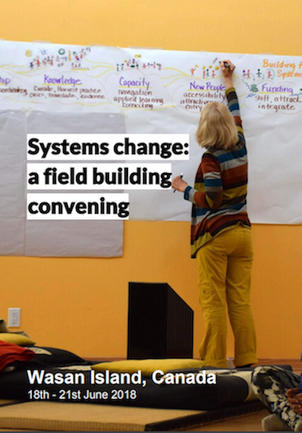
Building the Field of Systems Change
We reported last time on our participation in a groundbreaking gathering on Wasan Island, Canada, of 24 funders and other leaders interested in building the field of systems change.
The dynamic group dove into the challenge of scaling and building the field of system leadership and drafted possible strategies to build the field, including systems of learning and support for current and aspiring systems change leaders.
Want to learn more about what happened there? Here’s the report from that meeting.
One of the key analyses from that group was that, while there are many “toolbases” available for people wanting to do systems change-type work (mostly in the form of web pages with links to many frameworks, methods, and tools) and some good learning opportunities like CoCreative’s courses or the School of Systems Change, these are not reaching the millions of people interested in leading difficult change in their communities and the world. The problem, we’re thinking, is the lack of both visibility and a human component, including connections to other real people working on the same issues.
To test those hypotheses, CoCreative will be conducting a series of empathy interviews with systems change leaders from around the world. The interviewees will be drawn from clients, partners, and grantees of the Wasan Island group along with others. Interested in being interviewed? Please let us know.
School for Systems Change
Russ has joined the faculty of the School for Systems Change, produced by Forum for the Future. The 6-month program supports emerging systems leaders in learning and practicing five core systems change competencies: Systemic Diagnosis, Strategy Design, Innovation for Impact, Collaboration and Engagement, and Leadership and Learning. There are a few spots still available for Basecamp #6, kicking off in the Americas in July!
New Articles, Tools, & Resources
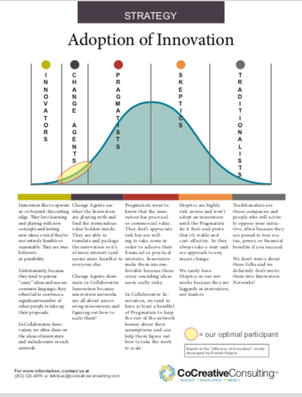
Adoption of Innovation Model (special expanded version)
Based on the pioneering research of Everett Rogers on how innovations spread throughout social networks, this model is helpful for identifying which stakeholders to engage in spreading social innovations too. Our version of the model identifies the unique roles of various groups in developing, translating, and scaling social innovations. (And this secret, expanded version explores how the 5 segments orient toward the future and systems change.)
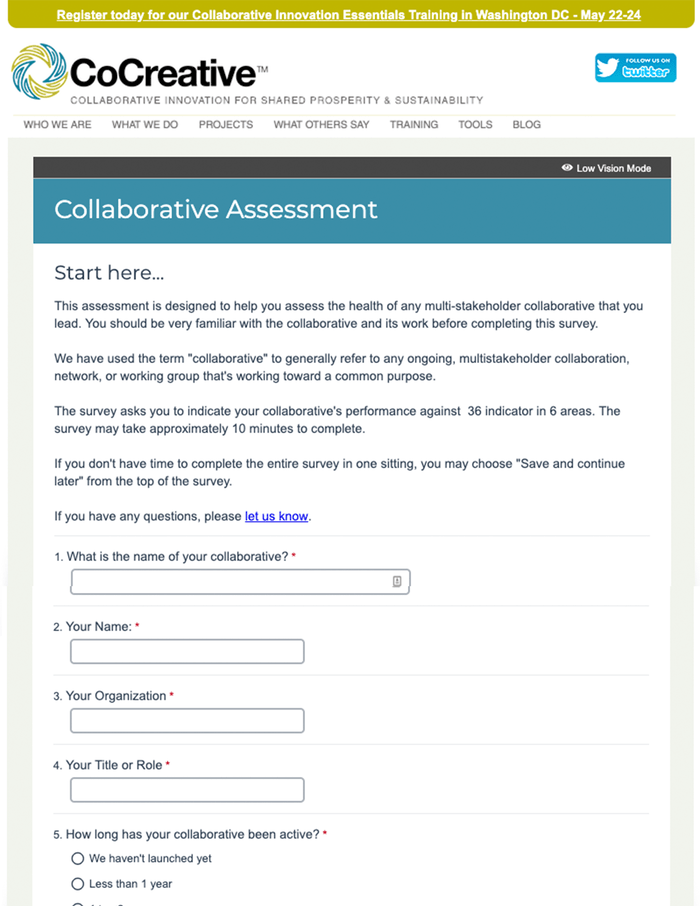
Collaborative Assessment Tool
Several groups have now used our collaborative assessment tool to collaboratively assess their strengths and places that require more attention in their collaboration. Interested in trying it out with your network? Let us know.

Secret Bonus:
Find More in our Pot ‘o Gold!
While CoCreative shares everything we make and use in our work, we don’t promote everything publicly because some of our resources, like training manuals, change often and we don’t want older versions floating around the Internet. However, as a site subscriber, you have access to our secret stash of manuals, mini-lectures, and experimental stuff in our pot ‘o gold. Enjoy!
What We’re Reading and Learning
Narratives and Storytelling
Here’s a brief article from Emily Esfahani Smith, author of The Power of Meaning: Crafting a Life That Matters, on the work by Dan McAdams on “narrative identity” and “narrative choices.” While MacAdams’ work focuses on individual narratives that determine one’s psychological health, the insights are very useful in networks, collaboratives, organizations, and teams.
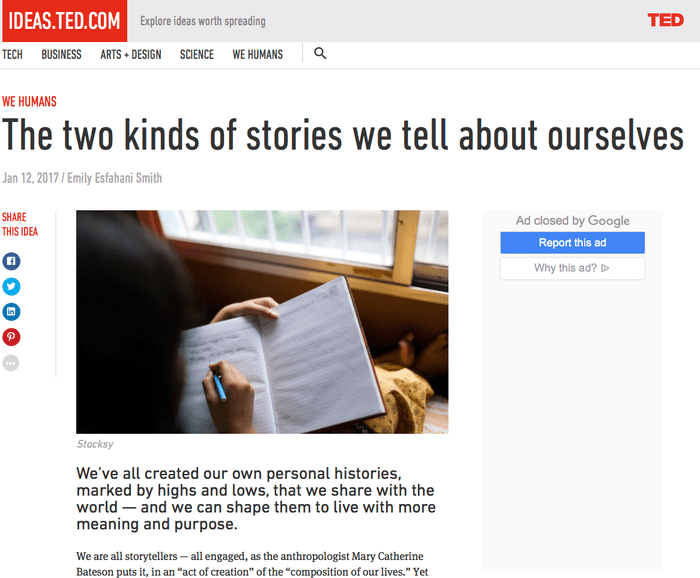
According to McAdams, people tend to interpret their life stories based on two basic narratives: Either “redemption stories” about how their lives are transitioning from bad to good or “contamination stories” about the opposite. While people who tell themselves redemption stories are more generative and more likely to contribute to society and future generations, they also tend to feel that their lives are more meaningful and experience less anxiety and depression. In addition to these two basic stories, McAdams has found that people who experience more meaning in their lives and work tend to tell stories based on growth, communion, and agency.
From our own observations, we’ve noticed a few things about shaping powerful and meaningful narratives in networks:
-
There are always competing narratives among participants, based on their participants’ own patterns and tendencies, but one or two narratives will dominate over time based on who’s advancing them, the actual direction and momentum in the work, and the feedback the network is getting from outsiders.
-
Stories of others’ experiences have a powerful influence on a network’s narrative. When we share stories of how other networks overcame similar challenges, for example, it can powerfully shape a network’s own narrative.
-
Directionality matters. The power of network narrative is not based on an objective analysis of how things are going at the moment, but include information selected from the participants’ past experience with the network and their future plans together. Even if things are going well now, if the future part of the narrative is pessimistic, the overall narrative is one of decline. That’s why we’ve found that it’s helpful in the second year of a network to really “amp up” the work by picking up the pace and setting more aggressive goals. In general, it’s simply most helpful to frame narratives to start with a negative and end with a positive (e.g. “Things have been difficult but I think we’re the right people to do this.”) than to end with a negative.
-
It’s helpful to normalize the difficulty in the work. We often do this by pointing out that (1) if the work was easy, someone would have already done it, and (2) the most difficult part of the work for any group is moving from the “diverging and expanding” part of the analysis or solution design to the “converging and deciding” part and that this group is no different, but we have methods to make it work.

Lego Serious Play
Our colleague Ian Jones at Jones Cubed in the UK turned us on to a fascinating duck exercise from the folks at Lego Serious Play. While we’ve experimented with some LSP methods in the past, this one is exceptional in its ability to return many insights from a quick and simple exercise.
The Duck Lego set is comprised of only 6 simple pieces. Give a set to each participant or to pairs or trios and tell them, “Make a duck.” Then be prepared to see as many unique ducks as there are teams. We’ve had groups produce 30 ducks, have used the exercise many times, and have never seen the same duck twice in any session!
We typically use it before doing prototyping with networks to talk about why it’s helpful to be concrete and specific with their prototypes, but it’s also useful in talking about ideation, communications, and mental models. Pere Juarez Vives shares other neuropsychology insights related to the same duck exercise.
You can order the Lego set on Amazon.
(If you want to order the pieces in bulk, it’s a bit more complicated, so send us a note at talktous@cocreativeconsulting.com and we’ll send instructions!)
Other Resources from the Field

Empathy Map Tool
This cool tool will help you to consider the perspectives of the stakeholders your project seeks to serve or affect. This will help you and your team to consider the many forces around your users and customers that affect their experiences.
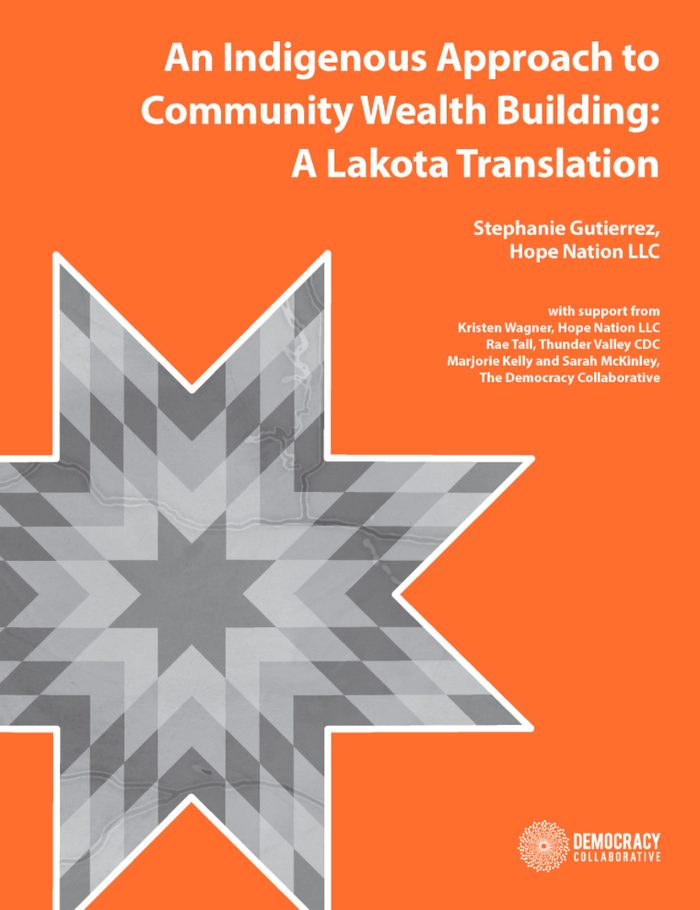
An Indigenous Approach to Community Wealth Building:
A Lakota Translation
by Stephanie Gutierrez.
Here’s a great resource for anyone doing community wealth building work in rural Native communities. Hear about the importance of storytelling, culture, the embrace of diversity & inclusion and decolonizing important concepts to get to a shared understanding.
Rob Ricigliano “Three beliefs in philanthropy that worry me”
Rob offers thoughts on the importance of humility and truly understanding the context and potential unintended, negative consequences of scaling strategies to tackle complex, dynamic problems.
“Let’s Bust the Lone Hero Myth: The Role of Collective Leadership in Systems Change,” by Reem Rahman, Michela Fenech, Nadine Freeman, Kris Herbst and Dani Matielo. Here you’ll find out why The Avengers may be one of the most popular superhero films! Great model that outlines The Collective Leadership Spectrum for Systems Change.

Best wishes for a creative and collaborative 2019
The CoCreative Team
 Systems Community of Inquiry