About WOSC | World Organization of Systems and Cybernetics


Source: About WOSC | World Organization of Systems and Cybernetics

About WOSC

The World Organization of Systems and Cybernetics (WOSC) – World Organization for Systems and Cybernetics (OMSC), is an association of individuals and organizations promoting systems thinking and cybernetics worldwide.

WOSC was founded in 1969 , with the desire to support the communication of individuals and organizations related to systems thinking and cybernetics worldwide. To perform its tasks, it is organized as follows:

President

Teacher. Raúl Espejo (UK)

Advisory Board

Director General:

Dr. Igor Perko (Slovenia)

Board of Directors, assisted by the Director-General

Source: About WOSC | World Organization of Systems and Cybernetics


The Search for the Weaver of Dreams by Russell Roberts – YouTube

This talk is my attempt to explain emergent order in economics, what I consider the discipline’s deepest idea–that some things are orderly and that some problems get solved without explicit design from the top down. This talk was given in 2012 at SMU’s O’Neil Center: https://www.smu.edu/cox/centers-and-i…

World Organisation of Systems and Cybernetics 18th Congress-WOSC2020 Moscow, 16-18 September 2020


Source: A manifesto for WOSC 2020 | WOSC 2020


World Organisation of Systems and Cybernetics

18th Congress-WOSC2020

Moscow, 16th to 18th September 2020

Systems approach and cybernetics, engaging the future of mankind

The significance of systems and cybernetics in the future of societies.

Important world institutions, such as the United Nations (UN), the World Health Organization (WHO) and the Organization for Economic Co-operation and Development (OECD) are publicly recognizing the highly interconnected nature of our world and therefore the relevance of systemic thinking and cybernetics as leading knowledge foundations to deal with the complexity of economic, social and environmental issues. This recognition by major international agencies of the CyberSystemic nature of policy issues makes apparent that in the context of the World Organisation of Systems and Cybernetics more than ever we need to debate and develop current ontological, epistemological and methodological approaches to understanding the future of humanity.

WOSC is honored that the Russian Academy of Sciences (RAS) has agreed to be the venue for its 18th Congress (WOSC 2020). Consistent with its scope scientists of this Academy have made important contributions to key issues of human society over the past decades. They have contributed to problems of nuclear disarmament, space exploration, the fight against terrorism, self-organization for strategic projects and many more. More recently, they have been developing aspects of socio-humanitarian cybernetics and of self-developing reflexive-active environments. Indeed, the RAS is a most valuable setting to support further developments of these and other issues.

Our aim in WOSC 2020 is to bring CyberSystemic scientists, and in particular younger researchers, together with politicians and practitioners to debate pressing economic, social and ecological problems of humanity, at all levels from local communities to global societies.

For this purpose, we propose to focus the discussions on the following four themes: philosophical and methodological foundations for the development of the systems approach and cybernetics, the cybernetics of democracy, the cybernetics of hybrid reality, and governance in an increasingly interconnected, ecologically sensitive, world. Short summaries of these themes are introduced below.

1.Philosophical and methodological foundations for the development of the systems approach and cybernetics.

Challenges and threats to the future of humanity are increasing pressure to develop systemic approaches and cybernetics. For this purpose, it is necessary to debate the foundations of the philosophy of science, ontology, epistemology and methodology. New ideas are needed concerning scientific rationality, the observer problem, the transdisciplinary approach, and the problems of complexity, reflexivity and ethics. We must increase the convergence of civilization and cultural specifics in the development of systemic approaches and cybernetics. The inclusion of multiple perspectives in systems thinking enables systems thinking and cybernetics to play a leading role in science diplomacy.

WOSC 2020 invites participants to discuss alternative approaches to recognize the participation of observers in human activities, starting from the traditional approaches of having external observers accepting an objective reality, going to observers as participants in the construction of our situational realities, as we interact with multiple environmental agents, and extending all this to an increased attention to the contextual constraints imposed by ecological and societal aspects to the co-evolution of situational actors and environmental agents.

The latter are relevant to societies to make them more functional and coherent. These meta-contextual aspects are not directly focused on actors and agents, but the framing of their interactions is limiting the free unfolding of situation-environment interactions. This way we can reflect on aspects of societal significance, such as the ecological chains straining resources or the economic inequalities limiting fairness as well as justice. WOSC 2020 wants to make inroads into how to study the mechanisms shaping interactions, communications and relationships in complex systems, whether enterprises, government agencies, small businesses or families. In particular, we want to offer an opportunity for participants to contribute with replicable approaches, emerging from their epistemological and methodological standing, their practical experiences in the life-world of societal, ecological and economic situations. Issues like boundaries, structures, communications and interaction mechanisms can influence good practice and improve our contributions to society.

2. The cybernetics of society ecology and governance

Cybernetics in the development of democracy. Cybernetic models of decentralized control. Cybernetics of self-developing reflexive-active environments. Cybernetic models of self-organizing communities of experts. Network democracy and collective intelligence. Strategic Control and Development Centres in initiating and supporting the consolidation of the state, business and society.

Our democratic models are functioning in the world of big data, artificial intelligence, cloud computing and algorithms and often are being explicitly used in the top-down direction. This makes it increasingly difficult to bridge global and local constructs and to provide constructive feedback loops. Effective interactions between citizens, experts and policy-makers are a major challenge.

Direct, representative and participative democracies need further development to be effective. We invite discussions of the significant distinction between the “wisdom of the crowd” emerging in citizens minds and evidence-based decisions, resulted from debates supported by experts, think tanks and political parties and also by the media. This distinction touches key aspects of communications in a complex world, today dominated by big data, which in practice implies data overload for citizens and politicians. How do we increase societal capacity to identify, understand and react on the dynamics of their environment? For citizens of a country, big data may support conflating their very local experience of income restrictions, immigration flows into their communities or poor local health services, with deciding whether or not to support global policies. Politicians, also overwhelmed by data -in an uncertain world- may construct and impose their truths influenced by ideology, weak expert advice and short-term political interests.

In WOSC 2020, we invite reflections on how to reduce the gap between sound evidence and emotional constructions. We need to discuss our responsibility to create regulatory procedures to contextualize what we hear in the media and social networks. We invite reflections on the authenticity, legitimacy and truthfulness of the arguments advanced by those forming public opinion. It may be argued that the complexity of social processes makes impossible dealing with these challenges. Complexity management tools such as situation centres for development, social networks and artificial intelligence, are emerging from systems thinking and cybernetics. These tools carry some risks but also have the potential to increase the opportunities for more effective participation in policy and decision-making processes. We need to learn how to keep open checks and balances between multiple viewpoints to bridge gaps between emotional and empirical truths. We need to learn how to construct dialogues enmeshed in multiple moral mazes. This proposed utopia for WOSC 2020 is an invitation for participants to contribute to more transparent societies.

3. Technology and humanity: co-developing a hybrid reality

Hybrid reality is about the close interconnection of technology and people, either individuals or groups, addressing every instance of their behaviour. From a cybernetic perspective, it is a convergence and integration of subject, digital and physical reality. It offers an amplification of individual capabilities as well as an attenuation of the digital representation of the world, actively affecting their lives. Hybrid reality refers to the dynamics of people’s life worlds in smart environments, experiencing the implications of new technologies.

In WOSC 2020, we are inviting contributions on the state of the art of technology research, focusing especially on its implications for people, organizations, societies and the environment. Discussions on computing in design and architecture, smart devices and environments (personal and organisational), big data analytics and sharing, artificial intelligence, situation centres for development, energy and transport related issues, cyber security, health, blockchains and the convergence of technologies. The reasoning on technological feasibility should be advanced with implications for society and the environment: economic justifications, accordance to law, the ethical perspective, effects on the environment, and paths for identifying not yet identified consequences.

People are adapting to huge changes in their surroundings. They are invited to share their experiences and thereby contribute to producing group knowledge, that may become the next meta-level of group consciousness. In the age of human-machine interdependence, the boundaries between individual and group intelligence are redefined, putting technology in everything we do and experience. Reasoning on group consciousness and clarification of these boundaries pose a challenge for WOSC 2020.

Special attention is given to the design of hybrid reality elements. In addition to being subject-supportive, proactive, secure and providing value-added, the seamless supplementing of the natural and artificial in hybrid reality adds to the desired positive user experience.

We think that it is important to use systems thinking to manage the complexity of interactions in the hybrid reality to maximize its synergetic potentials on individuals and organizations and to avoid misuse and mitigate undesired consequences.

4. The creation of new areas of knowledge from the transdisciplinarity of systems sciences and cybernetics

In a world increasingly dominated by interactions, one of the challenges is facilitating self-organization processes for the emergence of desirable values in societies and for the creation and production of related policies from the most local to the most global levels. These are processes, aimed at innovation as well as making more meaningful people’s collective concerns. Good governance increases the opportunities for people’s development. However, at the same time, it has the potential to avoid fragmentation by facilitating the alignment of their interests. For example, citizens’ participation in decision-support systems of distributed situational centers helps increase opportunities for self-organising networks.

We want to open debates to explore governance grounded in people’s interactions, communications and relationships. Through the investigation of institutions and evolving technologies, the Congress’s focus is to discuss contributions that guide, enable and facilitate interactions among available resources to increase society’s requisite variety to deal with social, ecological and economic challenges.

On the one hand, the creativity of people’s communications should help them by branching into all kinds of aspects necessary for a better life, and their moment to moment coordination of actions should help them align their interests. We want participants in WOSC 2020 to explore issues of social concern through deeper and wider appreciation of what is relevant.

As the complexity of societal issues grows the practical need for bringing together people’s concerns grows as well. This is an ongoing process of building ecosystems and making their boundaries operationally meaningful to all those affected.

We are proposing WOSC 2020 as a platform for cyber-systemic contributions to the above themes. We envisage a programme supported by group discussions supporting collective synergy, as well as by presentations of state-of-the-art research by individual researchers.

Systems Learning – Free your thinking (online and other courses from the Schumacher institute)

I’m surprised I haven’t shared this before!

Source: Systems Learning – Free your thinking

Skoll | Is It Possible to Measure Systems Change? video

Social entrepreneurs, funders, business, and civil society leaders want to create systemic impact. But how can we best measure progress towards systems change? In this interactive workshop, participants will dive into case studies and explore different approaches to addressing this question. Attendees will walk away with a stronger understanding of both the challenges of capturing […]

Source: Skoll | Is It Possible to Measure Systems Change?

the systems school Australia – resources, community of practice etc

https://www.the-systems-school.org/

Source: resources

systems thinking resources 

co-created resources

systems change framework

systems practices

systems storytelling

pocket guide to systems wayfinding

collection of systems resources harvested from across the web

Source: resources

Northeast Journal of Complex Systems (NEJCS) | Vol 1 | No. 1


Source: Northeast Journal of Complex Systems (NEJCS) | Vol 1 | No. 1


EP9 Joe Norman: Applied Complexity – The Jim Rutt Show

Joe Norman is affiliated with the New England Complex Systems Institute (NECSI), the Real World Risk Institute (RWRI), and Applied Complexity Science, LLC. In this podcast, Jim and Joe discuss applied complexity, emergence, climate science and GMOs.

Source: EP9 Joe Norman: Applied Complexity – The Jim Rutt Show

A Scrum Book: The Spirit of the Game (published 2019/08/14) – Systems Changes – Open Learning Commons


Source: A Scrum Book: The Spirit of the Game (published 2019/08/14) – Systems Changes – Open Learning Commons

1 / 1
Aug 16

In the pattern language movement, this book, long under development, is worth noting:

Jeff Sutherland, James O. Coplien, and The Scrum Patterns Group, A Scrum Book: The Spirit of the Game, The Pragmatic Bookshelf, Release 1.0 2019, ISBN: 978-1-68050-671-6, https://pragprog.com/book/jcscrum/a-scrum-book 3

The hardcopy book is also available via Amazon, at https://www.amazon.com/Scrum-Book-Spirit-Game/dp/1680506714

For background, there’s an interview with Jeff Sutherland and Jim Coplien as ” Q&A on A Scrum Book: The Spirit of the Game” | Ben Linders | June 29, 2019 | InfoQ at https://www.infoq.com/articles/book-review-scrum-spirit-game/ 2

The Scrum Book has two pattern languages:

  • The Product Organization Pattern Language; and
  • The Value Stream Pattern Language

The long development period for the 2019 publication dates back to 2008, when there was a preliminary meeting at VikingPLoP 2008. The second meeting at ScumPLoP 2010 meeting was described as the “world’s first topically focused PLoP” to capture patterns of Scrum practice.

The work of the worldwide community has been conducted in the wiki way.

The scale of the decade that passed between the initiation of the project and a bound copy of the book may be compared to that of Christopher Alexander.

The effort required for major works should not underestimated.

“We always overestimate the change that will occur in the next two years and underestimate the change that will occur in the next ten. Don’t let yourself be lulled into inaction.” From his book, “The Road Ahead,” published in 1996. [via “The quotable Bill Gates” | Nancy Weil | June 23, 2008 | PC World at https://www.pcworld.idg.com.au/article/225699/quotable_bill_gates/


Scrum Pattern Community

Home page of the Scrum PLoP conference community

Source: Scrum Pattern Community


what is black?

Graham Berrisford on Beer and Ashby

I haven’t included Graham’s attempts to – I guess – reconceputalise – much of systems thinking at http://grahamberrisford.com/, although he often comments and posts in the systems thinking groups. This is principally because I don’t usually feel I understand them, but tend to think of his content as obtuse and a bit off – a combination which tends to be the most effective in preventing me from posting. If I don’t agree but understand, I can post (with or occasionally without comment – my view is that everything intellectual has to be ‘buyer beware’), and if I agree – even if I don’t understand – I’m ok to amplify the signal…

However, there’s no doubt Graham’s efforts are sincere and I think there are some good challenges and interesting interpretations in these two pieces, in particular, which are worth a look. They also led me – with Graham’s voiced suspicion that the 1974 Hayek Nobel Prize Lecture might be a direct response to Cybersyn – to that interesting piece.


Link – Beer’s ideas: Overview

Beer’s ideas – applying cybernetic ideas to management science

https://bit.ly/2uPxFn5

Copyright 2017 Graham Berrisford. One of more than 100 papers on the “System Theory” page at http://avancier.website . Last updated 16/09/2019 12:59

Thinkers like Ackoff, Beer and von Foerster were wise men with good advice to offer people.

Arguably however, they and other thinkers in 1970s undermined the concept of a system.

Many today refer to ideas found in Beer’s work, especially his attempts to apply classical cybernetics and Ashby’s ideas about variety.

In my view, Beer stretched cybernetics beyond what Ashby would have regarded as science.

And stretched his analogy between the central nervous system and business management beyond rational analysis.

To say Beer succeeded in applying Ashby’s law to a nation’s economy, or in applying the structure of the central nervous system to the management of a business, seems pseudo-scientific.

Empirical evidence that Beer’s VSM is a useful reference model is better put down to the experience of Beer as a manager, and the experience of consultants who use it.

Contents

Beer’s inspiration

Ashby’s cybernetics

Ashby’s “variety”

Project Cybersyn

The five systems of the Viable System Model (VSM)

Beer’s use of the biology-sociology analogy

Conclusions and remarks

Further reading and references

Link – Beer’s ideas: Overview


Link – Ashby’s introduction to cybernetics with respect to Enterprise Architecture: http://grahamberrisford.com/AM%204%20System%20theory/SystemTheory/ChallengingSystemsThinkers/06%20An%20introduction%20to%20cybernetics%20(Ashby).htm

Ashby’s introduction to cybernetics

With respect to Enterprise Architecture

Copyright 2017-9 Graham Berrisford. One of a hundred papers on the System Theory page at http://avancier.website. Last updated 12/03/2019 21:17

TOGAF says EA “regards the enterprise as a system, or system of systems.”

A general system theory was developed in the1950s by Bertalanffy, Wiener, Ashby and others.

This discussion includes several quotes from Ashby’s Introduction to Cybernetics (1956).

  1. Ross Ashby (1903-1972) was a psychologist and systems theorist.

“Despite being widely influential within cybernetics, systems theory… Ashby is not as well known as many of the notable scientists his work influenced.”

Understanding Ashby’s ideas helps you to understand much else in the field of systems thinking.

The discussion that follows relates Ashby’s ideas to Enterprise Architecture (EA).


For example:

“Cybernetics was defined by Wiener as “the science of control and communication, in the animal and the machine” in a word, as the art of steersmanship.

Co-ordination, regulation and control are its themes, for these were of the greatest biological and practical interest.” (1956)

One may say coordination (or integration), regulation and control are the themes of Enterprise Architecture (EA).

This paper copies some sections from Ashby’s book.

It paraphrases some sentences, replacing Cybernetics by EA, and added comments presenting EA as a branch of Cybernetics.

Note that this is Cybernetics in its classical form – before sociologists messed with it by speaking of second-order cybernetics.

Contents

Chapter 1: WHAT IS NEW

Chapter 2: CHANGE

Chapter 3: THE DETERMINATE MACHINE

VECTORS

Chapter 4 THE MACHINE WITH INPUT

THE VERY LARGE SYSTEM

Chapter 5: STABILITY (intro only)

Chapter 6: THE BLACK BOX (intro only)

Chapter 7: QUANTITY OF VARIETY (intro only)

Chapter 8: TRANSMISSION OF VARIETY

Chapter 9: INCESSANT TRANSMISSION (intro only)

Chapter 10: REGULATION IN BIOLOGICAL SYSTEMS (intro only)

Chapter 11: REQUISITE VARIETY (intro only)

Chapter 12: THE ERROR-CONTROLLED REGULATOR (intro only)

Chapter 13: REGULATING THE VERY LARGE SYSTEM

Link – Ashby’s introduction to cybernetics with respect to Enterprise Architecture: http://grahamberrisford.com/AM%204%20System%20theory/SystemTheory/ChallengingSystemsThinkers/06%20An%20introduction%20to%20cybernetics%20(Ashby).htm


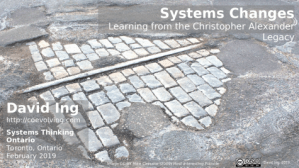
Systems Changes: Learning from the Christopher Alexander Legacy (ST-ON, 2019/02/11) – Coevolving Innovations (David Ing)

Source: Systems Changes: Learning from the Christopher Alexander Legacy (ST-ON, 2019/02/11) – Coevolving Innovations

Learning from the Christopher Alexander Legacy

One of the aims of the Systems Changes research program is to build on the pattern language approach.  This body of work stretches back into the 1960s, and has been cross-appropriated from built environments to software development (e.g. agile methods) and organizational change.  The February 2019 meeting of Systems Thinking Ontario was an opportunity to bring some people not familiar with the territory up to speed.

Here is the abstract for the talk:

The 1977 book, A Pattern Language: Towns, Buildings, Construction is prominent in public library collections around the world. It represents, however, only one stage of the many works by Christopher Alexander, from his first book published in 1964, to his final book released in 2012. In addition multiple international conferences continue his legacy, in architecture and urban design (PUARL, for 10 years), in software development (PLoP, for 25 years), and in social change (PURPLSOC, for 5 years). Alexander was a builder of environment structure — an architect — and other communities have aspired to adopt the approach that he championed.

This Systems Thinking Ontario session will review pattern languages in three parts:

  1. The Eishin School project (1985, published as a book in 2012);
  2. Multi-Service Centers (1968); and
  3. Beyond Built Environments, cross-appropriating the approach from architecture to other domains.

The pursuit of “systems generating systems” at the foundation of Christopher Alexander’s pattern language has generally not been appreciated, and deserves a deeper inquiry.

Noticeable by their absence are the books A Pattern Language (1977), and The Timeless Way of Building (1979), that are the most frequently cited works.  With the domain primarily not built environments, and instead other systems domains, the Eishin School and Multi-Service Centers projects reveal more about methods-in-practice.

Digital audio of the presentation and discussion has been synchronized with slides previously posted on Coevolving Commons.

For listening on-the-go, a downloadable audio file is provided.  In the case it’s hard to hear on a mobile device, there’s also a digitally boosted volume version.

Audio
February 11
(complete,
1h37m)
[20190211_ST-ON_Ing.mp3]
(90MB)
[20190211_ST-ON_Ing_plus3db.mp3]
(volume boosted 3db, 90MB)

The video is available as downloadable, for disconnected devices.

Video H.264 MP4 WebM
February 11
(complete,
1h37m)
[20180211_ST-ON_Ing HD m4v]
(HD 3331Kbps 2.4GB)
[20180211_ST-ON_Ing nHD m4v]
(nHD 71Kkps 147MB)
[20180211_ST-ON_Ing HD webm]
(HD 464Kbps 481MB)
[20170308_0840_OCADU_Ing nHD webm]
(nHD VP9 431MB)

The title reflects that we have much we can learning from the legacy of Christopher Alexander.  The challenge and opportunity is building on that work, recognizing its strengths, and acknowledging the contexts beyond build environments where new value may be uncovered.

Source: Systems Changes: Learning from the Christopher Alexander Legacy (ST-ON, 2019/02/11) – Coevolving Innovations


Narrating Wholeness: Pattern Language Generating Semi-Lattice(s), System(s), and/or Holon(s) (PUARL 2018/10/27) – Coevolving Innovations (David Ing)


Source: Narrating Wholeness: Pattern Language Generating Semi-Lattice(s), System(s), and/or Holon(s) (PUARL 2018/10/27) – Coevolving Innovations

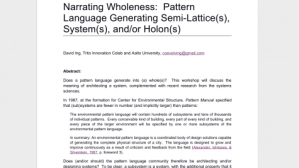
Narrating Wholeness: Pattern Language Generating Semi-Lattice(s), System(s), and/or Holon(s) (PUARL 2018/10/27)

In what ways might the generation of wholeness through pattern language be strengthened, through an appreciation of advances in the systems sciences?  A workshop at the 2018 International PUARL Conference was an opportunity to review linkages and discuss some details.

An outline to frame the conversation was written in three parts.

  • 1. Communicative Framing
    • 1.1 Form and synthesis
    • 1.2 Organization as semi-lattice
    • 1.3 Systems generating systems
    • 1.4 Generative patterns and non-generative patterns in software development
    •  1.5 System-A and system-B, as two ways of shaping and building living environments
    • 1.6 Holons (from systems ecology)
  • 2. Dialectical Sensemaking
    • 2.1 Types of systems and models
    • 2.2 Autopoiesis and allopoiesis
    • 2.3 Economies as agricultural, industrial and services (coproduction)
  • 3. Narrative Synthesizing

In full, the abstract read:

Does a pattern language generate into (a) whole(s)? This workshop will discuss the meaning of architecting a system, complemented with recent research from the systems sciences.

In 1967, at the formation for Center for Environmental Structure, Pattern Manual specified that (sub)systems are fewer in number (and implicitly larger) than patterns:

The environmental pattern language will contain hundreds of subsystems and tens of thousands of individual patterns. Every conceivable kind of building, every part of every kind of building, and every piece of the larger environment will be specified by one or more subsystems of the environmental pattern language.

In summary: An environmental pattern language is a coordinated body of design solutions capable of generating the complete physical structure of a city. The language is designed to grow and improve continuously as a result of criticism and feedback from the field (Alexander, Ishikawa, & Silverstein, 1967, p. foreword 3).

Does (and/or should) the pattern language community therefore be architecting and/or designing systems? To be clear, a subsystem is a system, with the additional property that it is contained within a larger whole.

The workshop will be conducted as a participatory session, with an intent to summarize findings for the proceedings. The workshop is organized as three steps:

  • 1. Communicative Framing
  • 2. Dialectical Sensemaking
  • 3. Narrative Synthesizing

The extended abstract (below) outlines the workshop. Subsequent publications (i.e. a blog post) may be released after the event, to summarize some of the discussions and findings.

Audio for the session was recorded.  In a departure from my usual presentations, I decided not to create a full slide deck, but instead step through the textual article.  The video accessible on Youtube roughly lines up the sections in the paper to the talk.

The plenary sessions preceding the workshop had run overtime, so this workshop was cut short in order to let participants catch lunch.

Audio
October 27
(24m16s)
[20181027_PUARL_Ing NarratingWholenessGenerative.mp3]
(23MB)

For people who want to warch offline, here are some downloadable video files.

Video H.264 MP4 WebM
October 27
(24m16s)
[20181027_PUARL_Ing HD m4v]
(HD 1448Kbps 287MB)
[20181027_PUARL_Ing nHD m4v]
(nHD 40Kkps 32MB)
[20181027_PUARL_Ing HD webm]
(HD 217Kbps 76MB)
[20181027_PUARL_Ing nHD webm]
(nHD VP9 57MB)

PUARL has been prominent in continuing the Christopher Alexander legacy, with director Hajo Neis as one of the original coauthors of pattern language works since the 1970s.  Formally, the Portland Urban Architecture Lab has focused on built environments with architects and designers.  Beyond them, the systems foundations in pattern language should recognize that the movement has now included software developer since the 1990s, and social change practitioners since the mid-2000s .

Narrating Wholeness: Pattern Language Generating Semi-Lattice(s), System(s), and/or Holon(s)

Reference:

  • Alexander, Christopher, Sara Ishikawa, and Murray Silverstein. 1967. Pattern Manual. Berkeley, California: Center for Environmental Structure.

Source: Narrating Wholeness: Pattern Language Generating Semi-Lattice(s), System(s), and/or Holon(s) (PUARL 2018/10/27) – Coevolving Innovations


McCulloch-Pitts Neuron — Mankind’s First Mathematical Model Of A Biological Neuron


Source: McCulloch-Pitts Neuron — Mankind’s First Mathematical Model Of A Biological Neuron


McCulloch-Pitts Neuron — Mankind’s First Mathematical Model Of A Biological Neuron

It is very well known that the most fundamental unit of deep neural networks is called an artificial neuron/perceptron. But the very first step towards the perceptron we use today was taken in 1943 by McCulloch and Pitts, by mimicking the functionality of a biological neuron.

Note: The concept, the content, and the structure of this article were largely based on the awesome lectures and the material offered by Prof. Mitesh M. Khapra on NPTEL’s Deep Learning course. Check it out!

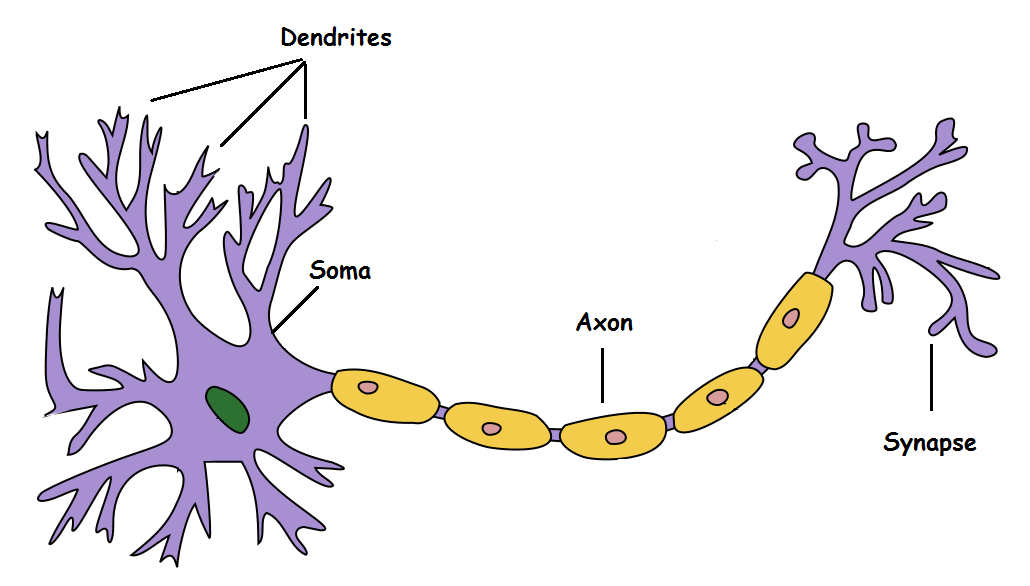
Biological Neurons: An Overly Simplified Illustration

A Biological Neuron — Wikipedia

Dendrite: Receives signals from other neurons

Soma: Processes the information

Axon: Transmits the output of this neuron

Synapse: Point of connection to other neurons

Basically, a neuron takes an input signal (dendrite), processes it like the CPU (soma), passes the output through a cable like structure to other connected neurons (axon to synapse to other neuron’s dendrite). Now, this might be biologically inaccurate as there is a lot more going on out there but on a higher level, this is what is going on with a neuron in our brain — takes an input, processes it, throws out an output.

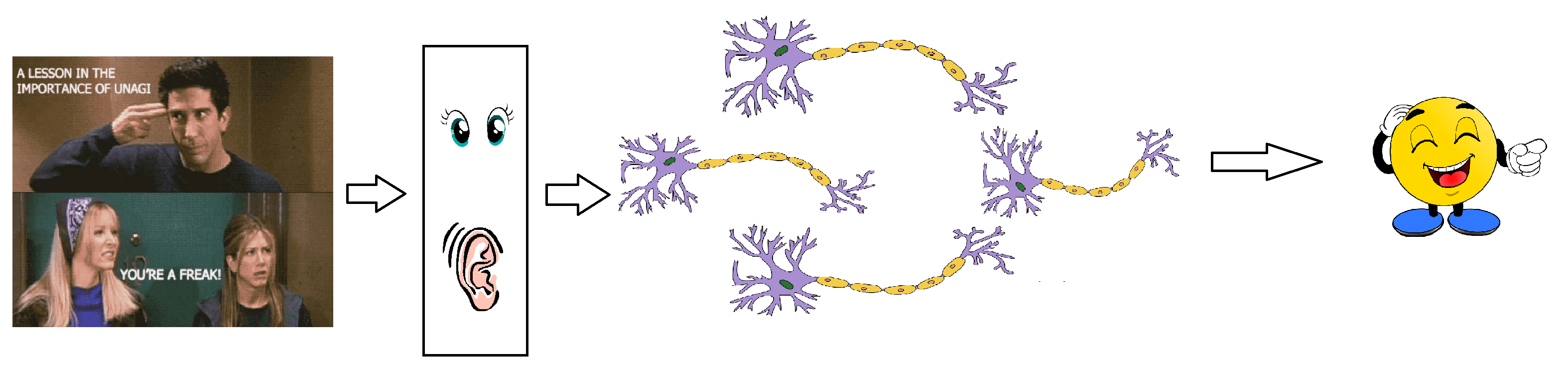
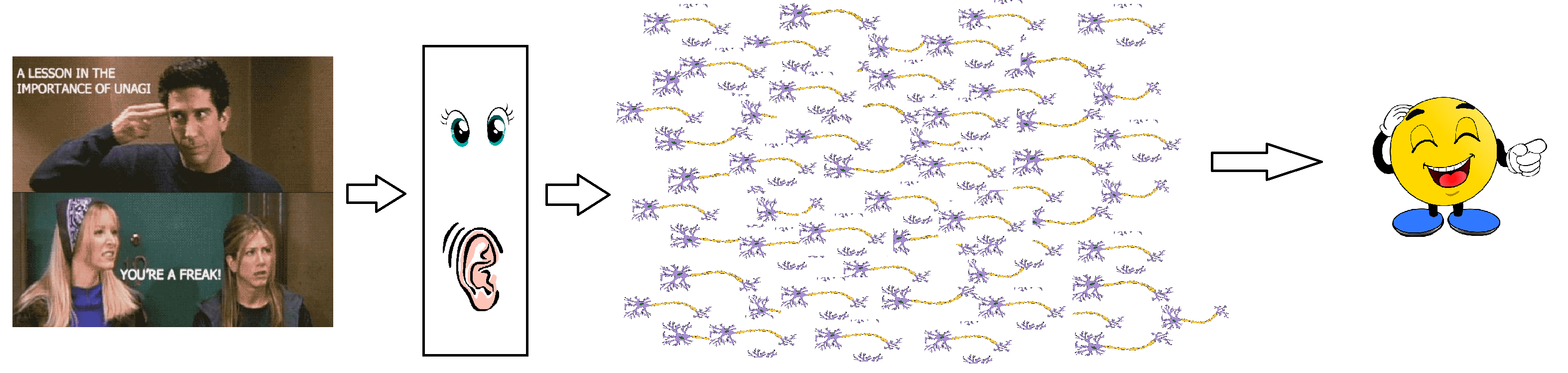
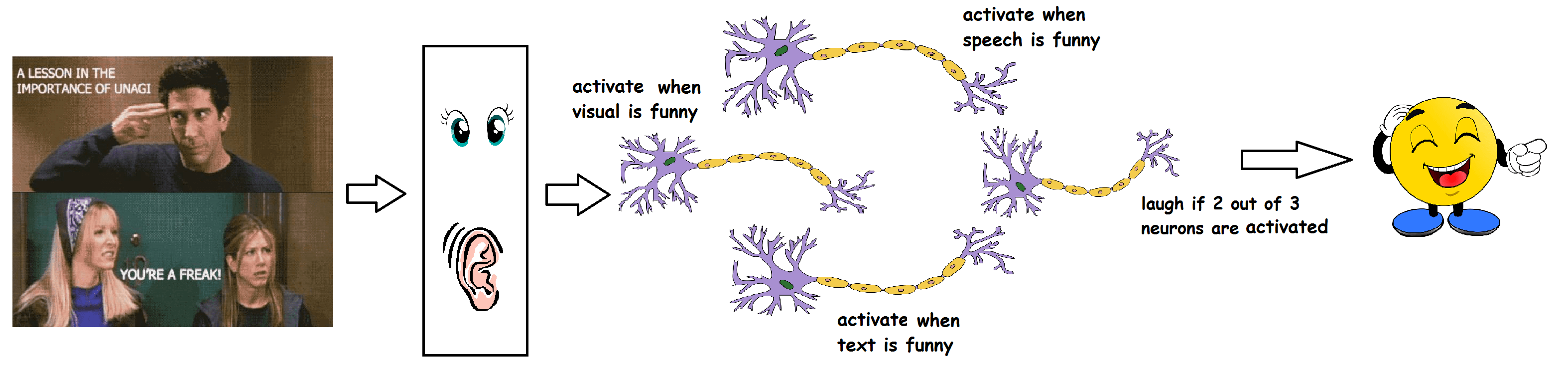
Our sense organs interact with the outer world and send the visual and sound information to the neurons. Let’s say you are watching Friends. Now the information your brain receives is taken in by the “laugh or not” set of neurons that will help you make a decision on whether to laugh or not. Each neuron gets fired/activated only when its respective criteria (more on this later) is met like shown below.

Not real.

Of course, this is not entirely true. In reality, it is not just a couple of neurons which would do the decision making. There is a massively parallel interconnected network of 10¹¹ neurons (100 billion) in our brain and their connections are not as simple as I showed you above. It might look something like this:

Still not real but closer.

Now the sense organs pass the information to the first/lowest layer of neurons to process it. And the output of the processes is passed on to the next layers in a hierarchical manner, some of the neurons will fire and some won’t and this process goes on until it results in a final response — in this case, laughter.

This massively parallel network also ensures that there is a division of work. Each neuron only fires when its intended criteria is met i.e., a neuron may perform a certain role to a certain stimulus, as shown below.

Division of work

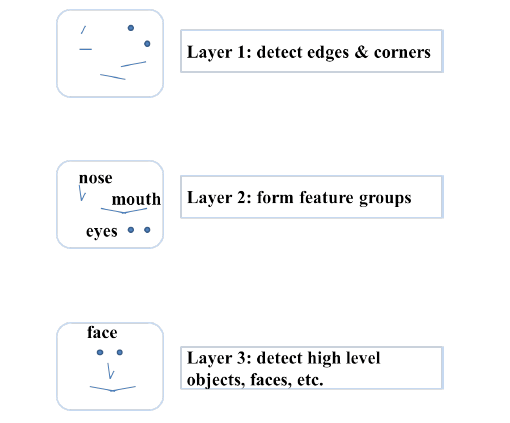
It is believed that neurons are arranged in a hierarchical fashion (however, many credible alternatives with experimental support are proposed by the scientists) and each layer has its own role and responsibility. To detect a face, the brain could be relying on the entire network and not on a single layer.

Sample illustration of hierarchical processing. Credits: Mitesh M. Khapra’s lecture slides

Now that we have established how a biological neuron works, lets look at what McCulloch and Pitts had to offer.

Note: My understanding of how the brain works is very very very limited. The above illustrations are overly simplified.

McCulloch-Pitts Neuron

The first computational model of a neuron was proposed by Warren MuCulloch (neuroscientist) and Walter Pitts (logician) in 1943.

This is where it all began..

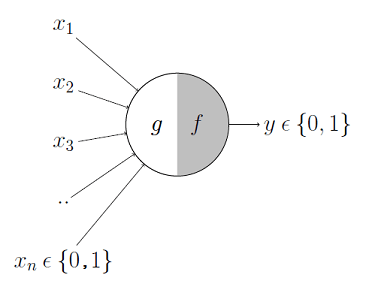
It may be divided into 2 parts. The first part, takes an input (ahem dendrite ahem), performs an aggregation and based on the aggregated value the second part, f makes a decision.

Continues in source: McCulloch-Pitts Neuron — Mankind’s First Mathematical Model Of A Biological Neuron

s
search
c
compose new post
r
reply
e
edit
t
go to top
j
go to the next post or comment
k
go to the previous post or comment
o
toggle comment visibility
esc
cancel edit post or comment