
Source: How do we help city dwellers psychologically? | Mirage News
How do we help city dwellers psychologically?
Why does one person flourish in the city while another wilts? This question will be the starting point for research at the Centre for Urban Mental Health, in which the UvA will invest 10 million euros in the coming five years. The focus will be on depression, anxiety and addiction – the three most commonly occurring mental health problems.
Insufficient progress
Many factors play a role in mental health problems, including (neuro)biological, genetic, cognitive and socio-economic ones. Family situation and even the neighbourhood where someone lives can also come into play. In addition, there are factors that can increase someone’s vulnerability, for example loneliness, sleep problems or poor physical health. Traditional research into mental health problems has usually focussed on only one specific factor at one particular time, without taking the relationships between the various factors into account. This has meant insufficient insight has been gleaned into how all these different factors influence each other at different times. The lack of focus on these complexities means unsatisfactory progress has been made in treatment and prevention – patients either don’t respond to treatments or they do respond but later experience relapses.
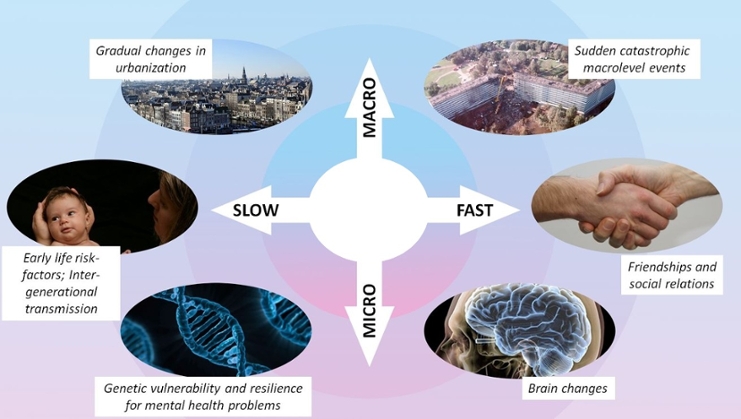
‘In the Centre for Urban Mental Health we will embrace the intertwined nature of psychological problems and disorders with the help of an inter- and transdisciplinary approach,’ says Claudi Bockting, professor of Clinical Psychology in Psychiatry and co-director of the centre. ‘We expect this to lead to new starting points for treatment and prevention. It will give us the possibility to develop treatments that are not only aimed at the patient themselves, but also at social factors, such as the consequences of social inequality.’
‘”Complexity science” will be at the core of all our research at the centre,’ adds co-director and professor of Developmental Psychopathology Reinout Wiers. ‘Our goal is to unravel the complex networks of factors that influence what happens to people’s mental health when they live in the city. We will not succeed if we continue to approach the issue exclusively from the viewpoints of psychology and psychiatry. We are therefore joining forces with our colleagues from other disciplines such as computational science, neurobiology, and communication science.’
‘Game changer’
Peter Sloot, professor of Complex Adaptive Systems and scientific director of the UvA’s Institute for Advanced Study (IAS), has built up a wealth of knowledge in complexity science in recent years. Sloot: ‘The complexity approach allows us to discover causal relationships in all these interlinked factors and to make numerical predictions about the outcomes of possible interventions. We have already demonstrated this with research into, for example, criminal networks or, very recently, with a study into the prevention of obesity in cities. What we are now going to do together in the Centre for Urban Mental Health is of unprecedented scale and could be the game changer when it comes to tackling mental health problems in the city.’
Continues in source: How do we help city dwellers psychologically? | Mirage News
 Systems Community of Inquiry