The Collective Systems Map is the result of 2 months of conversations with a group of professionals from the third sector in Spain. It tries to capture the relationships between the critical factors that will condition and impact the social and economic recovery process after the Covid19 pandemic. It doesn´t pretend to be an exhaustive model to forecast the near future, but it is a framework to enable deep conversations and to integrate the wide range of perspectives and experiences that the participants shared with us.
SYSTEMS THINKING APPROACH
Although we are using a causal loop diagram tool that is part of the systems dynamic methodology, we are not approaching this social complexity from only a positivist perspective, but also from an interpretative perspective. We believe that there are systems in place that condition the way we live and relate to each other, but at the same time people can change them by creating new meaning and acting congruently.
Our purpose is to provide social organizations with a holistic perspective to identify potential risks and threats to their mission to provide effective support to vulnerable people in this complicated moment in history.
COLLECTIVE SYSTEMS MAP
The map starts with the lockdown instigated by the Covid19 pandemic. To tackle the social and health care emergency, the Spanish Government enforced a national lockdown, reducing all economic activity and social interactions. This situation has triggered an economic recession, the size of which has prompted Germany and France to propose a 500bn€ recovery fund.
In our conversations, we focused on understanding what the economic, social, and political consequences of the pandemic could be.
Coinciding with the Conference on Complex Systems, and profiting from the opportunity offered by the presence of a wide variety of experts in different topics, we are organising one-day school for PhD students and early-stage researchers. The school is an informal one-day event that offers early-stage scientists the opportunity to learn about the scientific and life experience of young and senior researchers, try their skills in a data visualisation and have fun playing the specifically tailored online trivia.
This year, due to a worldwide pandemic situation, the school is going to be to be held online on December 4, 2020, before the main CCS conference. The school consists of two non-scientific lectures from young scientists, ask me anything session with a prominent senior researcher, data visualisation contest and an online pub quiz. The sessions will be divided by informal coffee breaks, where participants may chatter with their peers, as in a…
What Lies Beneath – A Human Systems Perspective: A Conversation with Barry Oshry
In this video we are joined by Barry Oshry, a distinguished educator/scholar/practitioner and a pioneer in the field of human systems thinking. Barry’s mission is to create robust human systems – systems of Power and Love. His research, writing and teaching have focused on the identification of patterns of human systems power dynamics arising when people work together in organisations, communities, groups, and families. He has also explored how such patterns can – without awareness – deteriorate into dysfunctional and conflict-laden systems. His research has led him to develop hope through growing partnerships between different parties by helping them understand and see their dynamic patterns, therefore giving rise to life-giving systems. Today, Barry shares with us his journey to seeing systems, describes the multiple patterns we fall into within organizations, and outlines how we can look beneath the veil to see these patterns.
Articles and Resources
Seeing Systems: Unlocking the Mysteries of Organizational Life
Context, Context, Context: How Our Blindness to Context Cripples Even the Smartest Organizations
The Organic Systems Framework: A New Paradigm for Understanding and Intervening in Organizational Life
Note: Barry would like to clarify that in his references to his Boston University experiences in the 1960s, he refers specifically to what was then called The College of Business Administration whose unique culture and student body were distinct from those of other colleges within the university.
Biography
Barry Oshry is a distinguished educator and a pioneer in the field of human systems thinking. His mission is to create robust human systems – systems of Power and Love. Barry serves this mission through transforming systems blindness into system sight. His research, writing and teaching have focused on the human systems dynamics arising when people are in top, middle, bottom, and customer relationships with one another. His research has also led him to investigate the dynamics at play when dominant cultures interact with “other” cultures. Barry is the developer of the Power Lab, a weeklong total immersion leadership development experience, the Organization Workshop on Creating Partnership, and the When Cultures Meet Workshop. Barry is the author of Seeing Systems, Leading Systems, and Context, Context, Context. He is also a playwright whose stage productions include “What A Way To Make A Living,” “Hierarchy” and “Peace.” In 1975, Barry and his wife and partner, Karen Ellis Oshry, founded Power+ Systems Training, Inc. in Boston, from which they retired in 2017. It continues to be the organization from which much of his work continues.
This is the first of two videos I created as part of Dr. Mee-Yan Cheung Judge’s Just in Case series. The request was to present the essence of my work along with what drives me to do that work. The title – What Lies Beneath – represents my attempt to cover both. My goal in these presentations is to bring about a cultural shift in how we make sense of our day to day interactions with one another, whether in the family, the organization, the community, or any of the many social systems of our lives. I draw a distinction between how our interactions are normally experienced and how they are viewed through a human systems framework. Using this framework, I demonstrate how, without awareness or choice, we regularly fall into scenarios that are unsatisfying, unproductive, and often destructive of our relationships and our systems.
This framework also enables us – with awareness and choice along with determination and strategic thinking – to create satisfying, creative, and productive relationships in all the systems of our lives.
This material is also covered in Barry Oshry, What Lies Beneath, Organization Development Journal, volume 38, number 3, 11-32. (Fall, 2020) My thanks to the editors.
[PUBLIC EVENT] IMPACT GAPS CANVAS: TACKLING HEROPRENEURSHIP USING AN ECOSYSTEM APPROACH
A two-part, research-focused workshop for social entrepreneurs to learn about the landscape and ecosystem they’re working within.
About this Event
“We are in an age of heropreneurship: everyone wants to ‘be’ a social entrepreneur. The myth of the entrepreneur creates a false hierarchy with ‘start-up founder’ at the top. We foster this obsession in our education, our funding, our awards, and our media. But we don’t just need more founders. We need more positive social impact.”
During this two-part workshop on September 21 and September 28, you will learn how to use the Impact Gaps Canvas: a research tool designed by Daniela Papi-Thornton. The Impact Gaps Canvas teaches entrepreneurs how to take an “ecosystem” approach both at the outset of building their social enterprise and as an iterative process in working on initiatives that require us to constantly adapt, evolve, and respond.
Please note that by registering for this event, you are committing to Part 1 and Part 2 of this workshop.
This workshop is best suited for early stage social entrepreneurs who are looking to understand the landscape of their work: their problem space, existing solutions, and gaps to meaningfully catalyze impact and innovation.
Monday September 21, 12:00-1:30pm ET | PART 1 (90 minutes)
This session explores how well-rounded research identifies landscape gaps that lead to more impactful solutions and enterprise models.
Monday September 28, 12:00-1:00pm ET | PART 2 (60 minutes)
This session is focused on peer coaching and feedback on participants’ first iteration of their Impact Gaps Canvas.
By the end of this workshop series, you will:
Understand the value of an ecosystem approach to problem solving
Frame ecosystem research using the Impact Gaps Canvas
Begin to uncover the root causes of the challenges in your landscape
Learn how to use the Impact Gaps Canvas to research an issue you are passionate about and understand how to identify meaningful gaps within the landscape
Learn the importance of interviewing a variety of landscape stakeholders
Be ready to test assumptions through guided research
We’ve mentioned before Lewes writing about emergence in 1875 – but another important link to the history of the concept here from Matthew Shapiro in the Ecology of Systems Thinking facebook group (https://www.facebook.com/groups/ecologyofsystemsthinking/permalink/3320043871408067/)
The Theory of Emergence
Reuben AblowitzPhilosophy of ScienceVol. 6, No. 1 (Jan., 1939), pp. 1-16 (16 pages)Published By: The University of Chicago Presshttps://www.jstor.org/stable/184327
Vladimir A. Lefebvre was born and educated in Russia. Since the early 1960s, he keeps working on studying reflexion as a special phenomenon. He has introduced the concepts of reflexive analysis, reflexive games, reflexive systems, and reflexive control in the realm of Social Sciences. Since 1974 he lived and worked in the USA.
Cybernetics helps us understand dynamic systems that are driven by a particular type of data. Here are some examples:
Many economists see markets as essentially driven by price data.
On the Internet (especially social media) we can see systems that are essentially driven by click data.
Stan culture, where hardcore fans gang up on critics who fail to give the latest album a perfect score
In a recent interview with Alice Pearson of CRASSH, Professor Will Davies explains the process as follows:
For Hayek, the advantage of the market was that it was a space in which stimulus and response could be in a constant state of interactivity: that prices send out information to people, which they respond to either in the form of consumer decisions or investment decisions or new entrepreneurial strategies.
Davies argued that this is now managed on screens, with traders on Wall Street and elsewhere constantly interacting with (as he says) flashing numbers that are rising and falling.
The way in which the market is visualized to people, the way it presents itself to people, the extent to which it is visible on a single control panel, is absolutely crucial to someone’s ability to play the market effectively.
Davies attributes to cybernetics a particular vision of human agency: to think of human beings as black boxes which respond to stimuluses in particular ways that can be potentially predicted and controlled. (In market trading, this thought leads naturally to replacing human beings with algorithmic trading.)
Davies then sees this cybernetic vision encapsulated in the British government approach to the COVID-19 pandemic.
from Ellen Lewis’ presentation at today’s OR62 conference:
Inclusive Systemic Evaluation for Gender equality, Environments and Marginalized voices (ISE4GEMs): A new approach for the SDG era
This event introduced a new guide to the Inclusive Systemic Evaluation for Gender equality, Environments and Marginalized voices (ISE4GEMs) approach. The guide provides a summary of the key theoretical concepts and practical guidance and tools.
With the advent of the United Nations’ 2030 Agenda for Sustainable Development and its 17 Sustainable Development Goals (SDGs), there is a call for new approaches and methodologies to understand and evaluate combinations of these global challenges, their integrated nature, and their complexities. One such approach is ISE4GEMs, which brings together innovative systemic evaluation practice with intersectional analysis. It promotes transdisciplinary evaluation methods, rethinks systemic evaluation methodology, and introduces the Gender equality, Environments and Marginalized voices (GEMs) framework.
This guide introduces the new approach and includes both a summary of the key theoretical concepts and guidance and tools for applying it in practice.
The event included the co-authors of the approach—Ms. Anne Stephens, Ms. Ellen Lewis, and Ms. Shravanti Reddy—and a panel discussion on its relevance for evaluating in the SDG era. It was chaired by Ms. Jessie Rose Mabutas, Director, a.i., of the UN Women Independent Evaluation and Audit Service.
I wonder what gaseous social cues we’re missing, working remotely.
Like, there’s that paper from 2016 about isoprene emissions in human breath…
First, attach a mass spectrometer to the outflow vent of a movie theatre. (They used a theatre for this experiment because it’s a closed box with lots of people in it, amplifying the signal. A good controlled environment.) Then measure the gas quantities every 30 seconds. And:
In Hunger Games: Catching Fire, for example, during the “suspense” scenes–when Jennifer Lawrence was in particular danger–the carbon dioxide, acetone, and isoprene levels in the theater air predictably increased.
The AtlanticEmotions Seem to Be Detectable in AirGo to text →
Check out the graphs in this other article, which continues: Nearly identical peak-trough-peak patterns occurred during all four screenings of the film in December 2013, allowing the researchers to blindly identify the film just by looking at its unique, air-based fingerprint.
RELATED: you can also tell what someone’s watching by looking at the electricity consumption of the TV. Multimedia Content Identification Through Smart Meter Power Usage Profiles (2012, pdf) shows that if you measure power draw through a smart meter, twice a second, the fingerprint can identify the movie.
Now, it’s not clear whether isoprene changes are signals to one another, or simply byproducts of emotion-based reactions.
But, given an available signal, it would be crazy of the human body to not take it into account.
[Shared not least because this is an interesting overview of the many videos prepared for WOSC 2020: https://www.wosc2020.org/program]
Dear Raul
Many thanks for moving my live contribution earlier today/tomorrow.
The objective of this message is to:
1. Provide my feedback on the five video presentations of Theme 1 and the eight video presentations of Theme 2. This will allow all those attending to provide me with second order feedback!
2. Suggest that WOSC invite to the Congress next year: (a) biologists who research the self-regulating and self-governing communication and control architecture within and between animals (includes humans), and (b) Engineers and/or scientists who design self-regulating and self-governing automobiles and self governing space exploring robots.
3. Invite feedback by email and/or during the live discussion from anyone to correct my impression that some of the intellectual giants I cite have been neglected and/or need introduction or re-interpreted by contemporary intellectual leaders.
My motives for my presentation is my belief that System Scientists possess unique insights to guide our political leaders to counter existential risks to our global environment and so avoid existential risks to humanity.
The basis for my belief is set out in another video I made for the ASC “Global Conversation” after making the video posted on the WOSC website. The ASC video abstract follows:
Avoiding extinction requires System Science
To avoid the loss of bio diversity and the risk of humans becoming extinct, world leaders need to be guided by system scientist like they use health experts to reduce the risk of pandemics. System scientists possess unique knowledge in solving highly complex problems like designing self-governing automobiles. However, complex risks require a requisite variety of bottom-up solutions. This means social scientists have an even more urgent task to intellectually re-direct their research focused on top-down solutions to widely distribute the knowledge of system scientist. This will require them to learn how teach their students how to establish what Laureate Ostrom describes as “polycentric republics”. These are illustrated in business case studies undertaken by the author who has also created examples in sporting and civic organisations.
Key words: Global tragedies, Polycentric republics, Self-governance, System scientists, Bottom-up governance.
For readers who have not watched my WOSC video its abstract follows:
Managing the complexity of climate change
The purpose of this talk is to indicate how the knowledge of complex systems can be put into practice to counter climate change. A contribution of the paper is to show how individual behaviour, institutional analysis, political science and management can be grounded and integrated into the complexity of natural systems to introduce mutual sustainability. This is achieved by using bytes as the unit of analysis to explain how nature governs complexity on a more reliable and comprehensive basis than can be achieved by humans using markets and hierarchies. Tax incentives are described to increase revenue while encouraging organisations to adopt elements of ecological governance found in nature and in society by some types of organisations identified by Ostrom and the author. Described is the ability of ecological governance to provide benefits for all stakeholders as desired by CEO’s of the US Business Round table. Ecological corporations become a common good to promote global common goods like enriching democracy from the bottom up while countering: climate change, pollution, and inequalities in power, wealth and income.
Please note that the abstract also described my paper that was prepared for the WOSC Congress now deferred.
My paper on Managing the complexity of climate change is posted at: https://papers.ssrn.com/sol3/papers.cfm?abstract_id=3636845
Review of WOSC video presentations for Themes 1 and 2
I have two concerns about the posted video presentations for Themes 1 and 2:
1. The intellectual giants that inspired me seem to have been missed, neglected and/or misinterpreted?
2. The lack of confidence that System Science can solve complex problems when there is abundance evidence described in my video that wicked problems can be solved, even before System Science emerged. Hence my suggestion that WOSC invites those who have such confidence and abilities be invited to the next Congress. This may illustrate the need for social scientists to acquire and apply the knowledge of physical scientists and engineers as suggested in my ASC abstract above?
The intellectual leaders I did not notice being cited were Nobel Laureates Herbert Simon (1978) and Lyn Ostrom (2009). Missing also was the idea of “Holism” articulated by Jan Smuts (1926) and the words “Holon” and Holarchy” coined by Arthur Koestler (1967). Missing also was the word “Tensegrity” coined by Bucky Fuller by combining the words “Tensional Integrity”. Tensegrity is a defining feature of Holons and Holarchies. Stafford Beer was aware of Bucky Fullers work when inventing his Syntegration process but I am not aware of Beer recognising the dual “Yin ~ Yang” characteristics of Tensegrity
One problem is that different writers use different words to describe the same phenomena and this may not be recognised? For example Dee Hock the founding CEO and organisational architect of the credit card company VISA International Inc invented his own words to describe the dual contrary ~ complementary characteristics of his organisation. He described it as “Chaordic” by combining the words “Chaos” and “Order”. Both Herbert Simon in his 1962 essay on “The architecture of complexity” and Dee Hock were describing Holons! Other intellectual giants use other words as documented by my PhD supervisor, John Mathews in “Holonic organisational architecture”, Human Systems Management, 1996 (15): 27-54.
Mathews in turn did not use the word “Tensegrity” but recognised its existence by describing (52-53) the paradoxical characteristics that combine: Centralisation ~ decentralisation,; Bottom-up ~ top-down; Autonomous ~ integrated; Order ~ ambiguity; Servants ~ leaders, etc.
The need to cope with a “The Westphalia paradox” was raised in the videos by German Bula, Clas-Otto Wene and your video response to them on the “Westhalian dilemma”. Command and control hierarchies create the problem of integrating political components of a nation in a way that allows local autonomy in its constituent parts to enrich democracy. The solution is to replace command and control hierarchies with radical different networks of holons that create holarchies. Refer to Mathews (41) as to how to design what holons do, how their tasks are combined and why some undertake some processes and not others. A simplistic explanation is the “Principle of subsidiary” function. This states that no higher level of a system should undertake a function that can be better achieved at a lower level. A process illustrated in the lateral and vertical holarchies of the Mondragon cooperative in Spain. Another example is in designing sofware programs.
I note that German Bula does refer to the concept of “polycentricity”. Bula also notes three ways of managing complexity. The second one being a market “approach being able solve problems better than governments.” However, Ostrom provides evidence that neither market nor hierarchies are required to solve wicked problems. It should be noted that what Ostrom, a political scientist, describes as “polycentric republics” represent holons and/or holarchies.
In Theme 1 I note the video by conference organiser of Vladamir Lepskiy in memory of his colleague Vladimir Lefebvre and the introduction by your-self. In his second video, Lepskiy refers to the “Chaos” in cybernetics and the “crisis in cybernetics”. As I do not understand second and higher order cybernetics I am not otherwise aware of such problems. Even after years of patient coaching face to face and over the Internet by Loet Leydesdorff, I still cannot understand how the work of Luhman relates to solving social problems.
My cybernetics is firmly in what Lepski describes as “Classical”. However, I do not fit the Lepski definition of Classical that he ties to hierarchies in his typology table. Niether Hierarchies or markets were required by pre-modern societies to overcome wicked problems of the Tragedy of the Commons.
I very much identified with the video of Michael Lissack. It reinforced my concerns over language being the tools of thinking and ambiguous language can lead to misunderstandings and incorrect analysis. No economist today can define economic value so why do we accept the social constructs like cost or price to organise society? Is it mass insanity? Or is it dysfunctional suicidal groupthink? Lissack pointed out that “understanding meaning is context depended”, “my simplification is not your “simplification”, “everyone brings a different context” and so how the same words and facts might communicate quite different conclusions.
However, Lissack unfortunately also promotes negative views about system science that I would like to encourage WOSC to counter? Lissack states: “complexity overwhelms us” and that “we keep hoping that AI is a new way to understand complexity”. This negative view of System Science that is only part of his 10minute video is reinforced in the 20 minute video by Michael Jackson. Michael Jackson states: “we understand the incomprehensibility of complex systems” (7:35), “ it like theologians trying to represent god” (8:12) “…we are never likely to get full understandings…”(18:02).
Alennard Leonard continues with some negative views in her video on “the problems of the digital age and its threats to people and systems”. Surprising she identifies one of the limitations of VSM.
The video presented by Ray Ison of his work with Ed Straw nicely complements my own video and positively promotes system thinking with its title. Ison uses System Science to describe how modern governance systems have failed. A story I have been sharing with deaf ears and closed minds of the great and the good for half a century! Ray Ison presents a framework for solving the problem but not a solution. In my view this is because his has made his framework too complicated and/or because he has neglected the work of Ostrom and the other authors cited earlier. However, I like his System Thinking in Practice (STiP) with its holistic duality of systemic and systematic. This means it could accept the duality inherent in Tensegrity.
Boris Slavin makes another positive contribution in his video on “Electric democracy and digital self-organisation”. It is broad conceptual presentation. He recognises the need for both local and bottom-up communications and control systems.
The video by Primiana Di Nauta, Alessandra Larassara and Marcello Martinez on Innovation, change creativity and organisation seems to reworks ideas presented 20 years ago by MIT Professor Eric Von Hippel on innovations arising from users and lead users. It is a puzzle to me how this relates to my limited interest in cybernetics. They use the word “Systems” in way questioned by
Zoraida Mendiwelso-Bendek and Matjaz Mulej present a video that starts with their experience in a command and control economy of Yugoslavia that paradoxically promoted self-management. This decentralisation led to power being centralised in overworked middle level bureaucracy. The title of their presentation is “Citizenship and democracy”. This circles us back to the Westhalian paradox and/or dilemma. The use and distribution of power becomes relevant at all levels from Global to local. Like Matjaz Mulej I was initially educated as an Electrical Engineer.
An outline that cites details of how such “Westhalian” dilemmas can be resolved are presented in my Global Keynote Webinar presented on July 15 this year to the Global Research Foundation for Corporate Governance. Refer to: https://www.grfcg.in/
An abstract of my webinar follows:
The case for radical corporate governance reform
Laureate Ostrom identified how pre-modern societies avoided “tragedies of the commons” from self-interests by forming “polycentric republics” to promote common interests. Business examples with civic and sporting examples created by the author. A defining feature of such self-governing polycentric republics is a duality of decentralized competing contrary and/or complementary characteristics described as Tensegrity. This Yin ~ Yang characteristic of Tensegrity is inherent in ecological governance. Tensegrity is described by biologists as the “architecture of life” and quantum physicists as the architecture of the universe. Command and control hierarchies that dominate modern society and governance research inhibit DNA programmed human complementary ~ contrary behavior. Radical governance reform is required to use and amplify human Tensegrity to reliably govern complexity with ecological governance. “A new model of corporate governance” is created to provide benefits to all stakeholders as wanted by US CEOs. This would promote global common goods including countering climate change.
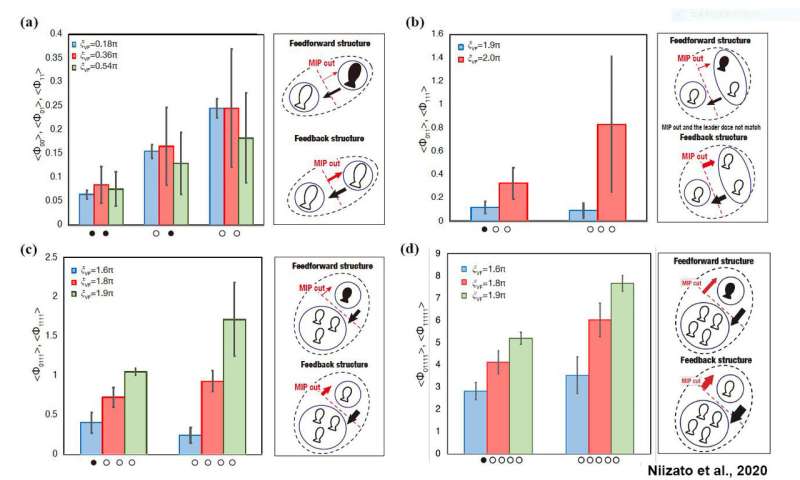
The classification from Φ values related to the school’s behaviour. (a) analysis of 2-fish schools. (b) analysis of 3-fish schools. (c) analysis of 4-fish schools. (d) analysis of 5-fish schools. Credit: University of Tsukuba
Researchers at the University of Tsukuba used advanced metrics from information theory to describe the collective behavior of small schools of ayu fish. They found that the overall dynamics were noticeably different for groups of three or more, compared with smaller groups, even over very short timescales. This work may help shed light on fundamental problems in complexity theory and assist in the development of cooperative biomimetic swarming robots.
Some of the most difficult questions in science today deal with the same fundamental question: How can complex dynamics arise from simple, local interactions? For example, schools of fish and flocks of birds can move and turn in near perfect synchrony without any top-down control from a leader. To try to make progress on this question, integrated information theory (IIT) has been used to provide a mathematical framework for measuring how information passes back and forth from individuals to the group as a whole.
A team including Professor Takayuki Niizato at the University of Tsukuba studied the swimming of Ayu, which are small fish related to smelts. Ayu were randomly chosen and placed in a tank in groups of two, three, four or five fish.
Explains Professor Niizato, “The trajectory of each fish was tracked, and a computer calculated three binary parameters for every fish at each time step. These parameters were as follows: if the subject fish was close to another fish, if the fish was turning, and if another fish was in its field of view. We found that, over times ranging from 40 milliseconds to one second, a grouping of three fish acted very differently than a pair.”
In this study, “integrated information” quantified the extent to which the cause and effect in a system can be explained by the repertoires of its components. And “integrated conceptual information” was used as an expression of the fish school’s group collective action, roughly how much the behavior of individual members is dependent on the behavior of the group.
“The aim of IIT is to try to shift the paradigm from ‘what a system does’ to ‘what a system is.” The former tries to analyze the system on the basis of observable behavior, while the latter tries to determine its intrinsic causal structure,” says Professor Niizato.
This work may help make inroads in some truly difficult questions surrounding group dynamics that emerge naturally when simple components join to form a complex group. This may also aid in the development of “swarming” robots that, like schools of fish or ant colonies, make use of this principle to achieve complicated goals.
Finding it hard to navigate all the scripts, their pundits,likes,call-outs: Flexing flexing flexing. Complexity blah blah. Emergence blah blah. Presencing blah blah. Am I being boring & grumpy? Has the complexity conversation lost its muchness?Is it time for silence or new words?
It’s late and I’m tired – am trying to offer Venkatesh something from Beer, Bateson, Perceptual Control Theory, Free Energy Principle…
I've heard of 3 hypothesized "basic drives" for living things: seek pleasure, avoid pain, minimize energy. I don't know that any of them is based on anything more solid than Freud-level hand-waving, but I think there's a fourth one: regulate uncertainty.
Regular readers will know that I think there are so many family resemblances across systems, complexity, and cybernetics that it’s invidious and counter-productive to attempt to draw those broad distinctions (see https://stream.syscoi.com/2020/04/21/bringing-together-some-reason-and-old-threads-on-systemsthinking-is-complexity-is-cybernetics/ ).
Nevertheless, the reading list at https://stream.syscoi.com/2020/05/06/a-very-rough-and-partial-draft-systems-thinking-reading-list/ – which is is avowedly rough and partial – doesn’t have a lot of things called ‘complexity’ on there.
You might also see https://stream.syscoi.com/2020/08/03/what-might-systems-leadership-be-and-how-does-it-relate-to-systems-change-a-happily-tentative-essay/
and https://stream.syscoi.com/2020/09/13/an-emergence-reading-list-axis-praxis/
For ‘complexity’:
A question on twitter
What books (rather than articles, websites or blogs) would you recommend on the topic of Complex adaptive systems? I am sharing some concepts with a team later but would like to leave some recommendations for further study. #cynefin@snowded@lunivore thanks
What is complexity science? A complex system is collective (many body–meaning many interacting parts), coupled (what i do effects what you do), characterized by adaptation/ learning, feedback b/w scales, nonlinearities, nonstationarity +noise from erroneous perception or… 1/? https://t.co/RHSUE7GeCZ
A few weeks ago, someone was asking about "complex systems". Is there anything to it, or is it just a buzzword? How does it compare to agent-based modeling, chaos theory, systems science, etc.? This concise survey by Mark Newman answers those questions: https://t.co/8Xe8D06GYn
Here are more details for our first meeting of the revival of the Macy Meetings in cybernetics on Sunday September 13th at Noon EDT, first reported in this prior post, as follows:
Our speakers Larry Richards and Ben Sweeting will respond to the provocation, “Why Can’t Cybernetics Tame Pandemics?” Then our respondents will each answer the questions, “Where did the speakers agree?” and “What did they leave out?” Our confirmed respondents are BCE Scott and Patricia Ticineto Clough. The speakers are then allowed to respond, and the process repeats. Read below for a longer description of context and intention.
Provocation: Why Can’t Cybernetics Tame Pandemics?
We live in the unprecedented era of multiple global pandemics. While the COVID-19 pandemic of biology has forced an immediate response, other pandemics have existed for some time: rapacious technology, uncontrolled climate change, inequitable healthcare systems, racist socio-economic structures, food and water insecurity… the list is long.
In design circles such ‘wicked challenges’ are construed to encompass but also to require more than viewpoints of first-order complexity; they require articulation of worldview(s) in which purpose, human values, and humility are most prominent. This second-order rhetorical step emphasizes the need for the dynamics of conversation, sufficient for shared understanding and coordinated action in the face of wicked challenges.
Cybernetics purports to offer both a first- and second-order praxis. Can it help here? To stimulate debate, the prompt for the panel is: Why can’t cybernetics tame the wicked pandemics of today? The purpose is not simply to identify what is outside of cybernetics but to point out the limitations of cybernetics as a praxis for today’s pandemics.
This panel is the first event in the revival of the Macy Meetings for the global challenges of the 21st-century. (See this doc for more details.)





 Systems Community of Inquiry
You must be logged in to post a comment.