Connect with inspiring transdisciplinary scholars, practitioners and creatives working on transformations towards regenerative and just futures. We favour short presentations, long conversations, and practical workshops.
Your regular reminder that MDPI has sometimes been listed as a ‘borderline predatory’ publisher. I’m not equipped to make definitive judgements on that, but a scan of these titles does not, to me, suggest a hugely coherent and relevant body of work…
https://www.mdpi.com/2079-8954/11/6
Cover Story (view full-size image): China’s response to COVID-19 is worth learning and discussing. We summarize the characteristics and process of emergency resource allocation (ERA) in public health emergencies by analyzing the situation in China. Firstly, we identified intelligent technologies that affect ERA based on China’s relevant research in recent years. Then, we constructed an intelligent ERA mechanism from the following four aspects: medical intelligence, management intelligence, decision-making intelligence, and supervision intelligence. Further, we evaluated the impact of intelligent technologies on ERA and ranked their criticality. Finally, we provide direction and suggestions for further research on the application of intelligent technology in ERA. View this paper
Please consider submitting by 4th August 2023 for:
The 9th International Workshop on Socio-Technical Perspective in IS development (STPIS’23). This year, STPIS will take place at the University of Portsmouth, UK. You can click hereto submit your paper.
Important dates:
Initial submission deadline: 4th August 2023Author notification: 15th September 2023Registration deadline: To be announcedCamera ready deadline: 1st October 2023Conference dates: 27-28 October 2023
All deadlines are 23:59 Anywhere on Earth (AoE) (UTC -12).
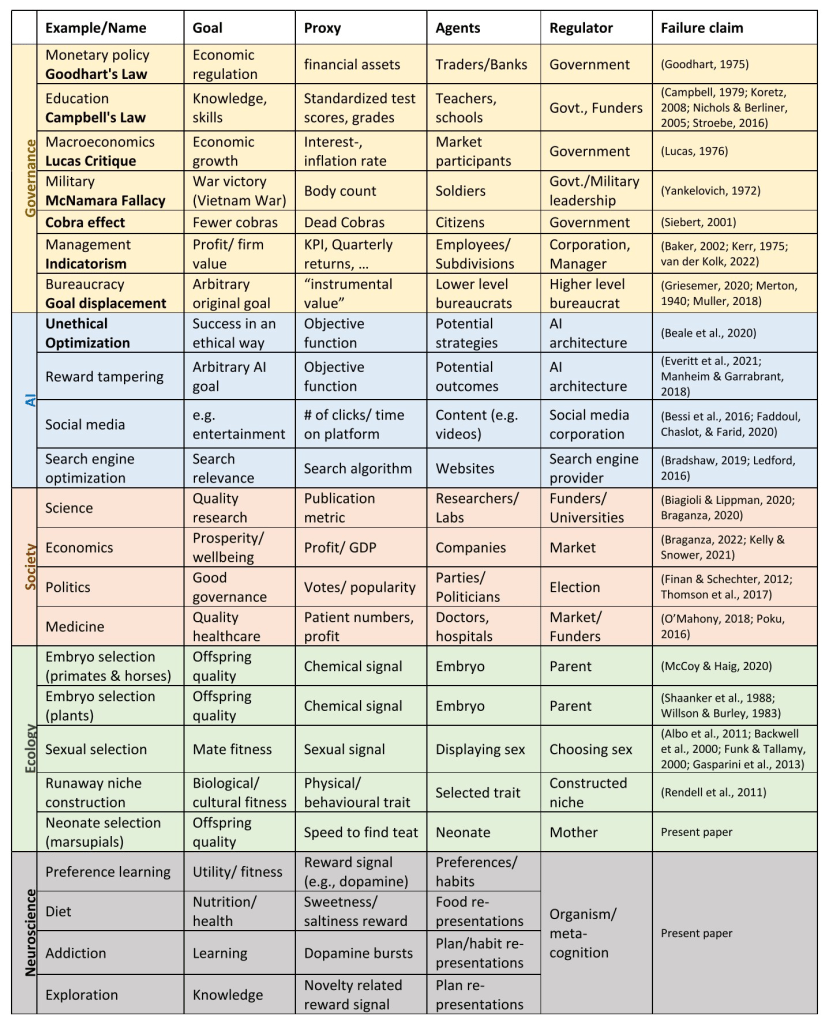
I'm very happy to announce that our paper on "proxy failure" — analogues of Goodhart's Law ranging from molecular biology to brains to business to ecology — has been made available at Behavioral and Brain Sciences.
When a measure becomes a target, it ceases to be a good measure. For example, when standardized test scores in education become targets, teachers may start ‘teaching to the test’, leading to breakdown of the relationship between the measure–test performance–and the underlying goal–quality education. Similar phenomena have been named and described across a broad range of contexts, such as economics, academia, machine-learning, and ecology. Yet it remains unclear whether these phenomena bear only superficial similarities, or if they derive from some fundamental unifying mechanism. Here, we propose such a unifying mechanism, which we label proxy failure. We first review illustrative examples and their labels, such as the ‘Cobra effect’, ‘Goodhart’s law’, and ‘Campbell’s law’. Second, we identify central prerequisites and constraints of proxy failure, noting that it is often only a partial failure or divergence. We argue that whenever incentivization or selection is based on an imperfect proxy measure of the underlying goal, a pressure arises which tends to make the proxy a worse approximation of the goal. Third, we develop this perspective for three concrete contexts, namely neuroscience, economics and ecology, highlighting similarities and differences. Fourth, we outline consequences of proxy failure, suggesting it is key to understanding the structure and evolution of goal-oriented systems. Our account draws on a broad range of disciplines, but we can only scratch the surface within each. We thus hope the present account elicits a collaborative enterprise, entailing both critical discussion as well as extensions in contexts we have missed.
link at https://twitter.com/Meaningness/status/1672763417948745728
The piece he’s commenting on is in Nautlius, ‘the man who tried to redeem the world with logic’, by Amanda Gefter – I’m sure I can’t find it here but (once again demonstrating that search for syscoi.com is rubbish), I can’t find it.
Our new paper with Masanao Igarashi and @h_shimazaki about the nonequilibrium thermodynamics of large, disordered networks (the asymmetric SK model) was just published in Nature Communications 😀https://t.co/GrIo4RjNTA
about the nonequilibrium thermodynamics of large, disordered networks (the asymmetric SK model) was just published in Nature Communications 😀 https://nature.com/articles/s41467-023-39107-y… Thread about the main ideas of the paper
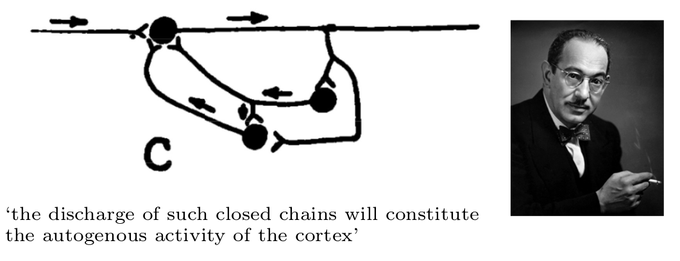
Brain circuits are generally asymmetrically connected, displaying reentrant connectivity and generating self-exciting activity. Perhaps one of the first to study it was Cajal’s student and cybernetic pioneer Lorente de Nó
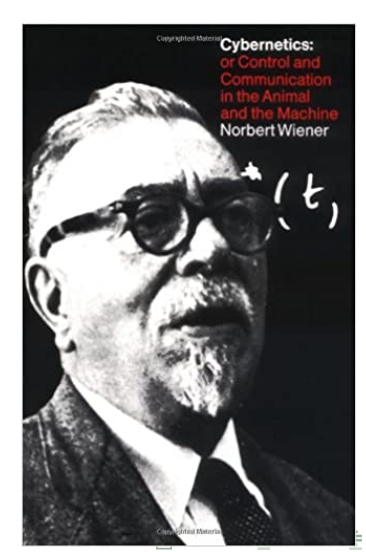
Lorente de Nó participated in the first Cybernetics meetings hosted by Norbert Wiener, who in the first chapter of his seminar book realizes that such asymmetric structures must be governed by the physics of nonequilibrium, irreversible processes
A classic example of an irreversible process is a cup breaking. A movie of a cup breaking feels perfectly natural, but watching the same movie backward is strongly unintuitive. This is because of the emergence of an arrow of time of the entropy dissipated by the cup shattering
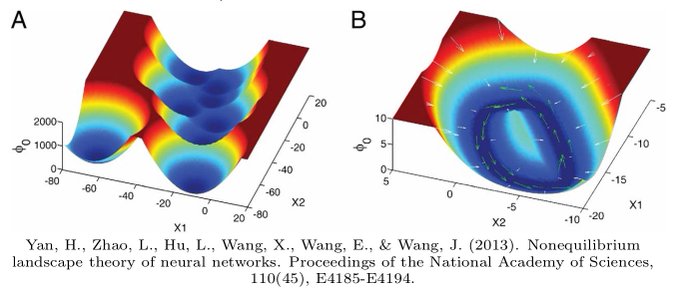
Neural and other networks can display a similar process. Networks in equilibrium (A) have attractors that organize the activity of the network, but behaviour is reversible. Networks out of equilibrium (B) can display interesting irreversible phenomena, like oscillations and chaos
Thermodynamically, out-of-equilibrium dynamics must dissipate entropy to the environment to sustain such irreversible activity. Thus, entropy production is a measure of the emergence of such dynamical dissipative structures
TL:DR — It is impossible for organisations to “demonstrate their impact” if they work in complex environments. Asking them to do so requires them to create a fantasy version of the story of their work. This corruption of data makes doing genuine change work harder because it is difficult to learn and adapt from corrupted data.
The Department for Environment, Food and Rural Affairs (Defra) is the UK government department responsible for improving and protecting the environment, growing the economy, sustain thriving rural communities and support our food, farming, and fishing industries.
The government has set ambitious commitments through the Environment Act, the Net-zero strategy, the food strategy, and the Plan for Water. These commitments will interact with our food system, land-use system, resource and waste flows, rural economies and communities and natural environment. To deliver these commitments our policies need to be coherent with the real-world systems that they affect, and systemic insights are essential for ensuring policy coherence.
Applied systems analysis is in high demand in Defra and we have three exciting opportunities to develop systemic insights in cross cutting and complex areas. You will join the Defra Systems Research Programme (SRP) which was established in 2019 to embed systems research principles in Defra’s policy, evidence, and research activities.
An unusual source and nisam znala ko George Rzevski – who I invited to speak at SCiO many years ago – was Serbian.
More and more founding figures of Artificial Intelligence are making tsunami-scale waves with headlines of imminent doom. Our community can boast one such innovator who is celebrating his 90th year with an open invitation to hear him speak on how our lives will change.
A Workshop in Honour of Emeritus Professor George Rzevski
10:00 – 16:00
Wednesday 21st June 2023
Systems Seminar Room, Walton Hall
For half a century George Rzevski has made many original contribuons to Arficial Intelligence, Complexity Science and Design. What sets George apart from many other researchers in these fields is successful praccal applicaons in areas such as dynamic scheduling of taxis, a fleet of oil tankers, and private jet aircra. George has published widely on his work. His latest book, The Future is Digital: How Complexity and AI will Shape Our Lives and Work, will be published this year by Springer.
09:30 – 10:00 Welcome
10:00 – 11:00 George Rzevski – How Complexity and AI will Shape our Life and Work
11:00 – 11:30 Coffee
11:30 – 13:00 Phil Picton – Deep Learning – What’s New? Soria Psoma – Biosensors for Intelligent Healthcare Systems Vikram Goolaup – Spintronics Neuromorphic Systems Miguel Valdez – AI, Complexity and Starship robots Marian Petre – to be announced Viktoriya Pyeshkova – to be announced Jeff Johnson – AI, Complexity and Designing the Future
13:00 – 14:00 Lunch Break
14:00 – 15:30 Serhan Cosar – Machine Vision and Robocs Alistair Wyllis – to be announced Claudia Eckert – The Data Challenge in Complex Engineering System Design Jon Hall – to be announced Lucia Rapano – to be announced Ihor Sobianin – Harvesng Energy for Bio-implants Anthony Lucas-Smith – to be announced
15:30 – 16:00 Coffee and Discussion: Is Arficial intelligence a subfield of Complexity Science? Everyone is welcome to attend, and everyone is invited to give a 5-minute presentation on their ideas. The more controversial the better !
Nuova edizione 2023-2024Mancano pochi giorni alla presentazione dell’Executive Master in Complexity Management in partenza a settembre. Il Master ha lo scopo di generare nei partecipanti la capacità di comprendere, riconoscere, padroneggiare con consapevolezza ed affrontare con efficacia scenari e situazioni complesse. È indirizzato a tutte quelle persone che desiderano sviluppare nuove capacità per affrontare con efficacia la complessità delle situazioni, per acquisire un nuovo stile di management orientato alla cura delle relazioni interpersonali e di contesto. Quando:15 giugno 202321.00-22.30Web Meeting | Zoom La partecipazione è gratuita con iscrizione obbligatoria tramite EventbritePer registrarti alla serata di presentazione clicca quiCOMPLEXITY LOUNGE #11 Giunge all’11° appuntamento l’incontro riservato alla Community del Complexity InstituteUn appuntamento settimanale, per vivere la nostra community, riservato alle persone associate, per chiacchierare in relax e conoscerci. Questo è il Complexity Lounge. Continuiamo a sperimentarlo insieme! Ogni martedì 18.30 – 19.00 su Zoom
Uno spazio dove generare sinergie inaspettate! Parlando di complessità, arte, filosofia, gite in barca, letture, organizzazioni, intelligenza artificiale e… chissà che altro!Per saperne di più clicca quiIL FASCINO DELLA COMPLESSITÀ
Shockwave traffic jams that appear for no reason have been recreated for the first time. Researchers in Japan applied mathematical theory to cars on a race track to show how drivers breaking can trigger disruptions to traffic flow. Read more about the phenomenon at https://www.newscientist.com/article/…











 Newsletter giugno 2023/02
 Questa comunità è un vero e proprio ecosistema che si ispira ai valori del
 Systems Community of Inquiry
You must be logged in to post a comment.