
Benjamin Taylor, with support from ChatGPT looking across links to #Syspac24 on LinkedIn
Materials from the conference at www.systemspractice.org/resources-from-sysprac25

Introduction
In September, systems thinkers from around the world gathered at Milton Keynes for SysPrac25 – a two-day Systems Thinking Practitioner Conference co-hosted by SCiO (Systems and Complexity in Organisation), the Open University’s STiP program, and the International Federation for Systems Research (IFSR) A household emergency kept me away on day one, so I arrived on day two with equal parts relief and regret – relieved to finally join colleagues, but regretful about the rich sessions I’d followed only through excited hashtags and reported hallway chatter the day before.
This conference mattered a great deal to me. SysPrac25 wasn’t just another academic meet-up; it was a milestone in the evolution and institutionalisation of systems practice. With a world in ‘accelerating, interlocking crises’ (as one attendee noted), the need for systemic thinking in action has never been greater. Yet bridging the gap between knowing and doing systems thinking – between theory and practice, academia and the ‘real world’ – remains a central challenge. The SysPrac25 event squarely addressed this challenge, bringing together 160 participants across sectors to share practical approaches for tackling complexity. In this personal reflection, I’ll recount the experience and insights from day two (with a nod to day one and other highlights shared by others, in quotes), exploring what the conference revealed about our community’s journey toward professionalising systems practice.
(And – sorry – I’d like to report that my house is fine now, but still waiting on the roofers!)
Vibes
Walking into the Open University’s conference centre on day two, I immediately felt the buzz. People were animatedly recounting yesterday’s sessions over coffee. The atmosphere was ‘buzzing’ with energy – a kind of ‘rich, generative space’ that the organisers had intentionally cultivated. Despite missing the first day, I was warmly folded into conversations as if I’d been there all along. It struck me that this was a safe place to think out loud – practitioners and academics openly wrestling with big questions, challenging each other yet offering support. The vibe was one of curiosity and camaraderie in equal measure, with productive dispute very evident too.
Attendees spanned a remarkable diversity of backgrounds. There were veteran luminaries like Professor Ray Ison (IFSR’s president) – and pretty much the entire OU faculty, including Martin Reynolds, who’s contribution and retirement was celebrated in the closing plenary – and Dr. Mike C. Jackson OBE, all chatting casually with early-career professionals and the ‘systems curious’. I met government policy advisors, corporate consultants, NGO workers, academics, and many current Systems Thinking Practitioner apprentices. As one participant observed, ‘the diversity of voices and approaches’ was a highlight – ‘from Patterns of Strategy with Mike Jones & Carla Owens to Humanising Systems with Jan De Visch, and from student case studies to practitioners grappling with real-world challenges.’ It felt like a microcosm of the whole systems community (a healthy version thereof!): all ages, multiple nationalities, and domains from health to climate to business.
Crucially, the mood was positive and practice-focused. Rather than hand-wringing over the state of the world, people here were doing something – swapping tools, stories, and tactics. The event was structured for interaction: two days, four parallel tracks, 48 sessions in total, including hands-on workshops and roundtables. This wasn’t a conference where you just sit and listen; every corner of the venue had impromptu breakout discussions and scribbled flipcharts. As one key organiser (Mike Jones) posted afterward, ‘from workshops and keynotes to practical conversations in every corner — this is what celebrating systems practice looks like.’ The celebratory aspect was real – there was joy in connecting with kindred spirits. People repeatedly described feeling ‘energised and full of ideas’, even ‘inspired’ and ‘excited to keep building this movement.’ For a community often working on complex, even daunting issues, it was heartening to see so much hope and motivation under one roof.
Personally, I felt a strong sense of community at SysPrac25. Perhaps because I missed the first day, I especially appreciated how welcoming everyone was on day two. It’s not easy to craft an environment where newbies and veterans both feel at home, but this conference nailed it. As one attendee put it, ‘the conversations were rich, the challenges real and the connections…are where the magic happens.’ There was a palpable ethos of ‘generous sharing, collaboration and learning’, which is ‘much needed in these challenging times.’ I left with new connections and a sense that our systems practice community is growing – and growing closer.
Key themes/insights
Despite my missing the first half, I managed to catch up on many of the key themes that emerged across SysPrac25. In conversations, plenaries, and tweets about Day 1, and through my full participation on Day 2, a number of common threads became clear:
Professionalising systems practice
A recurring theme was the ongoing quest to professionalise systems practice – to make what we do a recognized, supported profession in its own right. In his keynote, Dr. Ray Ison explicitly ‘challenged us to reflect on professionalising systems practice’. What does it mean to be a ‘systems practitioner’ as a profession, not just a mindset? Part of the answer lies in institutional support. Ray emphasized that the ‘first job of all institutions is to reproduce themselves’ – meaning organisations (universities, governments, companies) often prioritise preserving their own structures and habits. This can make them resistant to new ways of working. In fact, as keynote speaker Alison Guthrie-Wrenn wryly observed, ‘government needs systems thinking…but it is set up to repel it at every turn.’ In other words, we practitioners are trying to bring systemic approaches into institutions whose default is to maintain the status quo. Overcoming that inertia is a professional challenge – but one that wasn’t bemoaned here, just tackled.
But the level 7 (masters-level) Systems Thinking Practitioner apprenticeship is a sign of progress. One international delegate noted ‘I envy UK professionals. Some can now even pursue apprenticeships in systems practice, sponsored by their employers.’ This kind of official pathway is still ‘quite new’ – and now unfunded – but it signals momentum. Indeed, a fellow attendee told me over lunch that he was about to finish his Level 7 Systems Thinking Practitioner qualification, and the conference was a chance to celebrate that milestone. (And several speakers and award-winners were all recent graduates – both Mike Jones and Gavin Roberts had officially qualified as Advanced Systems Thinking Practitioners – with distinction during the week, underscoring how training and practice now go hand-in-hand.)
Ray Ison’s message went beyond just training individual practitioners – he urged the community to push for systemic support for systemic practice. He made an ‘appeal to systemically institutionalise the…design and realisation of context-appropriate learning systems’ – an appropriately fractal challenge, and a vital one given the state of the higher education sector in the UK (traditionally a big source of training and academics), and the UK government’s withdrawal of level 7 apprenticeship funding for new starts from January 2026, meaning that all the positive energy from the apprenticeship now needs to be refocused and find new resources.
In plain terms, we need to embed systems learning into how institutions work, so that cultivating systems practitioners becomes part of the system itself. Professionalising our field isn’t only about certifications or apprenticeships; it’s about creating learning systems that continually develop people with systemic skills. This theme resonated strongly with many of us. It reinforced the idea that being a ‘professional’ systems practitioner means engaging at two levels: improving our personal competencies and working to change the broader structures (policies, job frameworks, funding) that either enable or stifle systemic practice as a career – and as a daily, normal, organisational practice for all.
This is all very well, but I suspect we are in the middle of a liminal period of identity shift. I felt the symbolism of Martin Reynolds’ retirement and the very real challenges facing UK higher education; will higher education and academia continue to be the ‘pump’ for systems capabilities that it once was? And then there was the quality of thinking and depth of shared reference in methods, practice, and theory in the room (without, I hope, being exclusive) – systems thinking can be accessible and practical without being ‘dumbed down’, professional without being codified and stultified. And the need to move to embedded systems practice (even over systems practitioners), action inquiry, networked learning – well, there must be something in the air because this echoes themes from Reimagining Systems Thinking as Cybersystemic Researching: An Invitation to a Cyber-Systemic Co-Inquiry, Ison et al (2025, indeed this week). There was a feeling at the conference, if not of ‘passing the torch’, but of the flame catching on to something.
But we at SCiO know from hard experience that such transitions – which are, after all, transitions of, or threatening to, deeply embedded identities – can come with all the challenges that changing or moving beyond identities brings. We need to be alert to this (which is distinct from ‘finding practitioner identity’ below) and be able to combine single-mindedness of purpose as we cross the ‘marketing chasm’ with the kind of networked support that allows people to renegotiate their identities or identify themselves as remaining on one side of a boundary without rancour. We will, no doubt, return to this topic!
Systemic consulting and practitioner identity
Another rich discussion thread centered on what it means to practice systemic consulting and how we see our identity as practitioners. I ran a session on the role of the systems consultant – often a delicate balancing act. We talked about some provocative dualities describing what systemic consultants might do. We might ‘discuss the undiscussable’ in an organisation, yet also ‘create new possible conversations.’ We might ‘mirror back’ a client’s reality, yet sometimes ‘distort [it] productively’ to help them see fresh perspectives. We can ‘make boundaries explicit’ or deliberately ‘blur [the] boundaries’ – depending on what the situation needs. This list and an exercise looking at a spectrum of systemic consulting practice both elicited knowing chuckles in the room; it rang true to anyone who has juggled the many hats of a systems change agent. The takeaway was that systemic consulting is full of tensions – we operate in paradox, always mindful of when to intervene and when to step back.
The practitioner identity question also came up in an open fishbowl discussion. Are we facilitators? Experts? ‘Connectors’? One attendee’s reflection after the conference really hit home: perhaps our community needs to ‘rethink itself: from frameworks to ways of thinking…from experts to connectors…from theory to story.’ In other words, rather than identifying solely as ‘experts’ wielding specialized methods, effective systems practitioners might better see themselves as bridge-builders – people who can translate between the world of systemic ideas and the everyday world of budgets, targets, and common-sense language. This means being fluent in both, and embracing roles like educator, translator, convenor. It also means using narrative and metaphor (story) to complement models and diagrams, so that our insights become understandable and relatable. I found this perspective both reflective and challenging: it asks us to check our egos (the goal is not to be the smartest person in the room with a fancy framework) and instead focus on creating spaces where systemic insight can emerge for everyone.
Throughout SysPrac25, I sensed a healthy critical eye toward our own practice. In a fireside chat on ‘The Future of Systems Thinking,’ Dr. Mike C. Jackson and Patrick Hoverstadt debated where the discipline is heading. One theme was avoiding insularity – ensuring we don’t become a closed guild speaking jargon to ourselves. As one participant quipped, the world ‘doesn’t need systems thinking to be clever’; it needs it to be useful, usable, and alive in practice. For me, this was a timely reminder that the identity we craft as systems practitioners should be one of humility and service – we succeed when more people can engage with systemic approaches, not when we guard them as elite knowledge.
The Viable System Model and AI/human collaboration
Cybernetics made a strong showing at the conference, especially the classic Viable System Model (VSM) of Stafford Beer. It seems VSM is experiencing a renaissance in current practice, in part due to its relevance for complex organisational and technological challenges. Day one featured a popular workshop by Patrick Hoverstadt on using VSM to ‘balance complexity’ in organisations. Several talks on day two built on this theme. In one, Carola Ritzinger-Roll –proudly giving her first-ever conference presentation – shared her doctoral research applying VSM to cybernetic control in a manufacturing company. She examined how a medium-sized enterprise can structure itself to remain viable and adaptive, using VSM as a framework for its KPI systems. In Carola’s words, she was ‘exploring how the Viable System Model can serve as a framework for cybernetic organisational control’, and was thrilled that her findings ‘sparked valuable interest among participants.’ For a first-time presenter, Carola’s enthusiasm was infectious – and it underscored how VSM offers a practical lens for real-world management challenges.
Another compelling application came from Dr. Matvei Tobman, who focused on AI and human collaboration in healthcare. Matvei proposed that VSM, which ‘does not represent [organisational] structure, but rather the functions of a healthy (viable) system’, can serve as a diagnostic tool to integrate various AI applications within a hospital or clinic. Essentially, because VSM is an abstraction of the human nervous system, it resonates with how a medical organisation might coordinate its ‘organs’ and information flows. Matvei’s talk highlighted concrete issues: deploying AI without a holistic view can create imbalances, bottlenecks, and overloads, potentially destabilising processes. Using VSM helps identify where an AI might fit, or where it could cause a pathology in the organisational body. His memorable quote – ‘Systemic problems require systemic solutions.’ – became a bit of a conference mantra. Indeed, the intersection of VSM and AI emerged as a hot topic: how to ensure that as we add intelligent systems into human organisations, we maintain viability and augment human capacity rather than undermine it.
Beyond VSM specifically, the theme of human/AI collaboration surfaced repeatedly. A couple of talks (by Ollie Bream McIntosh and Dr. Xavier Matieni) sparked conversations about treating AI not just as a tool but as a new kind of actor in our systems. One discussion I joined considered the idea: If we design an organisation’s operating model by defining roles, capabilities, workflows… why not design AI’s ‘role’ with similar clarity? Rather than view AI as a black box, we could specify its decision rights, its boundaries, and how it interfaces with human roles. This practical re-framing – essentially, managing AI like we manage a team member – was thought-provoking. It raises tough questions, of course: Will the existing organisational paradigms suffice, or does AI force us to rethink structures completely? And on a societal level, ‘who is defining AI’s role in society? Do we trust those in power… are they designing for the future we want?’ as one participant poignantly asked. These questions lingered in coffee-break chats. I felt both excitement at the ingenuity of my peers in tackling AI systemically, and a sober recognition that the human choices around AI’s adoption are as critical as the tech itself. If SysPrac25 is any indicator, systems practitioners will be key voices in ensuring AI is integrated in a way that keeps systems humane and viable.
First- and second-order systems literacy
A major conceptual theme – one that got my intellectual synapses firing – was the emphasis on systems literacy, both first-order and second-order. This came through strongly in Ray Ison’s and Mike Jackson’s contributions, and was beautifully articulated by one conference attendee, Yu-Jieh Lin. She reflected: ‘If I had to sum it up in one idea, it is the importance of systems literacy. Both first-order, treating systems as if they exist ‘out there’ and intervening in them; and second-order, recognising that systems are always as if – constructs we bring forth – while also reflecting on our own process of engaging with them.’ In simpler terms, first-order literacy is about understanding systems out in the world (ecosystems, organisations, supply chains, etc.), whereas second-order literacy is about understanding how we understand those systems (recognising our perspectives, biases, and the fact that any system model is our human construct). This dual literacy came up again and again.
Why stress this? One reason is humility. As Yu-Jieh further noted, complexity and uncertainty will ‘always outrun us’ – we can never fully control or predict a living system. But without systems thinking, ‘our attempts at problem-solving would be so much worse’. So first-order literacy helps us do better in complex situations, and second-order literacy keeps us humble and open to learning when our interventions have unintended effects. In one session, Martin Reynolds and other Open University scholars emphasised the idea that there is no observation without an observer – whenever we map a system, we must remember we are in the picture too.
For me, this clicked with my own experience of the conference. The format itself encouraged second-order reflection. In a meta-move, one workshop had us reflect on our learning process during the conference, not just the content. We practiced being aware of how we frame problems and how that framing could shift. This emphasis on learning how to learn systemically is what second-order literacy is all about. It’s almost a form of mindfulness in systems practice – being aware of how we are thinking, not just what we are thinking about. I left SysPrac25 convinced that promoting systems literacy (first and second order) at a broad scale – in education, in organisations – is one of the most impactful things we can do. It equips people not just to use systems tools, but to continuously learn and adapt in complex environments, which may be the ultimate systemic competency.
Institutionalising learning systems
To return to the phrase that stuck with me from Ray Ison’s keynote, ‘institutionalising learning systems,’ Ray challenged us to think about how learning (and failing, and adapting) can be built into the fabric of our organisations and communities. He argued that all boundaries we deal with (between departments, disciplines, etc.) are essentially imaginary – social constructs – but that doesn’t make them meaningless. It means we have the agency to redefine boundaries in service of learning. Ray’s call to ‘design and realise context-appropriate learning systems’ within institutions is a call to action: rather than simply deliver one-off ‘systems interventions,’ we should help create ongoing processes for learning and reflection that persist after we consultants or facilitators depart.
A concrete example discussed was the idea of ‘learning in the flow of work.’ Instead of separating learning from doing (e.g. annual training workshops divorced from daily practice), forward-thinking organisations are trying to embed reflective practices into everyday workflows. One government attendee mentioned their department’s attempt to hold regular ‘systems clinics’ where project teams pause and reflect systemically on active challenges, treating it as part of project work, not an extra. This echoes approaches in agile software and safety management – think of it as systemic retrospectives as a routine. Ray Ison’s perspective, with his background in systemic governance, gave philosophical weight to this: to institutionalise learning systems is to make systemic reflection part of the institution’s DNA.
Another facet is how institutions themselves evolve. I thought about how institutions may need ‘fungal reproduction’ – spreading via spores and mycelium – as opposed to just copying their existing structure. In practice this might mean creating spin-off communities of practice, or ‘infecting’ other departments with systems thinking ideas in an organic way.
The conference itself felt a bit like that fungal spread in action: IFSR, the Open University, and SCiO collaborating to germinate new learning networks. As an attendee deeply involved in SciO and in IFSR, I felt proud that we were not only talking about learning systems but modeling one: the event was a temporary learning system, bringing together a community to reflect on its own practice. The challenge ahead is making sure this doesn’t remain a one-time mushroom bloom, but that it feeds back into our home institutions – that we create lasting systems learning ecosystems wherever we have influence.
Practical methods and tools
True to its promise of systems thinking in practice, SysPrac25 was packed with practical methods and tools. Several sessions were essentially mini-trainings, introducing or honing techniques that we can use in our work. For instance, Carolina Cullington’s workshop on Critical Systems Heuristics (CSH) – in just 45 minutes, she managed to give us usable tools to ‘interrogate assumptions and power dynamics’ in problem situations. She walked through defining who the stakeholders and decision-makers are in a scenario, what norms and metrics are in play, and what boundary judgments we might be unconsciously making. Even those familiar with CSH, found the refresher incredibly practical and left with ideas on how to incorporate those probing questions (‘Who ought to be the beneficiary of this system?’ etc.) into their work.
Likewise, classic systems mapping tools got hands-on treatment. In one room, a group was drawing Rich Pictures; elsewhere, someone ran a demo on causal loop diagramming a policy issue. A public sector manager later commented that he ‘came away with fresh insights into how…Rich Pictures, Causal Loop Diagrams and the Viable System Model can help me visualise interdependencies, and the people at the heart of them.’ The emphasis was not on theory but on using the tools – sketching, modeling, debating what the maps revealed about our mental models. Importantly, these techniques were presented not as ends in themselves, but as conversational devices. As Kevin Collins (OU) reminded us in a diagramming session: a systems map is not just a pretty output – it’s a way to surface different perceptions of the system before jumping to solutions.
One of the more novel methods introduced was ‘The 55 Minutes.’ This turned out not to be a time constraint, but the name of a new framework (and book) aimed at bridging the knowledge–practice divide. A team from Canada (George Constantinescu, James Stauch, Daniela Papi-Thornton, Anna Johnson) shared The 55 Minutes as an ‘atlas’ of systems tools and approaches for busy practitioners. They even gamified their talk by quizzing us on Canadian trivia and handing out copies of their book to winners! The core idea is to encourage people to take 55 minutes of focused time to map a problem systemically – essentially a structured zooming-out exercise to reveal patterns and invite deeper questions. The approach pulls from many sources (some attendees recognized elements of soft systems methodology, design thinking, etc.), but it’s packaged in a very accessible way. As James Stauch noted, their aim is to help practitioners and decision-makers take time to zoom out and see the bigger system. This got a lot of positive buzz, because it directly addresses a common issue: how to introduce systemic reflection in organisations that feel they ‘don’t have time’ for it. By the end of their session, the phrase ‘let’s do a 55’ was already entering the conference lexicon as shorthand for a quick systemic inquiry. I suspect many of us will be downloading the free PDF of The 55 Minutes resource (graciously shared by the authors) and trying it out back home.
Between these and other methods (we also saw bits of Soft Systems Methodology, System Dynamics modeling, and the Patterns of Strategy toolkit in action), I was impressed by how tangible and actionable the conference content was. This was not just talk about systems thinking; it was live demonstration. The format – lots of breakouts, short interactive sessions – meant we could actually practice using the tools. For the systems community, which sometimes gets caricatured as all talk and no do, SysPrac25 was a rebuttal: here was ‘systems thinking’ with markers on flipcharts, Post-its on wall charts, and sketches on napkins – messy, real, and applied.
The conference format as a participatory space
It’s worth noting how the conference design itself contributed to these themes. The organisers consciously set up SysPrac25 as a participatory, practice-focused space, and it drew praise from many attendees (myself included). The mix of session types – from keynotes to hands-on workshops to informal ‘open space’ slots – kept energy high and accommodated different learning styles. Plenaries gave us inspiration and big-picture provocations, then the breakouts let us engage directly with ideas and with each other. People remarked that it felt ‘safe to think’ differently and to ask naive questions, which is not always the case at professional conferences. Credit to SCiO and the OU team for this; they intentionally fostered an atmosphere of openness and experimentation.
One novel element was the strong integration of social media and real-time reflection. The conference hashtag #SysPrac25 was actively used by participants to share ‘aha’ moments, quotes, and even photos of flipcharts. Those of us who missed day one benefited from this Twitter/LinkedIn backchannel – I certainly did, scrolling through posts on the train to Milton Keynes. It created a distributed conversation beyond the physical venue, and it also now serves as an archive of insights. During breaks, I saw folks checking the hashtag to catch snippets from sessions they couldn’t attend (with four tracks, we all had FOMO!). In a way, the event lives on as a learning resource through these online reflections. Even IFSR’s official account chimed in to amplify an attendee’s summary that ‘systems problems demand systems approaches’ – a simple message that encapsulated the spirit of SysPrac25.
Lastly, I have to commend the culture of inclusivity, as I experienced it. The organisers set the tone that whether you’re a big-name author or a newcomer ‘currently only systems curious’, your participation was welcome and valued. I spoke with a few first-time conference-goers who were relieved that the space didn’t feel cliquish or overly academic. As one LinkedIn user posted after day one: ‘Sold out. Great energy. And filled with a fantastic community of systems thinkers…this is what celebrating systems practice looks like.’ That pretty much sums it up. It felt like a celebration – not in a superficial way, but a genuine acknowledgement that our field is evolving, maybe even ‘coming of age,’ and that we were all part of that story.
Quotes and visuals
Throughout the conference I jotted down quotes that struck me – pithy insights or provocations from speakers that capture the essence of SysPrac25. Here I’ll share a few that still ring in my ears, alongside some visual mental images from their talks:
- ‘Choose dualities, not dualism.’ – Ray Ison, urging us to avoid either/or thinking and embrace the power of both/and in complexity. Ray gave the example that effective strategy needs both long-term vision and short-term action. His slide contrasting systemic practice (soft) vs systematic practice (hard) as a complementary duality is a classic.
- ‘The machinery, the mindset and the mission.’ – Alison Guthrie-Wrenn titled her opening keynote with this triad, encapsulating why embedding systems thinking in government is so powerful when we get it right, and how challenging it is when we don’t. Her passionate call for systemic change in the public sector – even as she acknowledged the institutional barriers – left a strong impression. She shared a diagram of a government process with feedback loops, which visibly clashed with the linear org-chart lines – a visual gut-check of why new mindsets are needed.
- ‘Systemic problems require systemic solutions.’ – Dr. Matvei Tobman, concluding his talk on AI in healthcare with this straightforward truth. On screen was a VSM diagram of a hospital, highlighting where various AI tools fit. The quote became a kind of refrain for the conference; I saw it tweeted and scribbled on whiteboards more than once. It’s the kind of simple reminder I plan to put on my office wall.
- ‘Such dialogue is what makes events like SysPrac so enriching.’ – Carola Ritzinger-Roll, reflecting on her first conference presentation and the exchanges it sparked. This quote warms my heart because it speaks to the human side of these gatherings – the encouragement, curiosity, and constructive critique among peers. I picture Carola standing by her poster during a break, engaged in animated discussion with a small group – exactly the kind of peer learning that defines SysPrac25.
- (On government and systems thinking) ‘Many people in government value systems thinking, but the institution is set up to repel it at every turn.’ – Alison Guthrie-Wrenn, as recounted by James Stauch. This candid observation brought a knowing laugh from the audience. The accompanying visual was a tongue-in-cheek ‘immune system’ graphic of a bureaucracy fighting off a ‘systems thinking virus.’ It perfectly encapsulated the challenge of institutional change.
- ‘From experts to connectors…from theory to story.’ – Andy Wilkins, on the shift the systems community needs. This wasn’t a slide but part of a reflection he shared but is a quote I keep chewing on: how do I personally act more as a connector and storyteller in my practice? It’s almost a manifesto line for making systems thinking mainstream.
Each of these quotes, in its own way, reflects the ethos of SysPrac25 – provocative, pragmatic, and people-centered.
Many of the slides and recordings of the keynotes are www.systemspractice.org/resources-from-sysprac25
Next steps and reflections
As I step back from the immediacy of SysPrac25 and consider the road ahead, I find myself asking: what’s next for the systems practice community, and how can IFSR help? After all, the IFSR (International Federation for Systems Research) not only co-sponsored the event but also has a mission to advance systems science and practice globally. Here are a few reflections and ideas spurred by the conference:
- Bridging academia and practice: SysPrac25 demonstrated the value of bringing academics and practitioners into the same room (literally and figuratively). IFSR is uniquely positioned to be a bridge here – its very federation includes scholarly societies (like ISSS) and, increasingly, practitioner networks (like SCiO). There was lively conversation on a comment from Patrick Hoverstadt that ‘practice is often ahead of academia’, which was not denied. In any case, both sides benefit from the engagement of the other. As one attendee put it, we need a ‘translation layer…that connects leaders’ everyday challenges with deeper systemic dynamics’.
- IFSR could champion development of this translation layer – maybe through guides or training that help practitioners articulate systemic ideas in boardroom language, or help academics distill their findings into practitioner-friendly tools. In short, IFSR can help make sure the brilliant ideas from systems research actually find traction in practice, and vice versa.
- Supporting working groups and communities of practice: the energy at SysPrac25 shouldn’t dissipate. One idea floated during the closing session was to create ongoing working groups around key themes – e.g. a community of practice on Systems Thinking in Government, another on AI and Systems, another on Education for Systems Literacy. These could operate virtually, continuing the conversations and sharing experiments throughout the year. IFSR, with its global reach, could incubate or endorse such groups, providing a platform (and perhaps modest resources) for them to collaborate – including on Ray’s ‘Institutionalising Learning Systems’ challenge.
- Similarly, a ‘Professionalisation of Systems Practice’ task force could connect folks involved in apprenticeship programs, certification efforts, and competency frameworks across different countries, to learn from each other and harmonize efforts where possible. These initiatives would show IFSR’s commitment to fostering practitioner networks, not just theoretical discourse.
- Advancing systems literacy Initiatives: several voices at SysPrac25, especially from the Open University contingent, underscored the need for broader systems literacy in society. First- and second-order literacy, as discussed, is like a foundational competency for the 21st century. IFSR could play a convening role in bringing together educators, government trainers, and community leaders to strategise on spreading systems literacy. Could there be a global ‘Systems Literacy for All’ initiative, analogous to STEM literacy campaigns? Also, IFSR’s member organisations might partner with schools and professional bodies to integrate systems concepts into their curricula or professional development. The conference gave us success stories (like the UK apprenticeship) but also warnings – e.g. funding for some programs is ending, as one attendee lamented. IFSR might advocate to policymakers about the importance of sustaining support for systems education. In sum, if we believe, as many at SysPrac25 did, that ‘systems thinking [is] one of the things the world needs most right now’, then scaling up basic literacy is a critical mission.
- Institutionalising systems learning (Inside IFSR and Beyond): At the meta-level, IFSR can take a page from Ray Ison’s book and examine its own role as an enabler of learning systems. The federation could facilitate more cross-pollination among its member groups so that learning about successful (and failed) systemic interventions is shared widely. Perhaps the next IFSR Conversation series could explicitly focus on learning from practice: bringing practitioners and researchers to jointly reflect on cases where systemic change efforts succeeded or floundered, extracting lessons about institutional factors. IFSR might also help develop evaluation frameworks for systemic interventions – something practitioners sometimes struggle with – by leveraging academic expertise. This would help institutionalise learning by creating feedback loops: after a project, reflect and evaluate systemically, then feed that knowledge into improved practice. As a federation, IFSR can encourage each member institution to become a learning system in its own right, modeling what we preach.
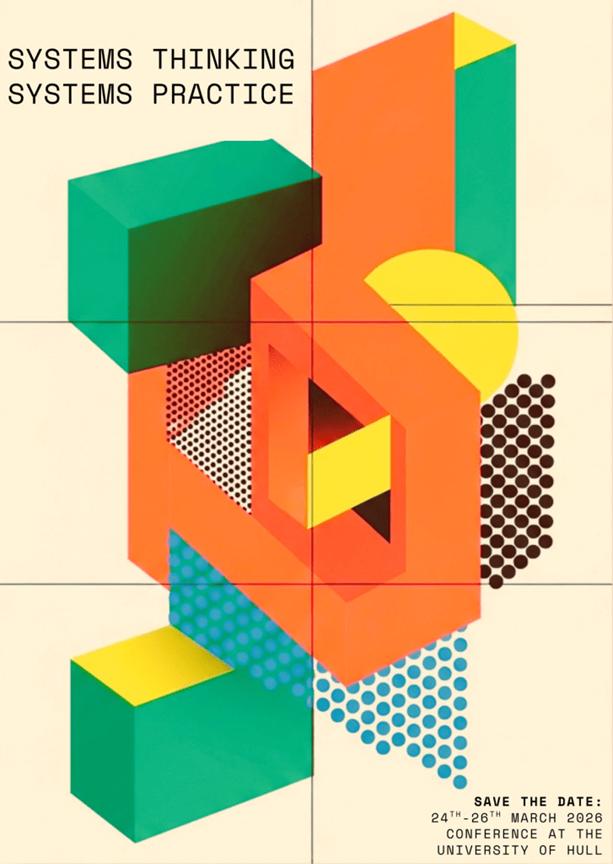
- Future conferences and collaboration: the enthusiastic response to SysPrac25 suggests it shouldn’t be a one-off. The next planned event:
𝗦𝘆𝘀𝘁𝗲𝗺𝘀 𝗧𝗵𝗶𝗻𝗸𝗶𝗻𝗴 𝗮𝗻𝗱 𝗦𝘆𝘀𝘁𝗲𝗺𝘀 𝗣𝗿𝗮𝗰𝘁𝗶𝗰e, 𝟮𝟰-𝟮𝟲 𝗠𝗮𝗿𝗰𝗵 𝟮𝟬𝟮𝟲 𝗮𝘁 𝘁𝗵𝗲 𝗨𝗻𝗶𝘃𝗲𝗿𝘀𝗶𝘁𝘆 𝗼𝗳 𝗛𝘂𝗹𝗹, 𝗨𝗞
Hosted by the 𝗖𝗲𝗻𝘁𝗿𝗲 𝗳𝗼𝗿 𝗦𝘆𝘀𝘁𝗲𝗺𝘀 𝗦𝘁𝘂𝗱𝗶𝗲𝘀, 𝗦𝗖𝗶𝗢, and the 𝗢𝗥 𝗦𝗼𝗰𝗶𝗲𝘁𝘆, with input from a broad conference committee including members of the UK government’s Systems Thinking Interest Group (STIG), and the IFSR, this event promises to be a unique opportunity to connect across communities, share diverse perspectives, and explore both the foundations and future frontiers of systems practice.
You can expect:
• Engaging conversations across methodologies and approaches
• New insights on emerging trends and global challenges
• Opportunities for learning, sharing, and professional networking
• A vibrant mix of practitioners, academics, and systems leaders
Whether you’re systems curious, deeply embedded in systems practice or just beginning your journey, this is a moment to come together, learn from each other, and help shape the future of the field.
CALL FOR CONTRIBUTIONS
This conference aims to do things differently, bringing together in lively debate systems academics and public and private sector systems practitioners. We’re looking for 250-word proposals for:
• Introductory training sessions for the systems curious
• Interactive workshops using systems thinking to address real-life predicaments
• Case studies showing systems thinking in practice
• Papers advancing systems theory and systems methodologies
• Poster presentations demonstrating systems thinking in practice
Preference will be given to proposals that bring together theory and practice in innovative and engaging ways suitable for a conference that combines researchers and practitioners of varying levels of experience.
𝗗𝗘𝗔𝗗𝗟𝗜𝗡𝗘 𝗙𝗢𝗥 𝗦𝗨𝗕𝗠𝗜𝗦𝗦𝗜𝗢𝗡: 𝟭𝟮𝗧𝗛 𝗗𝗘𝗖𝗘𝗠𝗕𝗘𝗥 𝟮𝟬𝟮𝟱
Please send your name, organisation, and summary with any queries to: Systems.Conference@hull.ac.uk
On a personal note, as someone who is involved in the worlds of practice and teaching, and learning from action, SysPrac25 left me with a renewed sense of purpose and possibility. Yes, we have a long way to go to fully professionalise this field and embed systemic thinking in our institutions (see my LinkedIn post). But the conference showed we’re on our way – we have champions at high levels and grassroots alike, and a hunger for more connection and shared learning. The IFSR, in my view, can be part of the connective tissue that holds this burgeoning community together and helps it grow. By continuing to nurture spaces like SysPrac25 and the initiatives that spin out of it, the IFSR will be doing exactly what its president, Ray Ison, urged: ‘reproducing’ the conditions for systemic learning, again and again, in ever wider circles.
In closing, I’ll echo a sentiment expressed during the conference wrap-up: we are not alone in this work. One attendee said, ‘I am grateful for the conversations, inspired by the people, and excited to keep building this movement.’ That pretty much sums up my feeling. The SysPrac25 gathering affirmed that around the world, a community of systemic doers and thinkers is emerging, ready to tackle complexity with both head and heart. The challenge and opportunity now is to support each other – through networks like IFSR – so that systems practice not only evolves, but truly institutionalises as a mainstream approach for making a better world. After these two intense days (and yes, even with missing one!), I am more convinced than ever that we’re on the right trajectory. There’s so much more to do, as Mike Jones said, but we have momentum and we have each other. And that gives me great hope for the future of systems practice.
 Systems Community of Inquiry
You must be logged in to post a comment.