Drawing inspiration from the Nataraja for systems thinking | Chowdhury (2022)

Drawing inspiration from the Nataraja for systems thinking

Published on March 20, 2022

Rajneesh Chowdhury, PhD

Drawing inspiration from the Nataraja for systems thinking | LinkedIn

The LinkedIn article above provides an overview – the paper is still paywalled:

https://www.ingentaconnect.com/content/jmsr/rmsr20/2022/00000019/00000002/art00003

Home / Journal of Management, Spirituality & Religion, Volume 19, Number 2

 logo

Holistic Flexibility for Critical Systems Thinking Inspired by the Nataraja

Author: Chowdhury, Rajneesh

Source: Journal of Management, Spirituality & Religion, Volume 19, Number 2, March 2022, pp. 154-185(32)

Publisher: International Association of Management, Spirituality & Religion

DOI: https://doi.org/10.51327/NHIY7714

The Bateson 50th & 10th Anniversaries Commemoration Kick-off—March 2022 Registration, Tue, Mar 29, 2022 at 4pm BST

MAR29

The Bateson 50th & 10th Anniversaries Commemoration Kick-off

March 2022

The Bateson 50th & 10th Anniversaries Commemoration Kick-off—March 2022 Registration, Tue, Mar 29, 2022 at 5:00 PM | Eventbrite

MAR

29

The Bateson 50th & 10th Anniversaries Commemoration Kick-off—March 2022

by International Bateson InstituteFollow

106 followers

Free

Actions and Detail Panel

  • Share this event

Register

Event Information

Bateson 50th & 10th Anniversaries Commemoration—a year-long series of offerings exploring Batesonian ideas.

About this event


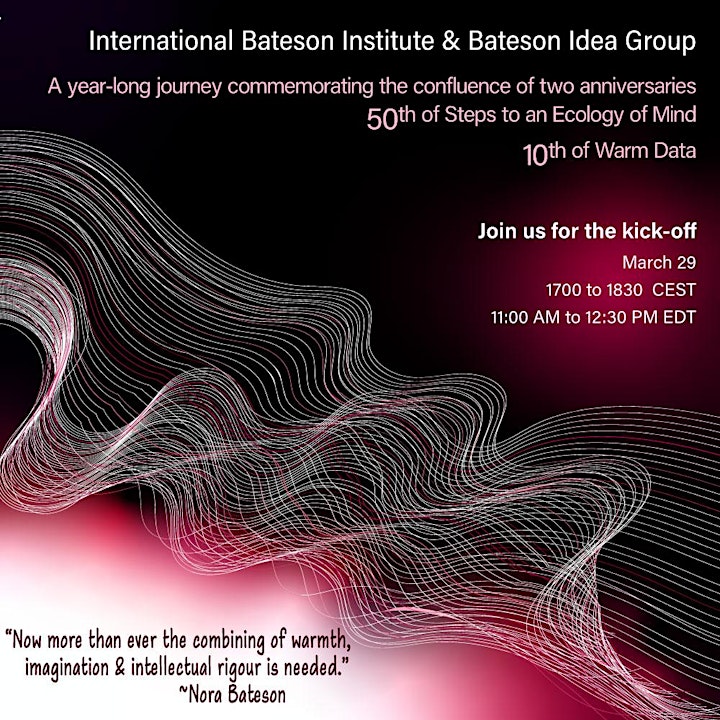
		The Bateson 50th &  10th Anniversaries Commemoration Kick-off—March 2022 image

Bateson Anniversaries Commemoration

50th of Steps to an Ecology of Mind

&

10th of Warm Data

Join us for the kick-off of a year-long series of warm offerings—each an exploration in mutual inquiry of Gregory’s seminal ideas—double bind, schismogenesis, play, deutero learning, communication, ecology, multiple description, abductive process, differences of abstraction and difference that makes a difference, mind, and interrelationships.

The conversations will happen in conjunction with Warm Data Labs and People Need People sessions—to commemorate the momentous confluence for the Bateson family lineage with the 50th Anniversary of Steps to an Ecology of Mind by Gregory Bateson and Nora Bateson’s work, Warm Data, birthed on a paper napkin 10 years ago and evolving into a rigorous practice called Warm Data Labs with over 630 hosts worldwide.

Hosted by Nora Bateson, International Bateson Institute, & Bateson Idea Group

Some of the guests throughout the year-long series include:

  • Barry Schwartz
  • Carlos Alvarez-Pereira
  • Erik Graffman
  • Fanny Marell
  • Fred Steier
  • Göran Janson
  • Howard Kornfeld
  • Imelda McCarthy
  • Jeff Bloom
  • Karin Schanger
  • Katja Neves
  • Lance Strate
  • Leslie Eubanks
  • Lois Bateson
  • Louise Lowings
  • Maimunah Mosli
  • Nicole Anne Boyer
  • Nicole Boyer
  • Per Jensen
  • Phoebe Tickell
  • Phillip Guddemi
  • Rex Weyler
  • Roxana Vatanparast
  • Serena Dinelli
  • Sevanne Kassarjian
  • Stephen Nachmanovitch
  • Thomas Hylland Eriksen
  • Tim Gasperak
  • Tim Keanini
  • Tom Cummings
  • Wendel Ray
  • Ylva Telegin

Find out more about Warm Data

Find out more about the International Bateson Institute

Find out more about the Bateson Ideas Group

Date and time

Tue, March 29, 2022

4:00 PM – 5:30 PM BST

Systems Convening in Practice – a Chat with Madi Hoskin, Diane Ketley

Systems Convening in Practice – a Chat with Madi Hoskin

Systems Convening in Practice – a Chat with Madi Hoskin, Diane Ketley

Madi shares her knowledge and experience of systems convening in practice in a video with accompanying blog.
Details in this tweet https://twitter.com/DianeKetley/status/1504448814513594368. 
Blog and video 
https://nhshorizons.passle.net/post/102hju4/systems-convening-in-practice-a-chat-with-madi-hoskin

CSCS Hybrid Seminar March 22, 2022 “The role of non-conservative interactions in non-equilibrium stochastic systems” – 11:30am PST

The role of non-conservative interactions innon-equilibrium stochastic systems

A Hybrid Complex Systems Seminar

The role of non-conservative interactions in
non-equilibrium stochastic systemsA Hybrid Complex Systems Seminar

Sarah Loos 
Abdus Salam International Centre for Theoretical Physics (ICTP)
Trieste, Italy


Tuesday, March 22, 2022
11:30AM EST
Weiser Hall Room 747
 https://umich.zoom.us/j/96616169868
Password: CSCS (all caps)Link to full event listingHybrid Seminar
https://umich.zoom.us/j/96616169868
Password: CSCS (all caps)Abstract: The complex world surrounding us, including all living matter and various artificial complex systems, mostly operates far from thermal equilibrium. A major goal of modern statistical physics and thermodynamics is to unravel the fundamental principles that govern the individual dynamics and collective behavior of such nonequilibrium systems, like the swarming of fish or flocking of birds. A novel key concept to describe and classify nonequilibrium systems is the stochastic entropy production, which explicitly quantifies the breaking of time-reversal symmetry. However, so far, little attention has been paid to the implications of non-conservative interactions, such as time-delayed (i.e., retarded) or non-reciprocal interactions, which cannot be represented by Hamiltonians contrasting all interactions traditionally considered in statistical physics. Non-conservative interactions indeed emerge commonly in biological, chemical and feedback systems, and are widespread in engineering and machine learning. In this talk, I will use simple time- and space-continuous models to discuss technical challenges and unexpected physical phenomena induced by non-reciprocity [1,2] and time delay [3,4].

[1] Loos and Klapp, NJP 22, 123051 (2020)
[2] Loos, Hermann, and Klapp, Entropy 23, 696 (2021)
[3] Loos and Klapp, Sci. Rep. 9, 2491 (2019)
[4] Holubec, Geiss, Loos, Kroy, and Cichos, PRL 127, 258001 (2021) Coffee Talk! Join us early for coffee chat.  The meeting will open 15 minutes before the seminar start time. Feel free to join us. Microphones and video will be enabled so you can engage in conversation around the virtual coffee table! Once the seminar begins, microphones will be turned to mute, and you can choose to remain visible to the speaker (everyone likes an audience!) or to mute your video as the seminar begins.  Questions can be submitted in the chat.

Control and Correlation – SLIME MOLD TIME MOLD

Control and Correlationmarch 15, 2022 slimemoldtimemoldcybernetics, statistics

Control and Correlation – SLIME MOLD TIME MOLD

Kevin Baker ⌜ktb⌟ on Twitter: “If you’re interested in the history of feedback thinking before cybernetics and digital computation, this is as good place to start..

⌜ktb⌟@kevinbakerIf you’re interested in the history of feedback thinking before cybernetics and digital computation, this is as good place to start. It treats servo engineering, etc, as more than just a prelude to cybernetics.

(1) ⌜ktb⌟ on Twitter: “If you’re interested in the history of feedback thinking before cybernetics and digital computation, this is as good place to start. It treats servo engineering, etc, as more than just a prelude to cybernetics. https://t.co/eSLqXt5bdI” / Twitter

Also noteworthy: “It’s one of the most important things I read in graduate school. Even though it’s about the prewar period, it really helps you understand the postwar engineering moment and and think beyond cybernetics’ imperial, universalizing project.” … “One of the core arguments is that the “engineering cultures” that developed during the interwar period weren’t subsumed by cybernetics. These cultures persisted, as did their distinctive ways of understanding feedback, system boundaries, etc.”

User oppression in human-computer interaction: a dialectical-existential perspective – Frederick van Amstel

User oppression in human-computer interaction: a dialectical-existential perspectiveGonzatto, R.F. and van Amstel, F.M.C. (2022),

User oppression in human-computer interaction: a dialectical-existential perspective – Frederick van Amstel

Cat Drop Borneo – by Gene Bellinger – SystemsWiki’s Musings

Cat Drop Borneo

Does the story hang together?

Gene Bellinger

Cat Drop Borneo – by Gene Bellinger – SystemsWiki’s Musings

Resources – Dalmau Consulting

Resources

Resources – Dalmau Consulting

Lots of interesting systems | complexity | cybernetics resources om Tim Dalmau’s refreshed site marking a true milestone of 40 years in consulting!

Conference on Complex Systems 2022: Call for Satellite Proposals

cxdig's avatarComplexity Digest

19-20/10/2022, Palma de Mallorca, Spain.
Deadline for submission: April 10th, 2022 (strict deadline).
The callfor satellites at the Conference on Complex Systems 2022 (CCS 2022) is officially open.Following the successful tradition of previous editions, CCS 2022 will host satellite events within the main conference.
A satellite session is a full-day or half-day meetingwith a focus on a specific topic of complex systems and its applications. Each satellite is organized and managed by its own committee, although the coffee-breaks and lunch will be offered by the CCS organization. The satellite organizers are responsible for reviewing proposed papers and working with their presenters.
More info on satellite events and submission can be found at:

View original post

System

Erm, hmm.

System is a free, open, and living public resource that aims to explain how anything in the world is related to everything else.

https://www.system.com/graph

Overview: https://about.system.com/about/overview

Annoucing the public beta: https://about.system.com/blog/announcing-the-public-beta-of-system

(h/t Systems Change Finland)

Where did the Eco go in Systemic Practice? | Palmer (2021) Murmurations: Journal of Transformative Systemic Practice

Where did the Eco go in Systemic Practice?

Published: Dec 9, 2021

DOI: https://doi.org/10.28963/4.1.2

Keywords:Bateson EcoSystemic systemic therapy ecology systemic activism posthuman systemic practice

Hugh Palmer

Where did the Eco go in Systemic Practice? | Murmurations: Journal of Transformative Systemic Practice

Seventy years of Family Therapy, from Bateson until now. What’s new? Tickets, Sun, Mar 20, 2022 at 12:00 PM EST

Seventy years of Family Therapy, from Bateson until now. What’s new?

Seventy years of Family Therapy, from Bateson until now. What’s new? Tickets, Sun, Mar 20, 2022 at 12:00 PM | Eventbrite

ASC Series – Seventy years of Family Therapy, from Bateson until now. What’s new?

March 20, 2021 | 9:00 PDT, 12:00 EDT, 18:00 CEST

FREE REGISTRATION

Abstract

Over 70 years ago, cybernetic thinking helped create a radical shift in psychiatry when birthing a new branch of therapy called family therapy. Yet, today, this revolutionary way of understanding human healing, thinking, behavior, relations and “social” systems, floats on the margins of our mental health systems.  As one family therapist from decades gone by suggested, family therapy quickly became more like a stillborn child whose fascinating ideas and practices disappeared almost as soon as they arrived. Why is that? 

Some say, family therapy was ahead of its time, in an attempt to understand people and their pathologies in context with the systems in which we live. We seem unable to comprehend that we do the only thing we can do in accordance with our biology and epistemology. 

One cannot not have an epistemology, only a bad one. – Gregory Bateson

So, what have we learned after 70 years of family theories and therapies?  Where do family therapists stand in regard to these issues today? What is the role of a family therapist, and in what domains? How can cybernetic ideas orient family therapists as change agents?

During our conversation on March 20th, we will explore, with a new generation of family therapists, how they shifted back to many of the original concepts associated with family therapy and cybernetics, such as Bateson’s ideas about power and inequality. We will also explore more recent concepts associated with cybernetics that orient this movement, and how we might shift the structures that generate intersectional systems of oppression that perpetuate pathologies. 

We will leave plenty of time for all to participate in the conversation. 

Participants Bios

Dr. Robyn Jardine owns and operates Life Solutions Counseling and Family Therapy, PLLC in Dallas, TX.   As an educator, researcher, activist, and mental health professional, she focuses on social justice and racial equity through dismantling systems of oppression within the context of intergenerational transmission and the interdependent relationship between macro and micro systems.  Particularity regarding the areas of white supremacy, intergenerational social conditioning, white fragility, historical trauma, gaslighting, the process of activating communities/individuals for system change, and interracial dynamics/relationships. 

Bethany Simmons, Ph.D., LMFT-S, LPC is an Associate Professor and Program Director at California Lutheran University Counseling Psychology-MFT Program with clinical experience in adult and juvenile psychiatric hospitals, intensive outpatient programs, juvenile drug court and private practice settings. She is the founder of The Big Systems Collective (BSC), a diverse group of therapists and educators from across the United States committed to creating social justice systemic change through cybernetic action. Her current research and scholarship applies cybernetic and social constructionist theories to address oppression, social responsibility, power, privilege and social control within mental health practices and societal systems.

Jude Lombardi, lcsw, phd. is a social worker by trade. As a social worker, she primarily worked with “special needs” children and their families, which led her to cybernetics. After completing her phd. in human relations and cybernetics, what she calls humane cybernetics, she became a sociology professor. In retirement she praxis cybernetics, constructs video for work and fun, and cares for honeybees at her local arboretum. In recent years, she has come to think the only way to generate transformative change is through the performance of everyday life and the arts.

FREE REGISTRATION

President’s Series 17: Cybernetics Tickets, Wed 13 Apr 2022 at 17:00 UK time – Design Cybernetics as a language for Service Design with Dr. Gustav Borgefalk and Russell Bee

President’s Series 17: Cybernetics by Cybernetics Society — President’s Series

£0 – £20

President’s Series 17: Cybernetics Tickets, Wed 13 Apr 2022 at 17:00 | Eventbrite

Raghav Rajagopalan, “Immersive Systemic Knowing” – book, video etc

Raghav Rajagopalan

Aug 17, 2021

Immersive Systemic KnowingAdvancing Systems Thinking Beyond Rational Analysis

SPRINGER NATURE 2020

New Books Network | Raghav Rajagopalan, “Immersive Systemic Knowing:…

Book link:

https://link.springer.com/book/10.1007/978-3-030-49135-2

Four ways of knowing – European School of Governance, position paper #55  by Raghav Rajagopalan

Presentation at Metaphorum 27 May 2021 – Meta Rational Ways of Knowing – Raghav Rajagopalan https://www.youtube.com/watch?v=aMKCG-50S30